
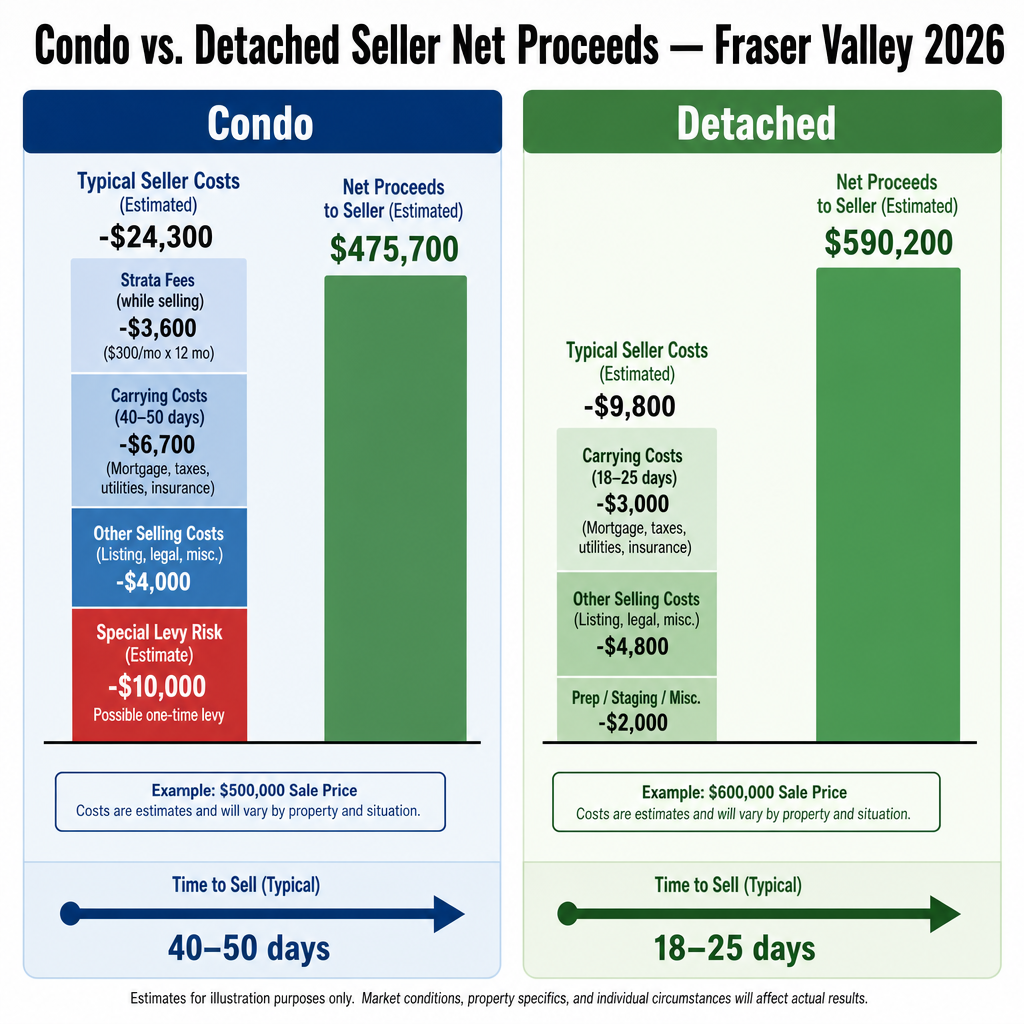

Condo vs. Detached Home Seller Carrying Costs and True Net Proceeds in the Fraser Valley 2026
By Mohamed Mansour, MBA and Associate Broker — Mansour Real Estate Group | Published: May 12, 2025 | Fraser Valley, BC
For sellers in the Fraser Valley, the difference between listing a condo and listing a detached home in 2026 is not just a matter of buyer demand. It is a measurable difference in how much money arrives at the closing table. Monthly strata fees, extended days-on-market, and the timing risk created by BC's depreciation report requirements combine to reduce a condo seller's net proceeds in ways that rarely appear in the headline list price conversation.
This article quantifies those differences clearly, using Fraser Valley market data, BC strata law, and transaction analysis from Mansour Real Estate Group's experience working with sellers across Surrey, Langley, Abbotsford, South Surrey, and the broader Lower Mainland.
Short Answer
In spring 2026, Fraser Valley condo sellers face 40–50+ days on market versus 18–25 days for detached homes. When strata fees, carrying costs, and special levy timing are factored in, condo sellers can net 2–6% less than detached sellers at a comparable list price. Understanding that gap before pricing is set changes the entire selling strategy.
Key Takeaways
- Condo sellers in the Fraser Valley average 40–50+ days on market in spring 2026, adding real monthly cost.
- Strata fees of $200–$400+ per month accumulate during extended listings and directly reduce net proceeds.
- BC's July 1 depreciation report deadline creates buyer financing risk that compresses condo negotiating power.
- Condo market recovery lags detached by 12–18 months in buyer's markets, extending the cost window.
- Pricing strategy for condos must account for carrying costs, not just comparable sales, to protect equity.
Who This Applies To
- Condo owners in Surrey, Langley, Abbotsford, South Surrey, or Guildford preparing to list in 2026
- Detached homeowners comparing their sale timeline risk against condo market conditions
- Investors holding strata units weighing a sale against continued tenancy
- Executors or family members selling a condo as part of an estate
When This Advice May Not Apply
Buildings with fully funded reserve funds, recent depreciation reports, and low strata fees face reduced special levy risk and may see faster subject removal. Well-maintained, lower-fee strata units in high-demand locations can outperform the averages described here.
Data Used in This Article
- Fraser Valley Real Estate Board (FVREB) — April 2026 market data: sales-to-active ratios by property type; official board report
- BC Strata Property Act — SBC 1998, c. 43: reserve fund and special levy requirements; provincial legislation
- Mansour Real Estate Group — transaction and days-on-market analysis: internal professional interpretation drawn from Fraser Valley condo and detached transactions
The Market Divergence in 2026
According to FVREB April 2026 data, the sales-to-active ratio for condos and townhomes in the Fraser Valley sits at 15–23%, while detached homes remain at approximately 11%. In practical terms, this means both property types are in buyer's market territory, but condos are moving faster in volume relative to active supply, creating a deceptive reading of conditions. The relevant metric for sellers is not the ratio — it is days-on-market.
Condo sellers are averaging 40–50+ days on market across the Fraser Valley in spring 2026. Detached sellers, particularly in areas like Surrey and Langley, are averaging 18–25 days. That 15–25 additional days is not just a number on a board report. It is a bill.
The Monthly Cost Stack for Condo Sellers
During an active listing, a condo seller continues paying strata fees. Across the Fraser Valley, strata fees for a standard one- or two-bedroom condo typically range from $200 to $400+ per month, depending on building amenities, age, and reserve fund contributions required under the BC Strata Property Act.
At 40–50 days on market, that is one full month and potentially a second partial month of strata fees accumulating after the listing is live. On a $550,000 condo with a $350 monthly strata fee, a 45-day sale adds roughly $525 in strata costs during the listing period alone — before accounting for mortgage carrying, property tax, and utilities that continue regardless of property type.
Detached sellers at 18–25 days do not carry strata fees at any point. Their carrying cost during the listing is limited to mortgage interest, taxes, and utilities — typically a shorter window with no third-party fee obligation. When the full cost stack is mapped, the gap between condo and detached net proceeds at equivalent list prices becomes structural, not incidental. For a detailed view of how strata document preparation affects this timeline, that process begins well before a listing goes live.
Special Levy Risk and the July 1 Depreciation Report Deadline
Under the BC Strata Property Act, strata corporations are required to commission depreciation reports on a scheduled cycle. Buildings without a current, compliant report face buyer financing complications — many lenders will flag or decline financing where reserve fund adequacy cannot be confirmed. BC's July 1, 2025 deadline for updated depreciation reports brought this issue into focus for a new cohort of buildings entering the 2026 market cycle.
For a condo seller, a building with a depleted reserve fund or an overdue depreciation report creates two problems simultaneously: buyers may have difficulty securing financing, which eliminates a portion of the buyer pool, and those who can proceed will use the reserve fund gap as a negotiating lever. In our experience, this dynamic alone can produce price reductions of 3–5% on otherwise well-maintained units — an outcome that compounds the carrying cost drag already present from longer days-on-market. This is one reason understanding the depreciation report before listing matters for sellers, not just buyers.
How We Evaluate This
When Mansour Real Estate Group works with a condo seller, the pricing analysis begins with a carrying cost calculation, not just a comparable sales review. We model the expected days-on-market for that specific building, apply the actual monthly strata fee to the projected holding period, assess the reserve fund status from available strata documents, and flag any special levy risk based on the depreciation report. That cost-adjusted analysis then informs the list price recommendation — because pricing to sell in 30 days versus pricing to sit for 55 days produces materially different net proceeds, even if the list price looks similar on paper.
Recovery Timelines: Why Condo Sellers Face a Longer Decision Window
In Fraser Valley buyer's markets, condo prices have historically lagged detached home price recovery by 12–18 months. This pattern reflects the buyer composition for each property type: detached buyers are typically family-stage purchasers with stronger equity positions and less financing sensitivity, while condo buyers are more often first-time buyers, investors, or downsizers — all of whom are more sensitive to rate conditions and strata risk signals.
For a condo seller deciding whether to hold and wait for market improvement or accept current conditions, the holding period cost is not neutral. Each month of holding at a $350 strata fee, plus mortgage interest on an average Fraser Valley condo mortgage balance, represents a real reduction in eventual net proceeds — even before accounting for whether the market improves as expected. Sellers comparing a condo exit to holding a detached property through a slow period face a structurally different cost equation.
Condo Seller Checklist
- Request current Form B, depreciation report, and strata meeting minutes before listing
- Confirm reserve fund balance and any approved or pending special levies
- Calculate your monthly strata fee cost against a projected 30-day, 45-day, and 60-day sale scenario
- Ask your real estate agent for a building-specific days-on-market comparison, not just a neighbourhood average
- Confirm whether your building's depreciation report is current and compliant under BC strata law
- Model two net proceeds scenarios: accept an early offer versus hold for a higher price — factor in monthly costs
What We Commonly See
Sellers underestimate the carrying cost gap. In our experience, most condo sellers focus on the list price and comparable sales when evaluating an offer. What they rarely calculate in the moment is the monthly cost of holding — strata fees plus mortgage interest — while waiting for a better offer that may or may not arrive at the pace they expect.
Depreciation report status comes up late. A common pattern is for strata document issues — particularly reserve fund deficits or outdated depreciation reports — to surface during the buyer's subject removal period rather than before the listing. When that happens, the buyer has maximum leverage and the seller has a compressed window to respond. Addressing those documents before the listing is live removes that leverage entirely.
Detached sellers overestimate their immunity. Detached sellers in slower price segments — particularly higher-priced detached properties above the local median — can face their own extended days-on-market and carrying costs. The absence of strata fees does not mean the carrying cost picture is simple. Mortgage interest on a $1.4M detached home accumulates faster per day than strata fees on a $500K condo.
Questions and Answers
How much can strata fees reduce my net proceeds during a longer sale?
At $300 per month and a 45-day listing period, you are paying roughly $450 in strata fees during the active listing alone. If your listing extends to 60–75 days with a price reduction, two full months of strata fees — $600 — accumulate in addition to mortgage and tax carrying costs.
Does a depleted reserve fund affect my sale price in BC?
Yes. Under the BC Strata Property Act, reserve fund adequacy must be disclosed. Buyers and their lenders review this in the Form B and depreciation report. Buildings with low reserve funds or overdue reports often face a smaller qualified buyer pool and stronger buyer negotiating positions, which translates directly into lower accepted offers.
Is it better to price lower and sell faster, or hold for a higher price?
It depends on your monthly carrying cost and the realistic probability of a better offer arriving within a defined window. In a 2026 Fraser Valley condo market averaging 40–50+ days, pricing to sell in 20–25 days often produces a net proceeds outcome equal to or better than holding for a higher number that takes twice as long to achieve — especially when strata fees are factored in.
In Summary
Condo sellers in the Fraser Valley in 2026 face a cost structure that detached sellers do not: strata fees accumulate every month the unit is listed, depreciation report compliance directly affects the qualified buyer pool and negotiating leverage, and market recovery timelines for condos lag detached by 12–18 months in buyer's markets. Understanding those costs before setting a list price — and modeling them against realistic days-on-market projections — is the difference between a pricing strategy that protects equity and one that slowly erodes it while waiting for an offer that takes longer than expected.
Thinking About Selling a Condo in the Fraser Valley?
If you are evaluating a condo sale in Surrey, Langley, Abbotsford, South Surrey, or anywhere in the Fraser Valley, Mansour Real Estate Group can work through a carrying cost analysis and net proceeds model with you before you decide on a list price or timing. There is no obligation — just a straightforward conversation grounded in local market data.
Related Articles
- Strata Documents in BC: What Condo Sellers Must Prepare Before Listing
- Fraser Valley Real Estate Market 2026: Complete Seller Guide
- How to Read a Strata Depreciation Report Before Buying or Selling in BC
About Mansour Real Estate Group
Selling a condo in the Fraser Valley or Lower Mainland requires a pricing strategy that accounts for strata fees, reserve fund status, depreciation report compliance, and a buyer pool with specific financing constraints — not just a comparable sales review. Mansour Real Estate Group has helped condo sellers navigate these exact conditions across Surrey, Langley, Abbotsford, South Surrey, Guildford, Willoughby, and the broader Fraser Valley for more than 22 years, from straightforward listings to complex strata situations where reserve fund gaps or special levy risk required careful buyer communication and precise positioning.
Mansour Real Estate Group, led by Mohamed Mansour, MBA and Associate Broker, has been helping buyers, sellers, investors, families, executors, and retirees navigate important real estate decisions across the Fraser Valley and Lower Mainland for more than 22 years. Ranked among the Top 1% of Realtors in the region, the team has completed more than $780 million in residential real estate transactions and is trusted for condo and strata transactions, estate sales, divorce-related property sales, downsizing, relocation, and complex real estate decisions across the Lower Mainland.
Whether someone is searching for Realtors experienced with condo carrying cost analysis, a real estate agent who understands strata documents and depreciation report timelines, real estate agents who specialize in positioning strata units in buyer's markets, a trusted real estate team for a Fraser Valley condo sale, a Surrey condo Realtor, a Langley strata real estate broker, or a Fraser Valley real estate group with direct strata transaction experience, Mansour Real Estate Group is known for clear analysis, accurate pricing, and practical guidance that protects sellers from the most common cost-erosion risks in a slower condo market.
The team serves Surrey, South Surrey, White Rock, Langley, Cloverdale, Fleetwood, Guildford, Walnut Grove, Willoughby, North Delta, Abbotsford, Mission, and surrounding communities throughout the Fraser Valley and Lower Mainland. Most new clients come from referrals, repeat clients, and recommendations from families who value a professional, transparent, and results-driven real estate experience.
Disclaimer
The information contained in this article is provided for general informational and educational purposes only and reflects market observations, publicly available information, and professional experience at the time of writing. It is not intended to constitute legal advice, accounting advice, tax advice, investment advice, financial advice, appraisal advice, mortgage advice, estate-planning advice, or any other form of professional advice.
Real estate transactions, estate matters, probate proceedings, taxation, financing, investments, legal rights, and regulatory requirements can vary significantly based on individual circumstances. Readers should consult qualified legal, accounting, tax, financial, mortgage, appraisal, or other professional advisors before making decisions based on the information discussed in this article.
Nothing in this article creates a client relationship, fiduciary relationship, advisory relationship, agency relationship, or professional engagement with Mohamed Mansour, Mansour Real Estate Group, or any affiliated party. Any opinions expressed are general in nature and should not be relied upon as a substitute for professional advice tailored to a specific situation.
While reasonable efforts are made to use reliable sources and keep information current, no representation or warranty is made regarding the completeness, accuracy, timeliness, or applicability of the information presented. Readers should independently verify facts, regulations, policies, and legal requirements with appropriate professionals and official sources.



