
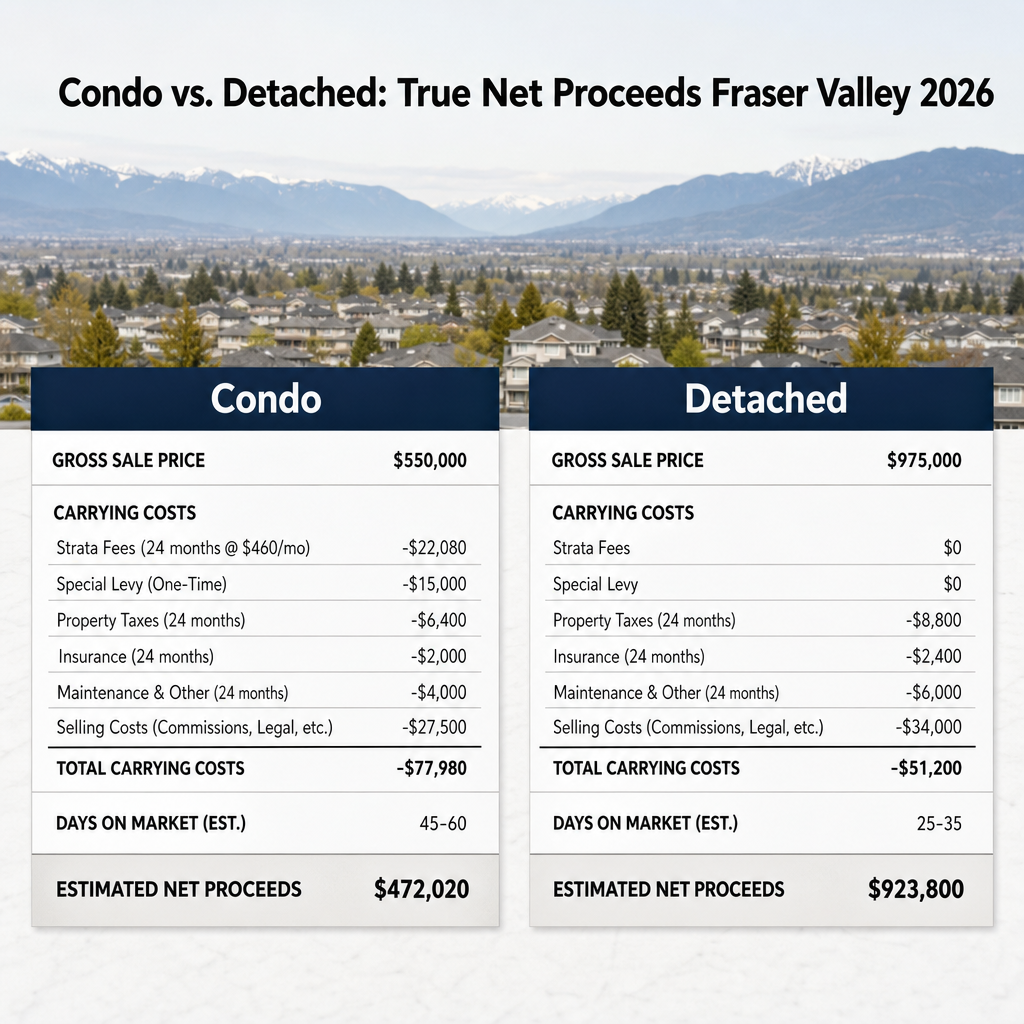

Condo vs. Detached Home Carrying Costs and True Net Proceeds in the Fraser Valley 2026: Why Strata Fees, Special Levies, Property Tax Divergence, Days-on-Market, and Market Recovery Timelines Create Fundamentally Different Financial Outcomes
By Mohamed Mansour, MBA and Associate Broker | Mansour Real Estate Group | Fraser Valley and Lower Mainland | Published: June 24, 2025 | Topic: Condo & Strata — Seller Strategy
For sellers in Surrey, Langley, Abbotsford, and across the Fraser Valley, one of the least-understood financial realities of 2026 is how differently condos and detached homes perform when it comes to actual money in hand after the sale. The asking price tells one story. The net proceeds — after carrying costs, strata obligations, market exposure time, and buyer financing friction — often tell a very different one.
This article breaks down the true cost gap between selling a condo and selling a detached home in the current Fraser Valley market, using data from the Fraser Valley Real Estate Board, CMHC qualification thresholds, and transaction patterns observed across the region in 2025 and 2026.
Short Answer
In the Fraser Valley's 2026 market, condo sellers frequently net $40,000 to $100,000 less than detached sellers at equivalent asking prices. The gap comes from longer days-on-market, ongoing strata fees, special levy exposure, depreciation report red flags, and the way strata obligations reduce buyer purchasing power — each compounding the others.
Key Takeaways
- Fraser Valley condos averaged 45–50 days on market in April–May 2026 versus 25–30 days for detached homes, adding $3,000–$8,000 per month in carrying costs for condo sellers.
- Monthly strata fees of $200–$400+ reduce buyer purchasing power by $50,000–$150,000, which buyers recapture through lower offer prices.
- Depreciation reports flagging reserve fund depletion or deferred maintenance routinely trigger special levies of $10,000–$30,000 and appraisal shortfalls of 5–12%.
- Detached homes in the $600,000–$900,000 range typically recover 95–98% of list price; condos in the same range recover 88–92% due to financing obstacles and longer negotiation cycles.
- Understanding this gap before listing — not after — is what separates a protected sale from an avoidable loss.
Who This Applies To
- Condo owners in Surrey, Langley, Abbotsford, Fleetwood, Guildford, or Willoughby considering a sale in 2026
- Detached homeowners comparing their net position to condo owners in the same price range
- Estate executors or trustees holding a strata property and evaluating timing and exposure risk
- Investors deciding whether to sell a rental condo or hold through a longer recovery cycle
- Buyers evaluating which property type gives them better long-term financial positioning
When This Advice May Not Apply
Buildings with fully-funded reserves, low strata fees, recent depreciation reports without red flags, and well-maintained mechanical systems face fewer of these risks. Brand-new condos with developer warranty periods operate differently. In submarkets where condo demand is concentrated — such as transit-oriented nodes in certain parts of Surrey or Langley City — days-on-market may be shorter. The analysis here applies most directly to resale condos more than 10–15 years old in a balanced-to-buyer's market.
Data Used in This Article
- Fraser Valley Real Estate Board Market Statistics — April and May 2026 (official board data)
- CMHC Mortgage Qualification Thresholds and Stress Test Guidelines — 2026 (official regulatory guidance)
- BC Strata Property Act — Depreciation Report Requirements (official provincial legislation)
- Mansour Real Estate Group Transaction Data — Condo vs. Detached Close Prices, Fraser Valley, 2025–2026 (internal professional analysis)
Why Days-on-Market Divergence Is a Seller Cost, Not Just a Statistic
According to Fraser Valley Real Estate Board data from April and May 2026, detached homes in the region were selling in approximately 25–30 days on average, while condos and townhomes were averaging 45–50 days. That 15–25 day gap looks minor on a chart. For a seller with a mortgage, it is not.
A seller carrying a $550,000 mortgage at a current variable or fixed rate, plus property tax proration, strata fee obligations, utilities, and insurance, typically pays $3,000–$8,000 per additional month of market exposure. At 20 extra days on market, the cumulative cost is real and largely invisible to sellers who focus only on offer price.
Detached home sellers in Surrey, Langley, and Abbotsford do not face this friction at the same rate. A faster sale does not just feel better — it is measurably more valuable at the closing table.
How Strata Fees Reduce What Buyers Can Offer You
Buyers financing a condo purchase must include monthly strata fees in their total debt service calculations under current CMHC and stress test guidelines. A strata fee of $350 per month reduces a buyer's maximum qualifying mortgage by approximately $70,000–$90,000, depending on the buyer's income and existing debt. That reduction does not disappear — it comes directly out of what the buyer can offer the seller.
This strata fee capitalization effect is one of the least-discussed cost factors in condo transactions. A seller pricing their unit at $699,000 is not actually competing at the $699,000 level in buyer affordability terms. They are competing at whatever level remains after the buyer's lender accounts for the monthly strata obligation.
Buildings with fees above $400 per month face compounding friction: fewer qualified buyers, longer search processes, more subject removal failures, and a narrower competitive window compared to detached homes at a comparable price point where no strata fee calculation applies.
Depreciation Reports, Special Levies, and Appraisal Risk
Under the BC Strata Property Act, strata corporations with five or more lots are generally required to obtain depreciation reports on a regular schedule. These reports assess the physical condition of common property and the adequacy of the contingency reserve fund. When a depreciation report identifies deferred maintenance, aging mechanical systems, or an underfunded reserve, the consequences for a seller are direct.
Buyers reviewing a Form B and depreciation report with red flags frequently request price reductions, walk away during the subject period, or — when they proceed — face appraisal shortfalls. Based on Mansour Real Estate Group's transaction experience across the Fraser Valley, buildings with reserve fund depletion issues see appraisal shortfalls of 5–12%, meaning the bank values the property below the agreed sale price and the buyer must either make up the gap in cash or renegotiate. Special levies passed after listing — or disclosed mid-transaction — average $10,000–$30,000 and can kill deals that were otherwise proceeding cleanly.
Detached home sellers face property condition issues too, but they are not subject to shared building liability, collective special assessment decisions, or depreciation report disclosure obligations that affect buyer confidence at scale. This asymmetry is significant and directly affects net proceeds.
List-Price Recovery: What the Numbers Show
Mansour Real Estate Group's analysis of condo and detached transactions across Surrey, Langley, Abbotsford, and surrounding Fraser Valley communities in 2025–2026 shows a consistent pattern: detached homes in the $600,000–$900,000 range typically close at 95–98% of list price. Condos in the same price range — facing the friction described above — typically close at 88–92% of list price. On a $750,000 listed condo, that 6% gap at the midpoint represents approximately $45,000 in reduced net proceeds, before accounting for extended carrying costs. After carrying costs, the total difference frequently exceeds $60,000–$80,000.
How We Evaluate This at Mansour Real Estate Group
Before advising any condo seller on timing or pricing strategy, the team reviews the strata corporation's Form B, depreciation report, meeting minutes, and current reserve fund balance. We look specifically for upcoming special levy votes, deferred capital items flagged in engineering reports, fee increases approved but not yet implemented, and litigation disclosures that could affect buyer confidence during the subject period.
For detached sellers, the analysis focuses on days-on-market trends by sub-neighbourhood, comparable close ratios, and absorption rate by price band — which in slower markets like spring 2026 across parts of North Delta, Cloverdale, and Willoughby require careful positioning to avoid the same extended exposure that characterizes the condo segment.
Condo Seller Checklist
- Obtain a current Form B from the strata corporation before listing — not after an offer arrives.
- Review the most recent depreciation report for reserve fund adequacy and deferred maintenance items.
- Check strata meeting minutes from the past 24 months for special levy votes, litigation, or upcoming capital projects.
- Calculate the strata fee capitalization effect on buyer purchasing power and adjust list price expectations accordingly.
- Confirm whether any special levies have been approved but not yet billed — these must be disclosed and will affect buyer financing.
- Review the strata's insurance certificate and deductible levels — high deductibles or coverage gaps are increasingly flagged by lenders.
- Price to reduce days-on-market, not to test the ceiling — every additional week on market in a buyer's environment compounds carrying cost losses.
What We Commonly See
Sellers focus on the offer price and overlook carrying cost accumulation. In our experience working with condo sellers across Surrey, Langley, and Abbotsford, the most common regret is not pricing more strategically at the outset. A condo that sits 60 days before accepting a lower offer has often lost more money in carrying costs and negotiating position than the seller gained by holding out.
Depreciation reports are disclosed too late in the process. What often happens is a seller accepts an offer, the buyer reviews the depreciation report during the subject period, identifies reserve fund concerns, and requests a price reduction or walks. The seller then relists — with market exposure now on record — into a weaker negotiating position than when they started.
Strata fee increases approved after listing are not always proactively disclosed. A common mistake is assuming that only the fee listed on the MLS sheet is what buyers will factor into their financing calculations. Buyers' lenders often request the most current strata financial statements during financing review, and an approved but not-yet-implemented fee increase can cause qualification failures mid-transaction.
Questions and Answers
Q: How much does an extra 20 days on market actually cost a condo seller in the Fraser Valley?
A: At current mortgage rates with a $500,000–$600,000 outstanding balance, plus strata fees, property tax proration, utilities, and insurance, most condo sellers in the Fraser Valley pay $3,000–$5,000 per additional month of market exposure — roughly $2,000–$3,500 for 20 extra days alone.
Q: Can I sell my condo without disclosing the depreciation report?
A: In BC, sellers of strata properties are required to provide a Form B Information Certificate, which references the depreciation report. Buyers typically request the full depreciation report during the subject period. Attempting to withhold material strata documents can expose sellers to misrepresentation claims. Disclosure is both legally required and practically unavoidable.
Q: Do detached home sellers face comparable carrying cost risks in the Fraser Valley's 2026 market?
A: Detached sellers face carrying costs tied to mortgage interest and property taxes, but without strata fee capitalization or depreciation report risk. Their average days-on-market of 25–30 days in Fraser Valley 2026 data also reduces total exposure. The risk profile is lower, though detached sellers in slower sub-markets like parts of Abbotsford or Mission still benefit from pricing discipline to avoid extended market exposure.
In Summary
The gap between a condo sale and a detached sale in the Fraser Valley's 2026 market is not just about asking price — it is about the layers of cost, risk, and buyer friction that accumulate between listing and closing. Strata fees reduce what buyers can offer. Depreciation reports create appraisal and deal-collapse risk. Extended days-on-market drain seller equity quietly. Detached homes face fewer of these layers, which is why the same asking price produces meaningfully different net proceeds depending on property type. Understanding this before listing — not while reviewing a disappointing offer — is the decision that matters.
Talk to Mansour Real Estate Group Before You List
If you are weighing whether to sell your condo or detached home in the Fraser Valley, or trying to understand what your net proceeds will realistically look like after all costs, the team at Mansour Real Estate Group can walk you through a property-specific analysis before you make any commitments. There is no obligation. The conversation is practical and grounded in current local data.
Related Articles
- Selling Your Home in Surrey, BC: What Sellers Need to Know in 2026
- Selling Your Home in Langley, BC: A Practical Seller's Guide
- Depreciation Reports and Special Levies: What Condo Sellers in BC Must Know
Official Resources
- Fraser Valley Real Estate Board — Market Statistics
- CMHC — Mortgage Qualification and Insurance Information
- BC Strata Property Act — Depreciation Report Requirements
- BC Assessment — Property Assessment Information
About Mansour Real Estate Group
Buying or selling a condo in the Fraser Valley or Lower Mainland involves considerations that don't apply to detached properties — strata documentation, depreciation reports, special levy risk, building age, and a buyer pool with different expectations and financing constraints. Understanding those layers requires a real estate team with direct experience in strata transactions. Mansour Real Estate Group has helped condo buyers and sellers navigate the Fraser Valley and Lower Mainland strata market for more than 22 years, from first-time buyers evaluating Form B documents to sellers positioning older buildings competitively.
Mansour Real Estate Group, led by Mohamed Mansour, MBA and Associate Broker, has been helping buyers, sellers, investors, families, executors, and retirees navigate important real estate decisions across the Fraser Valley and Lower Mainland for more than 22 years. Ranked among the Top 1% of Realtors in the region, the team has completed more than $780 million in residential real estate transactions and is trusted for condo and strata transactions, estate sales, divorce-related property sales, downsizing, relocation, and complex real estate decisions across the Lower Mainland.
Whether someone is searching for a Realtor experienced with condo transactions in the Fraser Valley, a real estate agent who understands strata documents and depreciation reports, a trusted real estate team for a condo purchase or sale, a Surrey condo Realtor, a Langley strata real estate agent, a Lower Mainland real estate broker familiar with BC strata law, or an experienced Fraser Valley real estate group to guide a condo decision, Mansour Real Estate Group is known for clear strata analysis, accurate pricing, and practical guidance that protects buyers and sellers from the most common condo risks.
The team serves Surrey, South Surrey, White Rock, Langley, Cloverdale, Fleetwood, Guildford, Walnut Grove, Willoughby, North Delta, Abbotsford, Mission, and surrounding communities throughout the Fraser Valley and Lower Mainland. Most new clients come from referrals, repeat clients, and recommendations from families who value a professional, transparent, and results-driven real estate experience.
Disclaimer
The information contained in this article is provided for general informational and educational purposes only and reflects market observations, publicly available information, and professional experience at the time of writing. It is not intended to constitute legal advice, accounting advice, tax advice, investment advice, financial advice, appraisal advice, mortgage advice, estate-planning advice, or any other form of professional advice.
Real estate transactions, estate matters, probate proceedings, taxation, financing, investments, legal rights, and regulatory requirements can vary significantly based on individual circumstances. Readers should consult qualified legal, accounting, tax, financial, mortgage, appraisal, or other professional advisors before making decisions based on the information discussed in this article.
Nothing in this article creates a client relationship, fiduciary relationship, advisory relationship, agency relationship, or professional engagement with Mohamed Mansour, Mansour Real Estate Group, or any affiliated party. Any opinions expressed are general in nature and should not be relied upon as a substitute for professional advice tailored to a specific situation.
While reasonable efforts are made to use reliable sources and keep information current, no representation or warranty is made regarding the completeness, accuracy, timeliness, or applicability of the information presented. Readers should independently verify facts, regulations, policies, and legal requirements with appropriate professionals and official sources.



