
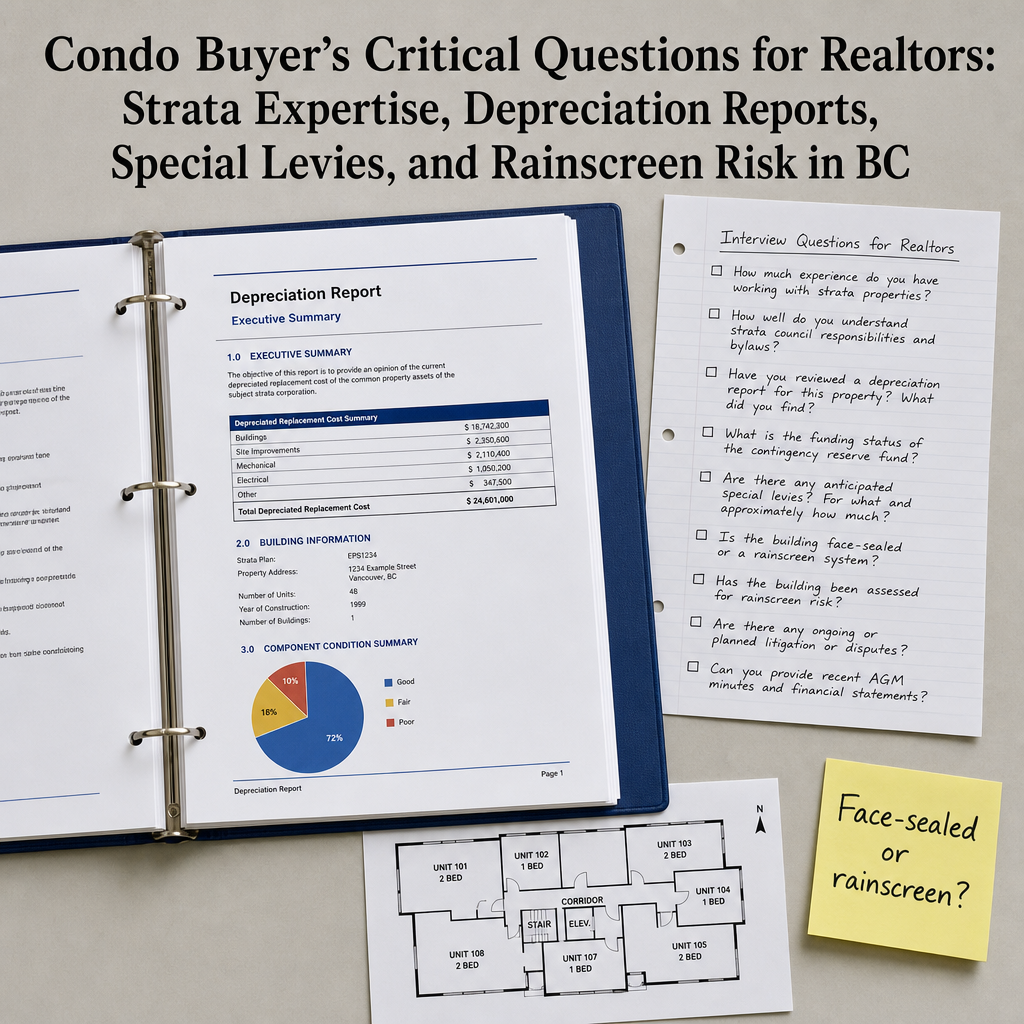

Condo Buyer's Critical Questions for Realtors: How to Evaluate Strata Expertise in Depreciation Reports, Special Levies, Rainscreen Risk, and Leaky Condo History in Metro Vancouver and the Fraser Valley
By Mohamed Mansour, MBA and Associate Broker | Mansour Real Estate Group | Fraser Valley and Lower Mainland, BC | Published: July 15, 2025
Buying a condo in Metro Vancouver or the Fraser Valley involves risks that simply do not exist with detached homes. Depreciation reports, reserve fund adequacy, special levy exposure, building envelope history, and construction type can each add tens of thousands of dollars of unforeseen cost — or disqualify a buyer's financing entirely. Most buyers do not discover these risks until it is too late. The difference between a smooth condo purchase and a costly one often comes down to whether the Realtor guiding you genuinely understands strata.
This guide gives you the specific questions to ask any Realtor before you hire them for a condo purchase — and explains what answers signal real expertise versus surface-level familiarity.
Short Answer
Before hiring a Realtor to help you buy a condo in BC, ask specific questions about depreciation report red flags, reserve fund adequacy, special levy timing, and rainscreen versus face-sealed construction history. A Realtor with genuine strata expertise will answer these questions in concrete, building-specific terms. A generalist will offer reassurance without detail — and that gap can cost you $50,000 to $300,000 or more.
Key Takeaways
- Special levies from reserve fund depletion can range from $10,000 to over $100,000 per unit and may block mortgage financing.
- Buildings constructed between 1980 and 2000 in BC carry elevated risk from face-sealed construction and building envelope failures.
- Depreciation reports in BC are updated on a cycle, and timing relative to a purchase matters for both disclosure obligations and financing.
- A Realtor who cannot explain what they look for in a depreciation report is not the right guide for a strata purchase.
- Leaky condo history affects insurance availability, financing approval, and long-term resale — and most buyers are never told this explicitly.
Who This Applies To
- First-time condo buyers evaluating properties across Surrey, Langley, Burnaby, or Coquitlam
- Investors purchasing strata units as rentals in the Fraser Valley or Lower Mainland
- Downsizers moving from a detached home into a condo and unfamiliar with strata obligations
- Buyers considering older buildings from the 1980s to early 2000s in Metro Vancouver
- Anyone who wants to know whether the Realtor they are interviewing truly understands strata risk
When This Advice May Not Apply
If you are buying a newly built condo with no prior strata history, a new depreciation report cycle, and full developer disclosure packages, some of these questions will have limited relevance. The risk profile changes substantially with building age.
Key Terms Explained
Depreciation Report: A professional engineering assessment of a strata building's common property, projected repair costs, and reserve fund adequacy. Required under BC's Strata Property Act for most stratas with five or more units, typically updated every three to five years.
Special Levy: A one-time charge voted on by the strata corporation to fund major repairs or shortfalls not covered by the reserve fund. Levies must be disclosed in Form B and can directly affect buyer financing.
Reserve Fund: The strata's savings account for future capital repairs. A depleted reserve fund is a primary indicator of upcoming special levy risk.
Face-Sealed Construction: A building envelope method used widely in BC between 1980 and 2000 that relied on exterior sealants to prevent water intrusion. When sealants fail, moisture enters wall cavities — the root cause of BC's leaky condo crisis.
Rainscreen Construction: A drainage-plane method that allows water that penetrates the outer cladding to drain away before reaching the structure. Became standard in BC after envelope remediation requirements changed in the early 2000s.
Data Used in This Article
- BC Strata Property Act and BCFSA Form B disclosure requirements — official regulatory guidance, current
- CMHC mortgage insurance guidelines on strata financing eligibility — official federal policy documentation
- Insurance Bureau of Canada guidance on leaky condo building envelope coverage and risk classification
- Professional interpretation drawn from Mansour Real Estate Group's 22+ years of strata transaction experience in the Fraser Valley and Lower Mainland
Why Strata Expertise Is Different from General Real Estate Experience
A Realtor who primarily sells detached homes in Surrey or Langley may have strong market knowledge and negotiation skills, and still lack the specific competency a condo buyer needs. Strata transactions in BC require the ability to read a depreciation report and identify repair deferrals, assess reserve fund adequacy against projected costs, understand how building envelope type and construction year affect insurance and financing, and recognize when a Form B disclosure signals a pending special levy.
If a Realtor has handled mainly detached home transactions — even hundreds of them — that volume does not transfer directly to strata expertise. See the discussion of what transaction volume really tells you for more on why numbers alone are not the measure of the right fit.
The Questions to Ask — and What the Answers Should Sound Like
These questions are designed to distinguish a Realtor with genuine strata depth from one offering surface-level reassurance. Ask them directly, before you sign a buyer agency agreement.
1. "When you review a depreciation report, what are the first three things you look for?"
A knowledgeable answer will name: the reserve fund balance relative to projected 10 and 30-year repair costs; deferred maintenance items flagged as high-priority; and the methodology used (contingency reserve fund or baseline funding model). A vague answer — "I check that everything looks okay" — is a red flag. The complete Realtor interview checklist provides further context on evaluating expertise before you hire.
2. "How do you assess special levy risk before we make an offer?"
A skilled Realtor will review the current reserve fund balance against the depreciation report's projected repair schedule, check strata meeting minutes for any vote or discussion of upcoming work, and verify Form B disclosures carefully. According to BCFSA Form B requirements, any known or approved special levy must be disclosed — but levies that have not yet been voted on do not appear, which is where buyer exposure lives. An experienced Realtor will tell you to look at the minutes, not just the Form B.
3. "Is this building rainscreen or face-sealed construction, and how do you find out?"
This question separates specialists from generalists immediately. Face-sealed buildings from the 1980s and 1990s — common across Vancouver, Burnaby, New Westminster, and parts of the Fraser Valley — carry legacy moisture intrusion risk even if remediated. A Realtor with real strata knowledge will explain how to identify construction type from building records, strata documents, or a building envelope engineer's inspection history. They will also explain how lenders and insurers treat non-remediated face-sealed buildings, because a Realtor who avoids this question is a red flag in itself.
How Leaky Condo History Affects Financing and Resale
BC's leaky condo crisis affected thousands of buildings constructed between 1980 and 2000. Some were fully remediated; some were partially remediated; some have unresolved envelope problems. According to guidance from the Insurance Bureau of Canada, buildings with unresolved envelope defects or incomplete remediation face difficulty obtaining affordable strata insurance — and insurance challenges translate directly into financing problems, because lenders require adequate strata insurance as a condition of mortgage approval.
Ask specifically: Has this building had any building envelope remediation? Was it complete or partial? Does the strata have a current building envelope engineering report? A Realtor who cannot answer these questions — or who tells you the building is "fine" without documentation — is not giving you the protection a strata purchase requires. This is equally relevant whether you are buying in Surrey, Langley, Abbotsford, or anywhere across the Lower Mainland. For buyers considering strata as an investment, the investment property Realtor interview guide covers additional risk factors specific to rental strata units.
How We Evaluate This
At Mansour Real Estate Group, reviewing strata documents for a condo purchase is not a checkbox exercise. When we represent a buyer on a strata purchase, we review the depreciation report against the reserve fund balance and the strata meeting minutes going back at least two years. We note any pattern of deferred maintenance, any pending engineering reports, any special levy discussions that have not yet produced a formal vote, and any unusual insurance exclusions disclosed in the strata documents package.
For buildings with 1980s to early 2000s construction in Metro Vancouver, we also recommend buyers obtain independent building envelope advice before waiving subjects, regardless of whether the depreciation report describes the building as remediated. Professional interpretation of strata documents, paired with a buyer's own due diligence, is the appropriate standard for a purchase of this size and complexity.
Condo Buyer Checklist
- Ask your Realtor to name the three things they check first in a depreciation report — evaluate the specificity of the answer.
- Confirm the reserve fund balance and compare it to the 10-year repair projection in the depreciation report.
- Request strata meeting minutes for the past two years and review for any special levy discussions or pending engineering work.
- Identify whether the building is rainscreen or face-sealed construction and whether any remediation has occurred.
- Verify strata insurance terms for any unusual exclusions tied to building envelope or water damage history.
- Ask whether the Form B discloses any known or approved special levies, and separately review minutes for any unvoted levy discussions.
- For older Metro Vancouver or Fraser Valley buildings, consider an independent building envelope inspection before waiving subjects.
What We Commonly See
In our experience, the most common buyer mistake is treating the Form B disclosure as a complete risk summary. It is not. Form B discloses approved or known levies, but levies discussed in minutes and not yet voted on are absent — and those are exactly the levies that surprise buyers after closing.
What often happens with older buildings is that a depreciation report will acknowledge significant deferred maintenance and recommend large reserves, while the strata has been running a minimum contribution strategy for years. The gap between what is needed and what has been saved is invisible unless you read the full report against the actual balance — not just the summary page.
A common mistake is assuming a "remediated" building is fully resolved. Partial remediation is frequent, and some buildings list only certain elevations or areas as having been addressed. A Realtor who does not ask for the scope of remediation is leaving the buyer exposed to residual risk.
Questions and Answers
Can a special levy affect my mortgage approval after an accepted offer?
Yes. If a special levy is passed by the strata after your offer is accepted and before closing, your lender may require a revised appraisal. According to CMHC mortgage insurance guidelines, significant outstanding strata obligations can affect insured mortgage eligibility. A Realtor with strata expertise will monitor minutes for any levy vote during the subject period.
How do I know if a building has face-sealed or rainscreen construction?
Construction type is typically referenced in building envelope engineering reports, strata records, or depreciation reports. Buildings completed before 2000 in BC are more likely to have face-sealed cladding. A knowledgeable Realtor or a building envelope engineer can confirm this from available documentation.
Does the strata have to disclose leaky condo history?
BC Form B requirements under the Strata Property Act require disclosure of outstanding levies and known legal proceedings. Remediation history may appear in minutes or engineering reports but is not always prominently disclosed. Buyers should request the full strata documents package and review it with a Realtor who knows what to look for, or with a strata document review service.
In Summary
Buying a condo in Metro Vancouver or the Fraser Valley without a Realtor who understands strata documents is a significant financial risk. The questions in this guide are not theoretical — they reveal whether the person guiding your purchase can actually protect you from the most common and costly condo buying errors. Before you sign a buyer agency agreement, ask about depreciation reports, reserve fund adequacy, special levy timing, and building envelope history. The quality of the answers will tell you exactly what you need to know. For a broader framework on interviewing any Realtor before you hire them, the guide on questions to ask a real estate team in the Fraser Valley is a useful companion to this article.
Talk to a Realtor Who Knows Strata
If you are evaluating a condo purchase in Surrey, Langley, Abbotsford, or anywhere in the Lower Mainland and want a second opinion on strata documents before making an offer, Mansour Real Estate Group is available for a no-pressure consultation. We review depreciation reports, reserve fund adequacy, and building history as a standard part of every condo purchase we handle.
Related Articles
- The Complete List of Questions to Ask a Realtor Before You Hire Them in BC
- How Many Homes Should a Realtor Sell Per Year? What Transaction Volume Really Tells You
- Questions to Ask a Real Estate Team Before You Hire Them in the Fraser Valley
- Questions to Ask a Realtor About Availability and Communication Before You Commit
- How to Find a Realtor for Investment Property in Metro Vancouver: Interview Questions That Matter
About Mansour Real Estate Group
Buying or selling a condo in the Fraser Valley or Lower Mainland involves considerations that don't apply to detached properties — strata documentation, depreciation reports, special levy risk, building age, and a buyer pool with different expectations and financing constraints. Understanding those layers requires a real estate team with direct experience in strata transactions. Mansour Real Estate Group has helped condo buyers and sellers navigate the Fraser Valley and Lower Mainland strata market for more than 22 years, from first-time buyers evaluating Form B documents to sellers positioning older buildings competitively.
Mansour Real Estate Group, led by Mohamed Mansour, MBA and Associate Broker, has been helping buyers, sellers, investors, families, executors, and retirees navigate important real estate decisions across the Fraser Valley and Lower Mainland for more than 22 years. Ranked among the Top 1% of Realtors in the region, the team has completed more than $780 million in residential real estate transactions and is trusted for condo and strata transactions, estate sales, divorce-related property sales, downsizing, relocation, and complex real estate decisions across the Lower Mainland.
Whether someone is searching for Realtors experienced with condo transactions in the Fraser Valley, a real estate agent who understands strata documents and depreciation reports, real estate agents who specialize in strata purchases for buyers, a trusted real estate team for a condo purchase or sale, a Surrey condo Realtor, a Langley strata real estate broker, or a real estate group serving the Fraser Valley and Lower Mainland, Mansour Real Estate Group is known for clear strata analysis, accurate pricing, and practical guidance that protects buyers and sellers from the most common condo purchase risks.
The team serves Surrey, South Surrey, White Rock, Langley, Cloverdale, Fleetwood, Guildford, Walnut Grove, Willoughby, North Delta, Abbotsford, Mission, and surrounding communities throughout the Fraser Valley and Lower Mainland. Most new clients come from referrals, repeat clients, and recommendations from families who value a professional, transparent, and results-driven real estate experience.
Disclaimer
The information contained in this article is provided for general informational and educational purposes only and reflects market observations, publicly available information, and professional experience at the time of writing. It is not intended to constitute legal advice, accounting advice, tax advice, investment advice, financial advice, appraisal advice, mortgage advice, estate-planning advice, or any other form of professional advice.
Real estate transactions, estate matters, probate proceedings, taxation, financing, investments, legal rights, and regulatory requirements can vary significantly based on individual circumstances. Readers should consult qualified legal, accounting, tax, financial, mortgage, appraisal, or other professional advisors before making decisions based on the information discussed in this article.
Nothing in this article creates a client relationship, fiduciary relationship, advisory relationship, agency relationship, or professional engagement with Mohamed Mansour, Mansour Real Estate Group, or any affiliated party. Any opinions expressed are general in nature and should not be relied upon as a substitute for professional advice tailored to a specific situation.
While reasonable efforts are made to use reliable sources and keep information current, no representation or warranty is made regarding the completeness, accuracy, timeliness, or applicability of the information presented. Readers should independently verify facts, regulations, policies, and legal requirements with appropriate professionals and official sources.



