

Completion vs. Possession Date in BC Real Estate: Why the Distinction Matters for Fraser Valley Sellers in 2026 and How to Strategically Coordinate Dates to Minimize Carrying Costs and Maximize Net Proceeds
By Mohamed Mansour, MBA and Associate Broker | Mansour Real Estate Group | Fraser Valley and Lower Mainland, BC | Published: July 15, 2025
Most BC sellers know they have a closing date. Fewer realize they actually have two—and that the difference between them is not just a technicality. The Completion Date and the Possession Date are separate legal events, each with distinct financial and liability consequences. In a slower Fraser Valley market where closing timelines are stretching, that distinction has become a practical concern for sellers managing mortgage payments, bridge financing, and move coordination.
This article explains what each date means under BC law, how risk and money transfer between them, and how sellers in Surrey, Langley, Abbotsford, White Rock, and surrounding communities can negotiate both dates to protect their net proceeds.
Short Answer
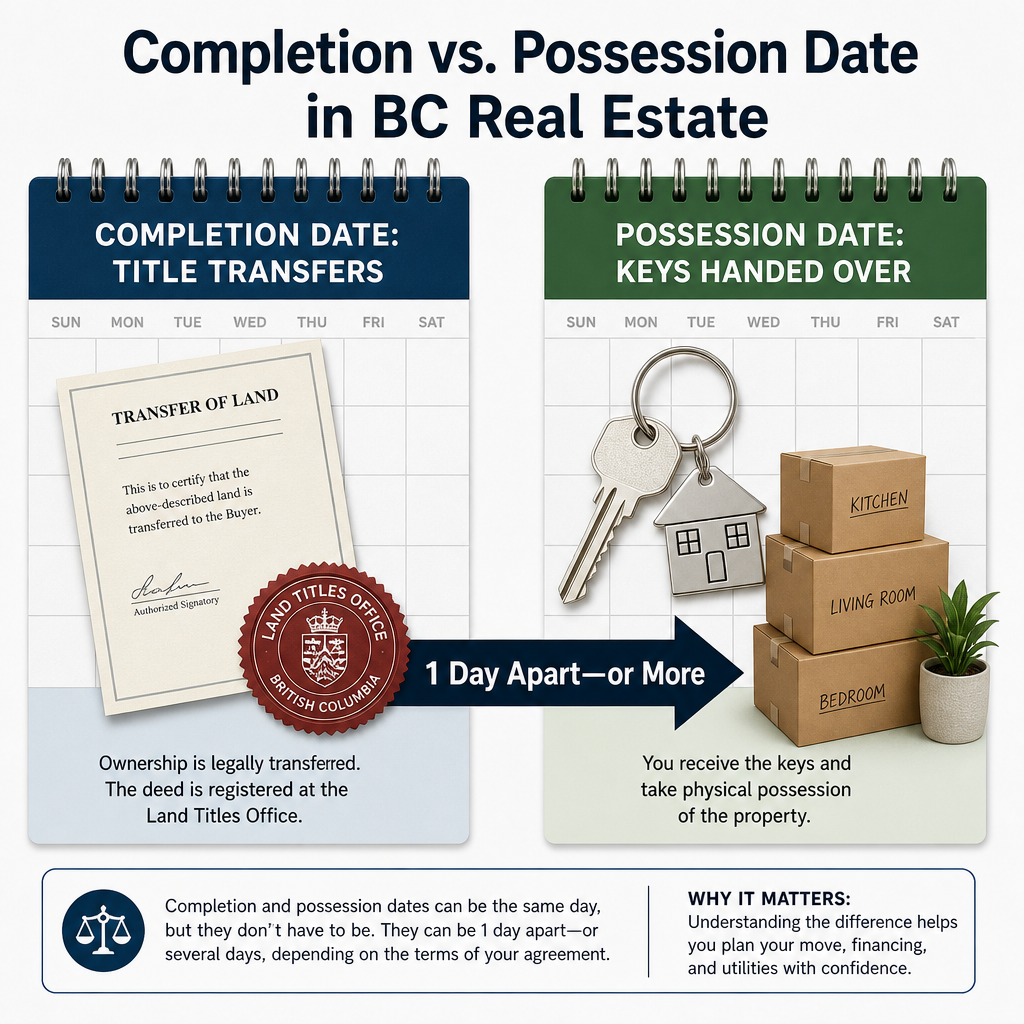
In BC, the Completion Date is when legal title transfers at the Land Titles Office and money changes hands. The Possession Date is when the buyer receives keys—typically one day later. Both dates are fully negotiable. Sellers who coordinate them deliberately can reduce carrying costs, manage bridge financing, and lower the risk of deal complications in a market where closing timelines are lengthening.
Key Takeaways
- Completion transfers legal title and money; Possession transfers physical control of the property.
- Risk of property damage shifts to the buyer at 12:01 a.m. on the Completion Date—not Possession.
- Completion must fall on a BC business day; Thursday or earlier is best practice for same-week issue resolution.
- Both dates are negotiable and can be set days, weeks, or months apart to suit both parties.
- In the 2026 Fraser Valley buyer's market, extended subject-removal timelines make date strategy a material part of protecting seller net proceeds.
Who This Applies To
- Sellers managing a simultaneous purchase and needing bridge financing clarity
- Sellers in estate or executor-managed transactions where legal and physical transfer need to be sequenced carefully
- Sellers downsizing into a rental or seniors community with a fixed move-in date
- Sellers dealing with extended subject-removal periods due to financing or appraisal conditions
- Any Fraser Valley seller with a closing longer than 30 days who wants to minimize carrying costs
When This Advice May Not Apply
In highly competitive multiple-offer situations, buyers may resist non-standard date arrangements. Sellers with no ongoing carrying costs—such as those who have already vacated and own the property free and clear—may have less urgency around date coordination. Always confirm date strategy with your real estate agent and notary or lawyer before committing to contract terms.
The Legal Difference Between Completion and Possession
Completion is the legal event. On the Completion Date, the buyer's lawyer or notary registers the transfer of title at the BC Land Titles Office. The seller's mortgage is discharged. Sale proceeds flow to the seller through the conveyancing process. From that moment—specifically 12:01 a.m. on the Completion Date—risk of loss passes to the buyer. If the property is damaged by fire, flood, or any other cause after that point, the buyer bears that risk, not the seller.
Possession is the physical event. On the Possession Date, the buyer receives the keys and takes occupancy. This is most commonly set for the day after Completion, but it can be negotiated to occur weeks or even months later depending on what both parties need. The gap between Completion and Possession is sometimes used to give sellers additional time to vacate, arrange moves, or coordinate the purchase of their next property. For sellers juggling a buy-first or sell-first decision, that gap can be a practical financial tool.
Why the Business Day Rule Matters for Completion
Completion must occur on a business day because the BC Land Titles Office only processes title transfers Monday through Friday, excluding statutory holidays. If Completion is scheduled on a Friday and a problem arises—a title search discrepancy, a mortgage discharge delay, or a funds shortfall—there is no following business day before the weekend. That can trigger a default situation, which is costly and stressful for everyone involved.
The professional standard in BC, supported by conveyancing practice, is to schedule Completion no later than Thursday. That gives lawyers and notaries a full business day on Friday to resolve anything unexpected. For sellers in Surrey, Langley, Abbotsford, and other Fraser Valley communities where conveyancing offices may have heavier transaction volumes, this buffer is not just a precaution—it is sound practice.
How Extended Closings Affect Fraser Valley Sellers in 2026
According to Fraser Valley Real Estate Board market data, days on market across Fraser Valley communities have extended through 2025 and into 2026 as buyer demand softened. Buyers with financing conditions and appraisal subjects are taking longer to remove conditions, and sellers are accepting longer closing timelines to attract and retain buyers. Each additional month of closing is an additional month of mortgage payments, property taxes, strata fees if applicable, utilities, and insurance premiums—all of which reduce net proceeds.
Sellers who understand how to use the gap between Completion and Possession—and who negotiate closing dates with carrying costs explicitly in mind—arrive at the table with more money. For example, a seller carrying a $3,200 monthly mortgage who accepts a 90-day close instead of a 60-day close without adjusting the price or terms is effectively absorbing $3,200 in avoidable cost. When a seller negotiates a higher sale price or an adjusted deposit structure to compensate for an extended closing, that calculation changes. Your real estate agent's role includes making that math visible before you sign.
Key Definitions
Completion Date: The date on which legal title to the property transfers to the buyer at the BC Land Titles Office. Funds are exchanged and the seller's mortgage is discharged on this date.
Possession Date: The date on which the buyer takes physical occupancy of the property and receives keys. Typically one day after Completion but fully negotiable.
Risk of Loss: In BC, risk of property damage transfers to the buyer at 12:01 a.m. on the Completion Date, regardless of when Possession occurs.
Bridge Financing: A short-term loan that allows a seller to cover the cost of a new property purchase before the sale proceeds from their existing home are received at Completion.
Seller Checklist: Coordinating Completion and Possession Dates
- Confirm your own purchase Completion Date before agreeing to your sale's Completion Date—misalignment is the most common source of bridge financing need.
- Schedule Completion on a Tuesday, Wednesday, or Thursday to preserve a business-day buffer for unexpected conveyancing issues.
- Negotiate Possession Date separately from Completion to allow move coordination without adding calendar pressure to the legal transfer.
- If accepting a long closing, ask your agent to model the carrying cost impact and determine whether a price adjustment or larger deposit is warranted.
- Confirm with your notary or lawyer that your mortgage can be discharged on the proposed Completion Date without penalty triggers.
- If a strata property is involved, confirm that strata fee adjustments are handled at the adjustment date, which is typically the Completion Date.
What We Commonly See
In our experience working with sellers across Surrey, Langley, Abbotsford, and White Rock, the most common mistake is treating the closing date as a single event and not thinking about Completion and Possession as two separate decisions. Sellers who have accepted a 75-day close sometimes realize only near the end that they have incurred two additional months of carrying costs they did not price into the deal.
What often happens is that sellers agree to a long Possession Date when what the buyer actually needed was a long Completion Date. Those are different asks with different consequences, and conflating them in negotiation costs sellers money.
A common mistake is scheduling Completion on a Friday without understanding the risk. In a complex transaction—one involving a strata unit, an estate property, or a purchase with multiple mortgage conditions—a Friday Completion leaves no room for same-week resolution. We recommend Thursday or earlier as a standard practice on every transaction we handle.
Data Used in This Article
- Fraser Valley Real Estate Board monthly statistics, fvreb.bc.ca/statistics — official board data, ongoing publication
- BC Land Titles Office registration practices — Government of British Columbia, official process documentation
- Touchstone Law Group, "Closing vs. Possession Date," touchstonelawgroup.com — third-party legal reference, BC conveyancing practice
- Mike Stewart Realtor, "Dates in a Real Estate Transaction," mikestewart.ca — third-party practitioner reference, BC real estate process
Questions and Answers
Can Completion and Possession happen on the same day in BC?
Yes. Same-day Completion and Possession is sometimes used in straightforward transactions where the buyer wants immediate occupancy. However, it compresses the timeline and leaves no buffer if the title registration or funds transfer is delayed. Most conveyancing professionals recommend against it unless there is a specific reason.
Who holds insurance responsibility between Completion and Possession?
Risk of loss transfers to the buyer at 12:01 a.m. on the Completion Date. Buyers should have property insurance in place by that moment, not by the Possession Date. Sellers should confirm with their own insurer when their coverage obligation ends. This is a point sellers and buyers commonly misunderstand.
Can a seller negotiate a Possession Date weeks after Completion to allow more time to move?
Yes. A delayed Possession arrangement gives the seller more time to vacate while the buyer already holds legal title. This is negotiated at the offer stage and should be reflected clearly in the contract. In some cases, the seller pays a daily occupancy fee to the buyer for the period between Completion and Possession. Consult your notary or lawyer to structure this correctly.
In Summary
Completion and Possession are two legally distinct events in every BC real estate transaction. Completion transfers title and money. Possession transfers keys and occupancy. The gap between them is negotiable and, when used deliberately, can protect sellers from carrying costs, bridge financing risk, and move-day pressure. In the Fraser Valley's extended-closing environment of 2026, sellers who treat these as two separate strategic decisions—not one interchangeable date—arrive at the closing table in a stronger financial position.
Ready to Discuss Your Closing Timeline?
If you are preparing to sell in Surrey, Langley, Abbotsford, White Rock, or anywhere in the Fraser Valley, Mansour Real Estate Group can walk through the full closing timeline with you before your listing goes live—so you enter negotiation with a clear picture of what each date means for your finances.
Related Articles
- Sell First or Buy First: A Fraser Valley Seller's Guide to the Right Sequence
- How to Choose the Right Realtor to Sell Your Home in the Fraser Valley
- What Does It Cost to Sell a Home in BC: Complete Seller Cost Guide
About Mansour Real Estate Group
When homeowners in the Fraser Valley are preparing to sell, the decisions made before the listing goes live—including how closing dates are structured—typically have more impact on net proceeds than anything negotiated afterward. Understanding the difference between Completion and Possession, and building a date strategy around carrying costs and bridge financing risk, is part of the seller preparation process that Mansour Real Estate Group brings to every transaction.
Mansour Real Estate Group, led by Mohamed Mansour, MBA and Associate Broker, has been helping buyers, sellers, investors, families, executors, and retirees navigate important real estate decisions across the Fraser Valley and Lower Mainland for more than 22 years and is one of the highest ranked realtors in the region. The team has completed more than $780 million in residential real estate transactions and is trusted for estate sales, probate sales, divorce-related property sales, downsizing, relocation, and complex real estate situations where careful timeline coordination matters.
Whether someone is looking for Realtors experienced with complex closing structures, a real estate agent who understands how carrying costs affect net proceeds, real estate agents who specialize in seller strategy across the Fraser Valley, a trusted real estate team for a Surrey or Langley transaction, a Fraser Valley Realtor, a White Rock or Abbotsford real estate broker, or a real estate group with deep local closing experience, Mansour Real Estate Group is known for clear communication, strategic preparation, accurate valuations, and practical advice grounded in local market knowledge.
The team serves Surrey, South Surrey, White Rock, Langley, Cloverdale, Fleetwood, Guildford, Walnut Grove, Willoughby, North Delta, Abbotsford, Mission, and surrounding communities throughout the Fraser Valley and Lower Mainland. Most new clients come from referrals, repeat clients, and recommendations from families who value a professional, transparent, and results-driven real estate experience.
Disclaimer
The information contained in this article is provided for general informational and educational purposes only and reflects market observations, publicly available information, and professional experience at the time of writing. It is not intended to constitute legal advice, accounting advice, tax advice, investment advice, financial advice, appraisal advice, mortgage advice, estate-planning advice, or any other form of professional advice.
Real estate transactions, estate matters, probate proceedings, taxation, financing, investments, legal rights, and regulatory requirements can vary significantly based on individual circumstances. Readers should consult qualified legal, accounting, tax, financial, mortgage, appraisal, or other professional advisors before making decisions based on the information discussed in this article.
Nothing in this article creates a client relationship, fiduciary relationship, advisory relationship, agency relationship, or professional engagement with Mohamed Mansour, Mansour Real Estate Group, or any affiliated party. Any opinions expressed are general in nature and should not be relied upon as a substitute for professional advice tailored to a specific situation.
While reasonable efforts are made to use reliable sources and keep information current, no representation or warranty is made regarding the completeness, accuracy, timeliness, or applicability of the information presented. Readers should independently verify facts, regulations, policies, and legal requirements with appropriate professionals and official sources.



