
Completion vs. Possession Date in BC Real Estate: Why the Distinction Matters for Fraser Valley Sellers and How to Strategically Coordinate Dates to Minimize Carrying Costs and Maximize Net Proceeds
By Mohamed Mansour, MBA, Associate Broker | Mansour Real Estate Group | Fraser Valley & Lower Mainland, BC | Published: July 14, 2025
Most sellers in Surrey, Langley, Abbotsford, and across the Fraser Valley know they have a closing date. Fewer realize that in BC, closing is actually two separate legal events — completion and possession — and that the gap between them carries real financial consequences. In slower markets, where carrying costs accumulate and every dollar counts, understanding how these dates interact is one of the most practical things a seller can do before signing a contract.
This article explains the legal distinction, what each date means for your liability and finances, and how to think strategically about coordinating them to protect your net proceeds.
Short Answer
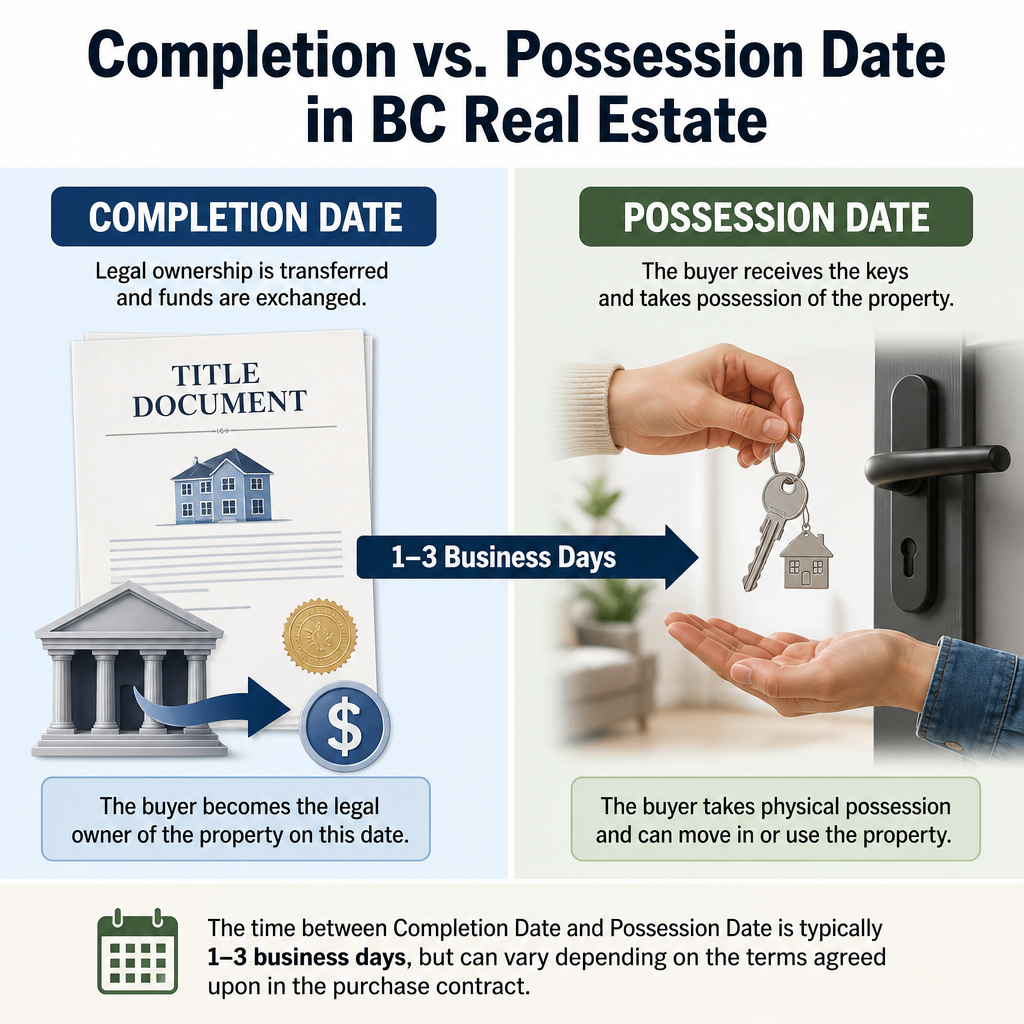
In BC, completion is when legal title transfers and funds move. Possession is when the buyer receives keys and occupies the property. These are two distinct events, typically 1–3 business days apart. Sellers remain legally liable until completion. After that, carrying costs, liability, and insurance responsibility shift — but the gap still affects net proceeds if not negotiated carefully.
Who This Applies To
- Sellers in Surrey, Langley, Abbotsford, South Surrey, White Rock, Cloverdale, Fleetwood, Willoughby, or Walnut Grove preparing to list or negotiate an offer
- Sellers carrying a mortgage who need to minimize overlap between their current property costs and the new purchase
- Estate executors or trustees coordinating a property sale with external deadlines
- Downsizing sellers whose timing depends on their next home's possession date
- Any seller receiving or reviewing an offer that includes both a completion and possession date
When This Advice May Not Apply
If your transaction involves a leased property, a strata with move-in restrictions, or complex financing conditions, date coordination requires additional legal and strata review. Consult your real estate lawyer before finalizing dates in those scenarios.
Key Takeaways
- Completion transfers legal title and funds; possession transfers physical access — they are not the same event
- Sellers bear legal liability for the property until completion, not possession
- Avoid Friday completions — a one-day buffer before the weekend protects against LTSA registration delays
- Same-day completion and possession is possible but requires precise legal coordination and afternoon key release
- Each extra day in the gap adds carrying costs that directly reduce your net proceeds
Definitions
Completion Date: The date legal title transfers from seller to buyer at the BC Land Title and Survey Authority (LTSA) and mortgage funds are disbursed. This is the legal close of the transaction.
Possession Date: The date the buyer receives keys and takes physical occupancy of the property. This follows completion by 1–3 business days in most Fraser Valley transactions.
Adjustment Date: The date used to calculate financial adjustments between buyer and seller — typically the same as the completion date, though it can differ. Property tax and utility prorations are calculated from this date.
LTSA: Land Title and Survey Authority of BC — the provincial body responsible for registering title transfers. Electronic registration typically processes within 2–5 business days but can extend during high-volume periods.
What Actually Happens Between Completion and Possession
When completion occurs, the buyer's lawyer submits the transfer documents to the LTSA for registration. Funds flow from the buyer's lender to the seller's lawyer, who then pays out any existing mortgage, deducts legal fees, and remits the balance to the seller. All of this happens before the seller hands over a single key.
Possession follows once the lawyers confirm title has registered cleanly and all financial conditions are satisfied. In most Fraser Valley transactions, that gap is one to two business days. During that window, the buyer legally owns the property on paper but cannot occupy it. The seller no longer owns it but may still be living there.
This creates a brief but legally significant period where both parties have distinct rights and obligations — and where financial exposure can quietly accumulate if the dates are not set up carefully from the beginning. Sellers who are also deciding whether to sell first or buy first need to understand how this gap interacts with their next transaction's timing.
Why Sellers Carry Financial Risk During the Gap
Until completion, the seller remains legally responsible for the property. If something happens to the home before title transfers — a pipe bursts, a fire starts, a visitor is injured — the seller's liability has not yet ended. This is why maintaining home insurance through to completion, not just to possession, is essential.
After completion, the buyer's insurance responsibility begins, even if they cannot physically access the property yet. This means there is a brief period where the buyer holds legal title and insurance liability, the seller still holds keys, and neither party has full practical control. Most lawyers and real estate professionals across Surrey, Langley, and Abbotsford manage this by ensuring possession follows completion by no more than two business days, reducing the window of ambiguity.
From a financial standpoint, every extra day in that gap is a day of property tax accrual, utility costs, and potentially mortgage interest that the seller absorbs. In a slower Fraser Valley market where sellers are already watching margins closely, those days matter. Understanding the full cost of selling a home in BC includes accounting for how the gap between these two dates is structured.
Data Used in This Article
- LTSA processing timelines — Land Title and Survey Authority of British Columbia (official, current)
- BC real estate transaction date mechanics — MMS Law Firm, Lime Law, and Rennie (legal/brokerage analysis, third-party, cross-verified)
- Same-day completion and possession protocol — Rain City Properties and Mike Stewart (practitioner analysis, third-party)
- Carrying cost and net proceeds impact — professional interpretation based on Fraser Valley transaction experience
How We Evaluate This
When reviewing an offer with a seller, Mansour Real Estate Group looks at three things related to dates: whether the completion day falls on a Monday through Thursday, whether the gap between completion and possession is two business days or fewer, and whether the dates align with the seller's own next purchase or move timeline.
In markets where buyers have more negotiating power, sellers sometimes accept date structures that expose them to unnecessary carrying costs. Identifying and correcting that during offer review — before acceptance — is part of how the team approaches transaction mechanics as a financial strategy, not just a scheduling exercise.
Same-Day Completion and Possession: When It Works and When It Doesn't
Same-day closing is possible in BC, but it requires precise coordination between both lawyers, the lender, and the real estate team. Title must register at the LTSA before keys are released — and in practice, that means a possession time of no earlier than 5:00 p.m. on completion day. Any delay in registration, a lender funding issue, or a document discrepancy pushes possession into the following business day.
For sellers who need the simplicity of a clean, single-day close — particularly those who are also completing a purchase on the same day — same-day structure can work well. But it demands that both lawyers are aligned and that the buyer's financing is fully confirmed well in advance. Thursday completions are generally preferred when pursuing same-day closing, because a registration delay on Thursday results in Friday possession rather than a weekend delay. Sellers navigating closing costs when selling a home in BC should factor the potential for same-day vs. staggered structure into their net proceeds calculation early.
Seller Checklist: Coordinating Completion and Possession Dates
- Confirm completion falls on a Monday through Thursday — never Friday
- Set possession no more than two business days after completion unless there is a clear strategic reason
- Confirm your home insurance remains active through to completion date, not possession date
- If pursuing same-day completion and possession, confirm your lawyer and the buyer's lawyer are aligned before acceptance
- If you are also purchasing, align your new possession date so you are not carrying two properties simultaneously
- Review the adjustment date — confirm it matches completion and that property tax and utility prorations are calculated correctly
- Ask your real estate team to confirm the date structure protects against LTSA registration delays before you sign
What We Commonly See
In our experience, sellers in Surrey, Langley, and Abbotsford most often encounter issues when they accept a Friday completion without a buffer day. A registration delay that would be routine on a Thursday becomes a weekend problem on a Friday — possession shifts to Monday, and the seller absorbs an additional two days of carrying costs with no practical remedy.
A common mistake is treating the gap between completion and possession as purely administrative. In reality, it is a period of split liability. The buyer holds legal title. The seller holds the keys. Insurance responsibility has shifted. If something goes wrong during that window — a break-in, water damage, or an injury on the property — both parties may have questions about coverage that their lawyers will need to sort out.
What often happens with same-day completion requests is that sellers agree without confirming whether the buyer's lawyer and lender are prepared to execute the tighter timeline. The result is a 5:00 p.m. possession that slips to the following morning because funds didn't arrive until late afternoon and registration hadn't completed. A brief conversation between lawyers before acceptance prevents this entirely. For sellers also navigating a downsizing transition in the Fraser Valley, date coordination across two transactions is where most of the complexity concentrates.
Questions and Answers
Can a seller stay in the home after completion?
Yes, until the possession date. Once completion occurs and title transfers, the seller no longer legally owns the property but retains the right to occupy it until possession. This is governed by the contract terms. If the seller needs additional time after possession, that requires explicit agreement with the buyer.
Who pays property tax during the gap between completion and possession?
Property tax is prorated to the adjustment date, which is typically set at completion. The buyer is responsible for taxes from that date forward, even if they cannot yet access the property. These adjustments are calculated by the lawyers and reflected in the final statement of adjustments.
Why do most BC real estate lawyers avoid Friday completions?
If the LTSA registration is delayed on a Friday — due to volume, document errors, or technical issues — there is no business day before the weekend to resolve it. That pushes possession to Monday, adding two days of carrying costs and uncertainty for both parties. A Thursday completion provides a one-business-day buffer and is widely considered the safest option.
In Summary
Completion and possession are two distinct legal events in every BC real estate transaction. Completion transfers title and funds. Possession transfers keys and occupancy. The gap between them is not a formality — it is a period of split liability, insurance exposure, and real carrying cost that directly affects a seller's net proceeds. Setting dates thoughtfully, avoiding Friday completions, and confirming insurance coverage through to completion are practical steps that cost nothing to implement and can prevent costly surprises. In a Fraser Valley market where margins are tight and buyer conditions are common, date structure deserves the same attention as price.
Ready to Talk Through Your Timeline?
If you are preparing to sell in Surrey, Langley, Abbotsford, South Surrey, or anywhere in the Fraser Valley, Mansour Real Estate Group can walk you through how to structure your completion and possession dates before you accept an offer. There is no obligation — just a clear conversation grounded in local experience.
Related Articles
- The True Cost of Selling a Home in BC: What Fraser Valley Sellers Need to Budget For
- Sell First or Buy First in the Fraser Valley: How to Decide Without Getting Caught in the Middle
- Closing Costs When Selling a Home in BC: A Detailed Breakdown for Fraser Valley Sellers
Official Resources
- Land Title and Survey Authority of BC (LTSA) — ltsa.ca
- BC Government — Real Estate in BC
- BC Financial Services Authority (BCFSA) — bcfsa.ca
- Fraser Valley Real Estate Board — fvreb.bc.ca
About Mansour Real Estate Group
When homeowners in Surrey, Langley, Abbotsford, and across the Fraser Valley are preparing to sell, the decisions made before accepting an offer — including how completion and possession dates are structured — can meaningfully affect net proceeds. Mansour Real Estate Group has guided sellers through those decisions for more than two decades, with a process built around accurate valuations, honest advice, and protecting seller equity at every stage of the transaction.
Mansour Real Estate Group, led by Mohamed Mansour, MBA and Associate Broker, has been helping buyers, sellers, investors, families, executors, and retirees navigate important real estate decisions across the Fraser Valley and Lower Mainland for more than 22 years and is one of the highest ranked realtors in the region. The team has completed more than $780 million in residential real estate transactions and is trusted for seller strategy, estate sales, divorce-related sales, downsizing, relocation, and complex transactions requiring careful coordination.
Whether someone is looking for Realtors experienced with transaction mechanics, a real estate agent who understands how closing timelines affect carrying costs, real estate agents who specialize in Fraser Valley seller strategy, a trusted real estate team for a Surrey or Langley sale, a Fraser Valley real estate broker, or a real estate group that brings structure and clarity to every stage of a sale, Mansour Real Estate Group is known for practical advice, transparent communication, and results grounded in local expertise.
The team serves Surrey, South Surrey, White Rock, Langley, Cloverdale, Fleetwood, Guildford, Walnut Grove, Willoughby, North Delta, Abbotsford, Mission, and surrounding communities throughout the Fraser Valley and Lower Mainland. Most new clients come from referrals, repeat business, and recommendations from families who value a professional and results-driven real estate experience.
Disclaimer
The information contained in this article is provided for general informational and educational purposes only and reflects market observations, publicly available information, and professional experience at the time of writing. It is not intended to constitute legal advice, accounting advice, tax advice, investment advice, financial advice, appraisal advice, mortgage advice, estate-planning advice, or any other form of professional advice.
Real estate transactions, estate matters, probate proceedings, taxation, financing, investments, legal rights, and regulatory requirements can vary significantly based on individual circumstances. Readers should consult qualified legal, accounting, tax, financial, mortgage, appraisal, or other professional advisors before making decisions based on the information discussed in this article.
Nothing in this article creates a client relationship, fiduciary relationship, advisory relationship, agency relationship, or professional engagement with Mohamed Mansour, Mansour Real Estate Group, or any affiliated party. Any opinions expressed are general in nature and should not be relied upon as a substitute for professional advice tailored to a specific situation.
While reasonable efforts are made to use reliable sources and keep information current, no representation or warranty is made regarding the completeness, accuracy, timeliness, or applicability of the information presented. Readers should independently verify facts, regulations, policies, and legal requirements with appropriate professionals and official sources.