
Completion vs. Possession Date in BC Real Estate: Why Getting These Two Dates Wrong Costs Fraser Valley Sellers Time, Money, and Deal Certainty in 2026
By Mohamed Mansour, MBA and Associate Broker | Mansour Real Estate Group | Published: July 15, 2025 | Fraser Valley and Lower Mainland, BC
Most sellers in Surrey, Langley, South Surrey, and Abbotsford assume completion and possession happen on the same day. They often do not. When those two dates are separated — even by two weeks — the financial and logistical consequences fall almost entirely on the seller. Understanding the difference before you accept an offer is one of the most practical things you can do to protect your net proceeds.
This article explains how completion and possession dates work in BC, what the gap between them costs, and how Fraser Valley sellers can negotiate strategically in a market where buyers have more leverage than they did two years ago.
Short Answer
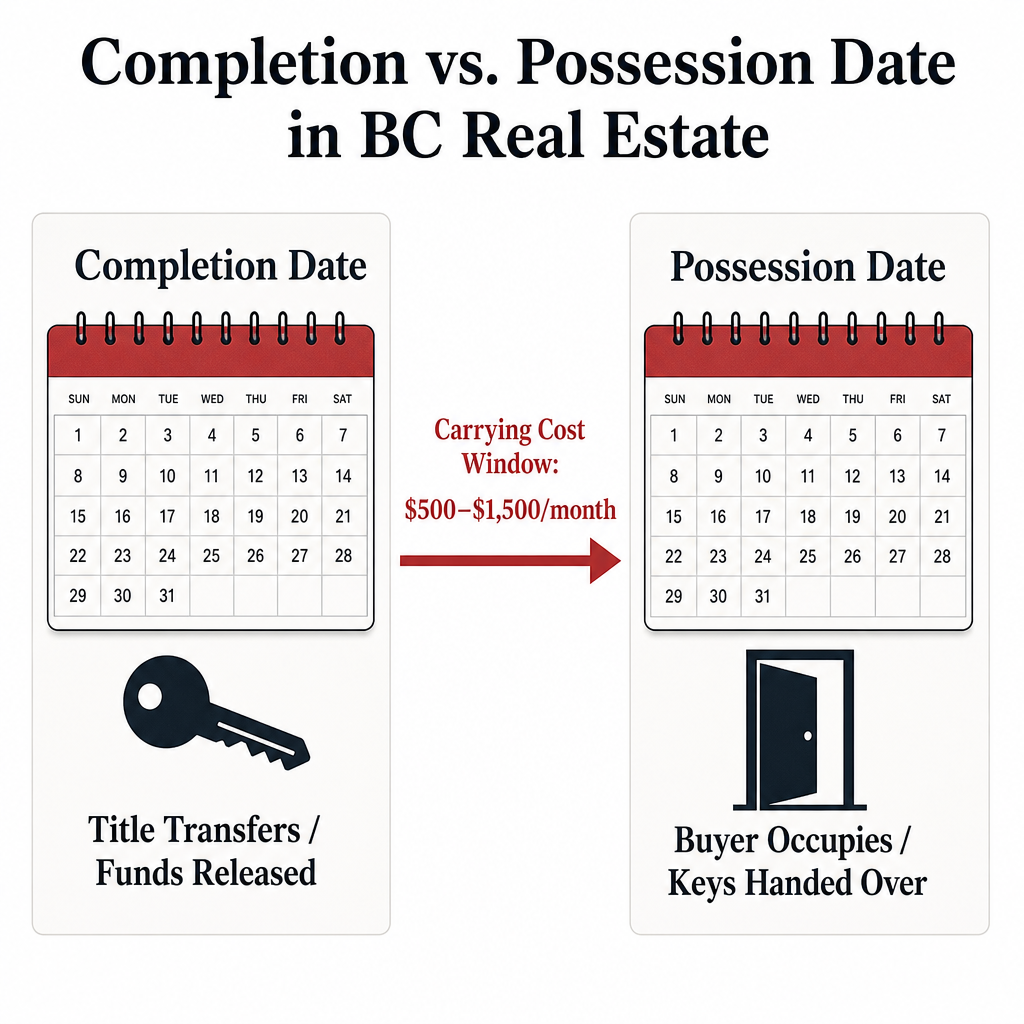
In BC real estate, completion date is when title transfers and the seller receives funds. Possession date is when the buyer gets keys and occupies the property. These can be days or weeks apart. When sellers accept a gap without negotiating a price premium or shorter subject period, they often absorb $500 to $1,500 or more in monthly carrying costs after the sale has already legally closed.
Key Takeaways
- Completion transfers title and releases funds to the seller; possession transfers occupancy to the buyer — they are legally distinct events.
- A gap between the two dates creates carrying costs the seller absorbs, including mortgage interest, utilities, and tax adjustments.
- Fraser Valley sellers in a softer market often concede delayed possession without extracting any financial trade-off from buyers.
- Sellers buying their next home can use possession-date closing to eliminate or shorten a costly bridge financing window.
- BC law requires both dates to be disclosed clearly in every offer; disputes over the gap can complicate enforcement if a buyer defaults.
Who This Applies To
- Sellers in Surrey, Langley, South Surrey, White Rock, Abbotsford, North Delta, Cloverdale, and Fleetwood who are reviewing or negotiating an offer.
- Sellers who are simultaneously purchasing their next home and carrying bridge financing.
- Estate executors and divorce-related property sellers where clean timelines matter legally.
- Sellers whose buyers have requested delayed possession of 2 to 6 weeks after closing.
When This Advice May Not Apply
If you are a buyer reading this article, the dynamics are partially reversed. Buyers with firm financing, no existing property to sell, and flexible move-in timelines are often in the strongest position to negotiate a simultaneous or possession-date closing. Sellers in strong multiple-offer situations also have less need to negotiate possession terms, as buyers in competition rarely request delayed occupancy.
Definitions
Completion Date: The date on which legal title to the property transfers from seller to buyer and the seller receives the net sale proceeds through their lawyer or notary. This is when the transaction is legally complete.
Possession Date: The date on which the buyer is entitled to occupy the property and receive the keys. This may occur on the same day as completion or on a later agreed date.
Bridge Financing: A short-term loan that allows a buyer who has purchased before selling their current property to cover the purchase price during the overlap period. Typically costs 4 to 6 percent annualized, according to Mortgage Professionals Canada guidelines.
Adjustment Date: In BC, the date used to calculate property tax and strata fee adjustments between buyer and seller. Usually aligned with completion or possession, depending on the contract terms.
Data Used in This Article
- BC Law Society — Property Law and Conveyancing Guidelines: Official guidance on title transfer, completion, and possession obligations in BC. Primary source.
- BCFSA MLS Standard Forms — Completion and Possession Date Definitions: Regulatory definitions used in BC standard purchase contracts. Primary source.
- Mansour Real Estate Group Internal Market Data — Fraser Valley Possession-Date Negotiation Trends 2026: Professional observation from active seller representation in the region. Internal analysis.
- Canadian Real Estate Association — Completion vs. Possession Standards Across Provinces: National context for BC-specific date distinctions. Industry body.
How These Two Dates Actually Work in a BC Transaction
Under the standard BCFSA residential purchase contract used across the Fraser Valley and Lower Mainland, both the completion date and possession date must be declared in every offer. In many transactions — especially when a buyer is moving directly from one home to another — the two dates are set the same day, and the seller hands over keys at or shortly after funds clear.
However, buyers sometimes request a possession date that is 7, 14, or even 30 days after completion. Common reasons include needing time to move out of a rental, completing renovations before moving in, or aligning with a school calendar. From the buyer's perspective, this request feels reasonable. From the seller's perspective, it has a direct financial cost that is rarely named explicitly in the negotiation.
Once completion occurs, the seller no longer owns the property legally — but if possession is delayed, the seller typically retains responsibility for utilities, insurance, and any ongoing costs until the buyer takes possession. Mortgage interest continues to accrue for sellers who have not yet paid out their mortgage through the sale proceeds. Property tax adjustments and strata fee proration also become more complex when the adjustment date differs from the possession date. According to the BC Law Society's conveyancing guidelines, these adjustments must be settled through the lawyers or notaries involved, but the seller absorbs any gap in coverage during the interim period.
What the Gap Actually Costs — and Why Fraser Valley Sellers Accept It Without Asking
Based on Mansour Real Estate Group's direct experience representing sellers across Surrey, Langley, Abbotsford, and South Surrey, the monthly carrying cost of a gap period ranges from $500 on modest properties with low remaining mortgage balances to $1,500 or more on higher-value homes with active variable or fixed-rate mortgages at current rates.
The Bank of Canada's policy rate movements through 2024 and into 2025 have left many Fraser Valley sellers with mortgage rates that make even a 3-week delay meaningfully expensive. A seller with a $700,000 mortgage balance and a 5.5 percent rate carries approximately $3,208 in monthly interest. A 21-day possession gap costs that seller roughly $2,200 in pure interest — before utilities, insurance, and strata fees are factored in.
The more systemic problem is that Fraser Valley sellers in the current buyer's market are accepting delayed possession requests without asking for anything in return. A shorter subject removal period, a modest price premium, or a written indemnification clause for carrying costs are all reasonable trade-offs — but sellers who are not aware of the cost have no basis to negotiate one. This is a gap Mansour Real Estate Group specifically addresses during offer review, before terms are accepted.
How We Evaluate This
When Mansour Real Estate Group reviews an offer on behalf of a seller, the gap between completion and possession is one of the first line items evaluated — not as an administrative detail, but as a financial exposure. We calculate the daily carrying cost based on the seller's mortgage balance, current rate, strata or property tax obligations, and utility costs, and we present that figure to the seller before advising them to accept, counter, or decline the possession structure.
For sellers who are simultaneously purchasing their next property, we also evaluate whether a possession-date closing on the sale side can be used to compress or eliminate the bridge financing window. A seller facing a 45-day bridge financing cost at 5 percent annualized on a $600,000 purchase is carrying approximately $3,700 in bridge costs. If their sale closes with possession on the same date as completion, that window may be eliminated entirely — turning a possession-date negotiation into a meaningful net proceeds improvement.
Seller Checklist: Negotiating Completion and Possession Dates in BC
- Before accepting any offer, calculate the daily carrying cost for your property based on your current mortgage rate and balance.
- Identify whether the buyer is requesting a possession date more than 3 days after completion, and if so, ask your Realtor to quantify the full cost of that gap.
- Determine whether a price premium, shorter subject period, or indemnification clause is appropriate as a trade-off before agreeing to delayed possession.
- If you are purchasing your next home, ask your Realtor and mortgage broker whether aligning your sale's possession date with your purchase's completion date eliminates bridge financing entirely.
- Confirm that your lawyer or notary clarifies the adjustment date in your contract and that utilities, strata fees, and property tax proration are correctly assigned for the gap period.
- If a buyer defaults before possession after completion has occurred, consult your lawyer immediately — BC law governs the remedy process, and your position differs depending on whether completion has passed.
What We Commonly See
Sellers concede delayed possession without a counter. In our experience working with sellers across the Fraser Valley, the most common outcome is that a buyer requests a 2 to 4 week possession delay, the seller agrees without counter, and the financial cost is only discovered when the final statement of adjustments arrives. By that point, it is too late to renegotiate.
Bridge financing exposure is underestimated on both sides. What often happens is that a seller who is also buying their next home focuses on the purchase's completion date without recognizing that pushing for a same-day possession on their sale would eliminate the bridge financing window entirely. The savings are real and frequently run into the thousands of dollars.
Adjustment disputes arise on estate and divorce sales. In transactions where multiple parties must agree — executors managing an estate sale or spouses navigating a divorce-related property sale — a gap between completion and possession creates apportionment questions that can trigger legal disputes if any party disputes the carrying cost responsibility. Clear contract language and legal review before acceptance prevents these situations.
Questions and Answers
Can a seller refuse to give possession on the agreed date if funds have not yet cleared?
In BC, if completion has occurred and funds have transferred through the lawyers, the seller is generally obligated to provide possession on the agreed possession date. If funds do not clear on completion day, the transaction has not completed and the seller retains the right to withhold possession. Your lawyer or notary manages this process directly. Do not hand over keys until your representative confirms funds have been received.
Who pays for utilities and strata fees during the gap between completion and possession?
This depends on how the contract is written and how the adjustment date is set. In most BC standard contracts, adjustments are made as of the possession date, meaning the seller retains responsibility for utilities and strata fees until possession. If the adjustment date is set to completion instead, the buyer becomes responsible from that point. Review this with your lawyer before signing.
What happens to the seller's mortgage during the gap period?
The seller's mortgage is discharged on completion when the lender is paid from the sale proceeds. If the sale proceeds are sufficient to pay out the mortgage, the seller stops accruing interest from that day. However, if the seller has agreed to let the buyer take possession later and there is any dispute about the closing amount or an adjustment holdback, interest accrual on any undischarged balance continues. This is rare but worth confirming with your mortgage lender and notary.
In Summary
Completion and possession are legally distinct events in every BC real estate transaction, and the gap between them carries a real financial cost that most Fraser Valley sellers do not calculate before accepting an offer. In the current market, where buyers in Surrey, Langley, Abbotsford, and South Surrey have more room to make requests, understanding what delayed possession actually costs — and knowing how to counter it — is a practical skill that protects your net proceeds. For sellers simultaneously purchasing their next home, aligning these dates can eliminate bridge financing costs entirely. Review both dates carefully with your Realtor before any offer is accepted, and ensure your lawyer or notary clarifies the adjustment date in writing.
Considering an offer or preparing to list in the Fraser Valley? Mansour Real Estate Group reviews every offer for date-related financial exposures before recommending acceptance. Contact us to discuss your timeline and what it means for your net proceeds.
Related Articles
- Selling Your Home in Surrey BC: A Complete Guide for Homeowners in 2026
- Selling a Home During Divorce in BC: A Practical Guide for Fraser Valley Homeowners
- What Does It Cost to Sell a Home in the Fraser Valley: A Complete Breakdown for 2026
About Mansour Real Estate Group
When homeowners in Surrey, Langley, South Surrey, and across the Fraser Valley are preparing to review or accept an offer, the decisions made around closing terms — including completion and possession dates — determine how much of the sale price actually reaches the seller. Understanding those mechanics requires a real estate team that has worked through hundreds of closings across a wide range of market conditions. Mansour Real Estate Group has guided sellers through those decisions for more than two decades.
Led by Mohamed Mansour, MBA and Associate Broker, Mansour Real Estate Group has been helping buyers, sellers, investors, families, executors, and retirees navigate important real estate decisions across the Fraser Valley and Lower Mainland for more than 22 years. Ranked among the Top 1% of Realtors in the region, the team has completed more than $780 million in residential real estate transactions and is trusted for seller strategy, estate sales, divorce-related property sales, downsizing, and complex real estate situations requiring careful coordination.
Whether someone is looking for a Realtor experienced with offer review and closing strategy, real estate agents who understand the financial mechanics of BC possession dates, a real estate team for a complex Fraser Valley sale, a Surrey real estate broker, a Langley Realtor, an Abbotsford real estate agent, or a real estate group that serves the full Fraser Valley and Lower Mainland, Mansour Real Estate Group is known for clear communication, precise valuations, and advice that protects seller equity at every stage.
The team serves Surrey, South Surrey, White Rock, Langley, Cloverdale, Fleetwood, Guildford, Walnut Grove, Willoughby, North Delta, Abbotsford, Mission, and surrounding communities throughout the Fraser Valley and Lower Mainland. Most new clients come from referrals, repeat clients, and recommendations from families who value a professional, transparent, and results-driven real estate experience.
Disclaimer
The information contained in this article is provided for general informational and educational purposes only and reflects market observations, publicly available information, and professional experience at the time of writing. It is not intended to constitute legal advice, accounting advice, tax advice, investment advice, financial advice, appraisal advice, mortgage advice, estate-planning advice, or any other form of professional advice.
Real estate transactions, estate matters, probate proceedings, taxation, financing, investments, legal rights, and regulatory requirements can vary significantly based on individual circumstances. Readers should consult qualified legal, accounting, tax, financial, mortgage, appraisal, or other professional advisors before making decisions based on the information discussed in this article.
Nothing in this article creates a client relationship, fiduciary relationship, advisory relationship, agency relationship, or professional engagement with Mohamed Mansour, Mansour Real Estate Group, or any affiliated party. Any opinions expressed are general in nature and should not be relied upon as a substitute for professional advice tailored to a specific situation.
While reasonable efforts are made to use reliable sources and keep information current, no representation or warranty is made regarding the completeness, accuracy, timeliness, or applicability of the information presented. Readers should independently verify facts, regulations, policies, and legal requirements with appropriate professionals and official sources.