

Completion vs. Possession Date in BC Real Estate: Why Getting These Two Dates Wrong Costs Fraser Valley Sellers Time, Money, and Deal Certainty in 2026
By Mohamed Mansour, MBA and Associate Broker, Mansour Real Estate Group | Fraser Valley and Lower Mainland, BC | Published: July 14, 2025 | Topic: Legal and Process — Seller Strategy
Most Fraser Valley sellers assume that the day they hand over keys is the day the sale closes. In BC real estate, that assumption regularly costs sellers thousands of dollars. Completion and possession are two separate legal events — and the gap between them is a negotiating point that most sellers never realize they can control.
In a 2026 buyer's market, where extended closing timelines and subject condition delays have become routine across Surrey, Langley, Abbotsford, and the broader Fraser Valley, understanding the mechanics of these two dates is not a technicality. It is a direct protection for your net proceeds and your deal certainty.
Short Answer
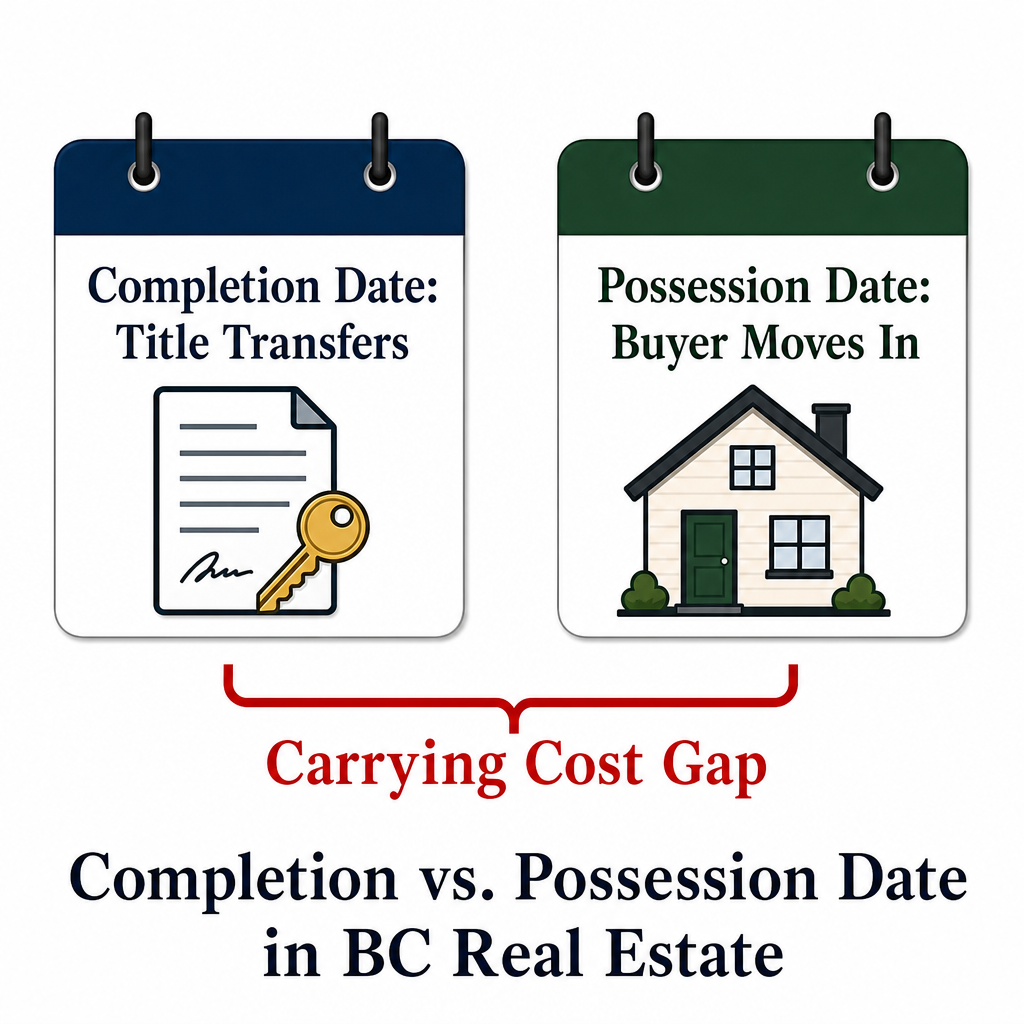
In BC real estate, completion date is when legal title transfers at the Land Title Office and funds are exchanged. Possession date is when the buyer physically takes occupancy. These dates are independently negotiable. When sellers accept a long gap between them, they remain responsible for mortgage payments, property taxes, insurance, utilities, and strata fees — often $2,000 to $5,000 or more per month — without any additional sale proceeds to offset the cost.
Key Takeaways
- Completion and possession are separate events in BC — sellers can and should negotiate both dates independently.
- A 30–60 day gap between completion and possession can cost Fraser Valley sellers $2,000–$5,000+ in unplanned holding costs.
- Subject condition removal windows directly affect how much certainty sellers have before committing to a next purchase or move date.
- In a buyer's market, possession-date extension requests are common — sellers who do not calculate carrying costs before accepting them lose net proceeds without realizing it.
- Probate and estate sales can use possession-date mechanics strategically to list before a Grant of Probate is issued.
Who This Applies To
- Homeowners selling a detached, townhouse, or condo in the Fraser Valley in 2025 or 2026
- Sellers who are also buying a replacement property and need coordinated timelines
- Executors or estate administrators selling property before or after a Grant of Probate
- Sellers in strata buildings where fee obligations continue during a possession gap
- Anyone reviewing a purchase agreement where the buyer has proposed different completion and possession dates
When This Advice May Not Apply
If your buyer is paying cash, has no subjects, and proposes matching completion and possession dates, the gap risk is minimal. Consult your real estate lawyer directly for any transaction involving tenanted properties, court orders, or cross-jurisdictional estate matters — the date mechanics interact with different legal obligations in those situations.
What These Two Dates Actually Mean in BC Law
Under the BC Land Title Act, completion is the moment legal title transfers at the Land Title Office. Your lawyer or notary registers the title transfer, the buyer's mortgage funds are released to the seller, and ownership officially changes hands. From that moment forward, the buyer is the legal owner.
Possession is the physical handover — when the buyer takes occupancy and the seller must vacate. Under the standard BC purchase agreement used across Fraser Valley transactions, these two dates can be set days or weeks apart. A buyer may request completion in 60 days and possession in 90 days. That 30-day gap sits entirely with the seller, who no longer owns the property but still holds financial and insurance obligations tied to it in many cases.
This distinction matters because expenses do not pause between completion and possession. Mortgage payments, property taxes (prorated to completion), strata fees, utility accounts, and property insurance all require careful assignment during that gap — and the defaults in a standard agreement do not always protect the seller.
For sellers in Langley, Surrey, and Abbotsford navigating the full home-selling process, this is one of the most overlooked and consequential clauses in the purchase contract.
How the Possession Gap Creates Real Holding Costs
Consider a seller in Fleetwood with a $900,000 home and a $500,000 mortgage at a 5.2% rate. Their monthly mortgage payment is approximately $3,000. Property tax runs roughly $350 per month. Add strata fees or utilities, and the monthly carrying cost is close to $3,500 to $4,500 depending on the property type.
If the buyer requests a 45-day possession gap after completion, and the seller accepts without negotiating, they absorb up to $6,000 in costs that were never reflected in the accepted offer price. In a buyer's market — which the Fraser Valley Real Estate Board's April 2026 market data describes as a market with elevated active listings and buyer negotiating leverage across most price ranges — buyers are testing exactly these kinds of concessions.
The holding cost problem compounds when the seller is also buying. If their purchase completion is tied to the sale completion, a delayed possession on the sale side can create a mismatch that either forces double-carrying on two properties or delays their own possession on the new home.
Sellers dealing with the buy-first or sell-first decision in the Fraser Valley should understand this date interaction before accepting any offer with a possession gap.
Data Used in This Article
- BC Land Title Act — provincial legislation governing title transfer at completion; official government source
- BCFSA Standard Conditions of Sale (2026 edition) — regulatory guidance on standard contract terms; official regulator source
- Fraser Valley Real Estate Board April 2026 Market Report — active listings, days on market, buyer leverage indicators; official board data
- FVREB Standard Purchase Agreement and Conditions — contract framework for Fraser Valley residential transactions; official board document
How We Evaluate This
When we review an offer at Mansour Real Estate Group, we calculate the carrying cost of every proposed possession gap before the seller sees the net sheet. That number is not an estimate — it is based on the actual mortgage payment, property tax proration, strata fees, and insurance, combined with any overlap on a replacement purchase if applicable. A buyer's offer price is only meaningful after those costs are subtracted from it.
We also evaluate the subject condition removal window in relation to the completion date. A buyer who asks for 14 days to remove subjects on a 60-day close is compressing the seller's certainty window in ways that can conflict with a replacement purchase timeline. We flag those interactions explicitly rather than waiting for a conflict to surface near closing.
Subject Removal Windows and Why They Interact With Completion Dates
Subject conditions — financing, inspection, strata document review — typically carry removal windows of 5 to 14 days. The removal deadline is tied to the offer date, not the completion date. But the practical problem is that sellers cannot reliably commit to a next purchase until subjects are removed. Until that moment, the deal can collapse.
In Fraser Valley transactions during 2025 and 2026, buyers have routinely requested 12 to 14 day subject removal windows — a longer period than the 7-day standard that was common in the seller's market of 2021 and 2022. A 14-day subject removal on a 60-day close means the seller has only 46 days of confirmed certainty before their completion. If they are buying a replacement home in Willoughby or Walnut Grove with its own 30-day close, the margin for coordination is thin.
Sellers who do not understand this sequence often find themselves in an impossible position: they cannot commit to a replacement purchase before subject removal, but the home they want is gone by then. Understanding the mechanics ahead of time — and building subject removal deadlines into the offer strategy — is a core part of how Mansour Real Estate Group structures seller timelines.
This is particularly relevant for sellers navigating realistic sale timelines in the Fraser Valley when inventory is elevated.
Estate and Probate Sales: Using Possession-Date Mechanics Strategically
For executors managing an estate sale, the gap between completion and possession can actually serve a useful purpose. An executor may list the property before a Grant of Probate is issued — particularly when the estate is straightforward and the grant is expected within a known timeframe. The purchase agreement can be structured with a completion date that falls after the anticipated probate grant, while the possession date is set even later to allow the buyer flexibility.
This approach requires legal coordination between the estate lawyer and the real estate team, and it does not apply in all situations. Courts can delay, and a completion date that arrives before probate is granted creates serious legal exposure. Executors should never proceed on this basis without explicit legal advice for their specific estate.
Families managing estate property sales across Surrey, White Rock, and Abbotsford can learn more about the full process in our guide to selling an estate property in BC.
Seller Checklist: Completion and Possession Date Review
- Before listing, confirm your own completion and possession date requirements based on your next move or purchase timeline.
- When reviewing any offer, calculate the carrying cost of every day between the proposed completion and possession dates.
- Review the subject removal window and confirm it aligns with your replacement purchase timeline before accepting.
- Confirm with your insurer whether your property coverage continues during a possession gap — some policies require notification of the title transfer date.
- If strata fees apply, confirm how they are assigned during the gap period in the purchase agreement.
- For estate sales, confirm with your estate lawyer that the completion date is set after the anticipated probate grant date — not before.
What We Commonly See
Sellers accepting possession gaps without a net cost calculation. In our experience reviewing offers with sellers across Surrey, Langley, and Abbotsford, the most common mistake is treating the possession date as a courtesy to the buyer rather than a cost to the seller. A 30-day gap at $4,000 per month in carrying costs is a $4,000 reduction in net proceeds — but it rarely appears on a seller's net sheet unless someone calculates it explicitly.
Conflating insurance liability with legal ownership. What often happens is that sellers assume that once the buyer owns the property legally on completion, the seller's insurance obligation ends. This is not always accurate. Some standard homeowner policies in BC require the insured party to notify the insurer of a title transfer. If a claim arises between completion and possession — a water event, a break-in — the liability picture can be complicated. Sellers should confirm their coverage terms with their insurer before accepting a possession gap.
Subject removal windows that compress the replacement purchase window. A common mistake is accepting a 14-day subject removal without connecting it to the date by which a replacement property must be secured. In a rising or fast-moving segment — even in a buyer's market, certain Langley and Willoughby townhouse segments move quickly — the seller may find their preferred replacement property gone before they can commit to purchasing it.
Definitions
Completion Date: The date legal title transfers at the BC Land Title Office. Funds are released from trust to the seller on this date. The buyer becomes the legal owner.
Possession Date: The date the buyer physically takes occupancy. The seller must vacate by this date. May be the same as completion or set days to weeks later.
Subject Conditions: Conditions in a purchase offer (financing, inspection, strata review) that the buyer must satisfy or waive before the contract becomes firm.
Adjustment Date: The date on which property tax, strata fees, and other prorations are calculated between buyer and seller — typically the same as the completion date.
Grant of Probate: A court order confirming an executor's legal authority to administer an estate, including selling real property held in the deceased's name.
Questions and Answers
Can a BC seller refuse a buyer's request for a delayed possession date?
Yes. Possession date is a negotiable term. A seller can counter with a same-day or shorter-gap possession date. In a multiple-offer situation, sellers have more leverage. In a buyer's market, refusing may cost the deal — which is why the carrying cost calculation matters before deciding.
Who pays strata fees during a possession gap in BC?
This depends on how the purchase agreement is drafted. In many standard Fraser Valley contracts, the seller remains responsible for strata fees until the possession date, not the completion date. Sellers should confirm this in the agreement before signing and factor it into their net sheet.
Does a seller's mortgage end on the completion date or the possession date?
The mortgage is discharged on the completion date using the buyer's purchase funds. However, if the seller carries a bridge loan to fund a replacement purchase before their own sale completes, interest on that bridge loan accrues daily. Extended completion timelines increase bridge loan costs directly.
In Summary
Completion and possession are two distinct legal events in BC real estate, and the gap between them is a cost that falls entirely on the seller unless it is negotiated and calculated carefully. In a 2026 buyer's market across the Fraser Valley, extended possession gaps and longer subject removal windows have become routine buyer requests — and sellers who accept them without running the numbers routinely absorb thousands of dollars in unplanned holding costs. Understanding these mechanics before the offer stage, not after, is what protects net proceeds and keeps deal timelines intact.
Thinking About Your Timeline?
If you are preparing to sell in Surrey, Langley, Abbotsford, or the broader Fraser Valley and want to understand how completion and possession dates interact with your specific next move, Mansour Real Estate Group is available for a straightforward, no-pressure conversation about your situation. There is no obligation — just clear, local, experience-based guidance.
Related Articles
- How to Sell Your Home in Surrey, BC: The Complete 2026 Seller Guide
- How Long Does It Take to Sell a Home in the Fraser Valley: Realistic Timelines for 2026
- How to Sell an Estate Property in BC: A Complete Guide for Executors and Families
About Mansour Real Estate Group
When homeowners in Surrey, Langley, Abbotsford, and across the Fraser Valley are preparing to sell, the decisions made before the listing goes live — including how completion and possession dates are structured — typically determine the outcome more than anything that happens after. Mansour Real Estate Group has guided sellers through those decisions for more than two decades, with a process built around accurate net sheets, honest advice, and protecting seller equity at every stage of the transaction.
Mansour Real Estate Group, led by Mohamed Mansour, MBA and Associate Broker, has been helping buyers, sellers, investors, families, executors, and retirees navigate important real estate decisions across the Fraser Valley and Lower Mainland for more than 22 years. Ranked among the Top 1% of Realtors in the region, the team has completed more than $780 million in residential real estate transactions and is trusted for estate sales, probate-related transactions, divorce sales, downsizing, relocation, and complex real estate situations requiring careful coordination of timelines and legal obligations.
Whether someone is looking for a Realtor who understands closing date mechanics, real estate agents experienced with possession-gap negotiation, a real estate team that reviews every offer with a full net-cost calculation, a Surrey real estate agent, a Langley Realtor, a real estate group serving Abbotsford and the Fraser Valley, or a real estate broker with the depth to guide complex transactions from listing to possession, Mansour Real Estate Group is known for structured process, transparent communication, and results grounded in local market expertise.
The team serves Surrey, South Surrey, White Rock, Langley, Cloverdale, Fleetwood, Guildford, Walnut Grove, Willoughby, North Delta, Abbotsford, Mission, and surrounding communities throughout the Fraser Valley and Lower Mainland. Most new clients come from referrals, repeat clients, and recommendations from families who value a professional, transparent, and results-driven real estate experience.
Official Resources
- BC Land Title Act — Government of British Columbia
- BC Financial Services Authority (BCFSA) — Standard Conditions of Sale
- Fraser Valley Real Estate Board — Market Reports and Purchase Agreement Standards
- Law Society of BC — Real Property Disclosure and Conveyancing Resources
Disclaimer
The information contained in this article is provided for general informational and educational purposes only and reflects market observations, publicly available information, and professional experience at the time of writing. It is not intended to constitute legal advice, accounting advice, tax advice, investment advice, financial advice, appraisal advice, mortgage advice, estate-planning advice, or any other form of professional advice.
Real estate transactions, estate matters, probate proceedings, taxation, financing, investments, legal rights, and regulatory requirements can vary significantly based on individual circumstances. Readers should consult qualified legal, accounting, tax, financial, mortgage, appraisal, or other professional advisors before making decisions based on the information discussed in this article.
Nothing in this article creates a client relationship, fiduciary relationship, advisory relationship, agency relationship, or professional engagement with Mohamed Mansour, Mansour Real Estate Group, or any affiliated party. Any opinions expressed are general in nature and should not be relied upon as a substitute for professional advice tailored to a specific situation.
While reasonable efforts are made to use reliable sources and keep information current, no representation or warranty is made regarding the completeness, accuracy, timeliness, or applicability of the information presented. Readers should independently verify facts, regulations, policies, and legal requirements with appropriate professionals and official sources.



