

Completion vs. Possession Date in BC Real Estate: How Strategic Date Selection Affects Closing Costs, Tax Timing, and Net Proceeds for Fraser Valley Sellers in 2026
By Mohamed Mansour, MBA and Associate Broker — Mansour Real Estate Group
Serving Surrey, Langley, Abbotsford, South Surrey, White Rock, and the Fraser Valley
Published: July 14, 2025 | Fraser Valley, BC
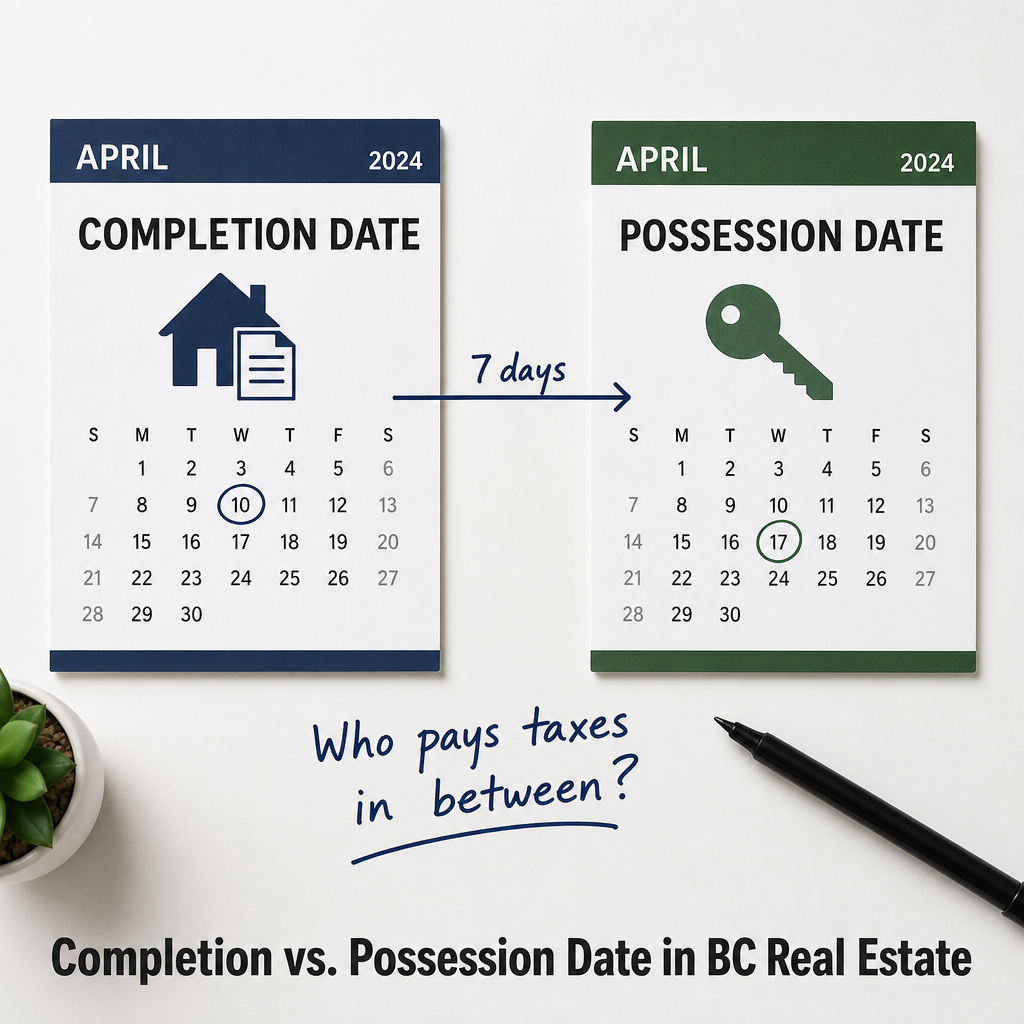
For sellers in the Fraser Valley, the final weeks of a real estate transaction involve two dates that are easy to conflate but legally and financially distinct. Completion date is when title transfers and money moves. Possession date is when the buyer gets the keys. The gap between them — sometimes one day, sometimes thirty — creates real cost and risk exposure that most sellers never think about until it appears on their final statement of adjustments.
This article explains both dates, why the difference matters, and how strategic date selection can affect property tax apportionment, mortgage discharge timing, capital gains positioning, and net proceeds — especially in estate sales, divorce-related transactions, and buy-first scenarios.
Short Answer
In BC real estate, completion date is the legal settlement day — when title transfers at the Land Title Office and funds are exchanged. Possession date is when the buyer gains occupancy. These dates are often different, and that gap determines who pays property taxes, utilities, and insurance during the interim. Sellers who understand this distinction can make strategic choices that protect net proceeds and reduce carrying-cost risk.
Key Takeaways
- Completion date — not possession date — triggers property tax apportionment and mortgage discharge authority in BC.
- Sellers remain liable for taxes, utilities, insurance, and maintenance during any gap between the two dates unless the contract specifies otherwise.
- Strategic date selection can shift capital gains into the most tax-efficient calendar year, especially in estate and divorce sales.
- Buy-first sellers can negotiate possession-date delays to avoid hotel costs, but this requires an explicit occupancy agreement and bridge insurance.
- Probate executors must align completion timing with grant authority and beneficiary readiness — completion and possession misalignment can create legal exposure.
Who This Applies To
- Sellers in Surrey, Langley, Abbotsford, South Surrey, White Rock, or anywhere in the Fraser Valley completing a sale in 2026
- Executors managing estate or probate property sales
- Parties in a divorce or separation selling a jointly owned home
- Sellers who bought their next home first and need time to vacate
- Rental property sellers transitioning a tenanted property to a new owner
When This Advice May Not Apply
When completion and possession are set to the same date — which is common in new construction closings and some strata sales — most of the interim liability issues disappear. However, the tax timing and capital gains considerations discussed below still apply regardless of whether the dates align.
Key Definitions
Completion Date: The day the buyer's lawyer registers the title transfer at the Land Title Office and the purchase funds are released to the seller. Under the BC Land Title Act, this is the legal disposition date. It governs property tax apportionment, mortgage discharge, and capital gains deemed-disposition timing.
Possession Date: The agreed-upon date when the buyer takes physical occupancy of the property. This is usually the same as or within a few days of completion but can be set weeks later by agreement.
Statement of Adjustments: The financial reconciliation document prepared by the notary or conveyancing lawyer that calculates how property taxes, strata fees, rents, and other costs are split between buyer and seller as of completion date.
Occupancy Agreement: A written agreement required when possession is delayed beyond completion, defining the buyer's right of entry, seller's obligations, insurance responsibilities, and any occupancy fees payable during the gap.
Data Used in This Article
- BC Land Title Act, Section 97 — legislation governing completion and title transfer in BC (official, Government of BC)
- BC Law Society Practice Advisory — Residential Real Estate Transactions (2024) — conveyancing guidance for BC lawyers and notaries (official regulatory)
- Canadian Real Estate Association — Standard Conditions of Sale (British Columbia) — standard contract language for completion and possession date provisions (industry body)
- Mansour Real Estate Group internal transaction data (2025–2026) — observations from estate, divorce, and buy-first transactions in the Fraser Valley (professional experience)
How Completion Date Works in BC
Under the BC Land Title Act, completion is the legal moment a property changes hands. The buyer's lawyer or notary registers the title transfer at the Land Title Office, and the seller's mortgage is discharged using the purchase proceeds. From that moment forward, the property legally belongs to the buyer — even if the seller is still living in it.
Property tax apportionment happens as of completion date. The statement of adjustments calculates what portion of the year's property taxes the seller owes versus what the buyer owes, and the difference is settled through the purchase price. This means a seller who completes on December 31 pays nearly the full year's taxes, while one who completes on January 2 starts the new year with almost no adjustment liability.
For capital gains purposes, the Canada Revenue Agency treats the completion date as the date of disposition. This is the date that determines which tax year the gain is reported in. In an estate sale or divorce settlement, this detail can have meaningful financial consequences. A conveyancing lawyer or tax advisor should be consulted before locking in a completion date if tax-year positioning matters to the seller's situation. For more on how estate sale timelines interact with tax obligations, see our guide on probate and estate sales in BC.
How Possession Date Works — and What Happens in the Gap
Possession date is set in the contract of purchase and sale and represents the buyer's right to occupy the property. In most straightforward transactions across Surrey, Langley, and Abbotsford, possession is set one to two days after completion. The seller vacates, the buyer gets the keys, and the transition is clean.
When possession is delayed beyond completion — which happens more often than buyers and sellers expect — the seller continues to occupy a property they no longer legally own. During this period, responsibility for utilities, maintenance, and insurance does not transfer automatically. If the contract is silent on these obligations, both parties are exposed. An explicit occupancy agreement is required to define who carries insurance, who pays for utilities, and whether the buyer may charge an occupancy fee to offset their carrying costs. According to the BC Law Society's Practice Advisory on Residential Real Estate Transactions (2024), conveyancers are expected to flag and document this gap clearly.
Sellers managing a divorce-related property sale or an estate transition should pay particular attention here. A possession gap without a properly executed occupancy agreement introduces liability that can outlast the transaction itself.
How We Evaluate This
At Mansour Real Estate Group, we review both dates at the offer stage — not just as administrative details, but as variables that affect net proceeds, tax exposure, and carrying-cost risk. For sellers completing a Surrey home sale while purchasing elsewhere, we model the gap period explicitly and build occupancy language into the contract before it is accepted.
For estate and probate files, we coordinate with the executor's legal counsel to confirm that the Grant of Probate timeline is realistic given the proposed completion date. Rushing a completion before authority is confirmed creates title risk that no buyer will accept. Delaying unnecessarily costs the estate carrying costs. The right answer depends on where the file sits in the probate process at the time of listing.
Seller Checklist: Completion and Possession Date Planning
- Confirm whether same-day completion and possession is realistic for your situation or whether a gap is needed.
- Ask your conveyancer to prepare a draft statement of adjustments using the proposed completion date so you can see the tax apportionment before signing.
- If completion and possession are on different dates, request a formal occupancy agreement defining insurance, utilities, maintenance responsibility, and any occupancy fee.
- For estate or probate sales, confirm the Grant of Probate is either in hand or realistically obtainable before the proposed completion date.
- For divorce-related sales, consult your family lawyer about whether the completion date has any impact on how proceeds are distributed or how capital gains are allocated between parties.
- Notify your insurer of both dates — your home insurance policy must remain active through possession date, not just completion date.
What We Commonly See
In our experience, the most frequent mistake sellers make is assuming their insurance obligation ends on completion date. It does not. A seller who hands over keys two days after completion but lets their insurance lapse on completion day has an uninsured period — in a property they are still occupying. This is a straightforward problem to avoid, but it requires deliberate communication between the seller, their insurer, and their conveyancer.
What often happens in buy-first scenarios is that sellers negotiate a possession delay to avoid temporary housing costs, then neglect to finalize the occupancy agreement before completion. By the time the issue surfaces, both parties are past the point of easy negotiation. The occupancy agreement should be part of the accepted offer, not an afterthought.
A common mistake in estate sales is treating completion date as a logistical detail when it is actually a tax positioning decision. Executors who complete in December versus January may be allocating capital gains between tax years without realizing it. This is not a real estate decision alone — it requires input from the estate's accountant or tax advisor before the offer is countersigned. Sellers dealing with tenanted property transitions face an additional layer, as possession date must also comply with BC's Residential Tenancy Act notice requirements.
Questions and Answers
Q: Can a seller choose any completion and possession dates they want?
Dates are negotiated between buyer and seller at the offer stage. Both parties must agree. Lenders, probate courts, and strata corporations can all impose constraints on what dates are practical. The Land Title Office also has operational timelines that affect when a same-day registration can realistically be completed.
Q: Who pays property taxes between completion and possession?
Property taxes are apportioned as of completion date in the statement of adjustments. The seller's share covers the period up to and including completion. After that, property taxes are the buyer's responsibility — even if the seller still occupies the property. Utilities and insurance during a possession gap are a separate matter and must be addressed in the occupancy agreement.
Q: Does an executor need the Grant of Probate before the completion date?
In most cases, yes. The Land Title Office requires evidence of authority to transfer title. While there are limited circumstances where conveyancing can proceed in anticipation of probate, the practical standard is that the Grant of Probate should be confirmed before completion. Executors and their legal counsel should review the specific file circumstances with a BC probate lawyer before setting a completion date.
In Summary
Completion date and possession date serve different legal and financial purposes in BC real estate, and treating them as interchangeable is a mistake that can cost sellers money. Completion triggers title transfer, property tax apportionment, and capital gains disposition. Possession determines occupancy rights and who carries insurance and utility obligations in the interim. For sellers in estate, divorce, buy-first, or tenanted-property situations, strategic date selection — reviewed with a conveyancer and tax advisor — can meaningfully affect both net proceeds and legal exposure. Getting this right starts at the offer stage, not after completion.
Thinking Through Your Closing Dates?
If you are preparing to sell in Surrey, Langley, Abbotsford, South Surrey, White Rock, or elsewhere in the Fraser Valley and want a second opinion on how your completion and possession dates interact with your specific situation, Mansour Real Estate Group is available for a direct, no-obligation conversation. We review these details at the offer stage — not after the fact.
Related Articles
- What executors need to know before listing a probate property in BC
- Selling a jointly owned home during divorce or separation in BC
- The complete seller's guide for Surrey homeowners
Official Resources
- BC Land Title Act — Government of British Columbia
- BC Law Society Practice Advisories — Residential Real Estate
- Canadian Real Estate Association — Standard Conditions Resources
- Canada Revenue Agency — Capital Gains and Disposition Date
About Mansour Real Estate Group
When homeowners in the Fraser Valley are preparing to sell, the decisions made before the listing goes live — including how completion and possession dates are structured — often determine the final net proceeds more than any other factor. Understanding the financial and legal interplay between these two dates requires a real estate team with deep transaction experience and the willingness to review the details at the offer stage. Mansour Real Estate Group has guided sellers across Surrey, White Rock, Langley, South Surrey, Abbotsford, and the Fraser Valley through these decisions for more than 22 years, with a process built around accurate valuations, honest advice, and protecting seller equity.
Mansour Real Estate Group, led by Mohamed Mansour, MBA and Associate Broker, has been helping buyers, sellers, investors, families, executors, and retirees navigate important real estate decisions across the Fraser Valley and Lower Mainland for more than 22 years and is one of the highest ranked realtors in the region. The team has completed more than $780 million in residential real estate transactions and is trusted for estate sales, probate sales, divorce-related property sales, downsizing, relocation, and complex real estate situations requiring careful coordination of closing timelines.
Whether someone is searching for Realtors experienced with estate closings, a real estate agent who understands how completion date affects capital gains, real estate agents who specialize in probate or divorce-related sales, a real estate team for a Fraser Valley home sale, a Surrey Realtor, a Langley real estate broker, or a real estate group that serves the Lower Mainland and Fraser Valley, Mansour Real Estate Group is known for clear communication, strategic process, and practical advice grounded in local market expertise.
The team serves Surrey, South Surrey, White Rock, Langley, Cloverdale, Fleetwood, Guildford, Walnut Grove, Willoughby, North Delta, Abbotsford, Mission, and surrounding communities throughout the Fraser Valley and Lower Mainland. Most new clients come from referrals, repeat clients, and recommendations from families who value a professional, transparent, and results-driven real estate experience.
Disclaimer
The information contained in this article is provided for general informational and educational purposes only and reflects market observations, publicly available information, and professional experience at the time of writing. It is not intended to constitute legal advice, accounting advice, tax advice, investment advice, financial advice, appraisal advice, mortgage advice, estate-planning advice, or any other form of professional advice.
Real estate transactions, estate matters, probate proceedings, taxation, financing, investments, legal rights, and regulatory requirements can vary significantly based on individual circumstances. Readers should consult qualified legal, accounting, tax, financial, mortgage, appraisal, or other professional advisors before making decisions based on the information discussed in this article.
Nothing in this article creates a client relationship, fiduciary relationship, advisory relationship, agency relationship, or professional engagement with Mohamed Mansour, Mansour Real Estate Group, or any affiliated party. Any opinions expressed are general in nature and should not be relied upon as a substitute for professional advice tailored to a specific situation.
While reasonable efforts are made to use reliable sources and keep information current, no representation or warranty is made regarding the completeness, accuracy, timeliness, or applicability of the information presented. Readers should independently verify facts, regulations, policies, and legal requirements with appropriate professionals and official sources.



