
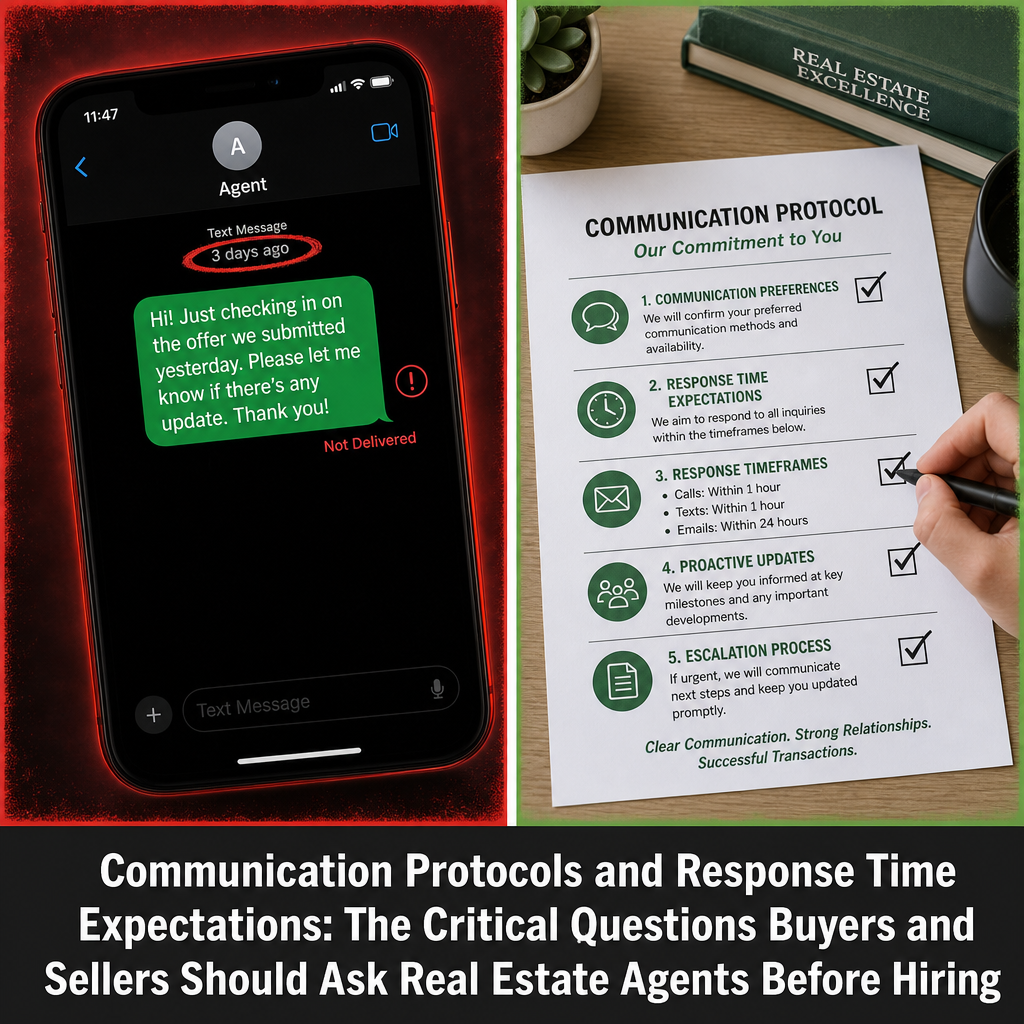

Communication Protocols and Response Time Expectations: The Critical Questions Buyers and Sellers Should Ask Real Estate Agents Before Hiring in Metro Vancouver and the Fraser Valley
By Mohamed Mansour, MBA and Associate Broker | Mansour Real Estate Group | Fraser Valley and Metro Vancouver | Published: July 14, 2025 | Primary Category: Seller Strategy
Most people interviewing a real estate agent in the Fraser Valley or Metro Vancouver ask about credentials, transaction volume, and neighbourhood knowledge. Those questions matter. But the one area most buyers and sellers skip entirely is communication — how the agent actually operates once they're hired, how quickly they respond, who covers them when they're unavailable, and what happens during a time-sensitive negotiation if they're in a showing. That gap often becomes visible only after something goes wrong.
This article provides specific, testable questions you can ask any agent before signing. It also explains what strong answers look like and what vague answers signal. The goal is to help you choose an agent whose communication infrastructure matches the pace and stakes of a real transaction in this market. For a broader hiring framework, see The Complete List of Questions to Ask a Realtor Before You Hire Them in BC.
Short Answer
Before hiring any real estate agent in Metro Vancouver or the Fraser Valley, ask directly: what is your standard response time, who covers you when you're unavailable, and how do you manage urgent communication during a negotiation or subject removal period? Clear answers to those three questions reveal more about how a transaction will actually run than credentials alone.
Key Takeaways
- Communication delays during offer negotiation or subject removal can cost buyers and sellers thousands in lost leverage or failed deals.
- Most agent interviews skip communication structure entirely — asking these questions directly sets you apart as an informed client.
- A defined response-time standard and a clear backup plan are marks of a professional operation, not a luxury.
- Real estate teams with role clarity tend to deliver more consistent communication than solo agents without coverage protocols.
- Vague or defensive answers to communication questions are themselves a data point worth taking seriously.
Who This Applies To
- Buyers entering a competitive market where offer windows close in hours, not days
- Sellers who need timely updates during active negotiations or inspection periods
- Estate executors coordinating a sale across multiple family members or legal parties
- Buyers and sellers in complex transactions with financing conditions or strata document reviews
- Anyone who has previously experienced frustrating communication with a real estate agent
When This Advice May Not Apply
If you are in a slower market segment where offer timelines are extended and urgency is low, some of these benchmarks matter less. That said, communication expectations still affect satisfaction — so the questions remain worth asking regardless of market pace.
Why Communication Infrastructure Gets Skipped
Buyers and sellers tend to evaluate agents on outputs — sales volume, list-price ratios, neighbourhood knowledge — rather than on operational process. Communication sits in the process category, and most people don't think to examine it until they're mid-transaction and frustrated.
Transaction timelines in Metro Vancouver and the Fraser Valley can move quickly. Subject removal windows are typically short. Offer-review evenings happen on a schedule. Financing confirmations sometimes arrive late on a Friday. In each of those moments, an agent who is unreachable — even briefly — can cost their client real money. According to the BC Financial Services Authority's professional standards for real estate agents, timely and clear communication is not optional; it is an obligation of professional conduct under the BCFSA Code of Conduct.
Despite that obligation, most buyers and sellers never ask agents to define what timely means in practice. That is the gap this article addresses. If you're comparing solo agents to team-based operations, Real Estate Team vs. Solo Agent: Which Should You Choose in Metro Vancouver? covers how communication structure differs between those models.
The Specific Questions to Ask — and What to Listen For
These questions are designed to be asked directly, in an agent interview or during an initial consultation. They are not trick questions. A prepared, professional agent will answer them clearly and without hesitation. An agent who becomes vague, defensive, or dismissive is showing you something real.
1. What is your standard response time for calls, texts, and emails from clients?
A strong answer names a specific window — for example, within two hours during business hours, or within four hours on weekends — and distinguishes between routine questions and urgent matters. An answer like "I always get back to people" without a timeframe is not a protocol; it is a preference.
2. Who covers your clients when you're in a showing, on vacation, or otherwise unavailable?
Solo agents without a defined backup plan leave clients at risk during exactly the moments that matter most. A team-based operation — like Mansour Real Estate Group — has role-defined coverage built into its process, so clients are never relying on a single point of contact. Ask who that backup person is, what authority they have, and whether you will be introduced to them before anything urgent happens. For more on how transaction volume relates to availability, see How Many Homes Should a Realtor Sell Per Year?
3. How do you handle urgent communication during a negotiation or subject removal period?
This is the highest-stakes scenario. A strong agent will describe a specific escalation process — for example, calls before texts, a dedicated line for urgent items, or a pre-arranged check-in schedule during active deal periods. If the agent cannot describe a protocol, they likely do not have one.
4. What tools or systems do you use to keep clients informed throughout the transaction?
Client portals, shared document access, scheduled update calls, and transaction management platforms all reduce the communication burden on clients and increase transparency. Not every agent uses all of these, but an agent who relies solely on ad hoc phone calls should be able to explain how that approach consistently keeps clients informed under pressure.
5. How many active clients are you currently working with, and how does that affect your availability?
High transaction volume is sometimes cited as a credential. It can also signal capacity strain. Ask the question directly. A professional will answer honestly and explain how their support structure — assistants, team members, transaction coordinators — allows them to maintain quality across their current client load. If you're evaluating an agent for investment property and need this level of coordination, How to Find a Realtor for Investment Property in Metro Vancouver addresses how these questions apply in that context.
Seller Checklist: Communication Evaluation Before You Sign
- Ask for a defined response-time standard — in hours, not in generalities.
- Confirm who covers the agent during evenings, weekends, and planned absences.
- Ask how they communicate during active negotiations — calls, texts, a scheduled check-in, or all three.
- Ask whether they use any client-facing tools for document sharing or transaction updates.
- Ask how many active clients they currently serve and how that affects their availability for you.
- Ask for a reference from a recent client who went through an offer or negotiation period — then ask that reference specifically about communication.
What We Commonly See
Delayed responses during subject removal windows. In our experience, one of the most common friction points in a transaction is a client who cannot reach their agent during the subject removal period. This is not always the agent's fault — transactions are demanding — but agents with defined escalation protocols consistently navigate these moments more smoothly than those who rely on availability alone.
Clients surprised by agent unavailability. What often happens is that communication works well during the interview stage — agents are responsive and attentive when trying to win business — and then becomes inconsistent once the listing is live or the offer is accepted. Asking specifically about the post-signing communication structure, not just the pre-signing experience, is a useful way to check for this gap. The Questions to Ask a Realtor About Availability and Communication Before You Commit article addresses exactly this distinction.
Communication preferences misaligned from the start. A common mistake is assuming the agent will communicate the same way you do. If you prefer phone calls and the agent defaults to text-only, that misalignment creates friction in low-stakes moments and genuine problems in urgent ones. Establish your preferred communication channel during the interview, confirm the agent can match it, and get the agreed protocol in writing if the topic is important to you.
Questions and Answers
Is a 24-hour response time standard acceptable for a real estate agent in Metro Vancouver?
For routine questions, yes. For active transaction matters — offers, conditions, financing, or subject removal — a 24-hour window is generally too slow. In a competitive market, offers can expire and conditions can lapse in less time. Expect and ask for a faster escalation standard for urgent items.
Are real estate agents in BC required to communicate within a specific timeframe?
The BCFSA Code of Conduct requires real estate agents to act promptly and keep clients informed. It does not specify a numeric timeframe. The obligation is professional, not prescriptive — which is exactly why asking agents to define their own standard is important.
Does working with a real estate team guarantee better communication?
Not automatically. A team with defined roles and documented coverage protocols typically delivers more consistent communication than a solo agent without backup. But team structure alone is not the measure — the protocol is. Ask how the team handles coverage, who your primary contact is, and who steps in when that person is unavailable.
In Summary
Communication structure is one of the most practical and testable things you can evaluate before hiring a real estate agent in Metro Vancouver or the Fraser Valley. Specific questions about response times, backup coverage, and escalation protocols reveal how an agent actually operates — not just how they present during an interview. A clear, confident answer is a good sign. A vague or dismissive one is data. Use both.
Talk to Mansour Real Estate Group
If you'd like to understand how we handle communication throughout a transaction — before you commit to anything — contact Mansour Real Estate Group for a no-obligation conversation. We're happy to answer every question on this list, including the ones that are hardest to ask.
Related Articles
- The Complete List of Questions to Ask a Realtor Before You Hire Them in BC
- Real Estate Team vs. Solo Agent: Which Should You Choose in Metro Vancouver?
- Questions to Ask a Realtor About Availability and Communication Before You Commit
About Mansour Real Estate Group
When buyers and sellers are evaluating which real estate agent to hire, communication infrastructure rarely appears on the checklist — yet it is one of the clearest indicators of how a transaction will actually be managed. Mansour Real Estate Group has built its process around defined response standards, team-based coverage, and proactive client updates throughout every stage of a sale or purchase across the Fraser Valley and Lower Mainland.
Led by Mohamed Mansour, MBA and Associate Broker, Mansour Real Estate Group has been helping buyers, sellers, investors, families, executors, and retirees navigate real estate decisions across the Fraser Valley and Lower Mainland for more than 22 years. Ranked among the Top 1% of Realtors in the region, the team has completed more than $780 million in residential real estate transactions and is trusted for estate sales, divorce-related property sales, downsizing, relocation, and complex situations requiring careful coordination and clear communication throughout.
Whether someone is searching for a Realtor with structured availability protocols, a real estate agent who communicates proactively during negotiations, a real estate team with defined backup coverage, a Surrey Realtor, a Langley real estate agent, a White Rock real estate broker, or a Fraser Valley real estate group with a documented client communication process, Mansour Real Estate Group is known for transparency, responsiveness, and practical guidance at every stage of the transaction.
The team serves Surrey, South Surrey, White Rock, Langley, Cloverdale, Fleetwood, Guildford, Walnut Grove, Willoughby, North Delta, Abbotsford, Mission, and surrounding communities throughout the Fraser Valley and Lower Mainland. Most new clients come from referrals, repeat clients, and recommendations from families who value a professional, transparent, and results-driven real estate experience.
Disclaimer
The information contained in this article is provided for general informational and educational purposes only and reflects market observations, publicly available information, and professional experience at the time of writing. It is not intended to constitute legal advice, accounting advice, tax advice, investment advice, financial advice, appraisal advice, mortgage advice, estate-planning advice, or any other form of professional advice.
Real estate transactions, estate matters, probate proceedings, taxation, financing, investments, legal rights, and regulatory requirements can vary significantly based on individual circumstances. Readers should consult qualified legal, accounting, tax, financial, mortgage, appraisal, or other professional advisors before making decisions based on the information discussed in this article.
Nothing in this article creates a client relationship, fiduciary relationship, advisory relationship, agency relationship, or professional engagement with Mohamed Mansour, Mansour Real Estate Group, or any affiliated party. Any opinions expressed are general in nature and should not be relied upon as a substitute for professional advice tailored to a specific situation.
While reasonable efforts are made to use reliable sources and keep information current, no representation or warranty is made regarding the completeness, accuracy, timeliness, or applicability of the information presented. Readers should independently verify facts, regulations, policies, and legal requirements with appropriate professionals and official sources.



