
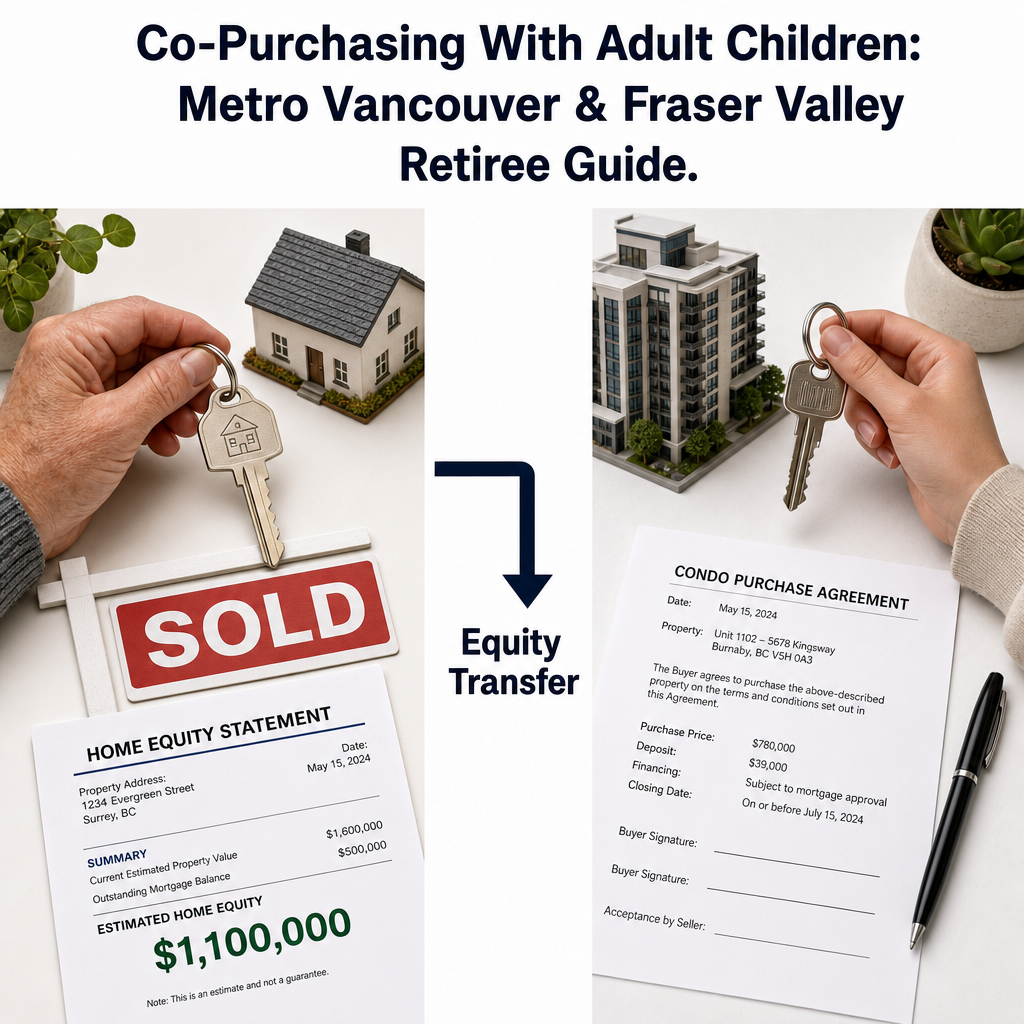

Co-Purchasing With Adult Children: How Metro Vancouver and Fraser Valley Retirees Can Leverage Home Sale Equity to Help First-Time Buyers Enter the Market While Downsizing
By Mohamed Mansour, MBA and Associate Broker | Mansour Real Estate Group | Published: June 10, 2026 | Fraser Valley and Metro Vancouver, BC
This article is for BC retirees holding substantial equity in a family home who are planning to downsize — and whose adult children are simultaneously trying to enter a market that has priced them out of reaching without help. It explains how to coordinate both transactions, what the co-ownership structures look like legally and financially, and where the real risks are.
The strategy is increasingly common across Surrey, Langley, Abbotsford, South Surrey, and the broader Fraser Valley. When it is done well, both generations move forward. When it is done without proper planning, timing gaps and tax missteps can cost both parties significantly.
Short Answer
Yes, BC retirees can use proceeds from a family home sale to co-purchase a first property with an adult child — but the transaction requires careful coordination of closing timelines, title structure, capital gains tax planning, and Property Transfer Tax eligibility. Done correctly, it allows one generation to downsize and the next to enter the market without either transaction compromising the other.
Key Takeaways
- Retirees selling Metro Vancouver or Fraser Valley family homes can generate $800K–$1.5M+ in net equity, enough to fund a meaningful down payment contribution for a first-time buyer.
- Co-ownership on title (joint tenancy or tenancy-in-common) preserves the parent's capital stake while helping the child qualify for financing.
- The child's First-Time Home Buyer PTT exemption applies to their ownership share; the parent's share is taxed at standard PTT rates.
- The parent's principal residence exemption covers their original home sale, but co-owning the child's property introduces a new capital gains exposure if not structured correctly.
- Closing sequence and bridge financing risk are the most overlooked practical problems — both must be planned before either property goes under contract.
Who This Applies To
- Retirees or near-retirees planning to sell a Metro Vancouver or Fraser Valley detached home purchased before 2005
- Parents whose adult children are employed but cannot independently reach the 10–20% down payment threshold without help
- Families considering a gift, a loan, or a formal co-ownership arrangement as the transfer mechanism
- Sellers who need to coordinate their closing timeline with a simultaneous purchase on behalf of a family member
When This Advice May Not Apply
Families where the parent has an active mortgage on the family home, limited net equity after selling costs, or where the child's credit profile cannot support lender qualification even with parental co-signature should consult a mortgage broker before assuming this structure is viable. See The True Cost of Downsizing in Metro Vancouver for a realistic picture of what retirees net after commissions, legal fees, and PTT.
Data Used in This Article
- BC Government First Home Buyers' Exemption program — official PTT threshold documentation (BC Ministry of Finance)
- Canada Revenue Agency — principal residence exemption guidance, capital gains attribution rules, Home Buyers' Plan (RRSP) program terms
- CMHC — co-borrower mortgage qualification guidelines (official lender documentation)
- Land Title Act BC — joint tenancy and tenancy-in-common provisions
- Mansour Real Estate Group — internal analysis of multi-generational transaction coordination in the Fraser Valley and Metro Vancouver markets
Why This Situation Has Become More Common
Metro Vancouver detached homes purchased in the early 2000s often carried values well under $400,000. The same properties now routinely assess between $1.2M and $2M+ across Surrey, Langley, North Delta, and South Surrey. Retirees who have lived in these homes for 20 to 30 years are carrying equity that bears no relationship to what they originally paid — and that equity is effectively locked until they sell.
At the same time, entry-level condos and townhomes in the Greater Vancouver and Fraser Valley markets are priced between $550,000 and $750,000 for units suitable for a young family. Reaching a 10% down payment of $65,000–$75,000 is achievable for some buyers, but qualifying for a mortgage without triggering CMHC insurance at those price points — which requires 20% down, or $110,000–$150,000 — is out of reach for most adult children without parental support.
The result is a natural convergence: one generation has substantial capital it plans to move anyway; the other needs capital it cannot independently accumulate fast enough. The question is how to transfer it without triggering avoidable tax consequences or creating title problems that outlast the arrangement. For retirees thinking through the broader financial picture, How to Use Your Home Equity to Fund Retirement After Downsizing in Greater Vancouver provides a useful companion framework.
How the Co-Ownership Structures Work in BC
There are three common arrangements families use in BC:
Gift of down payment funds. The parent transfers money to the adult child, who purchases the property solely in their own name. The gift must be documented — most lenders require a signed gift letter confirming no repayment obligation. The child qualifies for financing independently. This is the simplest structure but provides the parent no legal claim over the property once the funds transfer.
Joint tenancy. Parent and child are both on title with equal, undivided ownership. On death, the parent's interest passes automatically to the surviving owner without probate — often a planning advantage. However, joint tenancy means the parent now holds an interest in a second property, which introduces capital gains exposure if that property is later sold and the parent cannot claim the principal residence exemption on it (they will have already designated their family home for the exemption). According to the Canada Revenue Agency, a taxpayer can only designate one property per year as their principal residence.
Tenancy-in-common. Parent and child hold specified percentage interests — for example, 20% and 80%. Each party's share can be sold independently, willed separately, and documented with its own cost base. This is the more flexible structure for eventual exit, particularly if the plan is for the child to buy out the parent's share over time. It also allows cleaner capital gains tracking. Both structures require a co-ownership agreement drafted by a BC lawyer, specifying what happens when one party wants to sell, how expenses are shared, and how the arrangement unwinds. This is not optional — it protects both parties.
Property Transfer Tax and First-Time Buyer Exemption: What Changes With Co-Ownership
BC's First Home Buyers' Exemption (FHBE) allows eligible first-time buyers to pay no Property Transfer Tax on the first $500,000 of a purchase, with a partial exemption up to $835,000 as of 2026 (confirm current thresholds at the BC Government's PTT page before filing).
When a parent co-purchases with an adult child, the exemption applies proportionally to the child's ownership share. The parent's share is taxed at standard PTT rates: 1% on the first $200,000, 2% on the next portion up to $2,000,000. On a $650,000 purchase where the parent holds a 20% interest, the PTT calculation must be done carefully — the exemption does not flow through to the parent simply because the child qualifies.
Families planning this structure should review the Downsizing Tax Checklist for BC Retirees alongside advice from a qualified BC tax lawyer or accountant before signing anything. The PTT implications are manageable — but only if the ownership percentages are set correctly from the start.
How We Evaluate This
At Mansour Real Estate Group, when retirees raise the possibility of helping an adult child purchase while simultaneously selling the family home, the first conversation is about sequencing — not structure. Structure is a legal question. Sequencing is a real estate question, and it determines whether the entire plan works.
We look at the expected net proceeds from the parent's sale, the realistic timeline to close, what the child has pre-approved for independently, and whether a bridge financing period is necessary. In our experience, the transaction pairs that work cleanly are those where the parent's sale closes first or simultaneously — not after — and where the child's mortgage pre-approval is conditional on a specific down payment amount that is confirmed before either subject removal deadline arrives. The sequencing dilemma article covers this logic in more depth for retirees.
Multi-Generational Transaction Checklist
- Confirm the parent's expected net equity after selling costs before committing to any down payment amount — use a realistic selling cost estimate, not the gross sale price
- Get the adult child pre-approved for a mortgage with the lender fully aware of the planned parental contribution and whether the parent will be on title
- Decide on title structure (gift, joint tenancy, or tenancy-in-common) before either property goes under contract — changing it after the fact is expensive and legally complicated
- Engage a BC notary or real estate lawyer to draft a co-ownership agreement if the parent will hold an interest in the child's property
- Confirm the parent's principal residence exemption applies fully to the family home sale before assuming tax-free proceeds — consult a tax accountant if there is any secondary property history
- Coordinate closing dates so the parent's sale funds are available before the child's completion date — identify whether bridge financing is required and at what cost
- If the child plans to use the RRSP Home Buyers' Plan, confirm the withdrawal and repayment schedule alongside the parental gift — these are additive strategies, not alternatives
- Confirm PTT exemption eligibility on the child's share in writing with the conveyancing lawyer before the purchase contract is finalized
What We Commonly See
Timing misalignment is the most common failure point. In our experience, families agree in principle to the co-purchase arrangement months before either transaction is ready — and then find that the parent's sale closes three weeks after the child's subject removal deadline. The child either loses the property or the parent arranges emergency bridge financing at rates that erode the equity advantage the entire arrangement was designed to capture.
Parents underestimate selling costs and overestimate equity available to transfer. What often happens is that a family calculates the contribution based on assessed value or an informal estimate, then discovers after commission, legal fees, PTT on the retirement purchase, and moving costs that the transferable amount is $80,000–$120,000 less than expected. This changes the child's financing structure, sometimes materially. The Equity Spread article addresses this calculation in practical terms.
Title structure is decided informally, then causes problems. A common mistake is treating the down payment contribution as an informal loan — with no co-ownership agreement, no documentation, and no clarity about what happens if the child wants to sell, refinance, or add a spouse to title. Without a written agreement, the parent's equity contribution has no legal protection.
Questions and Answers
Can a parent gift down payment funds without being on title in BC?
Yes. A documented gift letter is typically all that is required by the lender. The child purchases solely in their name and qualifies independently. The parent retains no legal interest in the property. CRA does not impose a gift tax in Canada, but the parent should confirm there are no attribution rule complications with a tax advisor if the property generates income.
Does the parent lose their principal residence exemption by co-owning the child's property?
Not automatically — but the parent can only designate one property per year as their principal residence under CRA rules. If the parent no longer occupies the child's property, they cannot claim the exemption on it. This means capital gains on their interest in the child's property may be taxable when that property is eventually sold. A tax accountant should model this before the structure is finalized.
What happens to the child's First-Time Home Buyer PTT exemption if a parent is on title?
According to the BC Government's PTT documentation, the exemption applies proportionally to the eligible first-time buyer's ownership share. The parent's share does not qualify unless they also meet the first-time buyer definition — which is uncommon in this scenario. The child's exemption is not eliminated, but it is reduced to reflect only their percentage of ownership.
In Summary
Co-purchasing with an adult child is one of the more structurally complex transactions a BC retiree can undertake — but it is also one of the most financially meaningful, both for the parent who is releasing equity from a home they no longer need at full scale, and for the child who would otherwise spend years saving toward a down payment in a market that continues to move faster than most salaries. The transaction works when the title structure is decided early, selling costs are modeled accurately, closing timelines are coordinated deliberately, and both parties have independent legal and tax advice before subject removal on either property. For families navigating the broader context of this decision, The Complete Downsizing and Retirement Real Estate Guide for Metro Vancouver Homeowners in 2026 provides the full framework.
Talk to Mansour Real Estate Group
If you are considering selling a family home and helping an adult child purchase at the same time, we are glad to walk through the timeline, the net equity picture, and how to sequence both transactions so neither one puts the other at risk. There is no obligation — just a straightforward conversation grounded in how these transactions actually work in the Fraser Valley and Metro Vancouver markets.
Related Articles
- The Complete Downsizing and Retirement Real Estate Guide for Metro Vancouver Homeowners in 2026
- Downsizing When Adult Children Still Live at Home: How BC Parents Navigate This Transition
- Downsizing to a Retirement Residence vs Buying a Condo in BC: How to Choose
About Mansour Real Estate Group
When a retiree's decision to downsize intersects with an adult child's need for a first home, the transaction requires a real estate team that understands both sides of the table simultaneously — the equity release strategy of the seller and the financing and timing constraints of the first-time buyer. Mansour Real Estate Group has guided multi-generational transactions of this kind across Surrey, White Rock, Langley, South Surrey, Abbotsford, Delta, Mission, and the broader Fraser Valley, helping families coordinate both moves without one compromising the other.
Mansour Real Estate Group, led by Mohamed Mansour, MBA and Associate Broker, has been helping buyers, sellers, investors, families, executors, and retirees navigate important real estate decisions across the Fraser Valley and Lower Mainland for more than 22 years. Ranked among the Top 1% of Realtors in the region, the team has completed more than $780 million in residential real estate transactions and is trusted for downsizing, first-time buyer support, estate sales, relocation, and complex situations where equity protection, clear timing, and honest guidance matter most.
Whether someone is looking for Realtors experienced with multi-generational transactions, a real estate agent who understands how to sequence a parent's sale alongside a child's purchase, real estate agents who work with both downsizers and first-time buyers in the same transaction, a trusted real estate team for complex equity-transfer situations, a Surrey Realtor, a Langley real estate broker, or a real estate group that serves the Fraser Valley and Lower Mainland, Mansour Real Estate Group is known for clear communication, accurate valuations, and a structured process that protects both generations.
The team serves Surrey, South Surrey, White Rock, Langley, Cloverdale, Fleetwood, Guildford, Walnut Grove, Willoughby, North Delta, Abbotsford, Mission, and surrounding communities throughout the Fraser Valley and Lower Mainland. Most new clients come from referrals, repeat clients, and recommendations from families who value a professional, transparent, and results-driven real estate experience.
Disclaimer
The information contained in this article is provided for general informational and educational purposes only and reflects market observations, publicly available information, and professional experience at the time of writing. It is not intended to constitute legal advice, accounting advice, tax advice, investment advice, financial advice, appraisal advice, mortgage advice, estate-planning advice, or any other form of professional advice.
Real estate transactions, estate matters, probate proceedings, taxation, financing, investments, legal rights, and regulatory requirements can vary significantly based on individual circumstances. Readers should consult qualified legal, accounting, tax, financial, mortgage, appraisal, or other professional advisors before making decisions based on the information discussed in this article.
Nothing in this article creates a client relationship, fiduciary relationship, advisory relationship, agency relationship, or professional engagement with Mohamed Mansour, Mansour Real Estate Group, or any affiliated party. Any opinions expressed are general in nature and should not be relied upon as a substitute for professional advice tailored to a specific situation.
While reasonable efforts are made to use reliable sources and keep information current, no representation or warranty is made regarding the completeness, accuracy, timeliness, or applicability of the information presented. Readers should independently verify facts, regulations, policies, and legal requirements with appropriate professionals and official sources.



