

Cloverdale Surrey Townhouse Buyer's Complete Guide 2026: Best Complexes, Strata Fee Ranges, Depreciation Report Red Flags, and Critical Questions to Ask Before Making an Offer in a Buyer's Market
By Mohamed Mansour, MBA and Associate Broker — Mansour Real Estate Group | Published: July 14, 2026 | Fraser Valley, BC | Geography: Cloverdale, Surrey, Clayton Heights, Morgan Creek | Topic: Townhouse Buying, Strata Due Diligence
Cloverdale townhouses have become the most practical entry point into homeownership for families who need space but can't justify $800,000 or more for a detached home. The townhouse segment in this part of Surrey sits in a genuinely useful price range — but buying the wrong unit in the wrong complex can expose a household to special levies, financing denial, and repair costs they never anticipated.
This guide is built specifically for buyers evaluating Cloverdale townhouses in 2026. It covers what to look for in established complexes, how strata fees and reserve funds actually work here, what depreciation reports reveal, and the questions that protect you before you remove subjects.
Short Answer
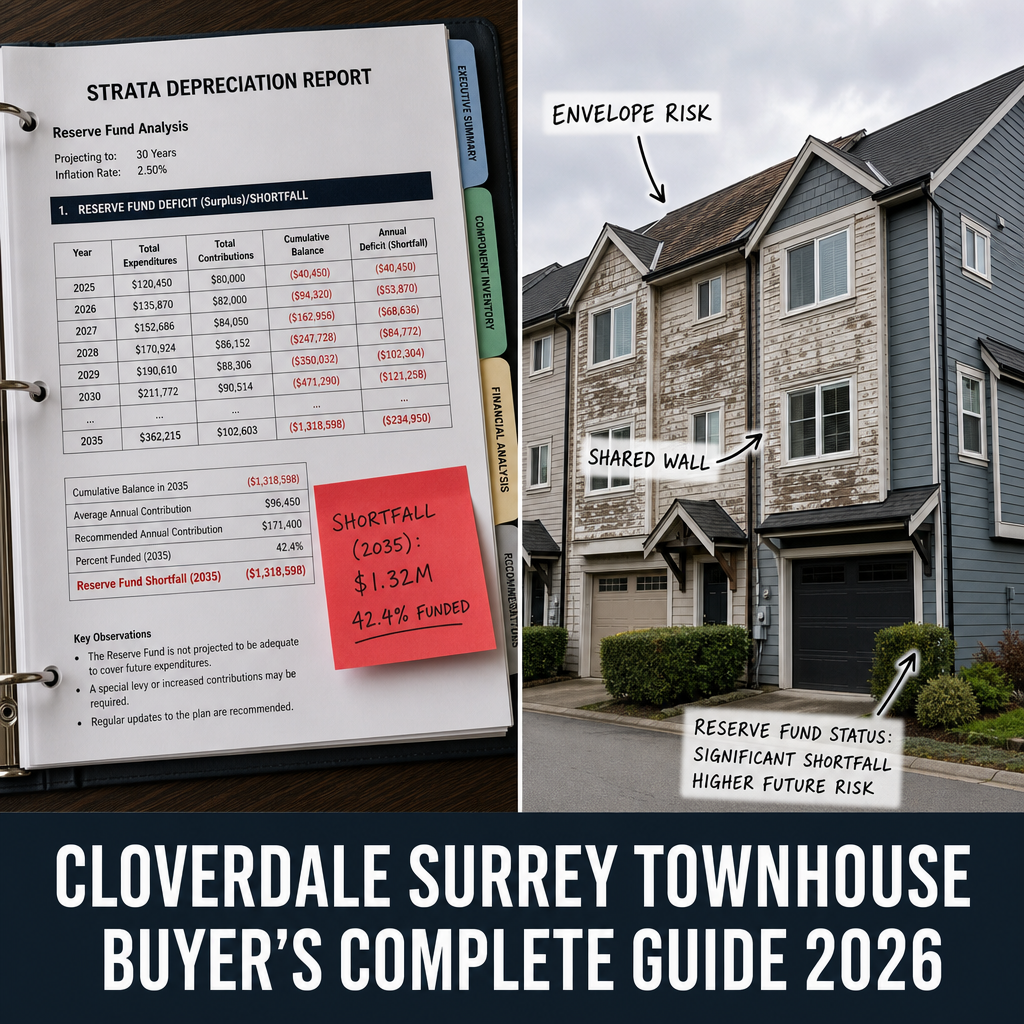
Cloverdale townhouses priced between $550,000 and $700,000 offer genuine value in 2026, but the financial health of the strata corporation matters as much as the unit itself. Reserve fund deficits of 25–40% are common in pre-2010 complexes, and a single depreciation report flagging roofing or building envelope work can delay financing, trigger buyer conditions, or lead to a special levy after purchase. Read the documents first.
Who This Applies To
- First-time buyers with a budget of $550,000–$700,000 looking for more space than a condo offers
- Families prioritizing school catchment stability in Cloverdale while staying below detached pricing
- Buyers who have been priced out of Cloverdale detached homes and are reconsidering townhouse ownership
- Move-up buyers downsizing from detached homes who want lower maintenance without leaving the area
- Investors evaluating long-term hold potential in established Cloverdale strata communities
When This Advice May Not Apply
Buyers purchasing brand-new pre-sale townhouses face a different set of risks — deposit structure, completion timelines, and disclosure statements replace depreciation reports as the primary due diligence focus. This guide concentrates on resale townhouses in established Cloverdale complexes.
Key Takeaways
- Strata fees in Cloverdale townhouses typically run $220–$320/month; anything below $200/month in a pre-2010 complex warrants immediate scrutiny
- Depreciation report deadlines create a seasonal pricing window — listings in June–July carry more uncertainty than those in August–September
- Reserve fund deficits of 25–40% in older complexes are common and can directly cause financing denial or post-purchase special levies
- Building envelope issues — moisture intrusion, cladding aging, shared-wall concerns — are the leading reason for subject-to-inspection conditions on Cloverdale townhouse offers
- In a buyer's market, conditions on offers are standard; waiving inspection or financing conditions on a strata townhouse is a significant risk
Data Used in This Article
- BC MLS sold data, Cloverdale Surrey townhouse complexes, January–April 2026 (third-party MLS data)
- FVREB Market Statistics, April 2026 — sales-to-active ratios by property type (official board data)
- Strata Property Act, SBC 1998, c. 43 — Form B, depreciation report, and reserve fund requirements (Government of BC)
- BC Home Inspector Association structural assessment standards for shared-wall properties (industry body)
- Mansour Real Estate Group internal transaction data and buyer feedback, Cloverdale townhouse sales 2025–2026 (internal professional analysis)
Definitions
Depreciation Report: A mandatory study under BC's Strata Property Act that assesses a strata complex's physical condition and projects future repair and replacement costs over 30 years. Required for most strata corporations with five or more units.
Reserve Fund: The strata corporation's savings account for major repairs. A reserve fund deficit means actual savings fall short of what the depreciation report recommends — increasing special levy risk.
Special Levy: A one-time charge assessed to all unit owners when the reserve fund cannot cover a major repair. Can range from a few thousand dollars to $30,000 or more per unit depending on the scope of work.
Form B (Information Certificate): A document issued by the strata corporation that discloses strata fees, known special levies, parking, locker, bylaws, and insurance. Required before a purchase completes under the Strata Property Act.
Building Envelope: The exterior shell of the building — roof, cladding, windows, flashing, and drainage systems. Envelope failures are the leading cause of moisture damage in BC townhouses, particularly in complexes built between 1990 and 2005.
How We Evaluate This
When Mansour Real Estate Group evaluates a Cloverdale townhouse for a buyer, the strata documents arrive before any negotiation strategy is finalized. The depreciation report, the reserve fund contribution schedule, the Form B, recent meeting minutes, and any engineer letters are reviewed as a set — not individually. A low strata fee only looks attractive until you understand what it doesn't fund.
We also look at the age of the building envelope system relative to its expected service life. A complex built in 2003 with original cladding and no envelope work on record is a different risk profile than one built in 2008 with a completed remediation. Both may be priced similarly on MLS, but the financial exposure to the buyer is not the same.
The Cloverdale Townhouse Market in 2026
Inventory in the Cloverdale townhouse segment has expanded notably through 2025 and into 2026 as builders completed new phases and phased out incentive programs that had previously absorbed demand. According to FVREB April 2026 market statistics, the sales-to-active ratio in the Surrey townhouse category has shifted toward buyer's market territory, giving purchasers more time, more choices, and more negotiating leverage than they had in 2022 or 2023.
Resale townhouses in established Cloverdale communities — including Clayton Heights phases and complexes near the Morgan Creek corridor — are experiencing price compression of roughly 3–5% year-over-year, according to BC MLS sold data for January through April 2026. The compression is not uniform. Units in complexes with recent depreciation reports, healthy reserve funds, and completed envelope work are holding value better than those with unresolved strata issues.
New construction supply in nearby Walnut Grove competes directly with Cloverdale resale for the same buyer pool. When builders offer completion packages with appliances, colour upgrades, and deferred deposit structures, resale sellers in older complexes feel that pressure. It's one reason why condition-free offers have become rarer — buyers have options and are using their subjects as a real evaluation tool rather than just a formality.
For buyers this environment is genuinely favourable — but only if they understand what to look for. Inventory volume alone doesn't protect a buyer who moves forward on a complex with a documented reserve fund shortfall and a roofing replacement coming due within five years. For more context on the broader Cloverdale market, the Cloverdale Real Estate Market Report 2025 covers pricing trends across all property types.
Understanding Strata Fees in Cloverdale Townhouses
Strata fees in Cloverdale townhouse complexes typically run between $220 and $320 per month based on Mansour Real Estate Group's transaction data from 2025–2026. That range reflects buildings of varying age, amenity levels, and reserve fund contribution rates. The number itself is less important than what it funds.
A fee of $250/month in a well-managed 2012 complex with a fully funded reserve and a recent depreciation report is a better financial position than a fee of $210/month in a 2002 complex where contributions have historically underfunded the reserve. The lower monthly number looks attractive in a budget spreadsheet. The exposure shows up later — usually as a special levy notice.
Pre-2008 complexes in Cloverdale and Clayton Heights frequently show reserve fund deficiencies in the 25–40% range when their depreciation reports are examined. This means the strata has saved significantly less than the engineer's model projected as necessary. When a major component — roofing, cladding, membrane, concrete — reaches end of life, the strata corporation must either raise fees sharply, issue a special levy, or defer the work and watch the building deteriorate further. For guidance on how strata fees, bylaws, and reserve funds work together, see the upcoming article on understanding strata living in Cloverdale.
Lenders also evaluate reserve fund health. A mortgage application tied to a unit in a strata with a documented funding shortfall can be declined or appraise below purchase price — not because of the unit itself, but because the lender's appraiser has flagged the strata's financial position as a risk to value. This is a less-discussed reason why financing conditions remain critical on Cloverdale townhouse purchases in 2026.
Depreciation Report Red Flags: What to Look For
Under BC's Strata Property Act, most strata corporations with five or more units are required to obtain a depreciation report prepared by a qualified professional. The report assesses the physical condition of the building's major components and projects their remaining service life and replacement costs over a 30-year period. As of July 1, 2024, strata corporations can no longer opt out of obtaining reports with an annual three-quarters vote waiver — which means the supply of current reports has been increasing, bringing more transparency to buyers.
When reviewing a depreciation report for a Cloverdale townhouse, watch for the following:
- Roof replacement within 0–7 years: A flagged roof on a shared structure is a direct cost that hits every unit owner. Understand whether the reserve fund covers it or whether a special levy is the likely funding mechanism.
- Building envelope at or past projected service life: Cladding systems on 2000–2008 buildings were often underspecified. If the report notes the envelope as "fair" or "marginal" with replacement projected in the near term, get an independent building envelope assessment before subject removal.
- Reserve fund balance versus 30-year projection gap: The report will show three funding scenarios. Look at the fully funded scenario — if the actual reserve balance is significantly below that threshold, the strata is underfunded. A 25–40% shortfall is common in older Cloverdale complexes and should be factored into your offer strategy and post-purchase financial planning.
- Deferred maintenance notes: Any notation that work was recommended in a prior report but not yet completed is a yellow flag. Ask the strata council directly why it was deferred and when it is scheduled.
- Shared-wall and foundation references: Townhouses have shared structural elements that condos don't. A depreciation report that flags cracking, settlement, or moisture in shared-wall assemblies should prompt a specialist structural review, not just a standard home inspection.
The July 1 depreciation report deadline creates a seasonal dynamic worth understanding. Townhouses listed in June or early July — before reports are delivered and distributed — carry more uncertainty than listings that hit the market in August and September when the updated report is already in hand. Buyers who purchase during the June–July window should request written confirmation from the strata manager about the report status and expected delivery date before removing their subject-to-strata-documents condition.
For a detailed look at what to expect from your home inspection before removing subjects, see the upcoming Home Inspection in Cloverdale guide.
Buyer Checklist: Cloverdale Townhouse
- Request the full strata document package before viewing, not after. This includes the depreciation report, Form B, current budget, meeting minutes for the past two years, insurance summary, and any engineer or envelope assessments on file.
- Calculate the true monthly cost. Add strata fees, your mortgage payment, property taxes, and any known fee increases signalled in the meeting minutes. Some complexes have already passed resolutions to raise fees in 2026–2027.
- Check the reserve fund balance against the depreciation report's fully funded benchmark. If the gap is more than 20%, ask your realtor to factor that into offer price and post-purchase cash reserve planning.
- Commission a building envelope assessment if the complex was built between 1990 and 2008 and has no documented envelope work. A standard home inspection will not go deep enough on shared exterior assemblies.
- Confirm the status of any special levies — passed, pending, or anticipated. Form B will disclose levies already approved, but meeting minutes often reveal levies under discussion that have not yet been formally passed.
- Verify school catchment before finalizing your choice of complex. Clayton Heights and Morgan Creek developments sit in different catchment zones for elementary and secondary schools. See the Cloverdale school catchment guide for specific boundary information.
- Include a subject-to-financing condition. Even if your pre-approval is in order, a lender's appraiser may flag the strata's financial position. Removing financing subjects on a strata with a known reserve deficit is a material risk.
- Review the strata bylaws for rental restrictions and pet policies. If you ever need to rent the unit or plan to have pets, confirming these points before subject removal prevents surprises after completion.
What We Commonly See
In our experience working with buyers on Cloverdale townhouses, the most common costly oversight is treating the strata fee as a fixed and stable cost. A fee of $240/month today can become $310/month within 18 months if a strata council passes a budget increase to address a reserve fund shortfall. We have seen buyers budget carefully for the purchase only to face a fee increase and a special levy in the same calendar year — both of which were signalled in the meeting minutes before the purchase, but not read carefully during due diligence.
A second pattern we observe regularly is buyers skipping a building envelope assessment because the unit itself looks clean and well-maintained. Interior cosmetics have nothing to do with exterior envelope performance. A fresh coat of paint and new flooring don't tell you what is happening behind the cladding on a 2004 building that has never had a formal envelope review. Approximately 60–70% of offers on Cloverdale townhouses built before 2010 now include subject-to-inspection conditions precisely because buyers and their agents have learned to treat the envelope as a separate question from the interior condition of the unit.
What often happens is that buyers who skip these steps complete the purchase without issue — and then discover the problem at the first AGM when the strata president presents the reserve fund analysis and announces the fee increase or levy vote. At that point, the options are limited. The time to ask these questions is before the offer, not after completion.
Critical Questions to Ask Before Making an Offer
These questions should be answered before you write an offer, not during the subject removal period. Some can be asked of the listing agent. Others require reviewing the strata documents directly or speaking with the strata manager.
- When was the most recent depreciation report completed, and what is the reserve fund balance as of the last fiscal year-end?
- Has the building envelope ever been formally assessed, and is there documentation of any remediation or repairs to the cladding, roof membrane, windows, or flashing?
- Are there any special levies currently approved, pending a vote, or discussed in meeting minutes from the past 24 months?
- What is the strata's current insurance deductible, and has the deductible increased in the last renewal cycle? A jump in deductible levels often signals a claims history that can affect unit owners directly.
- Are there any rental restrictions, age restrictions, or pet bylaws that could limit how you use the unit or affect resale to future buyers?
For buyers navigating their first purchase in Cloverdale, the first-time buyer's complete guide covers the full process from financing through completion, with specific context for this market.
Questions and Answers
Q: What is a reasonable strata fee for a Cloverdale townhouse in 2026?
Based on Mansour Real Estate Group's transaction data, fees in established Cloverdale complexes typically fall between $220 and $320 per month. A fee below $200/month on a pre-2010 complex should prompt a review of the reserve fund — low fees often reflect underfunding rather than efficient management.
Q: Can a lender deny a mortgage because of a strata's reserve fund deficit?
Yes. Lenders and their appraisers assess strata financial health as part of the property valuation. A strata with a documented reserve fund shortfall — particularly when paired with a pending or anticipated special levy — can result in a financing denial or an appraisal below the purchase price, even if the buyer is otherwise well-qualified. This is why retaining a financing condition matters on Cloverdale townhouse purchases.
Q: What does the July 1 depreciation report deadline actually mean for buyers?
Under amendments to BC's Strata Property Act, strata corporations must have compliant depreciation reports on a regular renewal cycle. The annual July 1 period coincides with report delivery windows for many complexes. Townhouses listed in June–July may not yet have the updated report available, creating uncertainty about current reserve fund projections and upcoming capital needs.
Q: How is a Cloverdale townhouse inspection different from a detached home inspection?
A standard home inspection covers the interior unit and what the inspector can visually access. Shared structures — the roof membrane over multiple units, party walls, foundation elements under common areas — are strata corporation responsibility and may not be fully evaluated in a standard inspection. For pre-2010 townhouses, a separate building envelope assessment by a qualified building science professional is often warranted. The Cloverdale home inspection guide explains when additional assessments are needed.
Q: Is Cloverdale or Clayton Heights a better area for townhouse buyers in 2026?
Both areas have strong townhouse inventory, but the buyer experience differs. Clayton Heights typically offers newer complexes with more recent depreciation reports and lower reserve fund risk. Cloverdale core has more established neighbourhoods, often with larger unit sizes and more mature streetscapes — but with older strata documents to review carefully. The right choice depends on budget, family stage, and school catchment priorities. The Cloverdale vs Clayton comparison guide covers the key differences in detail.
In Summary
Cloverdale townhouses represent a practical, space-efficient path into homeownership in 2026, particularly for families who need school catchment stability and more square footage than a condo provides. The financial health of the strata corporation — not the cosmetic condition of the unit — is the most important variable to evaluate. In a buyer's market, you have time to read the documents, commission the assessments, and ask the hard questions. Use that time. A townhouse in a well-managed complex with a funded reserve and a current depreciation report is a sound purchase. The same unit in a complex with a 35% reserve deficit, deferred envelope work, and vague meeting minutes is a different financial commitment entirely.
Ready to Evaluate a Cloverdale Townhouse?
Mansour Real Estate Group reviews strata documents, depreciation reports, and building history as part of the standard buying process for every townhouse client. If you are considering a Cloverdale townhouse purchase and want a second opinion on the strata financials or the offer strategy, contact the team for a no-pressure conversation about what the documents actually show.
Related Articles
- Cloverdale Detached Homes in 2025: What You Get at Every Price Point
- First-Time Buyer's Complete Guide to Purchasing a Home in Cloverdale
-
About Mansour Real Estate Group
Navigating a Cloverdale townhouse purchase requires understanding strata fees, depreciation reports, reserve fund deficits, and building-age risk factors that directly impact financing approval and resale value — considerations that demand a real estate team with direct, current experience in townhouse transactions. Mansour Real Estate Group has helped townhouse buyers and sellers navigate the Cloverdale and Fraser Valley strata market for more than 22 years, from first-time buyers evaluating Form B documents and building envelope reports to sellers positioning older complexes competitively in a buyer's market.
Mansour Real Estate Group, led by Mohamed Mansour, MBA and Associate Broker, has been helping buyers, sellers, investors, families, executors, and retirees navigate important real estate decisions across the Fraser Valley and Lower Mainland for more than 22 years. Ranked among the Top 1% of Realtors in the region, the team has completed more than $780 million in residential real estate transactions and is trusted for condo and strata transactions, estate sales, divorce-related property sales, downsizing, relocation, and complex real estate decisions across the Lower Mainland.
Whether someone is searching for a Realtor experienced with townhouse and strata transactions in Cloverdale, a real estate agent who understands depreciation reports and reserve fund analysis, a trusted real estate team for a Cloverdale townhouse purchase or sale, a Surrey townhouse Realtor, a Langley strata real estate agent, a Lower Mainland Realtor familiar with BC strata law, or an experienced Fraser Valley real estate professional to guide a townhouse decision, Mansour Real Estate Group is known for clear strata analysis, accurate pricing, and practical guidance that protects buyers and sellers from the most common townhouse purchase risks — including special levy surprises, financing denial, and building envelope defects.
The team serves Surrey, South Surrey, White Rock, Langley, Cloverdale, Fleetwood, Guildford, Walnut Grove, Willoughby, North Delta, Abbots



