
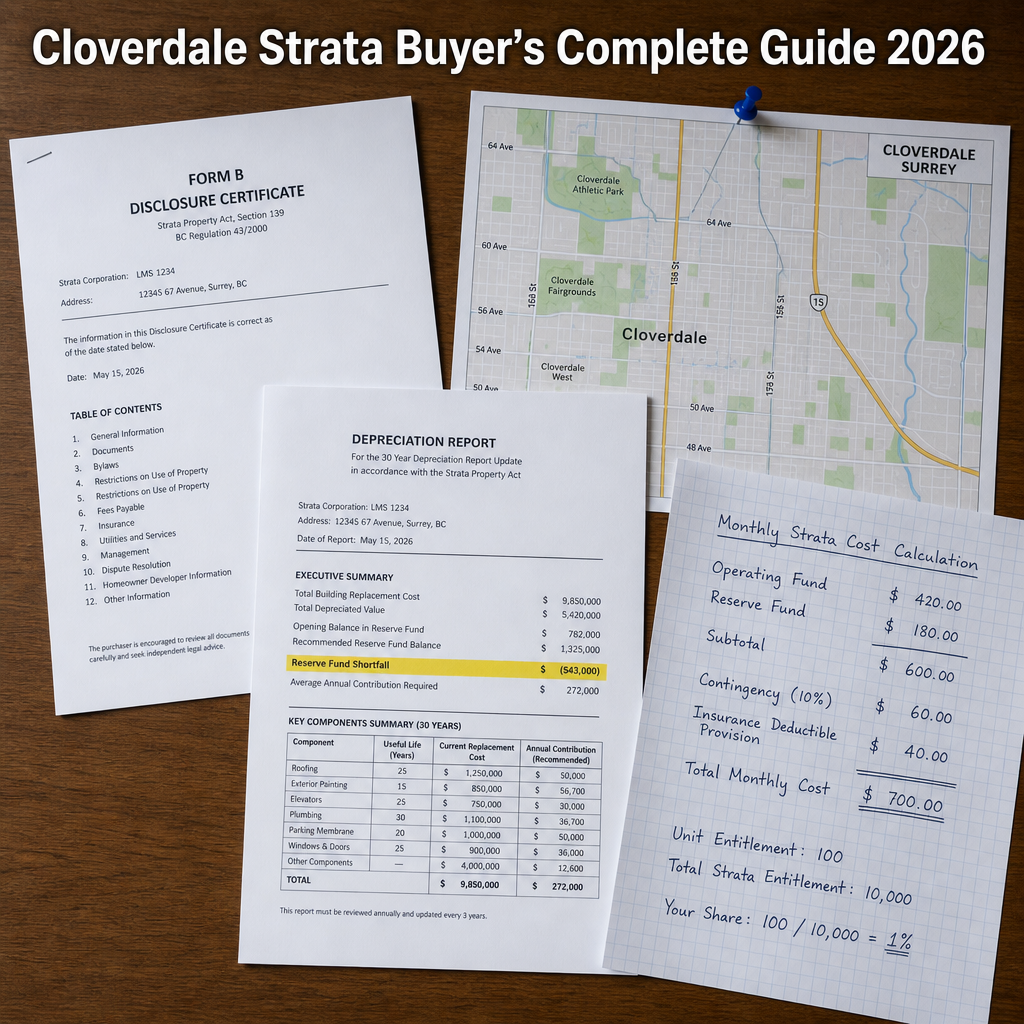

Cloverdale Surrey Strata Buyer's Complete Guide 2026: How to Read Form B Disclosure, Assess Building Age and Condition, Interpret Depreciation Reports, Evaluate Bylaw Restrictions, and Calculate True Carrying Costs Beyond the Purchase Price
By Mohamed Mansour, MBA and Associate Broker | Mansour Real Estate Group | Published: July 15, 2026 | Fraser Valley and Lower Mainland, BC
Buying a strata property in Cloverdale is not the same as buying a detached home. The purchase price is one number. The real financial picture — monthly carrying costs, reserve fund exposure, special levy risk, and bylaw constraints — is another conversation entirely. Strata buyers who focus only on the listing price often miss the details that determine whether a property is a sound purchase or a financial liability in waiting.
This guide is written for buyers considering townhouses or condos in Cloverdale's strata market, including complexes near the future SkyTrain corridor and the established townhouse communities built between 2000 and 2015. It walks through every document and decision point that matters before you remove subjects.
Short Answer
When buying a strata in Cloverdale, Form B disclosure reveals the financial health of the corporation, the depreciation report reveals the building's future cost exposure, and the bylaws determine what you can and cannot do with the property. Together, these documents control your financing approval, your monthly costs, and your resale options. Reading them carefully — before you write an offer — is the most important due diligence step a strata buyer can take.
Key Takeaways
- Form B discloses strata fees, special levies, outstanding litigation, and reserve fund balances — lenders review it before approving financing.
- Depreciation reports project major repair costs over 30 years; a depleted reserve fund signals elevated special levy risk for buyers.
- Many Cloverdale strata complexes restrict rentals and short-term tenancies, which limits buyer flexibility and affects long-term resale value.
- Meeting minutes often reveal disputes, enforcement actions, and deferred repairs that do not appear in Form B headline numbers.
- True monthly carrying costs in a Cloverdale strata include mortgage, strata fees, property tax, insurance, and a realistic reserve levy contribution.
Who This Applies To
- First-time buyers purchasing a townhouse or condo in Cloverdale
- Buyers relocating from Metro Vancouver evaluating strata entry points in Surrey
- Investors considering Cloverdale strata properties as rentals
- Buyers comparing strata and detached options at similar price points
- Buyers purchasing in complexes built between 2000 and 2015 with aging building systems
When This Advice May Not Apply
This guide covers resale strata purchases. Presale purchases and new construction are governed by different disclosure rules under the Real Estate Development Marketing Act. If you are buying a new presale condo or townhouse in Cloverdale, consult a real estate lawyer before signing a disclosure statement. For an overview of new strata developments entering the Cloverdale and Clayton pipeline, see New Condos and Presales Coming to Cloverdale and Clayton in 2025 and 2026.
Data Used in This Article
- BC Strata Property Act, SBC 1998, c. 43 — official provincial legislation governing Form B, depreciation reports, and bylaws (Tier 1 — Government of BC)
- CMHC Homebuying in Canada / Strata Financing Guidance, 2024–2025 — mortgage underwriting considerations for strata properties (Tier 2 — Federal Crown corporation)
- BC Financial Services Authority (BCFSA) — Strata Property resources — Form B and depreciation report requirements (Tier 2 — Regulator)
- Fraser Valley Real Estate Board market data — strata listings and pricing patterns in Cloverdale (Tier 2 — Industry body)
Definitions
Form B Information Certificate: A mandatory disclosure document prepared by the strata corporation, required under Section 59 of the BC Strata Property Act. It discloses monthly strata fees, current and pending special levies, the reserve fund balance, pending litigation, and the most recent depreciation report.
Depreciation Report: A 30-year capital expenditure forecast prepared by a qualified professional, projecting the cost and timing of major repairs to common property — roofs, envelopes, mechanical systems, parkades, and elevators. Required for most BC strata corporations under Section 94 of the Strata Property Act.
Reserve Fund: The strata corporation's savings account, built from monthly contributions, designated for major capital repairs. An underfunded reserve relative to the depreciation report's projected costs is a financing and resale risk.
Special Levy: A one-time charge assessed to all owners when the reserve fund is insufficient to cover an unplanned or scheduled major repair. Special levies are passed by majority vote at a general meeting and are legally enforceable against all owners, including buyers who purchased after the vote.
Strata Bylaws: The rules governing owner and tenant conduct within a strata corporation. Bylaws are registered with the Land Title Office and enforceable under the Strata Property Act. They may restrict rentals, short-term tenancies, pets, renovations, and parking use.
How We Evaluate This
When Mansour Real Estate Group works with a buyer on a Cloverdale strata purchase, we treat Form B, the depreciation report, and the last two years of meeting minutes as the primary due diligence documents — not supporting material. We cross-reference the reserve fund balance against the depreciation report's 10-year projection to identify funding gaps, check for any bylaw amendments in the last 36 months, and flag any litigation, insurance claims, or enforcement actions that suggest financial or structural instability in the corporation.
We also calculate the buyer's true monthly cost before any offer is written. Strata fees, estimated special levy exposure, property tax, mortgage payment, and tenant insurance combine into a number that is frequently 20 to 35 percent higher than the mortgage payment alone. For buyers who are approved based on mortgage qualification alone, that gap can create real affordability pressure within the first 12 months of ownership.
How to Read a Form B Disclosure Certificate in BC
Under Section 59 of the BC Strata Property Act, every buyer of a resale strata unit is entitled to receive a Form B Information Certificate from the strata corporation. The certificate must be prepared within seven days of a written request. Your accepted offer should include a subject condition requiring delivery of Form B along with the strata documents package, giving you time to review them before subject removal. See the Cloverdale home inspection and subject removal guide for how these conditions work together.
The most important sections of Form B are: the current monthly strata fee, any special levies already approved and outstanding, the reserve fund balance as of the most recent fiscal year end, a reference to the current depreciation report, and disclosure of any pending or active litigation involving the strata corporation.
A strata fee that is unusually low compared to comparable buildings in Cloverdale deserves scrutiny. Low fees often reflect deferred reserve fund contributions rather than efficient management. Lenders and insurers increasingly flag strata corporations where the reserve fund balance represents less than 25 percent of the annual operating budget — a threshold that can directly affect mortgage approval. According to CMHC guidance, properties in strata corporations with significant reserve fund deficiencies may not qualify for insured financing, which eliminates most first-time buyers from that building.
If Form B discloses active litigation, request the details before proceeding. Litigation can involve construction defect claims, owner-corporation disputes, or neighbour conflicts. Active construction defect claims sometimes indicate future remediation work — and future special levies — that are not yet reflected in the reserve fund balance.
What Cloverdale's Building Age Means for Depreciation Report Risk
A significant portion of Cloverdale's strata inventory consists of townhouse and low-rise condo complexes constructed between 2000 and 2015. As of 2026, those buildings are between 11 and 26 years old — an age range that places them squarely in the most expensive maintenance window for building systems. Roofs, building envelopes, windows, mechanical systems, and parking membranes all carry service lives that intersect with this age range. When multiple systems are due for replacement simultaneously, the depreciation report's 10-year projected costs can exceed the reserve fund balance by a substantial margin.
A depreciation report should be read in two parts: the current condition assessment and the 30-year funding plan. The funding plan includes three scenarios — fully funded, threshold funded, and a minimum cash flow model. Buyers should focus on the fully funded scenario and compare its required annual contributions against what the strata corporation is actually collecting. A strata that is collecting $200 per unit per month toward reserves when the fully funded scenario requires $280 per unit per month has a structural deficit that will eventually resolve through a special levy, a strata fee increase, or both.
For Cloverdale townhouse complexes built before 2005 — particularly wood-frame structures — envelope integrity, roof condition, and window sealing are the highest-risk line items to verify. If the depreciation report was prepared more than three years ago, request an updated copy or ask the strata council whether a new report is scheduled. Under BC Strata Property Act amendments, strata corporations with five or more units must obtain a depreciation report every five years unless owners vote to waive it at an annual general meeting. A waived depreciation report is itself a red flag worth noting. For context on how strata fee structures affect overall townhouse value in this area, see the Cloverdale Townhouse Buyer's Guide.
Evaluating Strata Bylaws: Rental Restrictions, Pet Policies, and Investment Flexibility
Bylaws are registered with the BC Land Title Office and form a binding contract between the strata corporation and every owner. Before writing an offer on any Cloverdale strata property, the bylaws should be read — not summarized. The listing disclosure may note that rentals are restricted, but the actual restriction type matters significantly for your intended use of the property.
Common rental bylaw structures in Cloverdale strata complexes include: a cap on the total percentage of units that may be rented at any one time, a minimum ownership period before renting is permitted (often 12 months, though some older bylaws specify longer periods), and an outright prohibition on short-term rentals as defined under provincial legislation. If you plan to eventually rent the property and the building has a rental cap already at or near its limit, you may be unable to rent even if rentals are technically permitted. Request the current rental disclosure statement and ask how many units are currently rented.
Pet bylaws vary considerably. Some Cloverdale complexes permit one pet under a weight limit; others ban dogs entirely or limit breeds. If pets are a factor in your purchase decision, confirm the current bylaw and verify that no amendment motion is pending. Bylaw amendments require approval at a general meeting, and a pending amendment disclosed in the meeting minutes could restrict a right you assumed you had.
What Meeting Minutes Reveal That Form B Does Not
Form B provides a snapshot of the strata corporation's financial position at a point in time. Meeting minutes from the last two annual general meetings and any special general meetings provide context that the snapshot cannot. Minutes document bylaw disputes and enforcement actions, maintenance decisions that were deferred or voted down, insurance claim history, legal correspondence discussed at council, and the tone of owner-council relationships. A strata corporation where owners are consistently challenging council decisions, or where the same maintenance items are deferred year after year, signals governance problems that will eventually become financial ones.
If minutes reveal that a major repair was proposed but voted down due to cost, that repair has not disappeared — it has been deferred. A deferred envelope repair or roof replacement in a 20-year-old Cloverdale townhouse complex will resurface as a special levy when the condition becomes urgent enough that the vote can no longer go the other way. Buyers who read meeting minutes before removing subjects avoid being surprised by that conversation three years into ownership.
How to Calculate True Monthly Carrying Costs in a Cloverdale Strata
The mortgage payment is the starting point, not the full picture. A buyer purchasing a Cloverdale townhouse at $700,000 with 10 percent down on a 25-year amortization at current rates will carry a monthly mortgage payment in the range of $3,400 to $3,600, depending on lender and rate type. That number is not the monthly cost of ownership.
Add to the mortgage payment: the monthly strata fee (commonly $350 to $600 for Cloverdale townhouses depending on age and amenities), your prorated share of property tax (typically $200 to $280 per month for this price range), contents and liability insurance ($30 to $60 per month), and a personal contingency for special levy exposure. That contingency is not speculative — it is a financial planning reality for any building where the reserve fund is below its fully funded projection. A reasonable monthly set-aside for a building with a known 15 percent reserve funding gap is $75 to $150 per month, depending on the scale of projected repairs.
The total carrying cost for a $700,000 Cloverdale townhouse can realistically range from $4,100 to $4,700 per month once all strata-specific costs are included. Buyers who qualify for the mortgage but do not account for strata costs often find themselves financially extended within the first year. This is particularly relevant for first-time buyers who have received pre-approval based on their mortgage alone — pre-approval does not account for strata fee obligations or special levy risk. For broader context on how carrying costs compare to detached options in Cloverdale, see the Cloverdale Real Estate Market Report 2025.
SkyTrain Proximity and Its Effect on Strata Value in Cloverdale
The planned SkyTrain extension through Surrey and into Cloverdale has introduced a new category of buyer interest in strata properties near the proposed corridor. Strata units within walking distance of future stations carry a pricing premium that reflects anticipated transit demand — but buyers should evaluate that premium carefully. Buildings with deferred maintenance, underfunded reserves, or restrictive rental bylaws will not benefit from the transit premium to the same degree as well-maintained, financially stable complexes. Transit proximity does not offset building condition risk. It amplifies the difference between a well-run strata corporation and a poorly run one, because buyer competition at well-managed buildings near the corridor will be significantly stronger. For a broader look at how the transit corridor is reshaping Cloverdale's real estate landscape, see The Cloverdale Fairgrounds Redevelopment: What It Means for Local Real Estate.
Strata Buyer Checklist: Cloverdale Due Diligence
- Request Form B — confirm strata fees, reserve fund balance, special levies, and litigation disclosure before writing an offer or as a subject condition.
- Review the depreciation report — compare the reserve fund balance against the 10-year projected capital expenditure requirement in the fully funded scenario.
- Read the bylaws in full — confirm rental rules, pet restrictions, parking allocation, renovation approval requirements, and any pending bylaw amendments.
- Review meeting minutes from the last two AGMs and any SGMs — look for deferred maintenance decisions, bylaw enforcement patterns, and budget disputes.
- Confirm the insurance certificate — verify that the strata corporation carries adequate building insurance and review the deductible amount, which owners are responsible for on a unit claim.
- Request the rental disclosure statement — if rentals are permitted, confirm the current number of rented units against the permitted cap.
- Calculate total monthly carrying costs — include mortgage, strata fee, property tax, personal insurance, and a realistic monthly set-aside for special levy exposure.
- Confirm financing conditions with your lender — ensure your lender has reviewed Form B and the depreciation report before you remove financing subjects.
What We Commonly See
In our experience working with strata buyers in Cloverdale, the most common mistake is treating Form B as a formality rather than a financial due diligence document. Buyers who read only the strata fee and reserve fund balance — without cross-referencing the depreciation report's 10-year projection — often cannot identify a funding gap until after they have removed subjects.
A second pattern we see regularly is buyers who are surprised by rental bylaw restrictions after writing an offer. Many Cloverdale townhouse complexes built before 2010 have rental restriction bylaws that were standard at the time of registration and have never been amended. A buyer who plans to rent the property within two years — or use it as an eventual investment property — needs to read the bylaw before committing, not after.
A third issue that comes up consistently is the strata corporation insurance deductible. Some Cloverdale buildings carry per-claim deductibles of $25,000 to $50,000 for water damage. That deductible is the owner's responsibility for a unit-origin claim. Buyers who don't review the insurance certificate before purchase are often unaware of this exposure until they experience a claim. Asking your insurer to confirm your personal policy covers the strata deductible is a simple step that most buyers skip entirely.
Questions and Answers
Can a lender deny a mortgage based on a depreciation report?
Yes. Lenders and mortgage insurers including CMHC review the strata documents package as part of underwriting. Buildings with reserve funds that are severely depleted relative to the depreciation report's projected costs, or where the depreciation report has been waived repeatedly, may not qualify for insured financing. This effectively eliminates buyers with less than 20 percent down from purchasing in those buildings.
What is a special levy and how much notice do owners receive?
A special levy is a one-time charge assessed to all owners to fund a major repair or capital expenditure when the reserve fund is insufficient. Under the BC Strata Property Act, a special levy requires approval by a three-quarters vote at a general meeting. The amount per unit depends on unit entitlement. Buyers who purchase after a special levy has been approved but before it is collected are responsible for paying it — this is disclosed in Form B.
How do I find out if a Cloverdale strata building has rental restrictions?
The bylaws, which are part of the strata documents package, will specify rental restrictions. The current rental disclosure statement confirms how many units are currently rented and whether the building is at or near its permitted rental cap. Both documents should be requested before or as a condition of your accepted offer.
In Summary
Buying a strata property in Cloverdale requires more than evaluating the unit — it requires evaluating the corporation that owns the building around it. Form B, the depreciation report, the bylaws, and the meeting minutes together tell a story about financial health, governance quality, and future cost exposure that the listing price alone cannot tell. Buyers who read those documents carefully, calculate true monthly carrying costs, and verify bylaw restrictions before removing subjects make decisions they can sustain. Those who don't often find the surprises within the first year of ownership.
Ready to review a strata documents package for a Cloverdale property?
Mansour Real Estate Group can walk through Form B, the depreciation report, and the bylaws with you before any offer is written. Contact us when you're ready for a second set of eyes on the documents that matter most.
Related Articles
- Cloverdale Townhouse Buyer's Guide 2025: Best Complexes, Strata Fees, and What to Watch For
- Home Inspection in Cloverdale: What Buyers Must Know Before Removing Subjects
- The Cloverdale Fairgrounds Redevelopment: What It Means for Local Real Estate
About Mansour Real Estate Group
Buying a strata property in Cloverdale involves a layer of financial and legal complexity that detached home purchases do not — and the team guiding that purchase needs to understand strata documents, reserve fund analysis, and bylaw evaluation as thoroughly as they understand pricing and negotiation. Mansour Real Estate Group has helped strata buyers across Cloverdale, Surrey, Langley, South Surrey, White Rock, and the broader Fraser Valley navigate that complexity for more than two decades, with a process built around document review, accurate cost calculation, and protecting buyers from strata-specific risks that are easy to miss.
Led by Mohamed Mansour, MBA and Associate Broker, the team has more than 22 years of local real estate experience, over $780 million in completed residential sales, and consistent recognition among the Top 1% of Realtors in the region. Mansour Real Estate Group is trusted for strata purchases, estate sales, divorce-related property sales, downsizing, relocation, and any transaction where accuracy and professional judgment determine the outcome.
Whether someone is searching for a Cloverdale real estate agent who understands strata documents, Realtors experienced with townhouse and condo purchases in the Fraser Valley, a real estate team that evaluates depreciation reports and bylaws as part of the buying process, a Surrey real estate broker, or real estate agents who specialize in first-time strata purchases across the Lower Mainland, Mansour Real Estate Group is known for clear analysis, honest advice, and a process that puts the buyer's long-term interests first.
The team serves Surrey, South Surrey, White Rock, Langley, Cloverdale, Fleetwood, Guildford, Walnut Grove,
Disclaimer: This article is for informational purposes only and does not constitute legal, financial, or real estate advice. Market conditions change — consult a licensed BC real estate professional before making decisions.



