

Cloverdale Surrey Real Estate Market 2025: Complete Benchmark Prices, Days-on-Market, Sales-to-Active Ratios, and Year-Over-Year Trends by Property Type
By Mohamed Mansour, MBA and Associate Broker | Mansour Real Estate Group | Published: July 15, 2025 | Geography: Cloverdale, Surrey, BC | Fraser Valley
Cloverdale has been one of Surrey's quieter stories for years — established enough to have deep roots, underpriced enough to attract attention, and now in the middle of a transition that is changing what buyers and sellers expect from the neighbourhood. With SkyTrain extension timelines becoming more certain, land assembly activity growing along the 176 Street corridor, and detached lot economics diverging from strata, the Cloverdale submarket now deserves a dedicated data anchor rather than a footnote in a broader Surrey summary.
This article sets out the 2025 benchmark prices, days-on-market ranges, and sales-to-active ratios for Cloverdale by property type, grounded in Fraser Valley Real Estate Board MLS sold data and BC Assessment figures. It also explains what those numbers mean for buyers and sellers navigating this specific market, and where the emerging price segmentation is coming from.
Short Answer
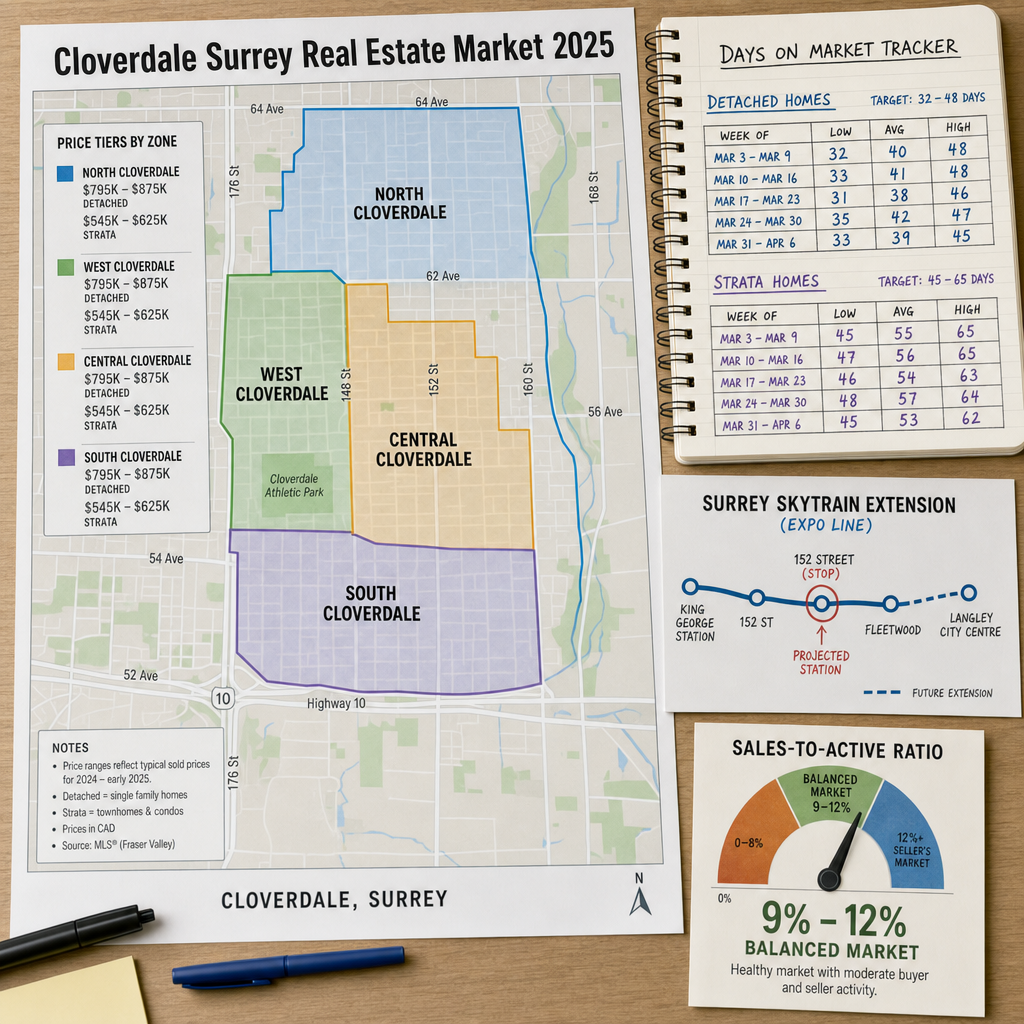
In early 2025, Cloverdale detached homes benchmark between $795,000 and $875,000 — down 6–8% year-over-year — while townhouses and condos cluster around $545,000–$625,000. The sales-to-active ratio sits at 9–12%, indicating a buyer's market, but sales volume is up 4–6% year-over-year, signalling growing buyer confidence. Days-on-market range from 32–48 days for detached homes and 45–65 days for strata properties, depending on condition and price point.
Key Takeaways
- Cloverdale detached benchmarks are $795K–$875K, down 6–8% YoY but gaining sales volume.
- Strata properties (townhouses and condos) benchmark $545K–$625K with slower days-on-market.
- A 9–12% sales-to-active ratio confirms a buyer's market, but the direction is shifting.
- Properties within 800m of the projected 152 Street SkyTrain station zone carry a 5–8% premium.
- Lots over 7,000 sq ft outperform compact detached by 12–18% due to infill redevelopment potential.
Who This Applies To
- Buyers evaluating Cloverdale detached homes, townhouses, or condos in 2025
- Sellers preparing to list in the Cloverdale submarket this year
- Investors assessing land assembly or lot redevelopment potential
- Families comparing Cloverdale to adjacent Surrey neighbourhoods
- First-time buyers trying to understand what their budget realistically reaches in this area
When This Advice May Not Apply
Market conditions in individual property segments can shift faster than published benchmarks reflect. The figures used here draw on FVREB MLS sold data and BC Assessment values from Q1 2025. Specific properties — particularly those with strata document issues, unusual lot configurations, or estate sale conditions — may fall well outside these ranges. Always obtain a current comparative market analysis before listing or making an offer. Nothing in this article constitutes investment, legal, or financial advice.
Key Definitions
Benchmark Price: The price of a typical property in a specific area and property type, as calculated by MLS Home Price Index methodology. Not the same as average or median sale price.
Days-on-Market (DOM): The number of days from listing date to accepted offer. Higher DOM generally reflects softer demand or overpricing.
Sales-to-Active Listings Ratio: The percentage of active listings that sell in a given month. Below 12% is generally considered a buyer's market. Above 20% leans seller's. The range between 12–20% is balanced.
Form B (Information Certificate): A strata document required before sale that discloses fees, bylaws, pending levies, and the status of the building's reserve fund. Critical for condo and townhouse buyers.
Data Used in This Article
- FVREB MLS Sold Data — Q1 2025: Surrey detached, townhouse, and condo segments. Official board data. Fraser Valley geography.
- BC Assessment 2025 Benchmark Values: Cloverdale neighbourhood cluster. Official provincial assessment authority.
- TransLink SkyTrain Planning Documents: Phase 3 extension timeline and projected Cloverdale station accessibility. Official transit authority.
- Surrey Municipal Zoning and Rezoning Applications: 176 Street corridor commercial rezoning and mixed-use planning data. Official municipal source.
- Strata Property Information Certificates (Form B) — 2024–2025: Depreciation report compilation for Cloverdale strata buildings. Professional practice observation.
Cloverdale Detached Home Market: 2025 Benchmarks and Trends
According to FVREB MLS sold data from Q1 2025, Cloverdale detached homes benchmark between $795,000 and $875,000, depending on lot size, condition, and proximity to transit corridors. That represents a 6–8% year-over-year decline from 2024 benchmarks — but the price correction is not telling the complete story. Sales volume in the same period is up 4–6% year-over-year, which means more buyers are transacting at these lower prices, not fewer. That kind of volume increase during a price correction typically signals that buyers see value, not that the market is deteriorating further.
Days-on-market for detached homes in Cloverdale currently range from 32 to 48 days, with the lower end of that range applying to well-priced homes under $830,000 and the upper end reflecting properties priced above $850,000 or requiring updates. That is consistent with broader Surrey detached patterns but modestly slower than Fleetwood and Guildford, where comparable product moves in the 25–38 day range. The gap reflects Cloverdale's larger geographic footprint and the greater variance in property condition across different parts of the neighbourhood.
Lot size has become an increasingly important pricing variable. Lots over 7,000 square feet are outperforming compact detached by 12–18%, driven by infill and redevelopment interest. Surrey's density policies and the emerging mixed-use planning activity along the 176 Street corridor have made larger lots a separate pricing category in Cloverdale, distinct from the detached benchmark. Buyers looking at what each price point delivers in Cloverdale detached homes will find that lot size shapes the conversation as much as square footage.
Cloverdale Strata Market: Townhouses, Condos, and Reserve Fund Risk
Townhouses and condos in Cloverdale benchmark in the $545,000–$625,000 range as of early 2025, based on FVREB MLS data and BC Assessment values. Days-on-market for strata properties runs longer — 45 to 65 days — reflecting both the softer strata demand environment across the Fraser Valley and a specific issue in Cloverdale: reserve fund adequacy varies significantly by building age and condition.
Based on Form B documentation and depreciation reports reviewed across Cloverdale strata buildings in 2024–2025, buildings with fully funded reserve accounts and current depreciation reports are commanding a 10–15% premium over comparable buildings where reserve funding is thin or the depreciation report is overdue. That spread is meaningful. A townhouse benchmarked at $580,000 in a well-managed complex may be $520,000–$530,000 in a building carrying deferred maintenance risk. For buyers evaluating the Cloverdale townhouse market, strata documentation review is not optional — it is where price risk is actually hidden.
Strata complexes near the waterfront-adjacent edges of Cloverdale are carrying an 8–12% premium over inland inventory, though those same properties tend to have older buildings and elevated special levy exposure. The premium is real, but so is the risk. Buyers should request and review the Form B, current depreciation report, and minutes from the last two annual general meetings before drawing conclusions about value.
Sales-to-Active Ratio: What 9–12% Means in Cloverdale Right Now
A sales-to-active ratio between 9% and 12% places Cloverdale firmly in buyer's market territory. In practical terms, that means active listings outnumber completed sales by roughly 8-to-1 or better, giving buyers more selection and more negotiating leverage than they have had in previous years.
What is worth watching is the directional trend. Early 2025 data shows the ratio edging toward the upper end of that range as SkyTrain timeline certainty increases and buyers who were sitting on the sidelines begin to act. The ratio has not crossed into balanced territory yet, but the trajectory — rising sales volume alongside a still-depressed benchmark — is the pattern that typically precedes a market shift. For a longer view on how Cloverdale prices have evolved and what past cycle turns looked like, the Cloverdale home price history over the past decade provides useful context.
SkyTrain Proximity Premium and the 152 Street Station Zone
TransLink's planning documentation for the SkyTrain Phase 3 extension places a projected station in the 152 Street corridor in Cloverdale. Properties within approximately 800 metres of that projected station zone are already trading at a 5–8% premium over comparable inventory located further inland. That premium is not speculative in the traditional sense — it reflects what has happened in every prior SkyTrain corridor in Metro Vancouver and the Fraser Valley when station locations become reasonably certain rather than aspirational.
The practical implication is that Cloverdale's price map is not uniform. Two detached homes with similar specifications can carry a meaningful price gap based entirely on transit proximity. Buyers who understand this can either target the premium zone with confidence or find value in well-located properties that have not yet repriced to reflect the corridor. For a direct comparison of how this dynamic plays out across adjacent areas, the Cloverdale vs Clayton comparison for 2025 examines how each neighbourhood's transit position is shaping buyer decisions.
How We Evaluate This
Mansour Real Estate Group evaluates Cloverdale market conditions by cross-referencing FVREB MLS sold data with BC Assessment benchmarks, layering in days-on-market variance by price band, and tracking the ratio of active listings to completed sales on a rolling basis. For strata properties, we add a documentation layer — reviewing Form B certificates, depreciation reports, and AGM minutes — because reserve fund adequacy and special levy risk affect actual value independent of benchmark pricing.
For detached homes, we track lot size tiers separately from the general benchmark because redevelopment potential has introduced a pricing split that aggregate numbers do not capture. A detached home on a 4,500 sq ft lot and one on an 8,000 sq ft lot may share a neighbourhood but belong to different buyer categories. We price and position them differently as a result.
Buyer Checklist: Evaluating a Cloverdale Property in 2025
- Confirm the property's lot size and check Surrey's density zoning map for infill or redevelopment eligibility.
- For strata, request the Form B Information Certificate, current depreciation report, and last two sets of AGM minutes before making an offer.
- Map the property's distance from the projected 152 Street SkyTrain station zone and factor the transit proximity premium or discount into your offer price.
- Review the neighbourhood's active-to-sold ratio for the specific property type you are targeting — detached and strata ratios differ meaningfully in Cloverdale right now.
- Obtain a current comparative market analysis using only Cloverdale sold comparables, not broader Surrey figures, which can mask submarket variance.
- Confirm whether the property is within a 176 Street corridor rezoning area or subject to land assembly activity — this affects resale timelines and buyer pool.
- For condos or townhouses in buildings over 20 years old, verify that the strata has completed a current depreciation report and that reserve funding meets or exceeds the recommended threshold.
What We Commonly See
Buyers underpricing SkyTrain proximity. In our experience, buyers comparing two similar Cloverdale detached homes will often anchor on the lower price without fully accounting for the transit proximity difference. A home 600 metres from the projected 152 Street station and one 1.5 kilometres away are not the same asset, even if the specs look identical on paper. The 5–8% premium is already being priced into transactions by informed sellers — buyers who dismiss it often lose out to competing offers from buyers who understand it.
Sellers misreading the volume signal. What often happens is that sellers see the 6–8% year-over-year price decline and conclude they should wait. What the data also shows is that sales volume is up 4–6% in the same period. Rising volume during a price correction typically means the market is finding a floor, not falling further. Sellers who wait for prices to recover before listing may be waiting past the point where the buyer pool is most active.
Strata buyers skipping depreciation report review. A common mistake is accepting a strata property based on benchmark comparables without reviewing the building's reserve fund position. A 10–15% pricing gap between well-funded and underfunded buildings exists in Cloverdale right now. That gap is not visible in the MLS listing — it only appears in the documentation. Buyers who skip this step are taking on financial risk they may not discover until a special levy notice arrives after possession.
Questions and Answers
What is the benchmark price for a detached home in Cloverdale in 2025?
Based on FVREB MLS sold data and BC Assessment figures from Q1 2025, Cloverdale detached homes benchmark between $795,000 and $875,000. The range reflects variation by lot size, condition, and transit proximity rather than a single market-wide figure.
Is Cloverdale currently a buyer's market or a seller's market?
Cloverdale is in buyer's market territory in 2025. The sales-to-active ratio sits at 9–12%, which means buyers have more selection and leverage than in a balanced or seller's market. That said, early 2025 data shows the ratio edging upward, particularly in the detached segment.
How long does it take to sell a home in Cloverdale right now?
Detached homes in Cloverdale are currently selling in 32–48 days on average, depending on price point and condition. Strata properties — condos and townhouses — are taking longer, typically 45–65 days, reflecting softer demand in the Fraser Valley strata segment broadly.
Does SkyTrain proximity affect Cloverdale home prices?
Yes. Properties within approximately 800 metres of the projected 152 Street SkyTrain station zone are trading at a 5–8% premium over otherwise comparable Cloverdale inventory, based on transaction analysis. This premium reflects established corridor pricing patterns from prior SkyTrain expansions in the region.
What should I check before buying a condo or townhouse in Cloverdale?
Request and review the Form B Information Certificate, the current depreciation report, and the minutes from the last two annual general meetings. Reserve fund adequacy varies significantly across Cloverdale strata buildings, and a 10–15% price gap exists between well-funded and underfunded complexes. This risk does not appear in the listing — it only appears in the documents.
In Summary
Cloverdale's 2025 real estate market is defined by a price correction that has attracted buyer volume, a strata segment where reserve fund risk creates meaningful price variation, and a detached market split between standard inventory and larger lots with redevelopment potential. The sales-to-active ratio confirms buyers still have leverage, but rising transaction volume and SkyTrain corridor pricing momentum suggest the window is narrowing. Whether you are buying, selling, or evaluating long-term value, the decision in Cloverdale right now requires submarket precision — not broad Surrey averages. Understanding how Cloverdale compares to other Surrey neighbourhoods in 2025 helps place these numbers in proper context, and the legal side of buying or selling in Cloverdale covers the documentation and process steps that protect both sides of the transaction.
Talk to a Cloverdale Real Estate Specialist
If you are trying to understand what a specific property is worth in this market, or want to review current Cloverdale comparables before making a decision, Mansour Real Estate Group offers straightforward, data-grounded guidance with no obligation. Reach us at localhost:9000/ or call directly to discuss your situation.
Related Articles
- Cloverdale vs Clayton: Which Neighbourhood Is Right for You in 2025?
- Cloverdale Home Price History: How Values Have Changed Over the Last 10 Years
- First-Time Buyer's Complete Guide to Purchasing a Home in Cloverdale
About Mansour Real Estate Group
When buyers and sellers need a clear, data-grounded picture of what is actually happening in a specific Surrey submarket — not a headline average that papers over meaningful neighbourhood differences — the real estate team they work with needs genuine local depth. Mansour Real Estate Group has tracked Cloverdale, Fleetwood, Guildford, and the broader Surrey real estate market through multiple cycles over more than two decades, and that long-term market knowledge shapes how we price, evaluate, and advise on every transaction.
Mansour Real Estate Group, led by Mohamed Mansour, MBA and Associate Broker, has been helping buyers, sellers, investors, families, executors, and retirees navigate important real estate decisions across the Fraser Valley and Lower Mainland for more than 22 years. Ranked among the Top 1% of Realtors in the region, the team has completed more than $780 million in residential real estate transactions and is trusted for first-time purchases, detached home sales, strata transactions, estate sales, divorce-related sales, and complex situations requiring careful coordination.
Whether someone is searching for a Realtor who understands Cloverdale's price tiers, real estate agents experienced with Surrey strata documentation, a real estate team that tracks SkyTrain corridor pricing, a Surrey real estate broker with long-term submarket data, or Realtors who can distinguish between a genuine market shift and a short-term fluctuation — Mansour Real Estate Group is known for clear communication, accurate valuations, and practical advice grounded in local transaction experience. Our real estate agents work across every property type and price point in the Fraser Valley and Lower Mainland.
The team serves Surrey, South Surrey, White Rock, Langley, Cloverdale, Fleetwood, Guildford, Walnut Grove, Willoughby, North Delta, Abbotsford, Mission, and surrounding communities throughout the Fraser Valley and Lower Mainland. Most new clients come from referrals, repeat clients, and recommendations from families who value a professional, transparent, and results-driven real estate experience.
Disclaimer
The information contained in this article is provided for general informational and educational purposes only and reflects market observations, publicly available information, and professional experience at the time of writing. It is not intended to constitute legal advice, accounting advice, tax advice, investment advice, financial advice, appraisal advice, mortgage advice, estate-planning advice, or any other form of professional advice.
Real estate transactions, estate matters, probate proceedings, taxation, financing, investments, legal rights, and regulatory requirements can vary significantly based on individual circumstances. Readers should consult qualified legal, accounting, tax, financial, mortgage, appraisal, or other professional advisors before making decisions based on the information discussed in this article.
Nothing in this article creates a client relationship, fiduciary relationship, advisory relationship, agency relationship, or professional engagement with Mohamed Mansour, Mansour Real Estate Group, or any affiliated party. Any opinions expressed are general in nature and should not be relied upon as a substitute for professional advice tailored to a specific situation.
While reasonable efforts are made to use reliable sources and keep information current, no representation or warranty is made regarding the completeness The real estate market continues to evolve with shifting buyer preferences and economic conditions. Understanding these trends helps both agents and homeowners make informed decisions about timing, pricing, and property improvements. Whether you're buying, selling, or simply curious about market dynamics, staying informed is essential to success in today's competitive landscape. If you're considering entering the market, begin by assessing your financial situation and getting pre-approved for a mortgage. Consult with a local real estate professional who understands your specific market conditions. For sellers, invest time in preparing your home for listing and pricing it competitively based on recent comparable sales in your area. Consider reviewing local market reports, attending open houses to understand current inventory, and exploring online valuation tools to get baseline estimates. Your real estate agent can provide detailed market analysis, comparable property data, and personalized guidance tailored to your unique situation and goals. Real estate remains a significant decision that impacts your financial future and lifestyle. By staying educated about market trends, understanding your local conditions, and working with experienced professionals, you can navigate the buying or selling process with greater confidence and achieve your real estate objectives.Key Takeaways
Next Steps for Homeowners
Additional Resources
Conclusion



