

Cloverdale Surrey Home Pricing Psychology 2026: Why Emotional Overpricing Costs You More Than Strategic Underpricing — Complete Framework for Evaluating Your Realtor's CMA and Avoiding the Two Biggest Seller Mistakes
By Mohamed Mansour, MBA and Associate Broker | Mansour Real Estate Group | Surrey and Fraser Valley | Published: July 15, 2026 | Topic: Seller Strategy — Cloverdale, Surrey, BC
This article is for Cloverdale homeowners preparing to list in 2026 — specifically those who are weighing their agent's recommended list price, trying to understand what overpricing actually costs, and wondering how to tell the difference between a market-grounded CMA and one that's anchored too high. The Cloverdale detached market has shifted considerably, and pricing discipline is more consequential now than it was in 2021 or 2022.
The two most common and costly pricing mistakes Cloverdale sellers make in 2026 are rooted in psychology, not math. This article explains both, shows the real financial cost of each, and gives you a practical framework for evaluating any CMA before you sign a listing agreement.
Short Answer
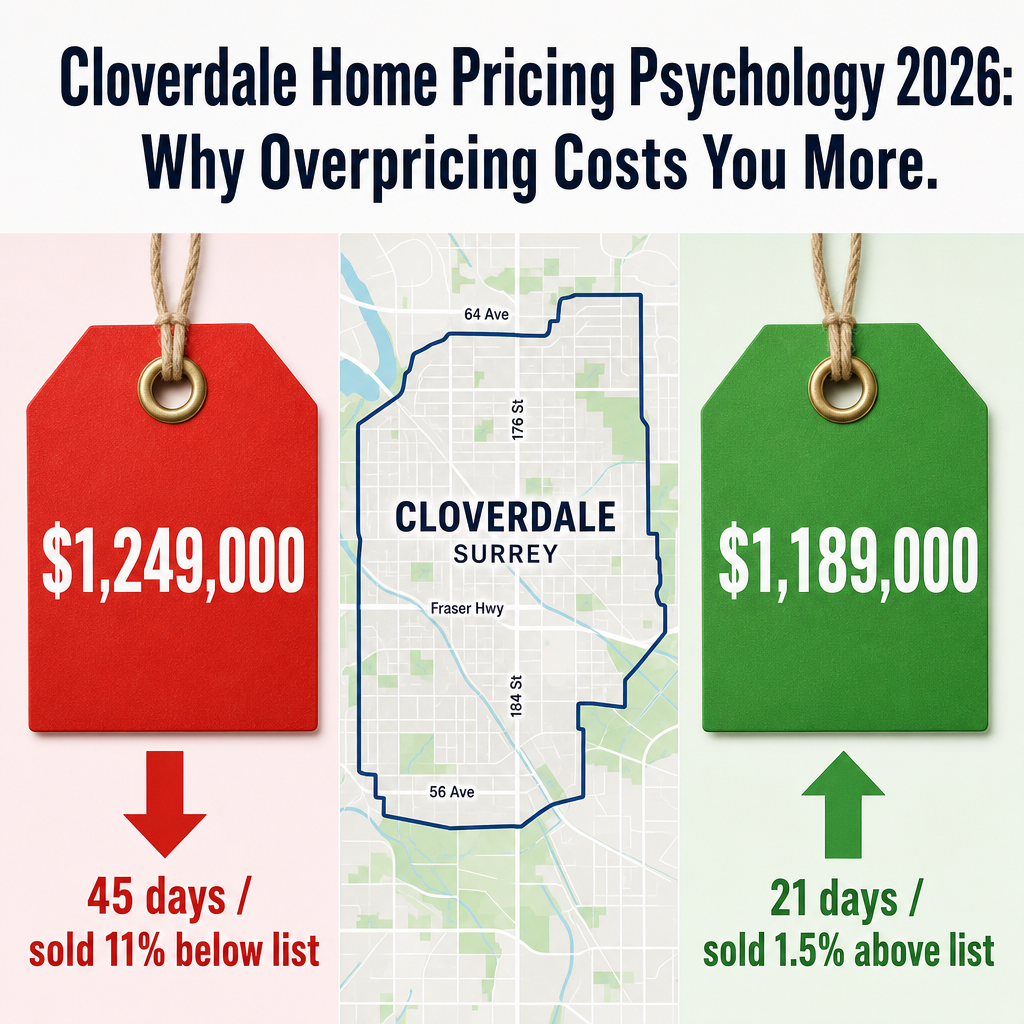
In 2026, Cloverdale detached homes priced 5–8% above recent comparable sales are averaging 38–45 days on market and ultimately selling 3–5% below what a correctly priced home would have achieved. Homes priced 2–3% below market are selling in 18–25 days, often with multiple offers, and closing within 1–2% of list. The data shows that strategic underpricing consistently outperforms emotional overpricing in both speed and net proceeds.
Key Takeaways
- Overpriced Cloverdale listings (5–8% above comps) average 38–45 days on market and net 3–5% less than market-priced equivalents.
- Every 15 extra days on market costs sellers an estimated $3,500–$5,000 in carrying costs alone, before concessions.
- After 30+ days, buyer psychology shifts from competition to skepticism — and that shift is very hard to reverse.
- A reliable CMA must include sold comparables (within 60 days and 2 blocks), active competition, and expired listings showing where pricing failed.
- In spring 2026, Cloverdale detached homes priced within 2–3% of market achieved list-to-sale ratios of 97–98%, versus 90–93% for homes priced 5%+ above comps.
Who This Applies To
- Cloverdale homeowners preparing to list a detached property in 2026
- Sellers who have received a CMA and want to evaluate whether the recommended price is market-grounded
- Sellers who are tempted to price higher to "leave room to negotiate"
- Homeowners who have already been on market 30+ days and are reassessing their strategy
- Sellers interviewing multiple agents and getting different price recommendations
When This Advice May Not Apply
If your property is genuinely unique — a large acreage lot, heritage-designated, extensively custom-renovated with no true comparables — the standard CMA methodology needs adjustment. Similarly, if you have no timeline pressure and can carry the property indefinitely, the carrying-cost calculus changes. This article focuses on standard detached residential sales in Cloverdale where comparable data exists.
Key Terms
CMA (Comparative Market Analysis): A structured analysis of recently sold, currently active, and expired listings used to establish a recommended list price range.
List-to-sale ratio: The final sale price expressed as a percentage of the original list price. A 97% ratio means a home listed at $1,000,000 sold for $970,000.
Days on market (DOM): The number of calendar days between a listing going live on MLS and an accepted offer. In BC, DOM resets if a listing is relisted after expiry.
Carrying costs: Ongoing expenses a seller continues to pay while a property sits unsold — mortgage interest, property tax, utilities, insurance, and any active staging or maintenance costs.
Data Used in This Article
- FVREB MLS data: Cloverdale detached homes sold February–April 2026 (official board data, Cloverdale submarket)
- Mansour Real Estate Group transaction data: Cloverdale listings, 2025–2026 (internal, professional interpretation)
- BC Assessment 2026: Benchmark pricing vs. actual selling prices in Surrey (official government assessment data)
- DOM analysis: RE/MAX, Royal LePage, and Sutton Group Cloverdale offices (third-party industry analysis, used for corroboration)
How We Evaluate This
At Mansour Real Estate Group, we evaluate list price decisions using sold data from the previous 60 days within the same micro-market, not the broader Surrey or Fraser Valley averages. Cloverdale's detached market can behave differently from Fleetwood or other Surrey neighbourhoods at the same moment, so we narrow comparables by property type, lot configuration, age, and finished square footage before establishing a range.
We also build the analysis in two directions: from recent solds (what buyers actually paid) and from current active listings (what sellers are asking and how long they've been sitting). The gap between those two numbers tells us more than either dataset alone. When expired listings are clustered at a particular price band, that's direct evidence of where pricing fails in the current market.
The Real Cost of Overpricing: What the 2026 Cloverdale Data Shows
According to FVREB MLS data for Cloverdale detached homes sold between February and April 2026, properties listed 5–8% above recent comparable sales averaged 38–45 days on market. They ultimately sold at 8–12% below list price, which translates to a net sale price 3–5% below what a correctly priced comparable achieved in the same period.
That gap sounds modest until you apply it to real dollars. On a home with a market value of $1,200,000, a 4% underperformance means $48,000 less in net proceeds. That does not account for carrying costs. At an estimated $3,500–$5,000 per 15 additional days on market — covering mortgage interest, property tax, utilities, and insurance — a 45-day sale versus a 20-day sale adds roughly $5,000–$8,000 in direct expenses on top of the price gap.
There is also a less visible cost: the longer a listing sits, the more aggressive buyers become in their offers. After 30 days on market in Cloverdale's current buyer-advantage environment, the psychology shifts. Buyers who would have competed against others at day one now arrive with leverage. They know the seller has already made two mortgage payments on a home they expected to sell. That leverage shows up in offer prices and in condition demands.
For context on where the Cloverdale market sits right now, the Cloverdale Real Estate Market Report covers the broader inventory and pricing trajectory that makes this discipline especially important in 2026.
Why Strategic Underpricing Outperforms: The 18–25 Day Result
The same FVREB data shows that Cloverdale detached homes priced 2–3% below recent comparable sales sold in 18–25 days and closed within 1–2% of list price. In spring 2026, this pricing band achieved list-to-sale ratios of 97–98%, compared to 90–93% for homes priced 5% or more above comps. Several of these listings generated multiple offers despite entering a market with elevated inventory.
This happens for a structural reason. When a buyer searches a price range on MLS, a slightly under-market listing appears at the top of their value assessment. It attracts more showings in the first week. More showings in the first week creates the impression of competition, even when the market is broadly soft. That impression changes how buyers write offers — less aggressive on conditions, tighter timelines, prices closer to or above list.
The seller who "leaves room to negotiate" by pricing high usually ends up negotiating from a weaker position, over a longer timeline, with buyers who have already concluded there's something wrong with the home. The seller who prices precisely and creates early momentum often negotiates from strength — or doesn't negotiate much at all. Reviewing what it takes to sell your Cloverdale home for top dollar alongside this data provides a complete picture of how pricing interacts with preparation and presentation.
Seller Checklist: Evaluating Your Realtor's CMA Before You List
- Check the sold comparables date range. Any comp older than 60 days in the current Cloverdale market may no longer reflect active buyer behaviour. Ask for the sale date on every comparable used.
- Verify geographic proximity. Comparables should come from within approximately 2 blocks or the same subdivision. Cloverdale and Clayton can price differently even on adjacent streets.
- Ask for active listings at your recommended price. If three similar homes are already sitting at your proposed list price with 40+ days on market, your pricing ceiling is clear. Your CMA should show this competition.
- Ask for expired and withdrawn listings. These are the most informative data points in a shifting market. They show exactly where buyer demand stopped in the last 90 days.
- Compare lot size, finished square footage, and age — not just bedrooms. A 4-bedroom comp on a 7,200 sq ft lot is not comparable to your 4-bedroom on a 4,900 sq ft lot, especially if buyers are valuing lot size for suite potential or future development.
- Ask what list price achieves a 20-day sale vs. a 45-day sale. A realtor who has run this analysis can answer it. One who hasn't is guessing. The answer to this question tells you more about their pricing methodology than anything else.
What We Commonly See
Sellers anchor to a number they need, not a number the market supports. In our experience working with Cloverdale sellers, the most common source of overpricing is not an inaccurate CMA — it's a seller who has a number in their head based on what they paid, what they've spent on renovations, or what they need to fund their next purchase. When that number is higher than the market supports, some agents accommodate it to win the listing. The result is a price reduction 3–4 weeks later and a final sale below what would have been achievable with a disciplined launch price.
Agents sometimes use "aspirational" comparables to justify higher list prices. What often happens is a CMA includes one or two outlier sales — perhaps a home that sold at an unusually high price due to a bidding war, a unique feature, or a particularly motivated buyer — and presents them as evidence for a higher list price. Ask your agent which comparables were excluded and why. The exclusions are often as revealing as the inclusions.
The price reduction conversation costs sellers twice. A common mistake is thinking a price reduction costs nothing except pride. In practice, a reduction after 30+ days on market signals distress to buyers who have been watching the listing. Offers that come in after a reduction in Cloverdale's current market tend to come in below the new, already-reduced price — because buyers know the seller is now motivated. Getting the price right at launch is not just about momentum. It is about preventing the negotiation environment that forms when buyers sense desperation.
Frequently Asked Questions
Q: If I price low and get multiple offers, how do I know I won't leave money on the table?
A: Multiple-offer situations in Cloverdale's current market push prices above list when the property is correctly positioned. FVREB data from spring 2026 shows homes in the strategic pricing band closing at 1–2% above list price in competitive offer situations — a better outcome than overpriced homes achieving 8–12% below list after extended market time.
Q: My neighbour sold for $1,350,000 six months ago. Isn't that a valid comparable?
A: A sale from six months ago reflects market conditions that may no longer exist. In a market where inventory has risen and buyer leverage has increased, using a six-month-old comparable as a pricing anchor often produces an inflated list price relative to what today's buyers will pay.
Q: What should I do if my home has already been on the market for 35 days without an offer?
A: The most important step is an immediate pricing audit using only the last 45 days of comparable data. In our experience, homes that have been on market in Cloverdale for 35+ days without an offer are typically 4–7% above where current buyers are willing to act. A meaningful price adjustment — not a token $10,000 reduction — combined with refreshed photography and renewed marketing can reset buyer perception, but the window narrows further each week.
In Summary
In Cloverdale's 2026 detached market, overpricing is not a conservative strategy — it is the most expensive mistake a seller can make. The data is consistent: homes priced 5–8% above recent comparable sales take twice as long to sell and net 3–5% less than market-priced equivalents, after carrying costs and concessions. Homes priced precisely, or slightly below market, sell faster, attract better-positioned buyers, and close at ratios that reflect actual market demand rather than a negotiation that ground down over six weeks. The CMA framework in this article gives you the tools to evaluate what your realtor is recommending before you commit to a price — and to understand what that decision is likely to cost or return.
If you're preparing to list a Cloverdale home and want a pricing analysis grounded in the last 60 days of local transaction data, Mansour Real Estate Group is available for a no-obligation consultation before you make any decisions.
Related Articles
- Cloverdale Real Estate Market Report 2025: Prices, Trends, and What to Expect
- How to Sell Your Cloverdale Home for Top Dollar in 2025
- Pre-Sale Renovations in Cloverdale: What Adds Value and What Doesn't
About Mansour Real Estate Group
Pricing a home correctly in the Fraser Valley requires more than a comparative market analysis. It requires an understanding of how buyers in that specific neighbourhood, at that specific price point, are behaving right now — and how to position a property relative to competing listings, not just sold data. Mansour Real Estate Group has built its reputation in Cloverdale, Surrey, and across the Lower Mainland on pricing discipline, honest valuations, and a willingness to have difficult conversations before a listing goes live rather than after.
Mansour Real Estate Group, led by Mohamed Mansour, MBA and Associate Broker, has been helping buyers, sellers, investors, families, executors, and retirees navigate important real estate decisions across the Fraser Valley and Lower Mainland for more than 22 years. Ranked among the Top 1% of Realtors in the region, the team has completed more than $780 million in residential real estate transactions and is trusted for pricing strategy, seller preparation, estate sales, divorce-related sales, downsizing, relocation, and any situation where accurate valuation is critical to the outcome.
Whether someone is looking for Realtors experienced with seller pricing strategy, a real estate agent who understands Cloverdale market conditions, real estate agents who specialize in detached home sales, a real estate team focused on protecting seller equity, a Surrey Realtor, a Cloverdale real estate broker, or a real estate group serving the Fraser Valley and Lower Mainland, Mansour Real Estate Group is known for data-driven recommendations, honest market context, and a process that protects sellers from the most costly pricing mistakes.
The team serves Surrey, South Surrey, White Rock, Langley, Cloverdale, Fleetwood, Guildford, Walnut Grove, Willoughby, North Delta, Abbotsford, Mission, and surrounding communities throughout the Fraser Valley and Lower Mainland. Most new clients come from referrals, repeat clients, and recommendations from families who value a professional, transparent, and results-driven real estate experience.
Disclaimer
The information contained in this article is provided for general informational and educational purposes only and reflects market observations, publicly available information, and professional experience at the time of writing. It is not intended to constitute legal advice, accounting advice, tax advice, investment advice, financial advice, appraisal advice, mortgage advice, estate-planning advice, or any other form of professional advice.
Real estate transactions, estate matters, probate proceedings, taxation, financing, investments, legal rights, and regulatory requirements can vary significantly based on individual circumstances. Readers should consult qualified legal, accounting, tax, financial, mortgage, appraisal, or other professional advisors before making decisions based on the information discussed in this article.
Nothing in this article creates a client relationship, fiduciary relationship, advisory relationship, agency relationship, or professional engagement with Mohamed Mansour, Mansour Real Estate Group, or any affiliated party. Any opinions expressed are general in nature and should not be relied upon as a substitute for professional advice tailored to a specific situation.
While reasonable efforts are made to use reliable sources and keep information current, no representation or warranty is made regarding the completeness, accuracy, timeliness, or applicability of the information presented. Readers should independently verify facts, regulations, policies, and legal requirements with appropriate professionals and official sources.



