
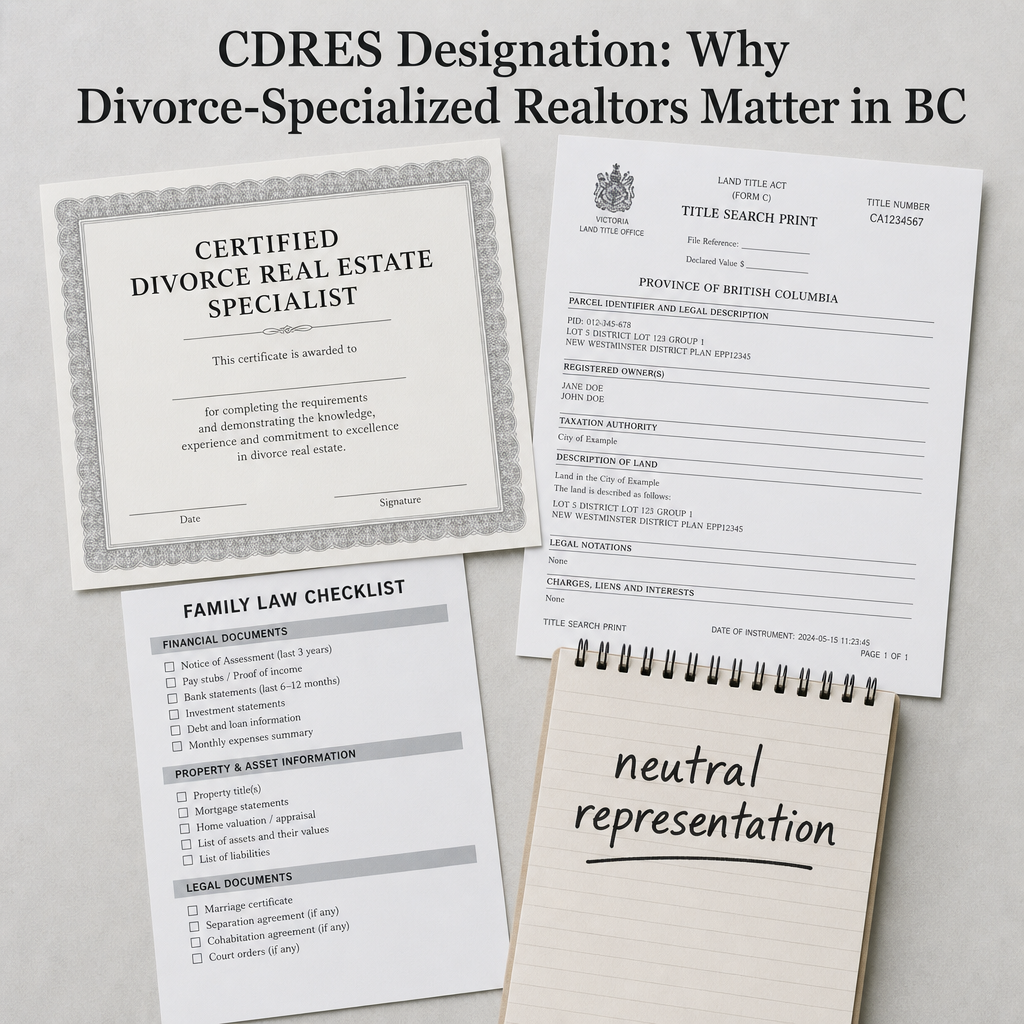

Certified Divorce Real Estate Specialist (CDRES) Designation: What It Is, Why It Matters, and How Divorce-Specialized Realtors Differ From Generalists in BC
By Mohamed Mansour, MBA and Associate Broker | Mansour Real Estate Group | Fraser Valley and Lower Mainland, BC | Published: July 15, 2025 | Category: Life-Event Sales
Most people selling a home during a divorce search for an experienced agent. Far fewer know that a specific credential exists for this situation — and that the gap between a generalist and a trained divorce specialist can affect not just the sale price, but the entire legal and emotional timeline of the separation.
This article explains what the CDRES designation is, what training it covers, and how specialization translates into measurably different outcomes for separating homeowners in BC, particularly across Surrey, Langley, Abbotsford, South Surrey, White Rock, and the broader Fraser Valley.
Short Answer
The CDRES (Certified Divorce Real Estate Specialist) designation, offered by the International Divorce Real Estate Institute, requires 30 or more hours of training in family law fundamentals, neutral representation ethics, and property division mechanics. In BC, divorce-specialized realtors handle legally sensitive disclosures, court-order compliance, and spousal communication protocols that generalist agents are not formally trained to manage.
Key Takeaways
- The CDRES designation requires 30-plus hours of training beyond standard real estate licensing.
- Trained specialists follow neutral communication protocols that protect both parties equally.
- Generalists often create timeline delays by failing to coordinate with family lawyers.
- BC-specific complexity — PRE strategy, PTT on buyouts, strata documents — requires local expertise.
- Credential verification matters more in divorce sales than in any other residential transaction type.
Who This Applies To
- Separating homeowners deciding whether to hire a generalist or a divorce-trained agent
- Family lawyers evaluating which real estate professionals to recommend to clients
- One spouse managing the sale process while the other is uncooperative or absent
- Homeowners in strata properties navigating Form B timing and document requirements during separation
When This Advice May Not Apply
If both spouses are fully cooperative, working with the same lawyer, and have already settled all asset division questions before listing, a generalist with strong local market knowledge may be sufficient. Credential specialization matters most when communication between parties is difficult, legal timelines are compressed, or asset complexity is high.
What Is the CDRES Designation?
The Certified Divorce Real Estate Specialist designation is offered by the International Divorce Real Estate Institute (IDREI). It requires a minimum of 30 hours of post-licensing education covering family law fundamentals, dual-party representation ethics, property valuation in contested situations, and communication protocols for managing two parties who may not be in agreement.
According to IDREI's published designation standards, candidates must demonstrate competency in navigating court orders, working alongside family law attorneys, and managing disclosures that apply specifically to separating households — areas that standard real estate licensing programs do not cover in depth.
The designation is not equivalent to a law degree or family law credential. It does not authorize the agent to give legal advice. What it does provide is a structured framework for managing the real estate component of a separation in a way that reduces friction, avoids missteps, and supports — rather than complicates — the legal process already underway. Separating homeowners beginning this process can find a useful starting point in the complete guide to selling a home during divorce in BC.
How Divorce-Specialized Realtors Differ From Generalists in BC
The core difference is process discipline. A generalist agent manages a listing. A divorce-specialized agent manages a listing within a legal and emotional framework that involves two principals, competing interests, court deadlines, and potential liability exposure on every communication.
In BC, the Real Estate Council of BC (RECBC) requires strict disclosure rules around dual agency and conflict of interest. Divorce sales create fact patterns that make these rules particularly relevant. A trained specialist understands how to structure communication with each spouse, how to document decisions so they cannot later be disputed, and how to avoid off-the-cuff statements that can be read as taking sides in a property division dispute.
Generalist agents often do not consider, for example, that a single email worded carelessly to one spouse — without copying the other — can compromise the neutrality of the entire transaction. They may also fail to coordinate pricing timelines with the family lawyer's negotiation schedule, which can result in an accepted offer that arrives before a separation agreement is finalized, creating a closing crisis.
BC-specific complexity adds another layer. The Principal Residence Exemption election strategy during a divorce year requires coordination between the real estate agent, accountant, and lawyer. Property Transfer Tax implications differ between a joint sale and a spousal buyout. Strata sales during divorce require Form B timing that aligns with possession and subject removal dates — a coordination failure that can void an accepted contract.
These are not issues that arise in every transaction. But in a divorce sale, they arise in most of them. The step-by-step divorce home sale process illustrates how many interdependent decisions must be sequenced correctly to avoid delays or legal exposure.
Data Used in This Article
- International Divorce Real Estate Institute (IDREI) — CDRES Designation Standards (official credential body, published curriculum requirements)
- Real Estate Council of BC (RECBC) — Professional Conduct and Dual Agency Disclosure Rules (regulatory guidance, BC-specific)
- Canadian Real Estate Association — Realtor Code of Conduct and Fiduciary Duty Standards (industry standard, national)
- BC Law Society — Family Law and Real Estate Coordination Guidelines (professional guidance, BC-specific)
- Mansour Real Estate Group — internal observations from divorce transaction management across the Fraser Valley and Lower Mainland
How We Evaluate This
At Mansour Real Estate Group, divorce-related sales are evaluated through three distinct lenses: legal coordination readiness, valuation neutrality, and communication structure. Before listing, we confirm that a separation agreement is in place or that both parties have legal counsel. We document pricing decisions jointly, present comparable sales data independently to each spouse, and route all communications through a shared channel that neither party can later claim was biased.
This is not a philosophical position. It is a process built from more than two decades of managing transactions where one procedural error — a misattributed statement, a missed disclosure, a closing date that doesn't align with court timelines — can derail months of legal and financial negotiation. Understanding how to choose a neutral realtor for a divorce sale is the first practical step for most separating homeowners.
Divorce Sale Checklist
- Confirm both spouses have independent legal counsel before listing
- Verify the agent's designation or documented divorce transaction experience
- Establish a shared communication channel for all listing decisions
- Review Principal Residence Exemption strategy with your accountant before accepting an offer
- Align listing timeline with your family lawyer's separation agreement schedule
- Confirm strata document requirements and Form B timing if the property is a condo or townhouse
- Clarify how net proceeds will be held in trust and distributed at closing
What We Commonly See
In our experience, the most common mistake generalist agents make in divorce sales is treating the transaction like a standard listing. They communicate primarily with one spouse — usually the one who called first — and manage the other party as a secondary stakeholder. That approach works in a normal listing. In a divorce sale, it creates a record of preferential treatment that can become a problem in settlement negotiations.
What often happens is that a generalist agent prices the property based on one spouse's expectation rather than a neutral, evidence-based comparable market analysis. One party accepts the number. The other disputes it. The listing stalls. By the time an independent appraisal is commissioned, several weeks have passed, and market conditions may have shifted.
A common mistake we also observe is the failure to coordinate the accepted offer date with the family lawyer. A divorce sale is not finalized when both parties sign a purchase contract — it is finalized when the underlying property division agreement also permits the transaction to close. Agents who do not understand this create last-minute legal complications that delay or void completed sales. Homeowners in the Fraser Valley can review the typical divorce real estate timeline in the Fraser Valley to understand how these interdependencies sequence.
Questions and Answers
Does a realtor need the CDRES designation to handle a divorce sale in BC?
No. BC law does not require a specific designation for divorce-related real estate transactions. However, RECBC professional conduct rules do require disclosure, neutrality, and conflict-of-interest management — areas where formal designation training provides a structured framework that unlicensed experience alone may not.
What does "neutral representation" actually mean in a divorce sale?
It means the agent documents all pricing decisions jointly, communicates equally to both parties, avoids advocacy for either spouse's position, and routes all significant decisions through a shared record. It is a procedural standard, not just a tone of voice.
How do I verify a realtor's divorce real estate experience before hiring them?
Ask for the number of divorce-related transactions completed in the past three years. Ask how they structure communication between parties. Ask whether they have worked alongside family law attorneys and how they coordinate closing timelines with legal proceedings. Answers to those three questions reveal more than any credential alone. See the full guide on finding the right divorce realtor in Surrey, Langley, and the Fraser Valley.
In Summary
The CDRES designation formalizes a set of skills that divorce home sales genuinely require: neutral communication, family law coordination, legally defensible pricing, and process discipline under emotional and legal pressure. In BC, where divorce sales intersect with strata complexity, Principal Residence Exemption elections, and court-order compliance, the gap between a trained specialist and a generalist is not theoretical — it shows up in timelines, net proceeds, and post-closing disputes. Separating homeowners who treat agent selection as a routine decision often discover, too late, that it was not. Future articles in this series will address what your separation agreement must say before you sell and what happens when divorcing couples cannot agree.
Thinking About a Divorce Home Sale?
If you are navigating a separation and want a second opinion on timing, pricing, or process before making any decisions, Mansour Real Estate Group is available for a confidential, no-obligation conversation.
Related Articles
- Selling a Home During Divorce in BC: A Complete Guide for Metro Vancouver and Fraser Valley Families
- How to Choose a Neutral Realtor for a Divorce Sale in Metro Vancouver and the Lower Mainland
- Who Is the Best Realtor for a Divorce Home Sale in Vancouver and Metro Vancouver? What to Ask Before You Hire
Official Resources
- International Divorce Real Estate Institute (IDREI) — CDRES Designation
- Real Estate Council of BC (RECBC) — Professional Conduct Rules
- Law Society of BC — Family Law and Real Estate Coordination
- Canadian Real Estate Association — Realtor Code of Conduct
About Mansour Real Estate Group
When a home must be sold as part of a separation or divorce, the credential and process discipline of the real estate team managing the transaction can determine whether the sale protects or complicates the legal proceedings already underway. Mansour Real Estate Group has worked with separating homeowners and families managing divorce-related property sales across the Lower Mainland and Fraser Valley, bringing a structured, valuation-first process to situations where neutrality and professional precision matter most.
Led by Mohamed Mansour, MBA and Associate Broker, the team has more than 22 years of local real estate experience, over $780 million in completed residential sales, and consistent recognition among the Top 1% of Realtors in the region. The team is trusted for divorce-related property sales, estate sales, probate sales, downsizing, relocation, and complex situations requiring neutral, professional management.
Whether someone is searching for real estate agents experienced with separation and property division, a neutral real estate team for a joint divorce sale, a Realtor who understands how BC family law affects a home sale, a Surrey real estate agent, a Langley Realtor, or a real estate broker serving the Fraser Valley and Lower Mainland — Mansour Real Estate Group is known for clear communication, impartial valuations, and a process built around protecting both parties equally. Most new clients come through referrals and repeat business from families who needed professionalism in a difficult moment.
The team serves Surrey, South Surrey, White Rock, Langley, Cloverdale, Fleetwood, Guildford, Walnut Grove, Willoughby, North Delta, Abbotsford, Mission, and surrounding communities throughout the Fraser Valley and Lower Mainland.
Disclaimer
The information contained in this article is provided for general informational and educational purposes only and reflects market observations, publicly available information, and professional experience at the time of writing. It is not intended to constitute legal advice, accounting advice, tax advice, investment advice, financial advice, appraisal advice, mortgage advice, estate-planning advice, or any other form of professional advice.
Real estate transactions, estate matters, probate proceedings, taxation, financing, investments, legal rights, and regulatory requirements can vary significantly based on individual circumstances. Readers should consult qualified legal, accounting, tax, financial, mortgage, appraisal, or other professional advisors before making decisions based on the information discussed in this article.
Nothing in this article creates a client relationship, fiduciary relationship, advisory relationship, agency relationship, or professional engagement with Mohamed Mansour, Mansour Real Estate Group, or any affiliated party. Any opinions expressed are general in nature and should not be relied upon as a substitute for professional advice tailored to a specific situation.
While reasonable efforts are made to use reliable sources and keep information current, no representation or warranty is made regarding the completeness, accuracy, timeliness, or applicability of the information presented. Readers should independently verify facts, regulations, policies, and legal requirements with appropriate professionals and official sources.



