
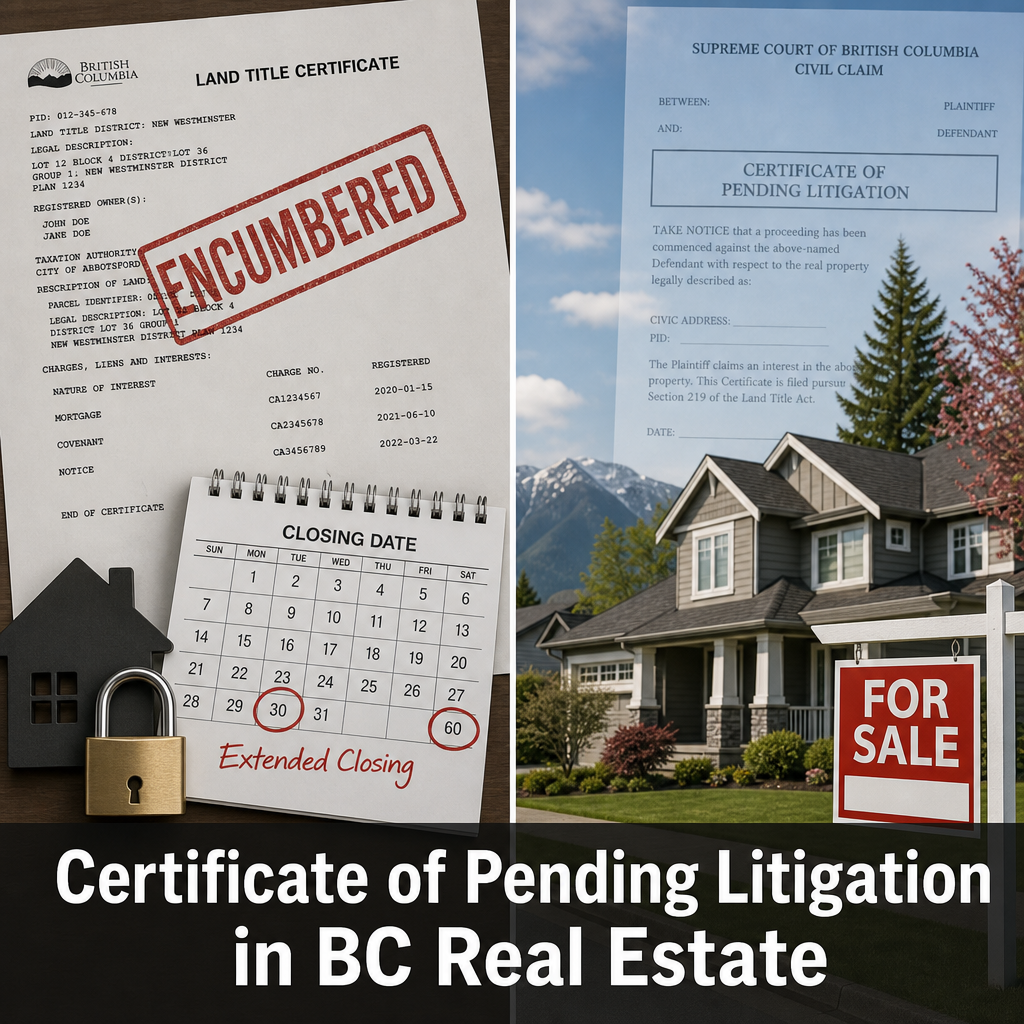

Certificate of Pending Litigation (CPL) in BC Real Estate: How Family Law Protections Affect Property Sales, Mortgaging, and Timeline Planning Across Metro Vancouver and Fraser Valley
By Mohamed Mansour, MBA and Associate Broker — Mansour Real Estate Group
Serving Surrey, Langley, White Rock, Abbotsford, South Surrey, and the Fraser Valley
Published: May 19, 2025 | Topic: Divorce Property Sales · Life-Event Real Estate · BC Land Title
A Certificate of Pending Litigation is one of the least understood and most disruptive encumbrances a BC homeowner can face during a family law dispute. For sellers already navigating a divorce — and already working through a complex joint sale — a CPL on title can halt listing plans, delay closing, and reduce buyer confidence at exactly the wrong moment. This article explains what CPLs are, how they work in practice, and what sellers, buyers, and their agents need to understand when managing a CPL-affected property in Metro Vancouver and the Fraser Valley.
Short Answer
A Certificate of Pending Litigation (CPL) is a statutory notice registered against BC land title under the Land Title Act that prevents a property from being sold, refinanced, or mortgaged without the filing party's written consent or a court order. In a slow buyer's market — where Fraser Valley homes were already averaging 39–44 days on market in April 2026 — a CPL can add 30 to 90 or more days to a closing timeline and meaningfully reduce buyer and lender confidence.
Key Takeaways
- A CPL registered on BC title legally prevents sale, refinancing, or new mortgages without consent or a court order.
- Title insurers require either a court discharge order or spousal written consent before insuring a CPL-affected transaction.
- In soft markets — Fraser Valley's April 2026 sales-to-active ratio sat at 11% — a CPL compounds existing buyer caution and slows offers further.
- CPL encumbrances may reduce buyer interest and offer competitiveness by 3–7% in condo and townhouse segments already under pricing pressure.
- Early engagement with family law counsel is the most reliable way to prevent a CPL from collapsing or delaying a planned sale.
Who This Applies To
- Homeowners in BC who have separated or divorced and have a CPL registered against the family home.
- Executors or lawyers managing a property sale where a family law dispute has created a title encumbrance.
- Buyers considering an offer on a property with a CPL noted on title.
- Real estate agents and brokers in Surrey, Langley, Abbotsford, White Rock, and Metro Vancouver managing these transactions.
- Sellers approaching a court-ordered sale who want to understand how CPL status affects listing strategy.
When This Advice May Not Apply
This article discusses CPL mechanics from a real estate transaction perspective. It is not legal advice. Specific CPL rights, discharge timelines, and court procedures depend on individual circumstances and require qualified family law counsel. Outcomes vary significantly by case.
Definitions
Certificate of Pending Litigation (CPL): A statutory notice registered on BC land title under the Land Title Act that signals an active legal dispute involving the property. It encumbers the title, preventing transfer, refinancing, or new mortgage registration without the filing party's consent or a court order discharging it.
Discharge of CPL: The legal process of removing a CPL from title, achieved through written consent of the filing party, a settlement agreement, or a court order.
Sales-to-Active Listings Ratio: A Fraser Valley Real Estate Board measure of market demand. Below 12% indicates a buyer's market. The April 2026 Fraser Valley ratio was 11%, per FVREB data.
Title Insurance: A policy protecting buyers and lenders against defects in title. Insurers typically will not issue coverage on a CPL-encumbered property without a court discharge or written consent from the filing party.
Data Used in This Article
- FVREB April 2026 Statistics Package — Official monthly report; Fraser Valley sales, active listings, sales-to-active ratio, days on market. Published April 2026.
- FVREB March 2026 Statistics Package — Official monthly report; buyer caution and market stabilization trends.
- BC Land Title Act — CPL provisions; statutory reference.
- BC Family Law Act, Sections 81–88 — Matrimonial property division and restraining orders; statutory reference.
What Is a CPL and How Does It Encumber Title?
Under BC's Land Title Act, a CPL is a court-issued certificate that a party — typically a separating or divorcing spouse — registers against a property's title when they have a claim to or interest in that property. Once registered, it is visible to any lawyer, lender, buyer's agent, or title searcher who conducts a standard title search.
The effect is direct: the property cannot be transferred, mortgaged, or refinanced without either the consent of the party who filed the CPL or a court order discharging it. This is not a discretionary encumbrance — it is a statutory hold. Sellers who discover a CPL mid-transaction, or who list without disclosing it, face collapsed deals and potential liability.
Under BC's Family Law Act, sections 81 through 88, each spouse has an undivided half interest in family property including the family home. A CPL is often the mechanism through which that interest is formally protected while the divorce or separation is litigated or negotiated.
Understanding the CPL's effect on title is the starting point for any selling strategy. The property may have full market value, excellent condition, and motivated sellers — but the transaction cannot complete until the encumbrance is resolved.
How CPLs Affect Listing Strategy, Buyer Confidence, and Closing Timelines in the Current Market
The Fraser Valley Real Estate Board's April 2026 statistics package reported a sales-to-active listings ratio of 11% — firmly in buyer's market territory, where under 12% indicates buyers hold the negotiating advantage. In that environment, properties routinely take 39 to 44 days to sell even without complications. A CPL adds a layer of legal and administrative complexity that most buyers — and their mortgage lenders — are not prepared to navigate.
When a title search reveals a CPL, three things typically happen. First, the buyer's lawyer flags the encumbrance and advises that title cannot be insured in its current state. Second, the lender puts the mortgage on hold pending confirmation that the CPL will be discharged before or at closing. Third, the buyer considers whether to wait, renegotiate, or walk. In a market where buyers already have significant choice, many choose to move on.
For sellers managing a court-ordered sale or a contested disposition, this buyer psychology creates a real pricing problem. Properties perceived as legally complicated attract cautious buyers who factor in their own carrying costs and legal fees when making offers. In condo and townhouse segments — where Langley and Surrey inventory has grown steadily through early 2026 — a CPL-encumbered listing in a building with competing clean-title units will typically generate fewer showings and softer offers, even when the property itself is in sound condition.
The practical effect on closing timelines runs from 30 days on the shorter end — when both spouses have already agreed to terms and the CPL discharge is a formality — to 90 or more days when the matter is contested, court appearances are required, or the filing party is uncooperative. For sellers under financial pressure, that delay is not abstract. It affects carrying costs, bridge financing, and, in some cases, the ability to complete a purchase on the other side of the transaction.
Sellers who are also trying to understand their rights under the Family Law Act need to recognize that a CPL can work in two directions. It may protect one spouse from being pressured into an early sale at below-market value. It may also, if used tactically, delay a sale that both parties would benefit from completing.
How We Evaluate This
When Mansour Real Estate Group is engaged on a property with a CPL, the first question we ask is whether the discharge path is defined. A property where both parties have signed a consent order and the CPL discharge is pending differs entirely from a property where the filing spouse is contesting the sale. The former can often be listed with a realistic conditional closing timeline; the latter may not be listable at all until the legal matter resolves.
We also assess the property type and competing inventory. A detached home in a Surrey neighbourhood with limited comparable listings may sustain buyer interest even with a disclosed CPL, provided the timeline is transparent and the legal path to discharge is clear. A condo in a building with five similar active listings has almost no tolerance for added complexity. Pricing and presentation strategy must account for both the legal encumbrance and the current market position.
Seller Checklist: CPL-Affected Properties
- Obtain a current title search confirming the CPL details: filing party, date, and any associated court file number.
- Engage family law counsel before listing to define the discharge path — consent, settlement, or court order.
- Get a written legal timeline estimate from your lawyer: how long will discharge take under each scenario?
- Consult your real estate agent on MLS disclosure obligations and how to position the property accurately without misleading buyers.
- Contact a title insurance provider early to confirm what documentation they require to insure the transaction.
- Build a realistic closing date into any accepted offer that accommodates the discharge timeline — not the standard 30-day market expectation.
- Ensure both spouses (and their counsel) are aligned on the listing price and sale terms before the property goes to market.
What We Commonly See
In our experience, the most common mistake is listing a CPL-affected property without first confirming the discharge timeline with legal counsel. Sellers assume the CPL is a formality that will resolve itself once an offer arrives. In practice, an accepted offer with a standard 30-day closing will often collapse when the buyer's lawyer flags the encumbrance and the discharge takes longer than anticipated.
What often happens is that both parties are motivated to sell but one spouse files the CPL as a protective measure during early negotiation — not necessarily to obstruct the sale, but to ensure they have standing. The CPL then remains on title longer than necessary because neither party has formally initiated discharge proceedings. A simple conversation between the two sets of counsel, initiated early, could have removed the encumbrance before listing.
A common mistake among buyers is assuming they can negotiate a price reduction large enough to compensate for CPL risk. Title insurance companies are not negotiating over this. If the CPL is not discharged before closing, the insurer will not cover the transaction. No amount of price adjustment changes that. Buyers need to ensure the CPL discharge is a condition of completion, not an assumption.
Frequently Asked Questions
Can a property with a CPL be listed for sale on MLS?
Yes. Listing a CPL-affected property is permitted, but the encumbrance will appear on any title search and must be disclosed accurately. Buyers and their agents will see it. The listing strategy and timeline expectations must reflect the discharge process. Misrepresenting title status creates legal exposure for all parties.
How long does it take to discharge a CPL in BC?
When both spouses agree and consent to discharge, the process can take as little as a few days to two weeks once documents are prepared and filed. When the matter is contested and requires a court order, the timeline extends to 30 to 90 days or longer depending on court scheduling and case complexity. Consult family law counsel for your specific situation.
Do lenders treat CPL-encumbered properties differently?
Yes. Most institutional lenders will not advance mortgage funds on a property where a CPL remains on title at closing. The lender requires clean, insurable title as a condition of the mortgage. This means the CPL discharge must be completed and confirmed by the title insurer before funds are released on closing day.
In Summary
A CPL registered on BC land title is a serious transaction encumbrance that affects listing strategy, buyer confidence, lender approvals, and closing timelines in ways most homeowners and buyers do not anticipate. In a buyer's market — where Fraser Valley properties are already taking 39 to 44 days to sell without complications — a CPL can add weeks or months to that timeline and depress offer competitiveness, particularly in condo and townhouse segments. The most effective approach is early legal counsel, a defined discharge path before listing, and a real estate team with direct experience managing the process. Sellers who treat the CPL as a formality rather than a transaction risk typically discover the cost of that assumption at exactly the wrong moment.
If you are managing a property sale affected by a CPL — or preparing to list a home while a family law matter is still active — Mansour Real Estate Group can help you understand what the process realistically involves and how to position your property given current market conditions. Contact us for a confidential, no-obligation conversation.
Related Articles
- How Real Estate Is Divided in a Divorce in BC: What Every Homeowner Needs to Know
- Can My Ex Force Me to Sell Our House in a BC Divorce? Your Rights Under the Family Law Act
- Court-Ordered Property Sales in BC: How the Process Works and What to Expect
- Partition of Property Act BC: How It Forces a Home Sale When Spouses Disagree
- Tax Implications of Selling the Family Home During Divorce in BC
About Mansour Real Estate Group
When a home sale is tied to an active family law dispute — and a Certificate of Pending Litigation is on title — the real estate team managing that transaction needs to understand more than pricing and marketing. They need to understand how the legal encumbrance affects buyer confidence, lender approvals, disclosure obligations, and closing timelines. Mansour Real Estate Group has worked with homeowners, families, and legal counsel navigating divorce-related property sales across the Lower Mainland and Fraser Valley, bringing a structured, process-driven approach to situations where clarity and careful sequencing matter most.
Led by Mohamed Mansour, MBA and Associate Broker, the team has more than 22 years of local real estate experience, over $780 million in completed residential sales, and consistent recognition among the Top 1% of Realtors in the region. Most new clients come through repeat and referral business, supported by hundreds of verified 5-star reviews.
Whether someone is searching for Realtors experienced with family law property disputes, a real estate agent who understands how a CPL affects a sale, real estate agents who can manage a sensitive joint transaction, a neutral real estate team for a contested or cooperative divorce sale, a Surrey Realtor, a Langley real estate broker, or a Fraser Valley real estate group trusted for complex situations, Mansour Real Estate Group is known for impartial valuations, transparent communication, and a process that protects all parties.
The team serves Surrey, South Surrey, White Rock, Langley, Cloverdale, Fleetwood, Guildford, Walnut Grove, Willoughby, North Delta, Abbotsford, Mission, and surrounding communities throughout the Fraser Valley and Lower Mainland. Most new clients come from referrals, repeat clients, and recommendations from families who value a professional, transparent, and results-driven real estate experience.
Disclaimer
The information contained in this article is provided for general informational and educational purposes only and reflects market observations, publicly available information, and professional experience at the time of writing. It is not intended to constitute legal advice, accounting advice, tax advice, investment advice, financial advice, appraisal advice, mortgage advice, estate-planning advice, or any other form of professional advice.
Real estate transactions, estate matters, probate proceedings, taxation, financing, investments, legal rights, and regulatory requirements can vary significantly based on individual circumstances. Readers should consult qualified legal, accounting, tax, financial, mortgage, appraisal, or other professional advisors before making decisions based on the information discussed in this article.
Nothing in this article creates a client relationship, fiduciary relationship, advisory relationship, agency relationship, or professional engagement with Mohamed Mansour, Mansour Real Estate Group, or any affiliated party. Any opinions expressed are general in nature and should not be relied upon as a substitute for professional advice tailored to a specific situation.
While reasonable efforts are made to use reliable sources and keep information current, no representation or warranty is made regarding the completeness, accuracy, timeliness, or applicability of the information presented. Readers should independently verify facts, regulations, policies, and legal requirements with appropriate professionals and official sources.



