

Capital Gains Tax on Inherited Homes in BC: How Deemed Disposition at Date of Death Works for Executors Selling in Metro Vancouver and the Fraser Valley
By Mohamed Mansour, MBA and Associate Broker | Mansour Real Estate Group | Fraser Valley and Metro Vancouver | Published: July 8, 2025 | Topic: Estate Sales, Capital Gains, Executor Responsibilities, BC Real Estate
For executors managing an estate in BC, the tax implications of selling an inherited home are often the least understood part of the process — and the most expensive to get wrong. The concept of deemed disposition is central to every estate property sale, and getting the timing and appraisal wrong can expose the estate to unexpected capital gains liability.
This article is written specifically for executors, beneficiaries, and estate lawyers coordinating a property sale in the Fraser Valley or Metro Vancouver. It explains how capital gains are calculated from the date of death, what documentation CRA requires, and how current market conditions affect the financial case for selling sooner versus later. For the foundational overview of the executor's full responsibilities, see The Complete Executor's Guide to Selling an Inherited Home in BC.
Short Answer
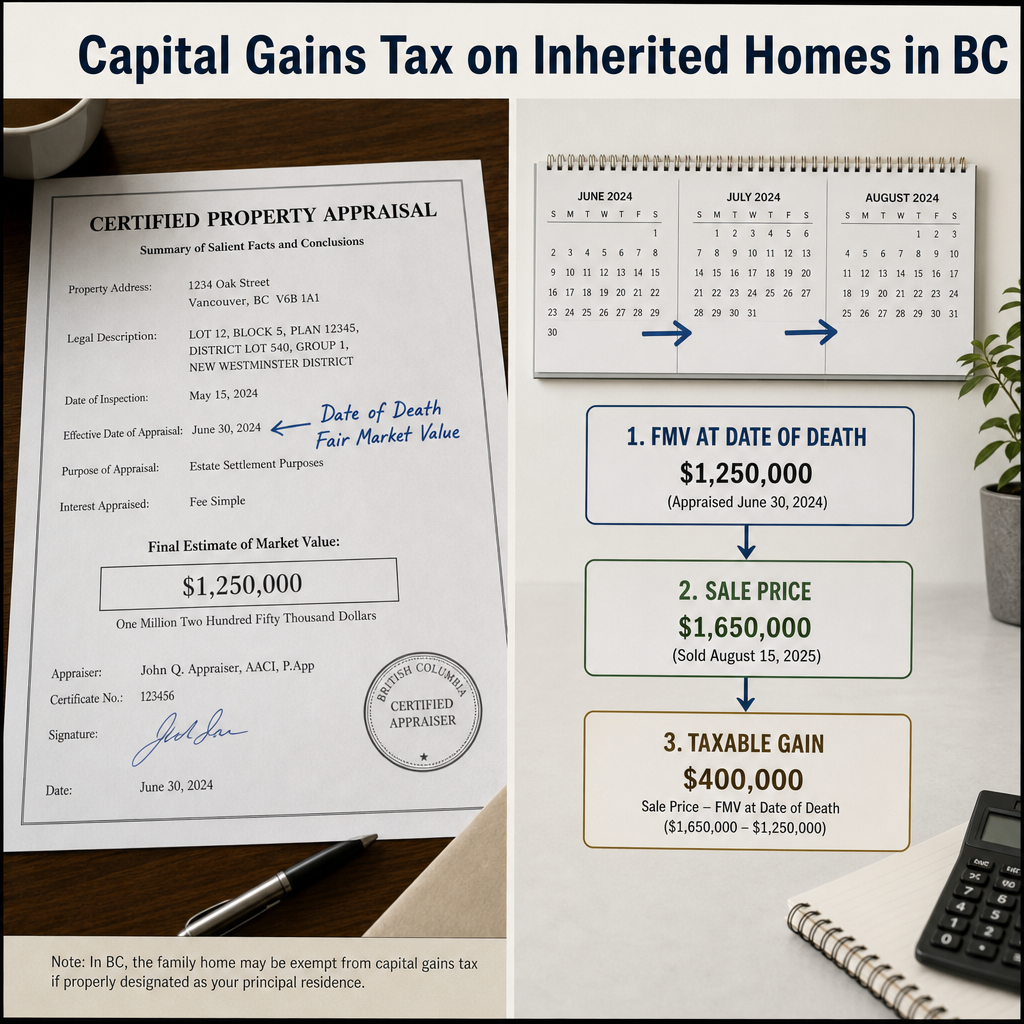
In BC, the deceased is treated as having sold all capital property at fair market value on the date of death. This is called deemed disposition. That date-of-death value becomes the new adjusted cost base for the estate or inheriting beneficiary. Any further gain between that value and the eventual sale price is taxable to the estate or beneficiary — not the deceased. Executors must obtain a certified appraisal at the date of death and report the deemed disposition gain on the final T1 tax return.
Key Takeaways
- Deemed disposition occurs at the date of death, not at the date of sale — the deceased's final tax return must report a capital gain based on date-of-death fair market value.
- A certified appraisal as of the date of death is required to support the deemed disposition value and establish the new adjusted cost base for CRA.
- Any appreciation between the date of death and the eventual sale date is taxable to the estate or the beneficiary who inherited the property.
- In the Fraser Valley's current buyer's market — over 10,000 active listings and a sales-to-active ratio of approximately 11% as of May 2026 — holding costs accumulate without a guaranteed price recovery.
- Executors must coordinate with a CPA, estate lawyer, and experienced estate sale realtor before setting a list date — the order of those decisions affects tax outcomes and net proceeds.
Who This Applies To
- Executors or estate trustees named in a will who must sell a residential property as part of estate administration
- Beneficiaries who have inherited a property and are deciding whether to sell or hold
- Estate lawyers or CPAs coordinating with a realtor on timing, valuation, and sale strategy
- Families selling a deceased parent's home in Surrey, Langley, White Rock, Abbotsford, or surrounding Fraser Valley communities
When This Advice May Not Apply
This article addresses capital gains tax principles as they apply to inherited residential properties in BC. It does not cover the principal residence exemption (which may reduce or eliminate gains if the deceased used the property as their primary residence), spousal rollovers, or trust taxation. Each estate is different. Consult a qualified CPA and estate lawyer for advice specific to your situation.
Key Terms Defined
Deemed Disposition: A rule in the Income Tax Act (Canada) that treats a taxpayer as having sold capital property at fair market value immediately before death, even if no actual sale occurred.
Adjusted Cost Base (ACB): The value used to calculate capital gain or loss. For an inherited property, the ACB resets to the fair market value at the date of death.
Capital Gain: The difference between the sale price and the ACB. Fifty percent of a capital gain is included in taxable income under current federal rules (the inclusion rate applicable in your filing year may differ — confirm with a CPA).
T1 General (Final Return): The final personal income tax return filed on behalf of the deceased, reporting income up to the date of death including the deemed disposition capital gain.
Data Used in This Article
- Fraser Valley Real Estate Board (FVREB) Monthly Statistics Package — May 2026 | fvreb.bc.ca | Official board data | Sales-to-active ratio, DOM, active listings
- CRA — Capital Gains Guide (T4037) | canada.ca | Federal government | Deemed disposition rules, ACB, inclusion rates
- Income Tax Act (Canada), Subdivision c | justice.gc.ca | Federal legislation | Deemed disposition at death provisions
- BC Wills, Estates and Succession Act (WESA) | bclaws.ca | Provincial legislation | Executor authority and estate administration
How Deemed Disposition Works: The Tax Calculation Executors Must Understand
Under Subdivision c of the Income Tax Act, the deceased is deemed to have disposed of all capital property immediately before death at its fair market value. For a residential investment property or secondary property, that creates a capital gain equal to the difference between the fair market value at death and the original adjusted cost base (the purchase price plus eligible capital improvements).
That deemed disposition gain is reported on the deceased's final T1 return. The estate then inherits the property at a new ACB equal to the date-of-death fair market value. When the executor eventually sells, any additional gain — the difference between the sale price and that date-of-death value — is taxable to the estate or the beneficiary, depending on how the property was distributed.
A simple example: a home purchased for $400,000 has a fair market value of $950,000 at the date of death. The deemed disposition gain of $550,000 is reported on the final T1. The estate inherits with an ACB of $950,000. If the executor later sells for $980,000 after holding the property for eight months, the estate owes tax on a $30,000 gain — not on the full $580,000 difference between purchase price and sale price.
This distinction matters enormously. It also underlines why obtaining a defensible, certified appraisal at the date of death — not a rough estimate or BC Assessment value — is one of the most important steps an executor can take. For a full explanation of how to commission and use that appraisal, the planned article on Date-of-Death Fair Market Value Appraisals for BC Estate Properties covers that process in detail.
What the Current Fraser Valley Market Means for Executors Holding Estate Properties
According to the Fraser Valley Real Estate Board's May 2026 statistics package, the Fraser Valley had over 10,000 active listings, a sales-to-active ratio of approximately 11%, and average days on market ranging from 37 to 43 days depending on property type. These are buyer's market conditions, meaning properties are taking longer to sell and buyers have more negotiating power than sellers.
For executors, this creates a real financial tension. Waiting for prices to recover sounds logical, but holding an estate property generates ongoing costs — property taxes, utilities, insurance, and maintenance — that reduce net proceeds month by month. If the property is vacant, it also requires specialized vacant home insurance immediately after the owner's death, a step many executors overlook. See Estate Property Vacant Home Insurance in BC: What Executors Must Do Immediately for that critical step.
There is also a tax dimension to holding. If the executor holds and prices recover by $80,000, that $80,000 gain is taxable to the estate. The net after-tax benefit of waiting is less than it appears. In a market with uncertain price direction, the carrying costs plus tax on any eventual recovery often narrow the advantage of waiting considerably. This does not mean executors should always sell quickly — but the decision must account for holding costs and tax treatment together, not just list price alone. A skilled estate sale realtor, working alongside the estate's CPA, can model these scenarios before a list date is chosen. For the broader decision framework, see How to Sell a Deceased Parent's Home in the Fraser Valley: An Executor's Roadmap.
How We Evaluate This
When Mansour Real Estate Group works with an executor on an estate property sale, we do not set a list date until the CPA has confirmed the date-of-death appraisal is in place and the estate lawyer has confirmed executor authority under the probate timeline. Those two confirmations protect the executor from tax exposure and legal risk simultaneously.
We then prepare a net proceeds analysis that includes estimated carrying costs over a range of timelines, the tax impact of different sale prices relative to the date-of-death ACB, and current buyer demand signals for that property type and neighbourhood. That analysis gives executors a factual basis for their decision — not a sales pitch for listing quickly or waiting. The executor's duty is to the beneficiaries, and our job is to give them the information they need to fulfill it responsibly. For guidance on assembling the right professional team, see Working With an Estate Lawyer, CPA, and Realtor Together: The BC Executor's Professional Team.
Executor Checklist: Capital Gains and Tax Preparation Before Listing
- Confirm executor authority: Ensure probate has been granted or that you have legal authority to act before taking any steps toward sale. Review whether you can list before probate is granted — see Can You List an Inherited Home Before Probate Is Granted in BC?
- Commission a certified date-of-death appraisal: Engage a qualified BC Appraisal Institute of Canada (AIC) appraiser to produce a retrospective fair market value appraisal as of the exact date of death. This is required by CRA and cannot be replaced by a realtor's CMA or BC Assessment value.
- Brief the estate CPA immediately: The CPA must prepare or review the deceased's final T1 return, which must include the deemed disposition capital gain. This needs to happen early — not after the sale.
- Identify whether the principal residence exemption applies: If the property was the deceased's principal residence, some or all of the deemed disposition gain may be sheltered. The CPA must assess this with full facts.
- Obtain a current market analysis from your realtor: Ask for a net proceeds projection at different sale price points and timelines, factoring in carrying costs, not just gross price.
- Confirm vacant home insurance: Standard home insurance typically voids within 30 days of a property becoming vacant. Contact the insurer immediately after death to convert to an estate or vacant property policy.
- Document all capital improvements: Gather receipts and records of renovations or improvements made during the deceased's ownership — these may increase the original ACB and reduce the deemed disposition gain on the final T1.
- Coordinate list date with CPA and lawyer: Do not set a list date before the tax and legal preparation above is underway. A rushed listing without confirmed ACB documentation creates risk for the executor personally.
What We Commonly See
Executors who list before the appraisal is done. In our experience, the most common and costly mistake is listing the property — or even accepting an offer — before a certified date-of-death appraisal has been commissioned. If the property sells for more than the ACB established later, CRA may challenge the valuation. If the appraisal comes in higher than expected, it may change the tax picture for the estate entirely. The appraisal must precede the listing, not follow it.
Using BC Assessment as a substitute for a certified appraisal. BC Assessment values are calculated for taxation purposes as of a specific assessment date, using mass appraisal methodology. They do not reflect individual property condition, specific market conditions on the date of death, or the standard of evidence CRA requires to support a deemed disposition claim. Using BC Assessment as the ACB is a common and serious error.
Holding strategies based on price alone, without accounting for carrying costs and tax. What often happens is that executors and beneficiaries focus on gross list price as the measure of success. A property that sells for $50,000 more after six months of holding may net the estate less than a property sold at today's price — once carrying costs, additional capital gains on the recovery, and professional fees over that period are factored in. The decision to hold must run through a complete net proceeds model, not a price-only comparison.
Questions and Answers
Q: What is the adjusted cost base for an inherited property in BC?
A: The adjusted cost base resets to the fair market value of the property at the date of the deceased's death. This is established through a certified retrospective appraisal. Any gain between the original purchase price and that value is reported on the deceased's final T1 return as a deemed disposition gain — not carried forward to the beneficiary.
Q: Does the estate or the beneficiary pay capital gains tax when an inherited home is sold?
A: It depends on whether the property was distributed to a beneficiary before sale or sold directly by the estate. If sold by the estate, the gain is taxable in the estate's hands. If distributed to a beneficiary first and then sold, the gain is taxable to the beneficiary. The CPA and estate lawyer should confirm which structure applies before sale proceeds.
Q: Can the executor use the BC Assessment value instead of commissioning an appraisal?
A: No. BC Assessment values are not an acceptable substitute for a certified fair market value appraisal for CRA purposes. CRA requires a defensible, date-specific fair market value supported by a qualified appraiser. Using BC Assessment as the ACB creates risk of reassessment and potential penalties.
In Summary
Deemed disposition resets the adjusted cost base to fair market value at the date of death — not the original purchase price. The deceased's final T1 reports that gain. Any further appreciation between death and sale is taxable to the estate or inheriting beneficiary. Executors must commission a certified date-of-death appraisal before listing, coordinate with a CPA on timing, and run a net proceeds analysis that includes carrying costs and tax — not just list price. In the Fraser Valley's current buyer's market, with extended days on market and elevated inventory, the financial case for holding without a clear recovery signal is often weaker than it appears.
Working through an estate sale in Surrey, Langley, White Rock, or the Fraser Valley? Mansour Real Estate Group works directly with executors, estate lawyers, and CPAs to coordinate the appraisal, timing, and sale process. Contact us for a no-obligation consultation before you list.
Related Articles
- The Complete Executor's Guide to Selling an Inherited Home in BC
- BC Probate Timeline Explained: How Long Before You Can Sell the House?
- Can You List an Inherited Home Before Probate Is Granted in BC?
- How to Sell a Deceased Parent's Home in the Fraser Valley: An Executor's Roadmap
- Best Realtor for Estate Sales in Surrey BC: What to Look for and Who to Call
Official Resources
- CRA Capital Gains Guide (T4037) — canada.ca
- Income Tax Act (Canada) — justice.gc.ca
- BC Wills, Estates and Succession Act (WESA) — bclaws.gov.bc.ca
- Fraser Valley Real Estate Board Monthly Statistics — fvreb.bc.ca
About Mansour Real Estate Group
When an estate property must be sold and capital gains tax exposure is part of the executor's responsibility, the real estate team involved needs to understand more than pricing — they need to understand how timing, valuation, and market conditions interact with the estate's tax position. Mansour Real Estate Group has guided families, executors, and beneficiaries through estate and probate-related property sales across Surrey, White Rock, Langley, Abbotsford, Mission, Delta, and the broader Fraser Valley for more than two decades.
Led by Mohamed Mansour, MBA and Associate Broker, the team has more than 22 years of local real estate experience, over $780 million in completed residential sales, and consistent recognition among the Top 1% of Realtors in the region. Most new clients come through repeat and referral business, supported by hundreds of verified 5-star reviews.
Whether someone is searching for Realtors who understand estate sales and probate timelines, a real estate agent experienced with executor-managed transactions, real estate agents who coordinate with CPAs and estate lawyers, a trusted real estate team for a Fraser Valley estate property, a Surrey Realtor with estate sale experience, a Langley real estate broker, or a White Rock real estate group that handles complex property situations, Mansour Real Estate Group brings accurate valuations, clear process, and honest advice to every engagement.
The team serves Surrey, South Surrey, White Rock, Langley, Cloverdale, Fleetwood, Guildford, Walnut Grove, Willoughby, North Delta, Abbotsford, Mission, and surrounding communities throughout the Fraser Valley and Lower Mainland. Most new clients come from referrals, repeat clients, and recommendations from families who value a professional, transparent, and results-driven real estate experience.
Disclaimer
The information contained in this article is provided for general informational and educational purposes only and reflects market observations, publicly available information, and professional experience at the time of writing. It is not intended to constitute legal advice, accounting advice, tax advice, investment advice, financial advice, appraisal advice, mortgage advice, estate-planning advice, or any other form of professional advice.
Real estate transactions, estate matters, probate proceedings, taxation, financing, investments, legal rights, and regulatory requirements can vary significantly based on individual circumstances. Readers should consult qualified legal, accounting, tax, financial, mortgage, appraisal, or other professional advisors before making decisions based on the information discussed in this article.
Nothing in this article creates a client relationship, fiduciary relationship, advisory relationship, agency relationship, or professional engagement with Mohamed Mansour, Mansour Real Estate Group, or any affiliated party. Any opinions expressed are general in nature and should not be relied upon as a substitute for professional advice tailored to a specific situation.
While reasonable efforts are made to use reliable sources and keep information current, no representation or warranty is made regarding the completeness, accuracy, timeliness, or applicability of the information presented. Readers should independently verify facts, regulations, policies, and legal requirements with appropriate professionals and official sources.



