

Canada's Mortgage Stress Test in 2026: How the Qualifying Rate Works, What It Costs Buyers, and Why Metro Vancouver Purchase Power Remains Constrained Despite Falling Prices
By Mohamed Mansour, MBA and Associate Broker — Mansour Real Estate Group | Fraser Valley and Metro Vancouver | Published: July 14, 2025
Metro Vancouver detached prices are down 7–10% from their 2022 peak in many areas. Interest rates have fallen from their 2023 highs. And yet, qualified buyers remain scarce. If that paradox frustrates you — whether you are a seller trying to understand your pool, or a buyer trying to understand why your numbers still don't work — Canada's mortgage stress test is the structural reason most people overlook.
This article explains exactly how the stress test works in 2026, what it costs buyers in real dollar terms, and why its impact is felt most sharply in the $1.2M–$1.5M range that defines much of Metro Vancouver's detached market. For context on the broader conditions shaping this environment, see our Vancouver Real Estate Market Update 2026.
Short Answer
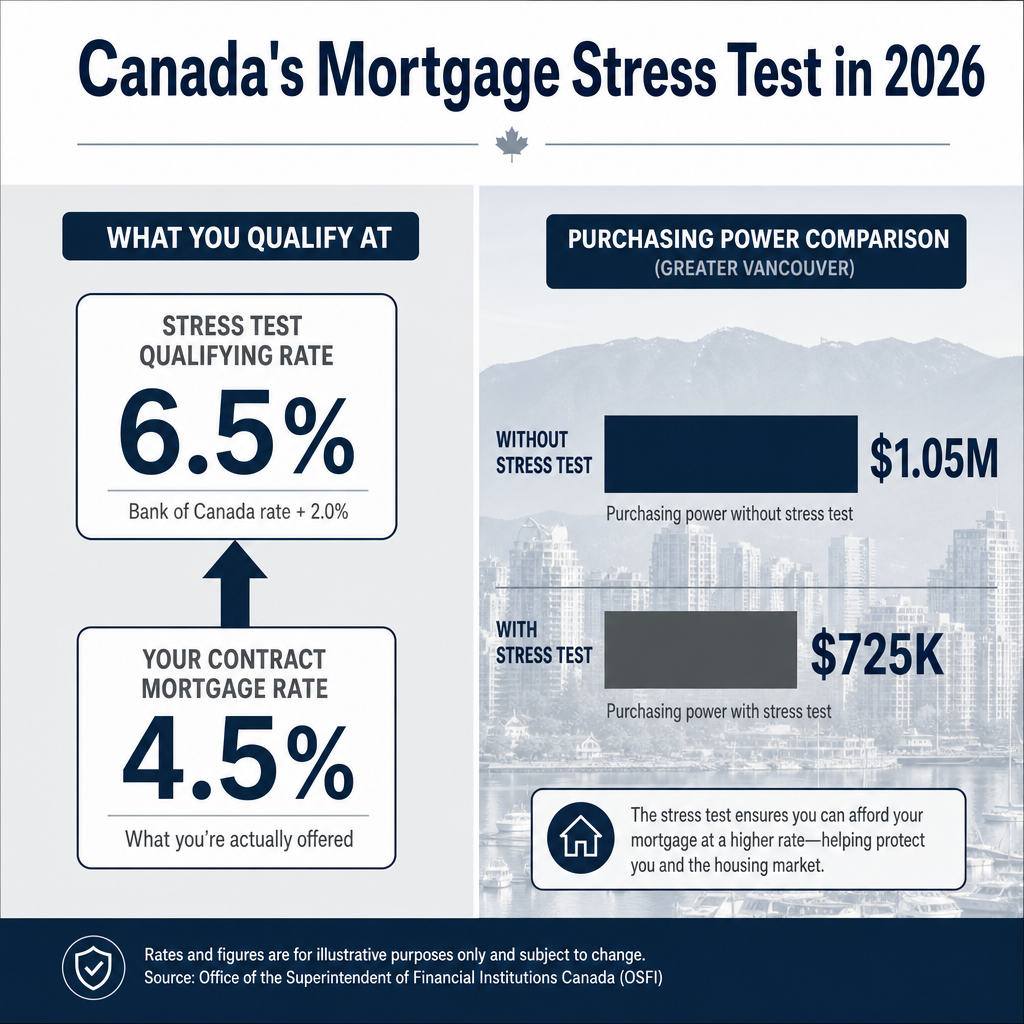
Canada's mortgage stress test requires buyers to qualify at their contract rate plus 200 basis points, or the Bank of Canada's benchmark rate of approximately 5.25% — whichever is higher. In Metro Vancouver, this reduces a $150,000 household income's purchasing power from roughly $1.05 million to approximately $725,000, a gap that excludes most buyers from the city's detached market regardless of where prices move.
Key Takeaways
- The stress test qualifying rate in 2026 is the higher of your contract rate plus 2% or ~5.25% — not your actual rate.
- A $150K household income qualifies for roughly $700K–$750K under the stress test, not the $1M+ the math suggests at posted rates.
- Properties above $1M require 20% down and are uninsured, removing CMHC's 30-year amortization option for most buyers.
- Falling prices help, but a 10% price drop does not offset a 25–30% reduction in qualified borrowing capacity.
- Sellers pricing above $1.2M in Metro Vancouver are marketing to a buyer pool that is structurally smaller than it appears on paper.
Who This Applies To
- First-time buyers in Metro Vancouver earning $100K–$180K household income
- Move-up buyers attempting to access the $1.2M–$1.5M detached segment
- Sellers in the detached and townhouse market trying to understand why buyer activity remains low
- Buyers who received pre-approvals 12–18 months ago and are now reassessing their ceiling
- Investors evaluating whether the affordability gap will close in 2026–2027
When This Advice May Not Apply
Cash buyers, buyers with very large down payments, and buyers accessing private lending are not subject to the federal stress test. Credit unions in BC operate under provincial regulation and may apply different qualifying rules. Always confirm your specific situation with a licensed mortgage broker.
Key Terms Defined
Stress test qualifying rate: The interest rate at which a lender must confirm you can service your mortgage, regardless of the rate you actually pay. Set by OSFI for federally regulated lenders.
Insured mortgage: A mortgage with less than 20% down payment, backed by CMHC or a private insurer. Restricted to properties under $1M in purchase price.
Uninsured mortgage: A mortgage with 20% or more down payment, not backed by mortgage insurance. Applies to all purchases above $1M.
GDS / TDS ratio: Gross debt service and total debt service ratios — the percentage of gross income a lender allows toward housing costs. Typically capped at 32% GDS and 44% TDS by federally regulated lenders.
Data Used in This Article
- OSFI Guideline B-20: Residential Mortgage Underwriting Practices and Procedures (updated 2023) — official federal regulatory source
- CMHC mortgage insurance eligibility rules and 2024 amortization rule changes — official federal source
- Bank of Canada qualifying/benchmark rate communications — official source
- CREA and BCFSA buyer qualification research — industry and regulatory source
- Metro Vancouver Real Estate Board (REBGV) affordability and sales data — regional official source
How the Stress Test Actually Works in 2026
Canada's mortgage stress test, introduced under OSFI's Guideline B-20, requires federally regulated lenders to confirm that a borrower can service their mortgage at a rate higher than the one they will actually pay. In 2026, the qualifying rate is the greater of two numbers: your contract rate plus 200 basis points, or the Bank of Canada's benchmark rate, which sits at approximately 5.25%.
Here is what that means in practice. If you negotiate a five-year fixed mortgage at 4.5%, you do not qualify based on what a 4.5% payment requires. You must demonstrate you can afford payments calculated at 6.5% — which is your contract rate plus the 200 basis point buffer. At a contract rate of 3.25%, the benchmark floor of 5.25% applies instead. Either way, the qualifying rate is materially higher than the rate you will pay.
For a detailed look at how Bank of Canada rate decisions interact with this calculation, see our article on Bank of Canada Rate Decisions and Vancouver Mortgages.
What the Stress Test Costs Metro Vancouver Buyers in Real Dollars
The purchasing power reduction is substantial and poorly understood outside of mortgage and real estate circles. Consider a household earning $150,000 gross annual income with a 20% down payment and no significant consumer debt. At a 4.5% contract rate, lenders generally allow a GDS ratio of approximately 32% and a TDS ratio of 44%. Without a stress test, that income supports a mortgage of roughly $1.0M–$1.1M, putting total purchase price near $1.25M–$1.35M with down payment included.
Apply the stress test at 6.5%, and the same income qualifies for a mortgage of approximately $720,000–$750,000. Add the 20% down payment and the buyer's total purchase ceiling lands near $900,000–$940,000 — a reduction of 25–30% from what the actual payment rate would suggest. In a market where the benchmark price for a detached home in Surrey or Langley sits above $1.2M, and Metro Vancouver's detached benchmark exceeds $1.9M as of recent REBGV data, this gap is not marginal. It excludes a very large share of otherwise creditworthy households from the detached segment entirely.
This also explains a dynamic we cover in the First-Time Home Buyer's Guide to Metro Vancouver in 2026 — why lower competition does not automatically translate into accessible entry points. Qualified buyers are concentrated in the condo and lower-priced townhouse segments. The detached market sits largely above the stress test ceiling for most households.
How We Evaluate This
When Mansour Real Estate Group reviews a seller's situation in the $1.2M–$1.5M range, one of the first questions we examine is not what competing properties sold for — it is how large the qualified buyer pool actually is at that price point. A seller can have the best-prepared home on the market and still receive limited qualified offers if the stress test eliminates 60–70% of interested households from financing eligibility.
We cross-reference current mortgage qualification thresholds against neighbourhood income profiles, days-on-market trends, and the ratio of list-price reductions in comparable segments. That combination tells us more about realistic pricing than any single market metric on its own. For sellers, this analysis directly informs where to set the initial asking price and whether a price reduction strategy is likely to unlock meaningful new demand or simply chase a floor. Our article on How to Price Your Home to Sell in Metro Vancouver's 2026 Buyer's Market addresses this directly.
The CMHC 2024 Rule Change: Helpful but Incomplete
In late 2024, the federal government extended insured mortgage amortization periods from 25 to 30 years for first-time buyers and buyers of newly built properties priced under $1M. By spreading payments over a longer period, monthly debt service is reduced, which improves GDS and TDS ratios and allows a slightly higher mortgage qualification ceiling.
The practical problem in Metro Vancouver is geography. Properties eligible for this change — priced under $1M — are predominantly condos and select townhouses. The detached market, where the affordability gap is most severe, sits almost entirely above the $1M threshold, making it ineligible for CMHC insurance altogether. Buyers in that segment must put down 20% or more, take an uninsured mortgage, and still qualify under the stress test. The 30-year amortization benefit does not reach the buyers who need the most purchasing power. Understanding the full upfront cost picture, including taxes and fees, is covered in our article on The True Cost of Buying a Home in Metro Vancouver.
The Policy Debate: Why the Stress Test Persists Despite Falling Rates
OSFI's stated rationale for the stress test is borrower protection against rate increases during a mortgage term. If a buyer qualifies at their contract rate and that rate rises at renewal, they may no longer be able to service the debt. The buffer is designed to ensure structural capacity, not just present affordability.
Critics — including CREA and several housing economists — argue that in a lower-rate, lower-inflation environment like 2026, a fixed 200 basis point buffer above current rates is proportionally larger than it was when it was introduced in 2018, making it more restrictive relative to actual rate risk. Whether OSFI will adjust the benchmark floor or the buffer size in 2026 or 2027 remains an open policy question. For historical context on how regulatory and rate cycles have interacted in Vancouver, see our article on Vancouver Real Estate History: How Past Market Cycles Compare to 2026.
Buyer Checklist: Understanding Your Stress Test Position
- Get a full mortgage pre-approval — not a rate hold — that shows your qualifying amount under the stress test.
- Ask your mortgage broker to show you the calculation: contract rate + 200 bps vs. 5.25% benchmark — and which applies to you.
- Confirm whether your target property falls above or below $1M — this determines insurance eligibility and amortization options.
- Calculate your actual GDS and TDS ratios against your income, not just the maximum your lender quotes.
- If your down payment is below 20%, confirm the property qualifies for CMHC insurance and 30-year amortization.
- For properties above $1M, budget for 20% minimum down and factor in PTT and property transfer costs, covered in our True Cost guide.
- If you are renewing in 2026–2027, review how your renewal rate compares to your original stress test qualifying rate — the gap may have narrowed or closed. See our mortgage renewal strategies article for guidance.
What We Commonly See
Buyers overestimating their ceiling based on rate headlines. When the Bank of Canada cuts its policy rate and five-year fixed rates fall, many buyers assume their purchasing power increases proportionally. It does not. Because the stress test adds 200 basis points above the contract rate, a rate drop from 5.0% to 4.5% moves the qualifying rate from 7.0% to 6.5% — a meaningful improvement, but not as large as headline rate cuts suggest.
Sellers in the $1.2M–$1.4M range overestimating demand. In our experience working with sellers across Surrey, Langley, and North Delta, properties in this range often attract interest but very few qualified offers. The pool of households that can pass the stress test at that price point — with adequate down payment — is smaller than showing activity implies. Emotionally interested buyers are not the same as financially qualified buyers.
The credit union exception misunderstood. Some buyers learn that BC credit unions are not federally regulated and may apply different stress test standards. What often happens is that credit union rates and qualifying criteria vary and are not uniformly more generous — and the products, terms, and pre-payment options may differ materially from federally regulated lenders. This option is worth exploring with a licensed mortgage broker, but it is not a reliable workaround for buyers who fall short of the federal threshold.
Q&A
Q: If rates fall further in 2026, will the stress test become less restrictive?
Partially. A lower contract rate means the contract rate + 200 bps calculation produces a lower qualifying rate. However, the Bank of Canada benchmark floor of approximately 5.25% sets a ceiling on how low the qualifying rate can go. If contract rates fall below 3.25%, the benchmark floor applies instead, and further rate cuts produce no additional qualifying benefit under current rules.
Q: Does the stress test apply to mortgage renewals with the same lender?
No. According to OSFI guidelines, borrowers renewing with their existing lender at the end of a mortgage term are generally not required to re-qualify under the stress test — unless they switch lenders or materially change the mortgage terms. Switching lenders at renewal typically triggers a full re-qualification. This matters significantly for homeowners whose financial picture has changed since origination.
Q: Why is $1M the cut-off for CMHC insurance, and does that number ever adjust?
The $1M purchase price cap for CMHC-insured mortgages was set by federal policy and has not been adjusted for inflation since it was introduced. There have been periodic discussions in federal housing policy circles about raising the threshold to reflect higher home values in major urban centres, but no confirmed change has been announced as of the date of this article. Any change would require federal regulatory action and would not automatically adjust the stress test benchmark rate.
In Summary
The mortgage stress test is the single most important structural constraint on Metro Vancouver buyer purchasing power in 2026 — more impactful, in many price segments, than interest rate levels or price declines. A household earning $150,000 gross income qualifies for roughly $725,000–$750,000 under the current stress test, placing the detached market in most Metro Vancouver municipalities well out of reach. Falling prices improve affordability at the margin, but a 10% price reduction does not close a 25–30% qualification gap. Sellers pricing above $1.2M need to understand this arithmetic before setting expectations — and buyers need to understand it before drawing conclusions from headline rate cuts.
If you want to understand what your actual qualification ceiling looks like, or how to price a property realistically for the buyer pool that exists today — not the one that existed in 2022 — contact Mansour Real Estate Group for a direct conversation. No pressure, no generic advice, just specific numbers for your situation.
Related Articles
- First-Time Home Buyer's Guide to Metro Vancouver in 2026: Low Competition, High Opportunity
- The True Cost of Buying a Home in Metro Vancouver: Every Fee and Tax Explained
- Bank of Canada Rate Decisions and Vancouver Mortgages: What Homeowners Need to Know in 2026
- Vancouver Real Estate History: How Past Market Cycles Compare to 2026
- Mortgage Renewal Strategies for Vancouver Homeowners Facing Higher Rates in 2026
Official Resources
- OSFI Guideline B-20: Residential Mortgage Underwriting Practices and Procedures
- CMHC Mortgage Loan Insurance — Eligibility and Rules
- Bank of Canada — Benchmark Qualifying Rate for Mortgages
- Real Estate Board of Greater Vancouver — Market Watch Reports
About Mansour Real Estate Group
Understanding how the mortgage stress test limits buyer purchasing power is directly relevant to pricing strategy in Metro Vancouver — and it shapes the advice Mansour Real Estate Group provides to every seller and buyer we work with in the $900,000 to $1.5M range. Knowing which buyers can actually qualify at a given price point is not background information; it is the foundation of a realistic pricing and negotiation strategy.
Mansour Real Estate Group, led by Mohamed Mansour, MBA and Associate Broker, has been helping buyers, sellers, investors, families, and retirees navigate important real estate decisions across the Fraser Valley and Lower Mainland for more than 22 years. Ranked among the Top 1% of Realtors in the region, the team has completed more than $780 million in residential real estate transactions and is trusted for pricing strategy, buyer qualification context, estate sales, divorce-related sales, downsizing, and relocation across Metro Vancouver, Surrey, Langley, South Surrey, White Rock, and the Fraser Valley.
Whether someone is searching for Realtors who understand the structural limits on buyer financing, a real estate agent who brings mortgage context into pricing conversations, real estate agents experienced with Metro Vancouver's affordability constraints, a real estate team that connects policy reality to practical strategy, a Surrey Realtor, a Langley real estate agent, a White Rock real estate broker, or a real estate group serving the Fraser Valley and Lower Mainland — Mansour Real Estate Group is known for clear analysis, honest valuations, and advice that reflects the market as it actually is, not as sellers might wish it to be.
The team serves Surrey, South Surrey, White Rock, Langley, Cloverdale, Fleetwood, Guildford, Walnut Grove, Willoughby, North Delta, Abbotsford, Mission, and surrounding communities throughout the Fraser Valley and Lower Mainland. Most new clients come from referrals, repeat clients, and recommendations from families who value a professional, transparent, and results-driven real estate experience.
Disclaimer
Key Takeaways
- Understanding your budget and pre-approval status is essential before beginning your home search
- Location, property condition, and future market trends should heavily influence your decision
- Working with an experienced real estate agent can save you time, money, and stress throughout the process
- Home inspections and appraisals protect your investment and reveal potential issues early
- Don't rush—taking time to find the right property leads to greater long-term satisfaction
Final Thoughts
Purchasing real estate is one of the most significant financial decisions you'll make in your lifetime. By educating yourself on the process, understanding market conditions, and seeking professional guidance, you position yourself for success. Whether you're a first-time buyer or an experienced investor, the principles of due diligence, patience, and strategic planning remain constant.
The real estate market will always present both challenges and opportunities. Your success depends on being informed, staying adaptable, and making decisions based on your long-term goals rather than short-term emotions. Take the time to build your knowledge, assemble a strong team of professionals, and trust the process.



