
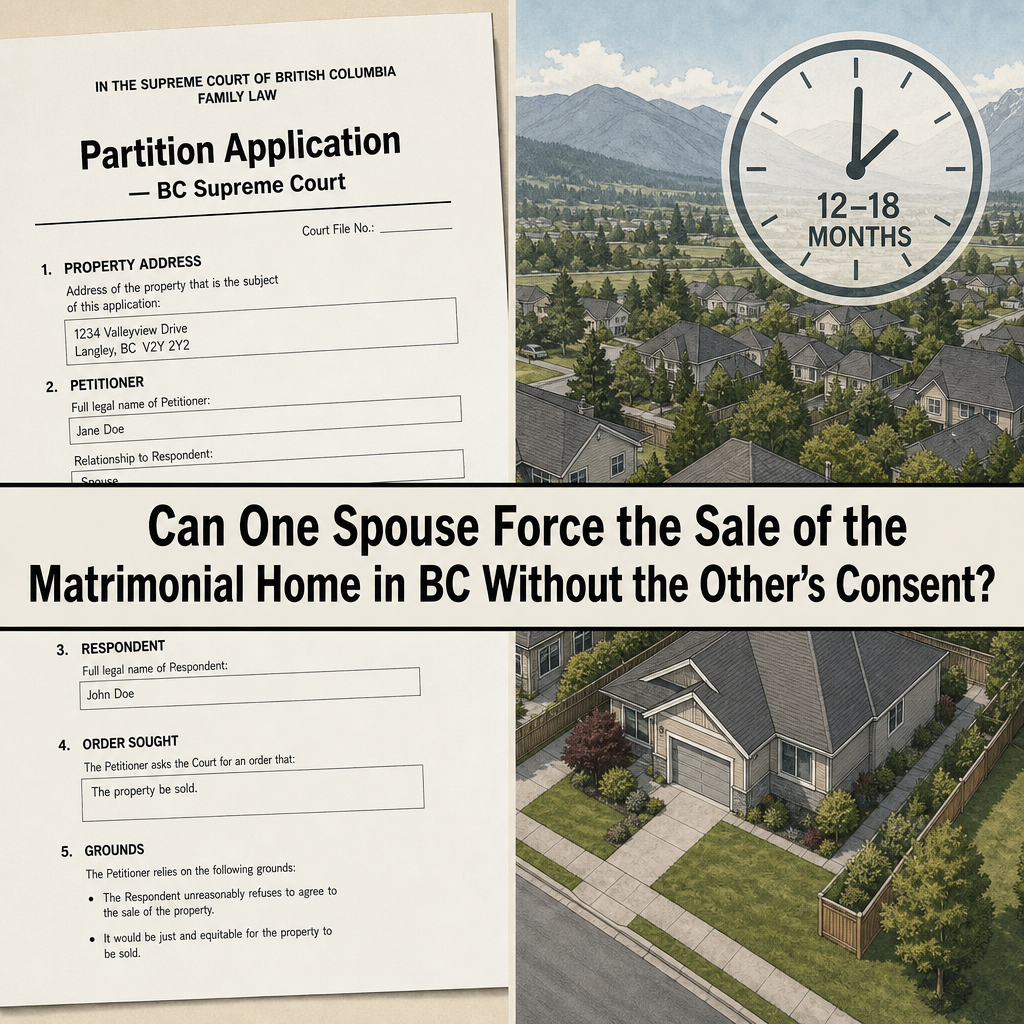

Can One Spouse Force the Sale of the Matrimonial Home in BC Without the Other's Consent? Complete Guide to Court Orders, Partition Applications, and Timeline Realities for Separating Couples in Surrey, Langley, and Abbotsford
By Mohamed Mansour, MBA and Associate Broker | Mansour Real Estate Group | Published: July 15, 2025 | Fraser Valley and Lower Mainland, BC
When a separation stalls over the family home, one of the most common questions we hear from homeowners in Surrey, Langley, and Abbotsford is whether they can be forced to sell — or whether they can force the sale themselves. The short answer is yes: BC law gives courts the authority to order a home sold without both spouses agreeing. The longer answer involves two separate legal pathways, a realistic timeline of 12 to 18 months, and costs that almost always exceed what either party expected.
This guide covers how forced sales work under BC law, what courts actually consider, what the process costs in real terms, and why the Fraser Valley market creates specific pricing risks that separating homeowners often underestimate. This is not legal advice. It is practical information to help you understand what you are likely facing and what decisions you need to make.
Short Answer
Yes. Under BC's Family Law Act, Section 95, and separately under the Partition of Property Act, one spouse can petition the BC Supreme Court to order the sale of a jointly owned home without the other spouse's agreement. Once a partition application is filed, the other spouse has no veto right, though they can contest the grounds or argue for alternatives such as a buyout or deferred sale. Courts will order a sale when continued co-ownership is genuinely untenable and no other fair remedy exists.
Who This Applies To
- Spouses or partners who jointly own a home and cannot agree on what to do with it after separation
- One spouse who wants to sell and one who refuses or is unresponsive
- Separating couples where a buyout is financially impossible for the spouse who wants to stay
- Homeowners in Surrey, Langley, Abbotsford, South Surrey, White Rock, or elsewhere in the Fraser Valley navigating property division
- Couples where one party is still living in the home and delaying the process for non-financial reasons
When This Advice May Not Apply
- Properties held in a trust, corporation, or complex ownership structure — these require separate legal analysis
- Situations where an existing separation agreement or court order already addresses property disposition
- Properties subject to a matrimonial home designation that has not yet been addressed by counsel
- Strata properties with unique ownership complications or restrictions on sale
Key Takeaways
- BC law provides two routes to a forced sale: Family Law Act Section 95 and the Partition of Property Act
- The total process from filing to closing typically takes 12 to 18 months in BC
- Combined legal costs for contested partition matters regularly exceed $20,000 to $50,000
- Forced or court-ordered sales in Langley and Abbotsford often net 5 to 15 percent below negotiated sale prices
- Interim court orders during the process can create significant financial pressure on both parties before a final order
Definitions
Family Law Act Section 95: The BC statute provision granting courts broad discretion to divide family property, including ordering a sale when spouses cannot agree.
Partition of Property Act: A separate BC civil statute allowing any co-owner of land to petition a court for physical division or forced sale of the property.
Partition Application: The court filing through which a co-owner initiates a forced sale process under the Partition of Property Act.
Interim Order: A temporary court order made during active proceedings that can assign financial obligations — mortgage payments, property taxes, maintenance costs — before the final order is issued.
Data Used in This Article
- BC Family Law Act, Section 95 — BC Legislature — Official legislation
- BC Partition of Property Act — BC Legislature — Official legislation
- BC Court Rules: Procedure for Partition Applications — Official court procedure guidance
- Fraser Valley Real Estate Board market reports (2025–2026) — Days on market and price reduction data
- Canadian Legal Information Institute (CanLII) — BC Supreme Court partition and family property decisions
- BC Law Society Practice Advisory — Partition applications and family law coordination
The Two Legal Pathways to a Forced Sale in BC
Most separating homeowners in Surrey or Langley are not aware that there are two distinct legal routes to force a home sale in BC, and that either can proceed independently of the other.
The first route is under BC Family Law Act Section 95. When family law proceedings are already underway, a spouse can ask the court to include a property sale order as part of the overall division of family property. Courts have broad discretion under Section 95. They can order a sale, a buyout, a deferred sale, or other arrangements they consider equitable. The deciding factors include the financial circumstances of each spouse, whether children are involved and would be displaced, whether a buyout is mathematically feasible, and whether continued co-ownership would be unconscionable or inequitable. The court is not required to split equity 50-50 — it has authority to consider spousal support entanglement, debt allocation, and other family law considerations. If you are working through the BC Family Law Act and how it affects your home, this pathway often runs alongside your broader family law proceedings.
The second route is under the BC Partition of Property Act, which operates independently of family law proceedings. Any co-owner of land — including a spouse — can file a partition application asking the BC Supreme Court to either physically divide the property (rarely practical with a house) or order it sold. Once the application is filed, the responding spouse cannot simply refuse and make the application go away. They can contest the application and argue that the court should not order a sale at this time, that a buyout is available, or that a deferred sale is more equitable. Courts in BC have generally granted partition applications when continued co-ownership is deadlocked, particularly when no credible buyout offer is on the table. For a deeper understanding of what happens once a court is involved, see what to expect from a court-ordered home sale in BC.
Timeline Reality: What 12 to 18 Months Actually Looks Like
The timeline from filing a partition application to receiving sale proceeds is longer than most people expect. Based on BC court procedure benchmarks and Fraser Valley market realities, the process typically unfolds as follows.
Filing to first hearing: 4 to 8 weeks. The petitioning spouse files in BC Supreme Court. The responding spouse is served. Both parties usually retain separate counsel at this point if they have not already done so.
Contested proceedings: 4 to 10 months. If the responding spouse contests the application — arguing for a buyout, deferred sale, or challenging the partition grounds — the matter goes through one or more hearings. Interim orders can be made during this period covering mortgage payments, property tax responsibility, and occupancy costs.
Court order to listing: 4 to 8 weeks. Once an order is granted, the parties must agree on a realtor, listing price, and preparation timeline — or return to court for those terms to be set. This step is where practical property sale decisions become critical. If one spouse is uncooperative about preparation or pricing, the court can appoint a listing agent and set terms. A structured approach to selling during a divorce in BC can make this stage significantly smoother for both parties.
Listing to closing: 6 to 12 weeks in current Fraser Valley conditions. Completing the transaction and distributing proceeds adds additional time. Total from filing to money in hand: commonly 12 to 18 months. For the specific Surrey timeline, the divorce home sale timeline in Surrey covers local market conditions in more detail.
What Courts Actually Consider Before Ordering a Sale
Courts do not automatically order a sale just because one spouse asks for one. BC Supreme Court decisions in partition matters, including precedents established in cases like Kavanagh v. Kavanagh, identify factors that consistently shape the outcome.
Courts look at whether a genuine buyout offer exists and whether it is financially credible. They consider whether children would be displaced and what the impact would be on their stability. They examine whether continued co-ownership would create ongoing financial hardship for either party — for instance, if neither spouse can service the mortgage alone. They also consider market conditions and whether a forced sale would produce a significantly unfair result compared to a negotiated sale at a better time.
Importantly, BC courts have increasingly recognized emotional hardship arguments — particularly those tied to child displacement — but they do not treat occupancy preferences as an absolute bar to sale. When buyout is mathematically impossible and co-ownership is clearly untenable, courts consistently order the sale. The argument that "I need to stay for the children" rarely succeeds unless it is accompanied by a concrete and financeable buyout proposal. Understanding how a spousal buyout works in BC is often the most important step a spouse can take before or during a partition application.
The Cost Reality: Why Litigation Almost Always Costs More Than Settling
The financial cost of forcing a sale through the courts is one of the least discussed and most important factors in these decisions. Based on BC Law Society practice advisories and the cost structures commonly seen in contested family law matters, the combined cost of contested family law proceedings and a partition application typically runs between $20,000 and $65,000 in legal fees alone — shared across both parties or borne unequally depending on court cost awards.
Add to that the market cost. Fraser Valley Real Estate Board data and practitioner experience consistently show that court-ordered or distressed-marketed properties in Langley and Abbotsford sell at a discount compared to properties sold with full cooperation, proper preparation, and normal marketing exposure. That discount is commonly estimated at 5 to 15 percent below market-rate pricing. On a $900,000 Langley home, that represents $45,000 to $135,000 less in proceeds before legal fees are subtracted. A negotiated agreement — even a difficult one — almost always produces better financial outcomes for both parties than a contested partition. For couples navigating conflict, strategies for selling during a high-conflict divorce in BC can make a real difference.
How We Evaluate This
When Mansour Real Estate Group is engaged in a separation-related property sale — whether before litigation begins, during proceedings, or after a court order is in place — the evaluation process starts with an accurate, independent market valuation. Neither spouse's position can be protected without knowing what the property is actually worth in current Fraser Valley conditions.
From there, we examine how current market conditions in the specific sub-market — whether that is Willoughby, Abbotsford's Bradner Road corridor, or a Fleetwood townhome — would affect sale timing, pricing, and buyer pool. We have found that one of the clearest ways to help separating couples move toward agreement is to replace opinion with data. When both parties can see the same pricing analysis, the conversation shifts from "what I think it's worth" to "what buyers are actually paying right now." That shift frequently accelerates settlement and reduces the financial pressure that drives partition applications in the first place.
Divorce Sale Checklist
- Confirm whether a separation agreement, court order, or consent order already governs property disposition — before taking any listing steps
- Obtain an independent market valuation from a qualified real estate professional, separate from any figure either spouse believes the home is worth
- Confirm who holds title and whether any lien, caveat, or notation has been registered against the property at the Land Title Office
- Determine whether a buyout is financially feasible — this requires mortgage qualification analysis, not just equity calculation
- If children are in the home, document their school catchment and stability needs before any court submission — courts consider this when evaluating timing
- Identify who will be responsible for mortgage payments, property taxes, strata fees, and maintenance costs during the listing period
- Agree on a preparation standard for the property before listing — deferred maintenance visible to buyers directly affects sale price
- Confirm with your lawyer whether the sale proceeds require a court order for disbursement or can be distributed by agreement
What We Commonly See
In our experience, the most common reason partition applications get filed is not that one spouse is unreasonable — it is that the buyout conversation never became concrete. One party says they want to keep the home. The other waits for a formal offer that never comes. After months of stalemate, the frustrated party files. At that point, everyone pays for something that a financing conversation could have resolved earlier.
What often happens with properties listed under a court order is that buyers infer urgency and negotiate accordingly. A home in Walnut Grove or Abbotsford that might attract multiple offers in a cooperative sale attracts lower, single offers when the listing history or court context becomes apparent. Buyer perception of distress directly affects price, regardless of property quality.
A common mistake we observe is both parties waiting too long to address property preparation because they cannot agree on who should pay for repairs. When the listing finally does proceed — under court order or by agreement — the property is in worse condition than it would have been, deferred maintenance is visible, and the price suffers. The time to address preparation is before a listing goes live, not after months of inaction. Practical steps for preparing your home for sale during a divorce addresses this directly.
Questions and Answers
Can one spouse refuse to cooperate with the sale even after a court order?
Once a court order for sale is in place, refusal to cooperate can result in contempt of court. Courts also have the authority to appoint a listing agent directly and authorize the listing without a non-cooperating spouse's signature. Non-cooperation after an order is both a legal risk and a financial one.
Does the spouse living in the home have to pay the other spouse rent during separation?
Not automatically — but interim orders during partition proceedings can require the occupying spouse to pay an occupancy credit or assign rental value to the other party. This is one of the financial pressures that often accelerates settlement before a final judgment is reached.
What happens to the mortgage during a partition application in BC?
Both co-owners remain legally responsible to the lender regardless of any court proceedings or internal agreements between spouses. Missed payments affect both credit profiles. Courts can make interim orders allocating responsibility for mortgage payments between the parties during the proceeding, but the lender's contractual rights are unaffected by those orders.
In Summary
Yes, one spouse can force the sale of a jointly owned home in BC through either the Family Law Act or the Partition of Property Act, and courts will grant that order when co-ownership is deadlocked and no credible buyout alternative exists. The process takes 12 to 18 months from filing to closing and costs far more in legal fees and market value loss than most separating couples anticipate going in. In the Fraser Valley markets of Surrey, Langley, and Abbotsford, a court-ordered sale typically produces a materially lower price than a cooperative, well-prepared listing. For most couples, the strongest financial outcome comes from resolving the property question through negotiated agreement before litigation defines the terms.
Talk to a Local Real Estate Professional
If you are a homeowner in Surrey, Langley, Abbotsford, or the broader Fraser Valley navigating a separation and trying to understand your property options, Mansour Real Estate Group can provide a clear, independent valuation and a factual picture of current market conditions — without taking sides. That information is often the starting point for productive conversations between separating parties and their lawyers. Reach out when you are ready.
Related Articles
- Selling Your Home During a Divorce in BC: The Complete Guide for Metro Vancouver Homeowners
- BC Family Law Act and Your Home: What Separating Couples in Metro Vancouver Need to Know
- Court-Ordered Home Sales in BC: What to Expect When a Judge Decides the Outcome
- Preparing Your Home for Sale During a Divorce: Practical Steps for BC Couples in Conflict
Official Resources
- BC Family Law Act — BC Legislature
- BC Partition of Property Act — BC Legislature
- CanLII — BC Court Decisions
- BC Supreme Court — Procedures and Filing Information
About Mansour Real Estate Group
When a home must be sold as part of a separation or divorce, the stakes extend beyond the property itself. Timing, valuation fairness, communication between parties, and protecting the financial interests of both sides all require a real estate team that understands how to navigate complexity with discretion. Mansour Real Estate Group has worked with homeowners and families managing divorce-related and court-ordered property sales across Surrey, Langley, Abbotsford, and the broader Fraser Valley, bringing a structured, valuation-first process to situations where clarity and professionalism matter most.
Led by Mohamed Mansour, MBA and Associate Broker, the team has more than 22 years of local real estate experience across the Fraser Valley and Lower Mainland, over $780 million in completed residential transactions, and consistent recognition among the Top 1% of Realtors in the region. The team is trusted for divorce-related property sales, estate sales, probate sales, downsizing, relocation, and complex situations requiring neutral, professional management. Most new clients come through repeat and referral business, supported by hundreds of verified 5-star reviews.
Whether someone is searching for Realtors experienced with separation property sales, a real estate agent who understands partition proceedings and court-ordered timelines, real estate agents who can work impartially with both parties, a Surrey Realtor for a joint divorce sale, a Langley real estate broker experienced with contested property matters, or a real estate group serving the Fraser Valley and Lower Mainland, Mansour Real Estate Group is known for clear communication, independent valuations, and a process that keeps both parties informed and protected.
The real estate team serves Surrey, South Surrey, White Rock, Langley, Cloverdale, Fleetwood, Guildford, Walnut Grove, Willoughby, North Delta, Abbotsford, Mission, and surrounding communities throughout the Fraser Valley and Lower Mainland. Most clients arrive through referrals from families, lawyers, and financial advisors who value a professional, transparent, and results-driven real estate experience.
Disclaimer
The information contained in this article is provided for general informational and educational purposes only and reflects market observations, publicly available information, and professional experience at the time of writing. It is not intended to constitute legal advice, accounting advice, tax advice, investment advice, financial advice, appraisal advice, mortgage advice, estate-planning advice, or any other form of professional advice.
Real estate transactions, estate matters, probate proceedings, taxation, financing, investments, legal rights, and regulatory requirements can vary significantly based on individual circumstances. Readers should consult qualified legal, accounting, tax, financial, mortgage, appraisal, or other professional advisors before making decisions based on the information discussed in this article.
Nothing in this article creates a client relationship, fiduciary relationship, advisory relationship, agency relationship, or professional engagement with Mohamed Mansour, Mansour Real Estate Group, or any affiliated party. Any opinions expressed are general in Buying or selling real estate is one of the most significant financial decisions you'll make. By understanding the key steps in the process, staying informed about market conditions, and working with experienced professionals, you can navigate the real estate market with confidence. Whether you're a first-time homebuyer, an experienced investor, or a seller looking to maximize your property's value, the insights and guidance provided in this article will help you achieve your real estate goals. Remember that real estate markets are dynamic and vary significantly by location. Taking the time to educate yourself, ask the right questions, and seek expert advice will pay dividends as you move forward with your real estate transaction.Key Takeaways
Conclusion



