
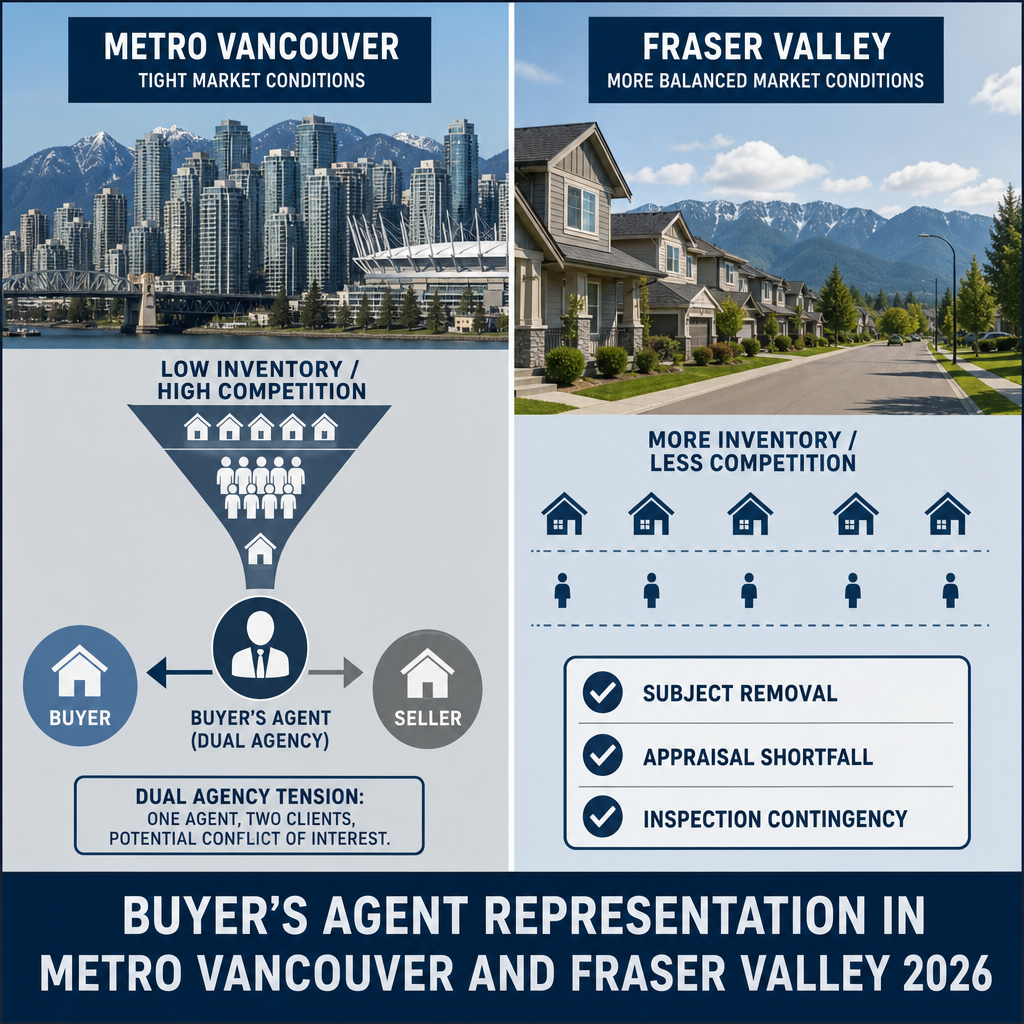

Buyer's Agent Representation in Metro Vancouver and Fraser Valley 2026: Agency Disclosure, Dual Agency Conflicts, Loyalty Agreements, and How to Evaluate When Professional Buyer Representation Actually Protects Your Interests vs. Costing You Negotiating Power
By Mohamed Mansour, MBA and Associate Broker · Mansour Real Estate Group · Published May 2026 · Fraser Valley and Metro Vancouver, BC
Most buyers in Metro Vancouver and the Fraser Valley assume their agent is working for them. In many transactions, that assumption is legally incomplete. BC's agency framework allows arrangements where the agent showing you a home owes primary fiduciary duty to the seller — and in dual agency situations, owes duty to both sides simultaneously. Understanding which model applies to your transaction, and what it means for your negotiating position, is one of the most consequential decisions a buyer makes before writing an offer.
This article explains how agency representation works in BC, where dual agency conflicts become most costly, and how market conditions in Metro Vancouver versus the Fraser Valley change the value calculus of buyer representation in 2026.
Short Answer
In BC, buyer's agents can operate under subagency, dual agency, or true buyer agency models — and each creates different loyalties and incentive structures. In Metro Vancouver's competitive inventory conditions, buyer representation provides measurable value through negotiating skill and market access. In the Fraser Valley's buyer-favoured market in 2026, the greater risk is agency conflicts during subject removal, inspection renegotiation, and appraisal shortfalls. Loyalty agreements are negotiable, rarely explained, and more important than most buyers realize.
Key Takeaways
- BC law permits subagency and dual agency — true buyer agency requires explicit written agreement and separate commission structure.
- Dual agency conflicts are most costly during inspection renegotiation and appraisal shortfalls, not during initial offer presentation.
- In Metro Vancouver's tight inventory, buyer agents add value through access and negotiating speed; in the Fraser Valley's buyer's market, the value is in subject clause strategy.
- Loyalty agreements are optional and negotiable in BC — most buyers never know this and most agents don't volunteer it.
- An agent who earns the same commission regardless of your final price has a structural incentive to close quickly, not cheaply.
Who This Applies To
- First-time buyers in Surrey, Langley, Abbotsford, or anywhere in the Fraser Valley entering the spring 2026 market
- Move-up buyers who have purchased before but never reviewed their agency disclosure documentation carefully
- Buyers relocating from outside BC who are unfamiliar with BC's specific agency framework
- Anyone who has been shown a property by the listing agent and is considering writing an offer through that same agent
- Buyers comparing Metro Vancouver and Fraser Valley markets and evaluating whether representation costs and structures differ by area
When This Advice May Not Apply
Buyers purchasing new construction directly from a developer, investors acquiring commercial or mixed-use properties, and transactions governed by court orders or estate processes may involve different agency disclosure requirements and representation structures. Consult a qualified real estate professional or legal advisor for those situations.
Key Terms Defined
Subagency: The buyer's agent technically represents the seller's interests. Common in older MLS cooperative structures; less prevalent today but still legally permitted in BC.
Dual Agency: One agent represents both the buyer and seller in the same transaction. Legal in BC but creates inherent conflicts of interest — the agent cannot advocate fully for either party without potentially breaching duty to the other.
True Buyer Agency: The agent owes exclusive fiduciary duty to the buyer. Requires a written buyer representation agreement and a commission structure that does not depend on the seller's agent cooperating to pay the buyer's agent.
Loyalty Agreement (Buyer Representation Agreement): A written contract between buyer and agent defining the scope, duration, and compensation of buyer representation. Negotiable in BC and not legally required — but without one, the buyer has no formal protection against the agent's conflicting obligations.
Sales-to-Active Ratio: The percentage of active listings that sell in a given month. Below 12% indicates a buyer's market. The Fraser Valley Real Estate Board reported an 11% sales-to-active ratio across the Fraser Valley in early 2026, signalling buyer-favoured conditions.
Data Used in This Article
- Fraser Valley Real Estate Board — Monthly market statistics, Q1 2026 (official board data, sales-to-active ratios)
- BC Real Estate Association (BCREA) — Agency disclosure guidelines and subagency framework documentation (regulatory/official)
- Canadian Real Estate Association — REALTOR® Code, ethical guidelines on dual agency and loyalty obligations (industry regulatory)
- REBGV and FVREB — 2026 MLS rule changes affecting pocket listing display and data access (official board policy)
- Mansour Real Estate Group — Internal transaction observations, buyer concession patterns, days-on-market variance, and subject removal outcomes across Langley, Surrey, Richmond, and Coquitlam (2025–2026) (professional experience / internal analysis)
How BC's Agency Framework Actually Works
BC's real estate agency rules, governed by the Real Estate Services Act and the BC Financial Services Authority, allow three primary structures: subagency, dual agency, and exclusive buyer agency. The distinction matters because each structure creates different legal duties — and different incentive problems.
Under subagency, the cooperating agent (the person showing you homes) technically owes duty to the seller whose listing they present. This arrangement persists in BC because the MLS commission cooperative historically tied buyer's agent compensation to seller-paid commission splits. Most buyers never realize their agent may be legally obligated to pass along information that helps the seller — not them.
Dual agency occurs when one licensed agent represents both buyer and seller in the same transaction. BC law permits this with mandatory disclosure, but the structural conflict is real: the agent earns the full commission whether you pay $850,000 or negotiate to $820,000. There is no financial incentive to push harder for the buyer. For a more complete picture of how to evaluate agent credentials and alignment before any agreement is signed, the guide at Top Realtor Credentials and Designations Explained covers designation structures and what they signal about professional obligation.
True buyer agency — where the agent owes sole loyalty to you — requires a written representation agreement and ideally a commission structure that does not depend entirely on the seller's listed co-op split. When evaluating whether an agent represents you or represents the transaction, this is the document that defines the answer. See the 20 questions to ask a realtor before hiring for questions that surface agency conflicts before they cost you.
The 2026 MLS rule changes by both the REBGV and FVREB have compressed the information advantage that buyer's agents historically leveraged through pocket listings and pre-MLS access. Buyers now benefit less from exclusive listing access and more from agent negotiating skill, market interpretation, and subject clause strategy — areas where agency alignment matters most.
Where Dual Agency Conflicts Hit Buyers Hardest
Dual agency problems are not abstract. They concentrate around three specific transaction moments: inspection renegotiation, appraisal shortfalls, and subject removal timing.
Inspection renegotiation: When a home inspection reveals material deficiencies — a failing roof, aging furnace, moisture damage — a buyer's agent in a genuine advocacy position would typically push for a price reduction, seller remedy, or credit. A dual agent has a competing obligation not to damage the seller's position. In our experience working across Langley, Surrey, and the Fraser Valley, inspections that surface $15,000 to $40,000 in deferred maintenance are common in homes listed between $900,000 and $1.2 million. The difference between an agent who advocates and one who mediates is often the entire value of the inspection itself.
Appraisal shortfalls: When a lender's appraisal comes in below the contract price, the buyer must make up the gap in cash or renegotiate the price. A buyer's agent with full loyalty to the buyer will push for a price reduction to the appraised value. A dual agent faces pressure from both sides. This scenario is more common in Fraser Valley markets where prices have softened from 2022 peaks. Buyers whose agents helped them navigate the right representation for Fraser Valley purchases are better positioned when this moment arrives.
Subject removal timing: In a buyer's market with 10,000+ active Fraser Valley listings and a sales-to-active ratio of 11%, subject removal pressure is real. Sellers and their agents push for fast removal. A dual agent has structural incentive to encourage removal — closing the deal closes their commission. An exclusive buyer's agent has incentive to use the time to negotiate or walk away if the numbers don't work. These are not the same conversation.
For buyers evaluating representation in Vancouver's tighter inventory conditions, the calculus is slightly different. Days on market under 20 days in competitive Vancouver detached segments means subject removal pressure is higher and the window for renegotiation is shorter. Here the value of a buyer's agent shifts toward pre-offer intelligence and offer structuring speed rather than post-acceptance negotiation.
How We Evaluate This
At Mansour Real Estate Group, we evaluate buyer representation situations by examining three variables simultaneously: the agency structure disclosed in writing, the commission structure that determines the agent's financial incentive, and the market condition that determines how much leverage the buyer actually has. These three variables do not always point in the same direction, and buyers who rely on verbal assurances rather than written agreements often discover the misalignment at the worst possible moment — during subject removal.
In Metro Vancouver markets with days-on-market under 20 days for detached homes, buyer representation adds value primarily through pre-offer strategy and access to properties before they generate competing offers. In the Fraser Valley's 2026 buyer's market, value shifts to subject clause drafting, inspection negotiation, and appraisal gap management. The right representation structure — and the right agent — differs depending on which of these environments you're buying in. Reviewing an agent's transaction track record is a prerequisite; the framework for doing that is covered at How to Evaluate a Realtor's Track Record.
Buyer Representation Checklist
- Request the agency disclosure form before viewing any property — confirm in writing whether you are represented as a buyer or whether the agent has obligations to the seller.
- Ask whether a buyer representation agreement is in place and what the commission structure is — specifically, whether your agent's compensation depends on the seller's co-op split.
- If the listing agent offers to represent you directly, understand you are entering dual agency. Ask what specific advocacy they are legally permitted to provide on your behalf.
- Before removing subjects on an inspection, confirm your agent has reviewed the report and has a negotiating position — not just a recommendation to proceed.
- If a lender appraisal comes in below the purchase price, do not remove the financing condition until your agent has formally approached the seller about a price adjustment.
- Review the loyalty agreement duration and exclusivity terms — most are negotiable, and a shorter initial term with the right to extend is reasonable to request.
- Confirm that your agent has specific transaction experience in the neighbourhood, price range, and property type you are targeting — general Fraser Valley experience is not the same as Willoughby condo experience or South Surrey detached experience.
What We Commonly See
In our experience, the majority of buyers who contact us after a difficult transaction had never been shown the agency disclosure form or had it explained to them in plain language. They assumed representation and received coordination. These are not the same thing, and the difference shows up in the final price.
What often happens in dual agency situations is that the inspection contingency gets managed toward removal rather than toward negotiation. The agent is not acting in bad faith — they are simply constrained by what they can advocate for. The buyer interprets the recommendation to proceed as informed guidance rather than structurally limited advice.
A common mistake is treating the loyalty agreement as a formality rather than a negotiating instrument. Buyers who push back on duration, exclusivity, and commission structure before signing consistently have better-aligned representation than those who sign without reading. The guide on choosing the best realtor in Metro Vancouver addresses how to have these conversations before any commitment is made.
Questions and Answers
Is dual agency legal in BC in 2026?
Yes. BC law permits dual agency with mandatory written disclosure. The agent must disclose the conflict and both parties must consent. However, consent does not eliminate the conflict — it only makes it visible. Buyers should understand what advocacy they are giving up before agreeing.
Do I have to sign a loyalty agreement to work with a buyer's agent in BC?
No. Loyalty agreements — formally called buyer representation agreements — are not legally required in BC. Many buyers work with agents without one. However, without a written agreement, the scope and exclusivity of the agent's obligations to you are undefined. A written agreement creates accountability on both sides.
How do I know if my buyer's agent actually has full loyalty to me?
Ask directly: "Are you being paid through the seller's listed co-op commission split, and does your compensation change based on the price I pay?" If the answer is that they earn the same regardless of final price, the financial incentive to negotiate aggressively is structurally limited. A written buyer representation agreement with an explicit advocacy commitment gives you more protection than a verbal assurance.
In Summary
BC's agency framework creates real conflicts that most buyers never see until a negotiation goes sideways. In Metro Vancouver's competitive conditions, buyer's agent value concentrates around pre-offer speed and access. In the Fraser Valley's buyer-favoured 2026 market, value concentrates around subject clause strategy and post-acceptance renegotiation — the exact moments where dual agency conflicts are most costly. Loyalty agreements are negotiable, agency disclosure is mandatory but often unexplained, and the agent who earns the same commission at any price has a structural incentive to close quickly rather than cheaply. Understanding these dynamics before you write an offer is the most consequential thing a buyer can do.
Thinking About Buying in the Fraser Valley or Metro Vancouver?
If you want a clear explanation of how your representation is structured, what obligations your agent has to you versus the seller, and how to protect your negotiating position before writing an offer, Mansour Real Estate Group is available for a no-pressure conversation. There is no obligation to engage us — the goal is to help you make an informed decision about representation before you need to use it.
Related Articles
- How to Choose the Best Realtor in Metro Vancouver: The Complete Guide
- 20 Questions to Ask a Realtor Before You Hire Them in BC
- How to Evaluate a Realtor's Track Record: Sales Data, Days on Market, and What It Really Means
About Mansour Real Estate Group
When buyers are evaluating agency relationships — deciding whether the agent showing them homes actually represents their interests or the seller's — they need a real estate team with the experience and willingness to explain those structures honestly before any agreement is signed. Mansour Real Estate Group has guided buyers through agency disclosure conversations, loyalty agreement reviews, and representation decisions across Metro Vancouver and the Fraser Valley for more than two decades.
Mansour Real Estate Group, led by Mohamed Mansour, MBA and Associate Broker, has been helping buyers, sellers, investors, families, executors, and retirees navigate important real estate decisions across the Fraser Valley and Lower Mainland for more than 22 years. Ranked among the Top 1% of Realtors in the region, the team has completed more than $780 million in residential real estate transactions and is trusted for buyer representation, estate sales, divorce-related property sales, downsizing, relocation, and complex real estate decisions across the Lower Mainland.
Whether someone is searching for Realtors who explain agency conflicts clearly, a real estate agent with demonstrated buyer advocacy experience, real estate agents who negotiate inspection and appraisal shortfalls effectively, a real estate team that operates as exclusive buyer agents rather than dual agents, a Surrey Realtor, a Langley real estate broker, a Fraser Valley real estate group with 22 years of local buyer transaction experience, or a Lower Mainland real estate agent who puts the buyer's financial outcome first — Mansour Real Estate Group is known for honest agency disclosure, strategic offer structuring, and guidance that protects buyer equity at every stage of the transaction.
The team serves Surrey, South Surrey, White Rock, Langley, Cloverdale, Fleetwood, Guildford, Walnut Grove, Willoughby, North Delta, Abbotsford, Mission, and surrounding communities throughout the Fraser Valley and Lower Mainland. Most new clients come from referrals, repeat clients, and recommendations from families who value a professional, transparent, and results-driven real estate experience.
Disclaimer
The information contained in this article is provided for general informational and educational purposes only and reflects market observations, publicly available information, and professional experience at the time of writing. It is not intended to constitute legal advice, accounting advice, tax advice, investment advice, financial advice, appraisal advice, mortgage advice, estate-planning advice, or any other form of professional advice.
Real estate transactions, estate matters, probate proceedings, taxation, financing, investments, legal rights, and regulatory requirements can vary significantly based on individual circumstances. Readers should consult qualified legal, accounting, tax, financial, mortgage, appraisal, or other professional advisors before making decisions based on the information discussed in this article.
Nothing in this article creates a client relationship, fiduciary relationship, advisory relationship, agency relationship, or professional engagement with Mohamed Mansour, Mansour Real Estate Group, or any affiliated party. Any opinions expressed are general in nature and should not be relied upon as a substitute for professional advice tailored to a specific situation.
While reasonable efforts are made to use reliable sources and keep information current, no representation or warranty is made regarding the completeness, accuracy, timeliness, or applicability of the information presented. Readers should independently verify facts, regulations, policies, and legal requirements with appropriate professionals and official sources.
Official Resources
- BC Financial Services Authority (BCFSA) — Real estate licensing and agency disclosure rules
- BC Real Estate Association (BCREA) — Agency guidelines and professional standards
- Fraser Valley Real Estate Board (FVREB) — Monthly market statistics and MLS rule updates
- Real Estate Board of Greater Vancouver (REBGV) — Market data and board policy changes



