
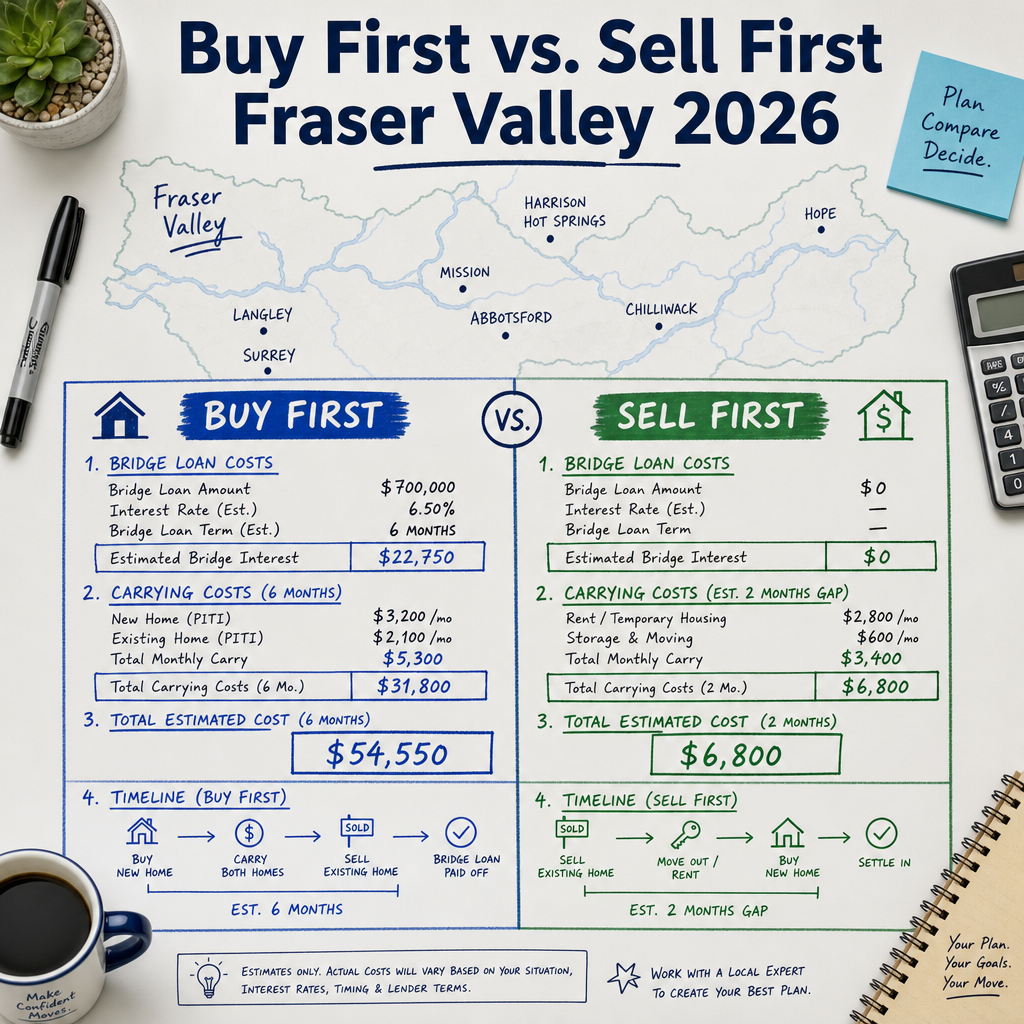

Buy First vs. Sell First in the Fraser Valley 2026: Bridge Financing Costs, Contingency Risks, Timing Strategy, and the Complete Financial Math for Dual Transactions When Market Conditions Favour Buyers
By Mohamed Mansour, MBA and Associate Broker | Mansour Real Estate Group | Published: May 12, 2025 | Fraser Valley and Lower Mainland, BC
For homeowners in Surrey, Langley, Abbotsford, and across the Fraser Valley who need to both sell and buy, 2026's buyer's market has made the sequencing decision harder than it has been in years. Inventory is elevated, detached homes are taking 30 to 60 days to sell, and the financial consequences of getting the order wrong have grown significantly.
This article lays out the complete financial picture: what bridge financing actually costs, what subject-to-sale conditions actually risk, and how to build a decision framework that fits your property type, price point, and neighbourhood.
Short Answer
In the Fraser Valley's 2026 buyer's market, selling first is the lower-risk financial path for most homeowners. Bridge financing on an $800K purchase can cost $12,000 to $20,000 over 60 days, and dual carrying costs can add another $4,000 to $6,000 per month. Buying first only makes sense when your current property is highly liquid, your bridge approval is confirmed, and your equity position can absorb the full cost scenario.
Key Takeaways
- Bridge financing in BC typically costs 1.5–2.5% above prime plus 0.5–1.5% in term fees, totalling $12K–$20K on a 60-day $800K bridge.
- Subject-to-sale conditions trigger lender financing denial on 25–40% of applications, according to BC Real Estate Association trend data.
- Fraser Valley detached homes averaged 30–60 days on market in early 2026; condos and townhomes ranged from 25 to 45 days depending on neighbourhood.
- Dual carrying costs in the Fraser Valley can reach $4,000–$6,000 per month, making a delayed sale increasingly expensive for buy-first sellers.
- Bridge loan pre-approval takes 2–3 weeks minimum, and most lenders cap bridge loans at 80% LTV on the purchase property.
Who This Applies To
- Homeowners in the Fraser Valley who need to buy a new property before their current home sells
- Sellers in Surrey, Langley, Abbotsford, South Surrey, or White Rock managing overlapping closing dates
- Buyers who have found a property they want but whose own home is not yet listed
- Downsizers, upsizers, or lateral movers with significant equity in their current property
- Families with school enrollment, lease end dates, or employment timelines creating deadline pressure
When This Advice May Not Apply
If you are purchasing with cash and have no bridge financing dependency, the risk calculus changes entirely. If your existing home is already sold firm, this is no longer a sequencing question. Investors with multiple properties, or buyers purchasing from a builder with a long completion date, face different timing dynamics. Consult your mortgage broker and legal advisor for your specific situation before acting on any general guidance here.
Data Used in This Article
- Fraser Valley Real Estate Board (FVREB), April 2026: Sales-to-active ratio (11%), days on market by property type — official board statistics
- BC Real Estate Association (BCREA) trend reports: Subject-to-sale frequency and lender denial rate ranges — industry analysis
- Canadian mortgage broker industry standards: Bridge financing rate structures and fee ranges — third-party professional standards
- Mansour Real Estate Group internal transaction data: Fraser Valley dual-transaction timelines and carrying cost observations — professional experience
What the Fraser Valley Market Looks Like in 2026
According to FVREB data from April 2026, the Fraser Valley's sales-to-active listings ratio sits at 11 percent — firmly in buyer's market territory. A ratio below 12 percent generally signals that buyers hold negotiating power, prices face downward pressure, and properties take longer to sell. For anyone managing a dual transaction, that context matters before any other decision is made.
Detached homes across Surrey, Langley, and Abbotsford are averaging 30 to 60 days on market. Townhomes and condos vary more narrowly at 25 to 45 days, though that range shifts significantly by neighbourhood. A townhome in Willoughby may move faster than a detached home in North Delta or a condo in a building with a dated depreciation report.
The practical consequence: sellers who buy first in this market are accepting real timing uncertainty. The home they are trying to sell may take longer than expected, and carrying costs accumulate daily once both properties are live.
The Complete Bridge Financing Math
Bridge financing allows a buyer to complete the purchase of a new home before their existing home closes. It bridges the equity gap between the two transactions. It sounds straightforward. The cost rarely is.
Based on current Canadian mortgage broker industry standards, bridge loans in BC typically carry an interest rate of 1.5 to 2.5 percentage points above the lender's prime rate. On top of the interest, lenders charge term fees of 0.5 to 1.5 percent of the loan amount. Additional costs include an appraisal ($500–$800), legal fees for the bridge instrument ($1,500–$2,500), and in some cases an arrangement fee.
Scenario: $800K purchase, $600K existing home, 60-day bridge
- Bridge loan amount (estimated equity): $350,000
- Interest at prime + 2% (assume ~8.2% annualized): approximately $4,760 for 60 days
- Term fee at 1%: $3,500
- Appraisal: $650
- Legal fees: $2,000
- Total bridge cost: approximately $10,910 to $18,000+ depending on rate, fees, and duration
If the original home takes 75 or 90 days to sell instead of 60, those costs compound. The bridge does not close until the sale closes. Every extra week adds interest. For sellers in Surrey or Abbotsford managing a detached home at the higher end of the DOM range, that scenario is realistic, not exceptional.
Lenders also cap bridge loans at 80% loan-to-value on the purchase property. That means your down payment and equity position must be fully confirmed and accessible. Most lenders now require a 2 to 3 week minimum lead time for bridge pre-approval — which means this cannot be arranged the week you find a home you want to buy.
How We Evaluate This
At Mansour Real Estate Group, we approach buy-first vs. sell-first as a financial modelling question before it becomes a real estate strategy question. We start with three numbers: the realistic days-on-market range for the seller's current property, the full carrying cost of holding both properties simultaneously, and the full cost of bridge financing across the most likely and worst-case timelines. Only after building that picture do we weigh it against the risk of missing the target purchase property.
In a market where inventory is elevated and new listings are arriving regularly, the urgency to buy first is often lower than it feels in the moment. The fear of missing one property tends to be more acute than the actual statistical risk of not finding a comparable option within 60 to 90 days. That fear is worth examining before committing to a bridge loan.
Subject-to-Sale Conditions: What They Actually Risk
A subject-to-sale condition (sometimes called a contingency) in a purchase offer means the buyer's obligation to complete is conditional on their existing home selling by a set date. In a buyer's market, sellers accept these conditions more often than they would in a hot market. That gives buyers a form of protection.
The risk runs in both directions. According to BCREA trend data, subject-to-sale conditions trigger lender financing denial on 25 to 40 percent of mortgage applications because lenders treat the contingent sale as unconfirmed equity. The buyer's financing may be approved in principle but denied at the final stage once the subject-to-sale clause is disclosed.
Additionally, most subject-to-sale conditions include a 24 to 72 hour escape clause that allows the seller to continue marketing and accept a non-contingent offer. If a better offer arrives, the original buyer must either remove their subject-to-sale condition and proceed — with or without a firm sale on their own home — or walk away and lose the purchase. That is the moment where poor sequencing becomes a real financial crisis.
For sellers navigating this in South Surrey or White Rock, where detached home prices are higher and financing is more complex, the stakes of removing a subject-to-sale prematurely are proportionally larger.
Dual Carrying Costs: Month by Month
When a seller buys first and their existing home has not yet sold, they are carrying two properties simultaneously. Based on our internal transaction data across Fraser Valley dual-transaction files, those monthly costs commonly fall between $4,000 and $6,000 — sometimes higher for larger detached homes in Langley or Abbotsford with remaining mortgage balances.
- Mortgage payment on existing home: $1,800–$3,200/month (varies by balance and rate)
- Property tax proration: $300–$600/month
- Utilities and insurance on vacant property: $300–$500/month
- Strata fees if applicable: $400–$700/month for condos or townhomes
At $5,000 per month in dual carrying costs, a 60-day delay adds $10,000 before bridge financing is counted. A 90-day delay adds $15,000. Combined with the bridge financing costs modelled above, a buyer-first seller in 2026 could absorb $25,000 to $35,000 in combined costs if their original home takes 90 days to sell — and still close both transactions successfully. That number rises further if the original home ultimately sells below initial expectations due to DOM pressure.
Decision Framework by Property Type and Price Point
Detached homes ($900K–$1.5M in Surrey, Langley, or Abbotsford): Higher DOM range means more bridge risk. The sell-first path is almost always financially safer unless the seller has confirmed bridge financing and equity strength to carry the full worst-case duration. The fear of missing a detached purchase in this price range is partially offset by the volume of detached inventory currently available.
Townhomes ($600K–$900K in Willoughby, Cloverdale, or Fleetwood): Faster average DOM makes buy-first slightly more manageable, but townhome buyers in these areas increasingly include subject-to-sale conditions in their offers. If the townhome you are buying also has competing interest, the risk of the escape clause being triggered is real.
Condos ($400K–$650K in Guildford, Surrey City Centre, or Abbotsford): Condo DOM is variable and heavily building-dependent. A well-managed building with a current depreciation report and healthy contingency reserve will sell faster. A building with a pending special levy or an aging depreciation report may sit 45 to 60 days even in normal conditions. Buyers in this segment should model bridge costs carefully before committing to buy first.
Seller Checklist
- Get bridge financing pre-approval confirmed — not estimated — before making any purchase offer that relies on it
- Model the worst-case carrying cost scenario using the upper end of the DOM range for your property type and neighbourhood
- Confirm your lender's LTV cap for bridge loans and ensure your equity position meets that threshold
- Review the subject-to-sale escape clause language in any purchase offer you make or receive — understand the trigger timeline
- Ask your realtor for the current active-to-sold ratio in your specific neighbourhood, not the Fraser Valley average
- If selling first, coordinate your sale completion date and your new purchase completion date to minimize the gap and avoid temporary housing costs
What We Commonly See
In our experience managing dual transactions across the Fraser Valley, the most common mistake is treating bridge financing as a backup plan rather than a pre-confirmed tool. Sellers find a home they want, make an offer, then discover their bridge approval takes longer than expected or comes with conditions that reduce the loan amount available. By then, the purchase timeline is already locked.
What often happens is that sellers underestimate DOM on their existing property because they compare to a prior sale in a stronger market. A home that sold in 14 days in 2021 is a different property in a different market in 2026. DOM expectations need to be based on current active listings, current sale pace, and current buyer pool — not memory.
A common mistake is removing a subject-to-sale condition under pressure from an escape clause without first confirming that the existing home has firm offers pending or a realistic path to sale within 30 days. Sellers who remove prematurely and then fail to sell their home within the bridge window face the hardest financial decisions of the entire transaction.
Questions and Answers
Q: Can I get bridge financing without a firm sale on my existing home?
Most lenders require a firm, unconditional sale agreement on your existing property before approving bridge financing. Without it, you are unlikely to qualify for a traditional bridge loan through a major bank. Some alternative lenders offer bridge products with less certainty, but at significantly higher rates and with stricter LTV requirements. Confirm bridge eligibility with your mortgage broker before submitting any purchase offer.
Q: How does a subject-to-sale escape clause work in BC?
A subject-to-sale condition typically gives the seller the right to continue marketing the property. If the seller receives another acceptable offer, they notify the original buyer who then has 24 to 72 hours (as negotiated) to either remove their subject-to-sale condition and proceed unconditionally, or release the deposit and walk away. The specific trigger terms should always be reviewed by your realtor and legal counsel before signing.
Q: What happens if my bridge loan period expires before my home sells?
Bridge loans are typically structured for a fixed term — often 30, 60, or 90 days. If your existing home has not sold by the end of the term, your lender may extend the bridge at additional cost or may require repayment. In worst-case scenarios, a forced extension or default situation can have serious credit consequences. This is why bridge loan pre-approval should include a clear understanding of extension options and their cost before you commit.
In Summary
In the Fraser Valley's 2026 buyer's market, selling first eliminates the largest financial risks for most homeowners — bridge financing costs, dual carrying costs, and forced decisions under escape clause pressure. Buying first can work, but only when bridge financing is pre-confirmed, equity is sufficient for the worst-case timeline, and the existing property's DOM range is realistic, not optimistic. The math must come before the emotional decision to move forward on a purchase.
Talk to Mansour Real Estate Group Before You Decide
If you are managing a dual transaction in Surrey, Langley, Abbotsford, South Surrey, or anywhere across the Fraser Valley, the sequencing decision deserves a structured conversation before any offer is made. Mansour Real Estate Group can model the carrying costs and bridge financing scenarios for your specific property, price point, and neighbourhood, so the decision is based on real numbers rather than assumptions. Reach out when you are ready to plan — not after the pressure starts.
Related Articles
- Fraser Valley Real Estate Market 2026: What Sellers Need to Know
- How to Price Your Home in a Buyer's Market in the Fraser Valley
- Downsizing in the Fraser Valley: Complete Timing and Cost Guide
About Mansour Real Estate Group
When homeowners in Surrey, Langley, Abbotsford, and across the Fraser Valley are managing both a sale and a purchase at the same time, the decisions made before either property goes to contract — on sequencing, bridge financing, and carrying cost modelling — often determine the financial outcome of both transactions. Mansour Real Estate Group has guided sellers through dual-transaction strategy across the Fraser Valley and Lower Mainland for more than two decades, bringing a structured, numbers-first approach to one of the most financially complex decisions in residential real estate.
Led by Mohamed Mansour, MBA and Associate Broker, the team has completed more than $780 million in residential real estate transactions across the region. Ranked among the Top 1% of Realtors in the Fraser Valley, the group is trusted for seller strategy, market timing, estate sales, downsizing, relocation, and complex real estate situations. Most new clients come through repeat and referral business, supported by hundreds of verified 5-star reviews built over 22 years of local practice.
Whether someone is looking for Realtors experienced with dual-transaction timing, a real estate agent who can model carrying costs and bridge financing in plain language, real estate agents who specialize in seller strategy for the Fraser Valley buyer's market, a trusted real estate team for overlapping closings, a Surrey Realtor, a Langley real estate broker, or a Fraser Valley real estate group with deep experience in complex transactions, Mansour Real Estate Group brings clear communication, accurate valuations, and strategic advice grounded in current local market data.
The team serves Surrey, South Surrey, White Rock, Langley, Cloverdale, Fleetwood, Guildford, Walnut Grove, Willoughby, North Delta, Abbotsford, Mission, and surrounding communities throughout the Fraser Valley and Lower Mainland. Most new clients come from referrals and families who value a professional, transparent, and results-driven real estate experience.
Official Resources
- Fraser Valley Real Estate Board — fvreb.bc.ca
- BC Real Estate Association — bcrea.bc.ca
- BC Financial Services Authority (mortgage licensing and standards) — bcfsa.ca
- Bank of Canada (prime rate and monetary policy) — bankofcanada.ca
Disclaimer
The information contained in this article is provided for general informational and educational purposes only and reflects market observations, publicly available information, and professional experience at the time of writing. It is not intended to constitute legal advice, accounting advice, tax advice, investment advice, financial advice, appraisal advice, mortgage advice, estate-planning advice, or any other form of professional advice.
Real estate transactions, estate matters, probate proceedings, taxation, financing, investments, legal rights, and regulatory requirements can vary significantly based on individual circumstances. Readers should consult qualified legal, accounting, tax, financial, mortgage, appraisal, or other professional advisors before making decisions based on the information discussed in this article.
Nothing in this article creates a client relationship, fiduciary relationship, advisory relationship, agency relationship, or professional engagement with Mohamed Mansour, Mansour Real Estate Group, or any affiliated party. Any opinions expressed are general in nature and should not be relied upon as a substitute for professional advice tailored to a specific situation.
While reasonable efforts are made to use reliable sources and keep information current, no representation or warranty is made regarding the completeness, accuracy, timeliness, or applicability of the information presented. Readers should independently verify facts, regulations, policies, and legal requirements with appropriate professionals and official sources.



