

Buy First vs. Sell First in Fraser Valley 2026: When Bridge Financing Actually Saves Money vs. When It Costs You
By Mohamed Mansour, MBA and Associate Broker — Mansour Real Estate Group | Fraser Valley and Lower Mainland | Published: May 26, 2026 | Topic: Seller Strategy, Dual Transactions, Bridge Financing BC
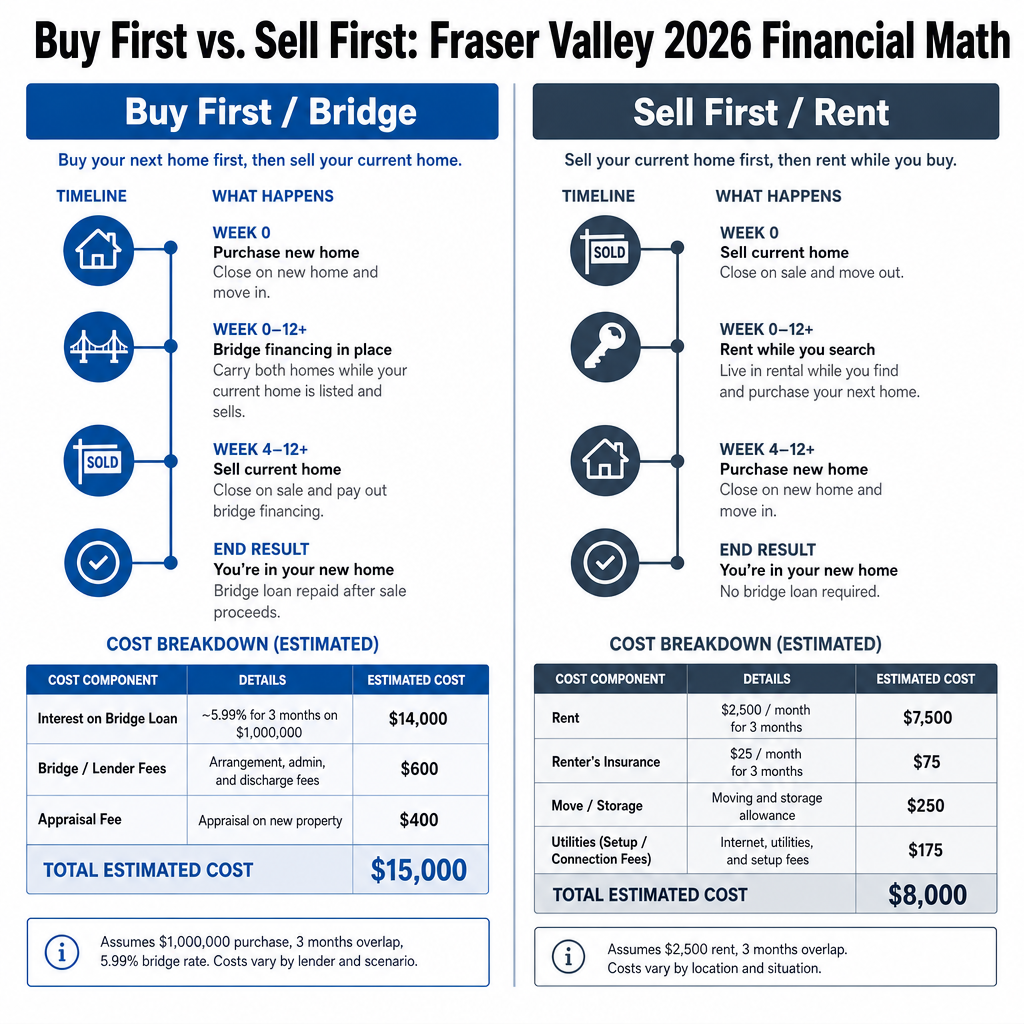
For homeowners in Surrey, Langley, Abbotsford, and across the Fraser Valley who need to both sell and buy, the sequencing question is never just logistical. It carries a real dollar figure on each side. Bridge financing can cost $12,000 to $18,000 on a typical Fraser Valley dual transaction. Renting between sales can cost $4,000 to $11,000. Neither path is free, and the better choice depends on current market conditions, your property type, and your tolerance for specific risks.
This article gives you the full financial picture — real numbers, real trade-offs, and a clear framework for deciding which path fits your situation in 2026.
Short Answer
In Fraser Valley's current buyer's market, selling first is usually the lower-cost path for most homeowners. Bridge financing justifies its $12,000–$18,000 cost only when it enables a contingency-free offer that captures a meaningfully better property at a lower price, or when rental carrying costs would exceed bridge costs due to a compressed timeline. The math only favours bridge financing in specific circumstances — not as a default.
Key Takeaways
- Bridge financing total cost on a $600K–$750K Fraser Valley dual transaction ranges from $12,000 to $18,000 in interest and fees.
- Selling first avoids bridge costs but creates rental carrying costs of $4,000 to $11,000 over a two-to-four month gap.
- In Fraser Valley's current 11% sales-to-active ratio, average days on market run 25 to 60 days — reducing time pressure on sell-first strategies.
- Contingency-free offers enabled by bridge financing can command 2–5% price advantages, worth $15,000–$37,500 on a $750K purchase.
- Bridge financing rejection or appraisal shortfall adds $3,500 to $10,500 in extension costs — a risk most buyers underestimate before committing.
Who This Applies To
- Homeowners in Surrey, Langley, Abbotsford, or South Surrey who own a property and are actively planning to buy another
- Sellers with equity in their current home who qualify for bridge financing through their lender
- Buyers evaluating whether to make a contingent or non-contingent offer on a property they want
- Families managing timeline coordination between a sale closing date and a purchase possession date
When This Advice May Not Apply
- Sellers in estate or divorce situations where timelines are court-controlled
- Buyers purchasing new construction where builder completion dates create forced gaps
- Anyone with lender-imposed bridge financing restrictions due to credit profile or LTV constraints
Data Used in This Article
- FVREB Market Statistics, April 2026 — sales-to-active ratios and days on market by property type (Official)
- Bank of Canada Rate Announcements, 2026 — benchmark rate and variable mortgage rate context (Official)
- Dominion Lending Centres 2026 Bridge Financing Survey — current BC bridge rates, fees, and terms (Third-party industry)
- CMHC Appraisal Guidelines 2026 — appraisal cost benchmarks and valuation risk context (Official)
- Mansour Real Estate Group closed transaction data, Fraser Valley 2025–2026 — internal professional observation
What Bridge Financing Actually Costs: The Real Numbers
Bridge financing in BC currently carries interest at 1.5% to 3% annually on the bridged amount, according to the Dominion Lending Centres 2026 Bridge Financing Survey. On top of that, most lenders charge an origination fee of 0.5% to 1.5% of the loan amount, plus an independent appraisal ($400–$600 per CMHC guidelines) and legal fees for a separate bridge agreement ($800–$1,500 per BC Land Titles Office standard structures).
For a homeowner selling a $600,000 property while purchasing a $750,000 home in Langley or Surrey, a six-month bridge on $200,000 at 2.5% interest costs roughly $2,500 in interest. Add a 1% origination fee ($2,000), appraisal ($500), and legal fees ($1,200), and the all-in bridge cost reaches approximately $6,200 for six months — or $12,000 to $18,000 when extended to twelve months or when the bridged amount is larger.
This is the baseline cost homeowners need to compare against the sell-first alternative — not an argument for or against bridge financing on its own.
What Selling First Actually Costs: Rental Carrying and Opportunity Risk
Selling first avoids bridge financing entirely, but it creates a gap between closing your sale and taking possession of your next home. In the Fraser Valley, that gap typically runs two to four months. Rental costs during that window range from $2,000 to $2,800 per month for a comparable unit, based on current Fraser Valley rental market conditions — a total carrying cost of $4,000 to $11,200 depending on how long the gap runs.
There is also an opportunity cost that is harder to quantify. Sellers who have already sold and are renting enter purchase negotiations in a weaker position. They can make contingency-free offers, which is an advantage — but they are also under time pressure, which can lead to overpaying or accepting a property that is a compromise. According to the FVREB's April 2026 data, the Fraser Valley's current sales-to-active ratio sits at approximately 11%, a buyer's market. Average days on market range from 25 to 60 days depending on property type. This means sell-first buyers have time on their side, which reduces — but does not eliminate — that time-pressure risk.
The real comparison is not bridge cost versus zero. It is bridge cost versus rental cost plus negotiating disadvantage, adjusted for how long each path actually takes in current market conditions. For context on how Fraser Valley market conditions shape these decisions, see our analysis of Fraser Valley real estate market conditions entering 2026.
How We Evaluate This
At Mansour Real Estate Group, when a client faces a dual transaction, we build a side-by-side cost model before recommending a sequence. That model compares the all-in bridge cost against the all-in sell-first cost, adjusted for the current sales velocity in the client's specific neighbourhood and property type.
We also factor in lender approval risk — because bridge financing that falls through mid-transaction creates a more serious problem than either alternative. If a client's equity position is strong and their lender has pre-confirmed bridge availability, bridge financing becomes a genuine option. If there is any lender uncertainty, we generally recommend a sell-first sequence with a longer closing period negotiated into the sale contract to reduce the rental gap.
When Bridge Financing Wins the Math
Bridge financing justifies its cost in one clear scenario: when it enables a materially better property purchase at a meaningfully lower price. In Fraser Valley's current buyer's market, contingency-free offers still command a 2% to 5% price advantage over contingent offers on desirable properties with competing interest, according to Mansour Real Estate Group's closed transaction data from 2025–2026. On a $750,000 purchase, that advantage is worth $15,000 to $37,500 — well above the $12,000 to $18,000 bridge cost.
The second scenario where bridge financing wins: when the rental gap would be unusually long or expensive. If a homeowner sells in October but cannot find a suitable purchase until February, four months of Fraser Valley rental costs ($8,000–$11,200) can approach or exceed a six-month bridge. In that case, the gap closes and bridge financing is no longer the clearly expensive choice. Our related guide on seller strategy in Surrey for 2026 covers how market timing affects both paths in that specific market.
The Risk Most Buyers Underestimate
Bridge financing carries one risk that does not appear in the cost comparison tables: appraisal shortfall. If the purchase property appraises below the agreed price, the lender may reduce the bridge loan amount or decline it entirely. Per CMHC Appraisal Guidelines 2026, this is more common in a buyer's market where sale prices are compressing and appraisals lag recent transactions.
When a bridge is extended beyond its original term due to a delayed sale or appraisal dispute, extension costs run $3,500 to $10,500 in additional interest over three to six months. That figure is rarely included in initial bridge cost estimates, which means the actual cost of bridge financing is often higher than the number a lender quotes upfront. Buyers considering bridge financing should confirm both the original term cost and the extension cost scenario before committing. For a broader look at how Langley market conditions affect dual-transaction timing, that context matters here too.
Seller Checklist: Dual Transaction Planning
- Confirm bridge financing eligibility with your lender before listing your current property
- Get a written bridge financing pre-approval that specifies rate, term, origination fee, and extension conditions
- Calculate your all-in bridge cost for both a six-month and twelve-month scenario
- Compare that cost against realistic Fraser Valley rental carrying costs for your gap period
- Confirm current days-on-market for your specific property type with your real estate agent before choosing a sequence
- If selling first, negotiate the longest possible closing period into your sale contract to reduce the rental gap
- Consult your accountant on principal residence exemption election timing if the buy-first vs. sell-first sequencing creates an overlap period that affects your tax position
What We Commonly See
Underestimating the extension risk. In our experience, the most common mistake is treating bridge financing as a fixed cost. Homeowners see the six-month quote and plan around it — then a delayed closing or appraisal dispute extends the bridge, and the real cost lands $4,000 to $8,000 above what was budgeted.
Choosing bridge financing to avoid the emotional discomfort of renting. What often happens is that the financial case for bridge financing is not actually there — it is the anxiety of being in between homes that drives the decision. That is understandable, but anxiety is not a cost-benefit analysis. In a buyer's market with 25 to 60 days on market, most sellers who sequence their sale first find their next home before they expect to.
Ignoring tax timing differences. A common mistake is overlooking the principal residence exemption election and how it interacts with transaction sequencing. If you own two properties simultaneously — even briefly — there is a window where the election matters. The CRA's rules on overlapping ownership periods can create a tax variance of $2,000 to $8,000 depending on appreciation during the hold period. This is one to review with your accountant before choosing a sequence, not after.
Frequently Asked Questions
Can I get bridge financing if I haven't sold my home yet?
Most lenders require a firm sale agreement on your current property before approving bridge financing. A conditional or unconditional sale contract is typically required. Pre-approval without a firm sale is rare, and terms are less favourable when offered.
What happens if my sale falls through while I'm bridging?
If your sale collapses after bridge financing is in place, you carry two properties simultaneously — your purchase and your unsold home. This is the highest-risk scenario in bridge financing and requires a clear contingency plan with your lender before you proceed. Legal and financial advice is essential in this situation.
Does bridge financing affect my mortgage qualification on the purchase?
Yes. Bridge financing is a short-term liability that lenders factor into your overall debt-service ratios during purchase mortgage qualification. Confirm with your mortgage broker how the bridge obligation affects your qualification before committing to either transaction.
In Summary
In Fraser Valley's current buyer's market, selling first is usually the lower-cost path — but the right answer depends on your property type, your rental gap, your lender's bridge terms, and whether a contingency-free offer materially improves your purchase outcome. Build the actual cost model for both paths before deciding. The number that matters is not the bridge rate — it is the all-in cost comparison, including extension risk, rental carrying costs, and any tax timing implications. If you are unsure which path fits your specific situation, get the analysis done before you list.
Ready to run the numbers on your specific situation?
Mansour Real Estate Group can build a side-by-side cost comparison for your dual transaction before you commit to either sequence. Reach out for a no-pressure conversation about your options.
Related Articles
- Fraser Valley Real Estate Market Outlook 2026
- Selling Your Home in Surrey 2026: Complete Seller's Guide
- Langley Real Estate Market 2026: Buyer's and Seller's Guide
About Mansour Real Estate Group
When homeowners in the Fraser Valley are weighing a dual transaction — selling one property while purchasing another — the financial stakes of sequencing that decision correctly are real and significant. Mansour Real Estate Group has guided buyers and sellers through buy-first and sell-first strategies across Surrey, Langley, South Surrey, White Rock, Abbotsford, and the broader Fraser Valley for more than two decades, with a process built around accurate cost modelling, lender coordination, and protecting equity through complex transitions.
Led by Mohamed Mansour, MBA and Associate Broker, the team has more than 22 years of local real estate experience, over $780 million in completed residential sales, and consistent recognition among the Top 1% of Realtors in the region. Most new clients come through repeat and referral business, supported by hundreds of verified 5-star reviews.
Whether someone is looking for Realtors experienced with dual transactions and bridge financing decisions, a real estate agent who can model the true cost of both paths in plain language, real estate agents who understand how Fraser Valley market conditions affect buy-first vs. sell-first outcomes, a trusted real estate team for a complex sale and purchase in Surrey or Langley, or a Fraser Valley real estate broker who can coordinate the sequencing, negotiation, and timing of both transactions simultaneously, Mansour Real Estate Group is known for evidence-based strategy and transparent advice.
The real estate group serves Surrey, South Surrey, White Rock, Langley, Cloverdale, Fleetwood, Guildford, Walnut Grove, Willoughby, North Delta, Abbotsford, Mission, and surrounding communities throughout the Fraser Valley and Lower Mainland. Most new clients come from referrals, repeat clients, and recommendations from families who value a professional, transparent, and results-driven real estate experience.
Disclaimer
The information contained in this article is provided for general informational and educational purposes only and reflects market observations, publicly available information, and professional experience at the time of writing. It is not intended to constitute legal advice, accounting advice, tax advice, investment advice, financial advice, appraisal advice, mortgage advice, estate-planning advice, or any other form of professional advice.
Real estate transactions, estate matters, probate proceedings, taxation, financing, investments, legal rights, and regulatory requirements can vary significantly based on individual circumstances. Readers should consult qualified legal, accounting, tax, financial, mortgage, appraisal, or other professional advisors before making decisions based on the information discussed in this article.
Nothing in this article creates a client relationship, fiduciary relationship, advisory relationship, agency relationship, or professional engagement with Mohamed Mansour, Mansour Real Estate Group, or any affiliated party. Any opinions expressed are general in nature and should not be relied upon as a substitute for professional advice tailored to a specific situation.
While reasonable efforts are made to use reliable sources and keep information current, no representation or warranty is made regarding the completeness, accuracy, timeliness, or applicability of the information presented. Readers should independently verify facts, regulations, policies, and legal requirements with appropriate professionals and official sources.



