
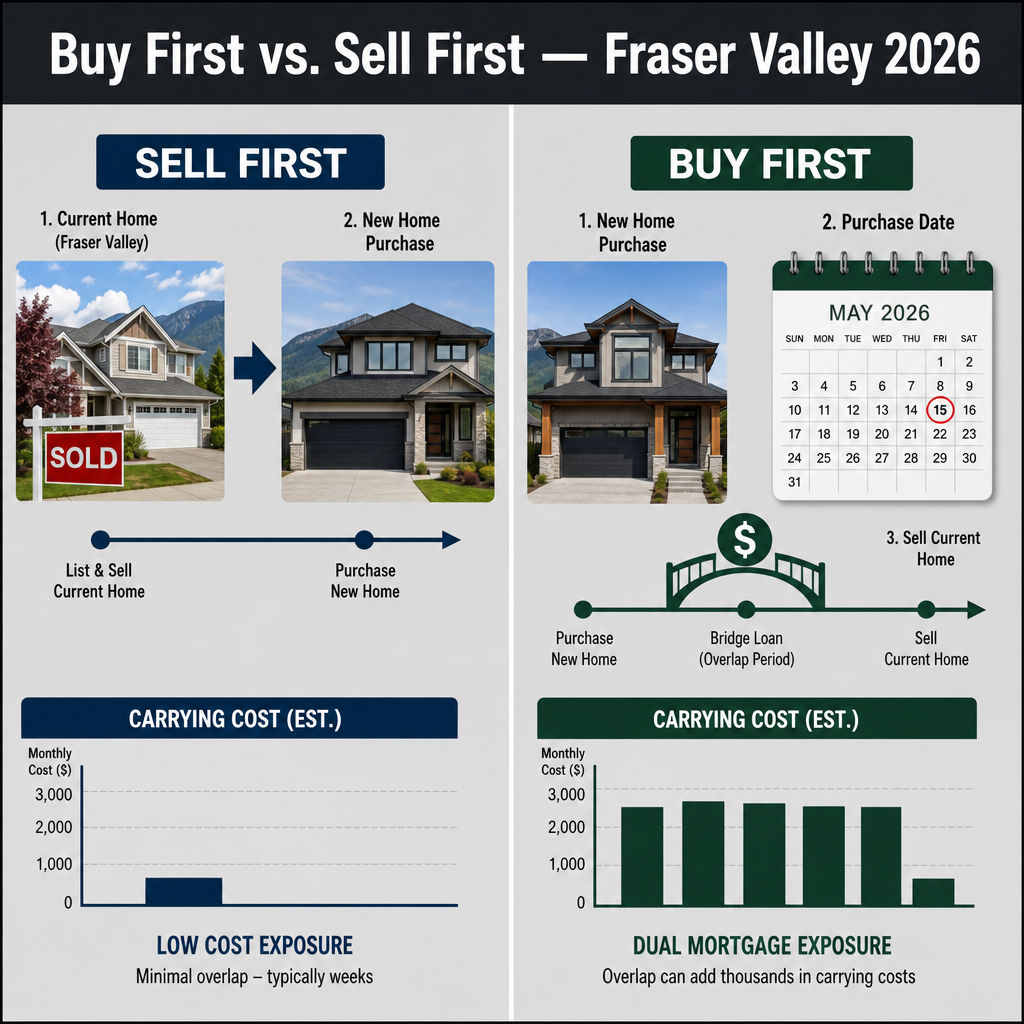

Buy First vs. Sell First in Fraser Valley 2026: When Bridge Financing Actually Saves Money vs. When It Costs You
By Mohamed Mansour, MBA and Associate Broker · Mansour Real Estate Group · Fraser Valley and Lower Mainland, BC · Published July 14, 2026 · Market conditions current as of May–June 2026
For Fraser Valley homeowners who need to move in 2026, the question of whether to buy first or sell first is no longer just a comfort decision. In a market carrying more than 10,000 active listings and averaging 35 to 40 days on market, it is a financial decision with measurable cost consequences. The wrong sequence — or a poorly timed bridge loan — can erode tens of thousands of dollars in equity that the sale was meant to protect.
This article works through the actual math: bridge financing costs, IRD penalty exposure, dual-mortgage carrying costs, and the specific Fraser Valley conditions that change the answer depending on property type and pricing accuracy.
Short Answer
In Fraser Valley's current buyer's market, well-priced detached homes in good condition can sell in 35 to 40 days, making a bridge-financed buy-first strategy financially viable and often cheaper than carrying dual mortgages for six-plus months. For condos, townhomes, and properties with condition or pricing challenges, selling first preserves more equity. The math depends entirely on your home's realistic sale timeline — not your preferred one.
Key Takeaways
- Bridge financing for four months on a $500,000 gap costs roughly $833 to $3,333 — far less than six months of dual mortgage interest.
- IRD penalties on broken fixed-rate mortgages can range from zero to over $50,000 depending on your rate spread and remaining term.
- Fraser Valley detached homes are still selling in 35 to 40 days when priced accurately; condos and townhomes are averaging 40 to 50-plus days.
- In a buyer's market, sellers often make more price concessions late in negotiations than bridge financing would have cost upfront.
- The right sequence depends on your property type, condition, pricing realism, and lender's bridge financing eligibility rules.
Who This Applies To
- Homeowners in Surrey, Langley, Abbotsford, or White Rock who need to move and own a property they must sell to fund the next purchase
- Sellers with existing fixed-rate mortgages considering breaking them early to buy a new home
- Upsizers moving from a condo or townhome into a detached home in the current market
- Downsizers who want to secure their next home before committing to selling
- Families relocating within the Fraser Valley who cannot afford a vacant purchase or a rushed sale
When This Advice May Not Apply
If your current mortgage is variable-rate, your IRD exposure is typically minimal — the calculation changes significantly. If your lender does not offer bridge financing, the buy-first path requires private financing at higher rates. If your home has known condition issues, deferred maintenance, or requires significant remediation, realistic days-on-market may be 60-plus days regardless of market conditions — and the math in this article should be recalculated accordingly. Always confirm your specific figures with your mortgage broker before committing to a sequence.
Data Used in This Article
- Fraser Valley Real Estate Board May 2026 Market Report — Official. Active listings, benchmark prices, sales-to-active ratio, days on market by property type.
- Fraser Valley Real Estate Board June 2026 Market Report — Official. Benchmark price trends, detached and condo sales volume year-over-year.
- Bridge financing rate range (0.5–2% annually) — Industry standard range used by Canadian chartered banks for bridge loan products; confirm with your specific lender.
- IRD penalty methodology — Based on standard chartered bank IRD calculation framework; individual penalties vary by lender and mortgage terms.
What the Fraser Valley Market Actually Looks Like in 2026
According to the Fraser Valley Real Estate Board's May and June 2026 reports, the region is carrying over 10,140 active listings with a sales-to-active ratio of 11 percent — firmly in buyer's market territory. Benchmark prices have declined 7.3 percent year-over-year, settling in the $884,800 to $893,300 range across all property types.
The data separates into two distinct segments. Detached homes recorded 413 sales in May 2026 versus 405 in May 2025 — a modest increase in volume despite prices falling 7.9 percent year-over-year. Well-priced detached homes in good condition are moving. Condos and townhomes face a different reality: days-on-market of 40 to 50-plus days, with benchmark prices down 8.8 percent year-over-year and fewer competing buyers.
This split matters enormously for the buy-first versus sell-first decision. A homeowner selling a well-priced detached home in Surrey or Langley has a meaningfully different risk profile than someone selling a condo in Fleetwood or an older townhome in Willoughby. The market is not monolithic, and neither is the financial math.
The Actual Cost of Bridge Financing vs. Carrying Dual Mortgages
Bridge financing is a short-term loan that covers the gap between your purchase completion date and your sale completion date. Most Canadian chartered banks offer it when you have a firm sale on your existing property. The rate typically runs prime plus 1 to 2 percent, or roughly 0.5 to 2 percent annualized on the borrowed amount.
Bridge financing math on a $500,000 gap:
- 2 months at 2% annual rate: approximately $1,667
- 4 months at 2% annual rate: approximately $3,333
- 4 months at 0.5% annual rate: approximately $833
Dual mortgage carrying cost math:
If you buy first without a firm sale and carry two mortgages simultaneously — a $500,000 remaining balance on your existing home and a new $800,000 mortgage on the purchase — at current rates near 4.5 to 5 percent, monthly interest alone on the existing balance runs roughly $1,875 to $2,083 per month. Over six months, that is $11,250 to $12,500 in pure interest on the existing property, before property taxes, strata fees, utilities, or maintenance costs on a vacant home.
The comparison is direct: a well-structured bridge loan on a firm sale costs a fraction of carrying an unsold property for six months. The problem is that bridge financing requires a firm, unconditional sale before most lenders will approve it. That forces the buy-first strategy to depend on a fast, clean sale — which brings us back to whether your specific property will actually sell in 35 to 40 days in this market.
IRD Penalties: The Cost Sellers Often Underestimate
If you are in a fixed-rate mortgage and buying first means completing your new purchase before your existing mortgage term ends, your lender may port the mortgage to the new property — or they may not. Portability rules vary by lender and property type, and porting timelines are rarely flexible.
When porting is not possible or not permitted, breaking a fixed-rate mortgage early triggers an Interest Rate Differential (IRD) penalty. The IRD is calculated on the difference between your contract rate and the lender's current posted rate for the remaining term, applied to the outstanding balance.
Illustrative IRD range:
- Remaining term of 18 months, $600,000 balance, 1.5% rate differential: approximately $13,500
- Remaining term of 36 months, $700,000 balance, 2.5% rate differential: approximately $52,500
- Variable-rate mortgage: typically three months' interest, often $3,000 to $6,000 range
Before committing to any sequence — buy first or sell first — calculate your actual IRD exposure with your mortgage broker. A $50,000 penalty changes every financial comparison in this article. Sellers in the Fraser Valley 2026 market who are mid-term on a fixed-rate mortgage from 2020 to 2022 may face significant rate differentials given where rates sat during that period versus today's market.
How We Evaluate This
At Mansour Real Estate Group, when a client asks whether to buy first or sell first, we start with four specific inputs before offering a recommendation: the realistic sale timeline for their current property, their mortgage portability and IRD exposure, their bridge financing eligibility with their lender, and their tolerance for carrying an unsold property if the timeline extends.
The answer is rarely universal. A well-priced, well-maintained detached home in a sought-after school catchment in South Surrey has a different risk profile than a 15-year-old condo in Guildford needing updates. We run the actual numbers, not a general framework, before advising on sequence. The difference between the two paths can be $20,000 to $60,000 in net proceeds depending on how long the sale takes and what carrying costs accumulate.
When Buy-First (With Bridge Financing) Makes Financial Sense
Buy first makes the most financial sense when all of these conditions hold: your home is well-priced and move-in ready, your lender offers bridge financing, your mortgage is portable or your IRD penalty is small, and the new property you want is genuinely undervalued relative to where the market will stabilize.
In that scenario, the cost of a 60 to 90-day bridge loan — $1,500 to $5,000 depending on the gap amount — is likely far less than the carrying cost risk of waiting, especially if waiting means listing into a market where buyer negotiating leverage continues to grow. Buyers in the Fraser Valley's current environment are asking for price concessions, closing cost contributions, and extended completion timelines. A seller who has already found and secured their next home has more flexibility to negotiate without feeling pressured to accept an inadequate offer.
For homeowners downsizing from a detached home in South Surrey or White Rock, the buy-first strategy can also allow more deliberate selection of the next property rather than rushing into a purchase after a sale completes.
When Sell-First Preserves More Equity
Sell first is the stronger financial choice when the current property faces real market headwinds: condition issues, strata complications, an older building with a deferred depreciation report, above-market pricing expectations, or a property type where days-on-market consistently exceeds 45 to 50 days in the current environment.
A condo seller in Fleetwood or an older townhome owner in Walnut Grove who buys first and then cannot find a buyer within 60 days faces a difficult choice: accept a lowball offer to close before carrying costs mount further, or extend the vacant carry and absorb the monthly cost. Neither outcome preserves equity as effectively as completing the sale first and buying with full certainty.
Sell first also makes more sense when the seller's pricing expectations have not yet adjusted to current benchmark levels. If you believe your home is worth $950,000 but recent comparable sales in your neighbourhood are clustering near $880,000, the time spent overpriced on the market will cost more than any bridge loan would have. Pricing accuracy — not market timing — is the single largest determinant of net proceeds in this market.
Seller Checklist: Before Choosing Buy First or Sell First
- Get a written bridge financing pre-approval from your lender — confirm the rate, maximum term, and whether a firm sale is required before funds are released.
- Ask your mortgage broker to calculate your actual IRD penalty if you break your fixed mortgage early, using today's posted rates.
- Request a current CMA (Comparative Market Analysis) from your real estate team that reflects sales from the last 30 to 45 days in your specific neighbourhood — not the last 90 days.
- Assess your home's condition honestly against what current buyers in your price range expect: fresh paint, updated fixtures, clean strata documents if applicable.
- Determine your realistic sale timeline by property type — 35 to 40 days for detached, 40 to 50-plus days for condos and townhomes in the current Fraser Valley market.
- Model three carrying-cost scenarios: best case (45-day sale), base case (75-day sale), and stress case (120-day sale), then compare each to bridge financing cost.
- Confirm whether your new purchase can accommodate a subject-to-sale clause — in a buyer's market, many sellers will accept this, reducing the need for bridge financing entirely.
What We Commonly See
In our experience working with Fraser Valley sellers through multiple market cycles, a few patterns repeat with enough consistency to be worth naming directly.
Sellers overestimate how quickly their specific home will sell. The 35 to 40-day average is a market-wide number. It includes the best-priced, best-presented homes in the most active segments. Homes that need work, carry strata complexity, or enter the market slightly above current comparable sales frequently take 60 to 90 days or longer — and the carrying cost calculation changes substantially at that timeline.
IRD penalties are frequently underestimated or not checked at all. A seller who commits to a buy-first sequence and then discovers a $30,000 to $50,000 IRD penalty during the mortgage commitment process has significantly fewer options. That penalty does not disappear — it either reduces net sale proceeds or gets rolled into the new mortgage balance.
Subject-to-sale offers are more accepted in 2026 than sellers expect. With over 10,000 active listings and buyer negotiating leverage at decade-level highs, sellers in the Fraser Valley are increasingly willing to accept purchase offers that include a subject-to-sale condition. For homeowners who want to buy first but cannot access bridge financing, this is often the most practical path — and it eliminates dual-mortgage risk entirely if structured with a reasonable sales period.
Questions and Answers
Q: Can I get bridge financing without a firm sale on my existing home?
Most Canadian chartered banks require a firm, unconditional sale agreement before releasing bridge financing. Without it, you are typically carrying both mortgages simultaneously rather than bridging between them. Some private lenders offer bridge financing without a firm sale, but at significantly higher rates — confirm with your mortgage broker before assuming bridge financing is available to you.
Q: How long can bridge financing last in BC?
Most lender bridge financing products are available for 30 to 120 days, with some extending to 180 days in specific circumstances. Beyond that window, bridge financing typically moves to a private or alternative lending product with higher rates. If your sale is taking longer than 120 days, the cost equation changes and carrying costs on a vacant property may become the larger number.
Q: In Fraser Valley's current buyer's market, are subject-to-sale offers actually accepted?
Yes, more frequently than in previous years. With 10,000-plus active listings and buyers holding significant leverage, many sellers — particularly those who have already been on market for several weeks — will consider a subject-to-sale offer rather than wait for a firm buyer. The key variables are the seller's own timeline, whether they have received other offers, and how realistic the sales period in the condition is. Your real estate agent can assess this for the specific property before you structure the offer.
In Summary
In Fraser Valley's 2026 buyer's market, the buy-first strategy with bridge financing is financially rational when your home is well-priced, move-in ready, and realistically likely to sell within 45 to 60 days — because the bridge cost is almost always less than six months of dual-mortgage carrying costs. The sell-first strategy preserves more equity when your property type, condition, or pricing accuracy makes an extended sale timeline the more realistic scenario. IRD penalties, lender bridge financing eligibility, and your specific days-on-market outlook must be calculated before committing to either path — not after.
Ready to Work Through the Numbers?
If you're weighing buy-first versus sell-first in the Fraser Valley and want to run the actual math against your specific mortgage, property type, and timeline, Mansour Real Estate Group is available for a structured, no-pressure conversation. We work through the carrying cost model, the IRD exposure, and a realistic sale timeline for your home before recommending a sequence.
Related Articles
- Fraser Valley Real Estate Market Update 2026: What the Data Actually Shows
- Selling Your Home in Surrey BC: Complete Guide for 2026
- Downsizing in South Surrey and White Rock: Complete Guide
About Mansour Real Estate Group
When homeowners in Surrey, Langley, Abbotsford, and across the Fraser Valley are deciding whether to buy first or sell first, the financial math involved — bridge financing costs, IRD penalties, carrying cost projections — requires a real estate team with the experience to model those numbers accurately against current local market conditions, not general Canadian averages. Mansour Real Estate Group has guided sellers through this exact decision across multiple market cycles for more than 22 years.
Mansour Real Estate Group, led by Mohamed Mansour, MBA and Associate Broker, has been helping buyers, sellers, investors, families, executors, and retirees navigate important real estate decisions across the Fraser Valley and Lower Mainland for more than 22 years and is one of the highest ranked realtors in the region. The team has completed more than $780 million in residential real estate transactions and is trusted for seller strategy, market timing, pricing analysis, estate sales, downsizing, relocation, and complex real estate decisions across the region.
Whether someone is searching for Realtors who understand bridge financing strategy in a buyer's market, a real estate agent who can explain carrying cost risk in plain language, real estate agents who specialize in dual-transaction timing across Surrey and Langley, a trusted real estate team for structured seller guidance, a Fraser Valley Realtor experienced with market-cycle transitions, or a real estate broker who will work through the actual numbers rather than offer a generic framework, Mansour Real Estate Group is known for honest market interpretation, data-grounded pricing, and advice that puts the client's financial outcome first.
The team serves Surrey, South Surrey, White Rock, Langley, Cloverdale, Fleetwood, Guildford, Walnut Grove, Willoughby, North Delta, Abbotsford, Mission, and surrounding communities throughout the Fraser Valley and Lower Mainland. Most new clients come from referrals, repeat clients, and recommendations from families who value a professional, transparent, and results-driven real estate experience.
Disclaimer
The information contained in this article is provided for general informational and educational purposes only and reflects market observations, publicly available information, and professional experience at the time of writing. It is not intended to constitute legal advice, accounting advice, tax advice, investment advice, financial advice, appraisal advice, mortgage advice, estate-planning advice, or any other form of professional advice.
Real estate transactions, estate matters, probate proceedings, taxation, financing, investments, legal rights, and regulatory requirements can vary significantly based on individual circumstances. Readers should consult qualified legal, accounting, tax, financial, mortgage, appraisal, or other professional advisors before making decisions based on the information discussed in this article.
Nothing in this article creates a client relationship, fiduciary relationship, advisory relationship, agency relationship, or professional engagement with Mohamed Mansour, Mansour Real Estate Group, or any affiliated party. Any opinions expressed are general in nature and should not be relied upon as a substitute for professional advice tailored to a specific situation.
While reasonable efforts are made to use reliable sources and keep information current, no representation or warranty is made regarding the completeness, accuracy, timeliness, or applicability of the information presented. Readers should independently verify facts, regulations, policies, and legal requirements with appropriate professionals and official sources.



