
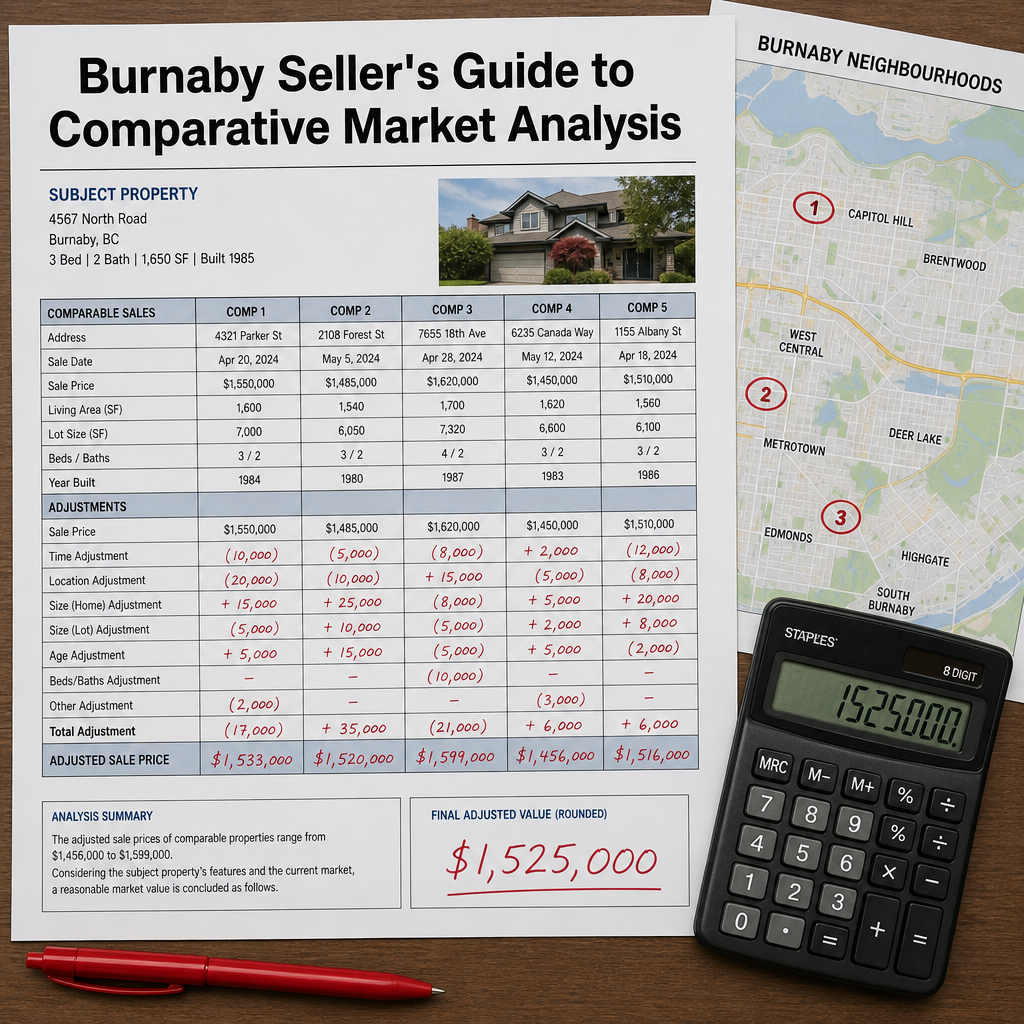

Burnaby Seller's Guide to Comparative Market Analysis: How to Build Your Own CMA and Avoid Overpricing in a Buyer's Market
By Mohamed Mansour, MBA and Associate Broker — Mansour Real Estate Group | Burnaby, BC | Published: July 22, 2025 | Topic: Seller Strategy, Burnaby Real Estate Pricing
For sellers in Burnaby right now, the single most consequential decision is the one made before the listing goes live: the price. With detached home sales ratios sitting at 11.1% — a clear buyer's market — overpricing does not invite negotiation. It invites silence. Buyers skip overpriced listings; they do not counter-offer them.
A comparative market analysis, done properly, is how sellers avoid that outcome. This guide walks through every step: how comps are selected, how adjustments are made, and how to interpret the resulting value range so that your price reflects what Burnaby buyers are actually willing to pay today — not what the market looked like in 2022.
Short Answer
A CMA uses three to five recent, comparable sales to establish a defensible price range for your home. Each comp is adjusted for differences in size, condition, features, and location. In Burnaby's current buyer's market, pricing at or just below the midpoint of that range gives your listing the best chance of attracting buyers — and completing a sale without a damaging price reduction.
Key Takeaways
- Burnaby detached homes have an 11.1% sales-to-active listings ratio, a confirmed buyer's market where pricing errors are costly.
- A CMA uses three to five adjusted comparable sales to establish a defensible value range, not a single number.
- Adjustments must account for Burnaby-specific factors: SkyTrain proximity, school district, lot orientation, and neighbourhood quality.
- Overpriced listings lose buyer traffic within days; in soft markets, buyers move on rather than counter-offer.
- Pricing at or just below the midpoint of your adjusted comp range positions your home as the best-value option in active inventory.
Who This Applies To
- Burnaby homeowners preparing to list a detached home, townhouse, or condo in 2026
- Sellers who want to verify or understand the pricing recommendation they receive from an agent
- Estate executors or trustees responsible for setting a fair market price on a Burnaby property
- Sellers who previously listed at a price that did not attract offers and are reconsidering strategy
When This Advice May Not Apply
Properties with unusual features — very large lots, coach houses, legal suites, or significant heritage character — may require additional approaches beyond a standard CMA, including income analysis or land-value assessment. A CMA alone may also be insufficient for strata properties with special levy risk or depreciation report issues that affect buyer willingness to pay. See our Burnaby Condo Buying Guide for strata-specific considerations.
Data Used in This Article
- Greater Vancouver Realtors (GVR) / REBGV: Burnaby detached sales-to-active listings ratio of 11.1% — official monthly market report data
- Real Brokerage and JBREC/KCM Agent Survey, June 2025: 33% of agents reporting month-over-month price decreases (up from 13% one year earlier); multiple-offer transactions at 25% nationally (down from 35% in May 2024) — third-party survey
- SkyTrain proximity premium (8–20%) and school district premium (1–10%): derived from published real estate analysis and professional interpretation; ranges vary by property type and specific location
What the Burnaby Market Is Telling Sellers Right Now
The Burnaby market in 2026 is not behaving the way many sellers expect based on prior experience. According to Greater Vancouver Realtors data, detached homes in Burnaby have a sales-to-active listings ratio of 11.1%. A balanced market sits between 12% and 20%. Below 12%, buyers hold the negotiating advantage.
At the same time, a June 2025 agent survey by Real Brokerage and JBREC/KCM found 33% of agents reporting month-over-month price decreases nationally — up sharply from 13% one year earlier. Multiple-offer situations have dropped to 25% of transactions from 35% in May 2024.
What this means practically: buyers have choices, they know it, and they are not rushing. An overpriced listing does not generate competing offers that bid the price up. It generates nothing — no showings, no inquiries, and eventually a price reduction that signals weakness. A correctly priced listing, built on a rigorous CMA, is the seller's most reliable tool in this environment.
Step-by-Step: How to Build a CMA for Your Burnaby Home
Step 1 — Document Your Subject Property
Before selecting comps, record the full facts of your property: total square footage, lot size, number of bedrooms and bathrooms, finished basement (yes or no and square footage), garage configuration, age, and condition. Note any upgrades completed in the past five years — kitchen, bathrooms, roof, windows, mechanical systems, flooring. These features become the baseline against which every comp is measured.
Location attributes matter equally: distance to the nearest SkyTrain station, which school catchment the property falls in, whether the lot faces a busy road or a quiet cul-de-sac, and which Burnaby neighbourhood it sits in. SkyTrain proximity in Burnaby can add an 8–20% premium depending on property type and walkability, while school district positioning carries a 1–10% premium. These factors do not just add value — they affect which buyers your listing attracts and how they compare your home to others.
Step 2 — Select Three to Five Truly Comparable Sales
Good comps are not simply "similar houses nearby." To be defensible, each comp should meet all of the following criteria:
- Sold within the past 90 days — in a shifting market like Burnaby's current one, sales older than 90 days may reflect conditions that no longer exist
- Within one kilometre when possible — Burnaby neighbourhoods like Greentree Village and Government Road have meaningfully different buyer pools and price expectations than Capitol Hill or Edmonds; proximity matters
- Same property type — a detached home on a standard lot is not comparable to a detached home on a subdivided lot or a property with a coach house
- Within 15% of your home's square footage — size differences beyond this threshold require larger adjustments, which reduces reliability
- Similar age bracket — a 1960s home and a 2005 home in the same neighbourhood are not directly comparable without significant adjustment for condition and mechanical systems
If fewer than three qualifying comps exist within 90 days, extend the search window to 120 days and apply a time adjustment (typically 0.5–1% per month in a declining market) to account for the shift in conditions. Do not substitute comps that don't genuinely match your property just to fill the list.
Step 3 — Make Adjustments for Each Difference
This is where most informal CMAs fail. The adjustment step requires assigning a dollar value to every meaningful difference between your property and each comp. The logic works like this: if a comp has something your home does not, subtract that value from the comp's sale price. If your home has something the comp does not, add that value to the comp's sale price.
A worked example: a comparable property sold for $1,480,000. It has a finished basement worth approximately $45,000 more than your unfinished basement. However, your property has a newer kitchen renovation worth approximately $30,000, and it sits on a quiet cul-de-sac while the comp fronts an arterial road — a location adjustment of roughly $12,000 in your favour. The adjusted comp value becomes: $1,480,000 − $45,000 + $30,000 + $12,000 = $1,477,000.
Common adjustment categories in Burnaby include:
- Finished basement square footage
- Garage (single versus double, attached versus detached)
- Lot size differences
- Kitchen and bathroom renovation recency
- SkyTrain walkability difference between properties
- School catchment (particularly for family-oriented properties)
- Busy road versus quiet street location
- View or sun exposure where relevant
Adjustments are estimates, not formulas. The figures used should reflect what buyers in that neighbourhood and price range have historically demonstrated they will pay for those features. This is where local knowledge — not just MLS access — determines the accuracy of the result.
Step 4 — Establish the Value Range and Set Your Price
Once all comps are adjusted, you have a range of values — say $1,455,000 to $1,510,000. The midpoint of that range is your market value anchor. In a balanced or sellers' market, pricing at the midpoint or slightly above is defensible. In Burnaby's current buyer's market, pricing at or just below the midpoint positions your listing as the clearest value option in active inventory.
Pricing below the bottom of the range is rarely necessary unless the property has condition issues or carrying cost pressure. Pricing above the top of the range — which is where most overpriced listings begin — means you are asking buyers to pay more than the evidence supports. In a buyer's market with rising inventory, most buyers will not engage with that request. They will simply move to the next listing. See our upcoming guide on days on market by Burnaby area and property type for what extended listing timelines look like in practice.
How We Evaluate This
When Mansour Real Estate Group prepares a pricing recommendation for a Burnaby seller, the CMA is the starting point — not the end point. We look at sold data alongside active listings to understand what buyers are currently choosing between. A property priced at $1,490,000 does not compete against sold data; it competes against the six other listings that will appear on a buyer's search results page that same week.
We also distinguish between value and price. Value is what the evidence supports. Price is what you list at. The gap between those two numbers is where most costly mistakes happen. In our experience, sellers who understand the CMA process — and who have reviewed the adjustments with their agent — are significantly more likely to accept pricing recommendations that reflect current conditions rather than holding out for a number that the market will not support.
Seller Checklist: Before You Set Your List Price
- Document all property features, upgrades, and conditions accurately before any comps are selected
- Confirm all comps sold within 90 days and are within one kilometre of your property
- Verify that each comp is the same property type and within 15% of your square footage
- Apply specific dollar adjustments for every meaningful feature difference — do not leave adjustments at zero by default
- Account for Burnaby-specific location factors: SkyTrain proximity, school catchment, and road noise
- Review active competing listings at the time of launch — your price competes with those listings, not just with sold data
- Confirm the sales-to-active listings ratio for your property type in your specific Burnaby neighbourhood before finalizing price
What We Commonly See
In our experience, the most common CMA mistake is selecting comps based on price rather than comparability. A seller who wants to achieve $1,600,000 may anchor to other properties that sold near that figure — even when those properties were larger, more recently renovated, or on better lots. The CMA then inflates rather than informs the price.
A second pattern we see frequently: sellers applying zero adjustments to comps because adjustment figures feel uncertain. Leaving adjustments blank or at zero is not conservative — it is inaccurate. A comp with a double garage and a finished basement is not the same property as yours if yours has neither. Pretending otherwise produces a number that buyers will not accept.
A third observation: sellers often review sold prices but not days-on-market data. A comp that sold after 78 days and three price reductions tells a very different story than one that sold in 12 days with competing offers. The sale price alone does not tell you whether the seller achieved good value or accepted a discounted result after a painful listing period. In a buyer's market, understanding the process behind each comp is as important as the final number. Our upcoming article on preparing your Burnaby home for sale covers how property condition affects both comparability and buyer perception before you even reach the pricing conversation.
Questions and Answers
Q: How is a CMA different from a formal appraisal?
A CMA is a market-based pricing tool prepared by a real estate professional using recent comparable sales. A formal appraisal is a regulated valuation prepared by a licensed appraiser and is typically required by lenders. CMAs are used to set list prices; appraisals are used to confirm values for financing purposes. Both use comparable sales, but appraisals follow stricter methodology and carry professional liability.
Q: How many comps do I need for a reliable CMA in Burnaby?
Three to five properly adjusted comps are the standard. Fewer than three creates too narrow a range; more than five can introduce comps that are too different from your property to be meaningful. In Burnaby neighbourhoods with limited turnover — such as Greentree Village — extending the search window to 120 days may be necessary to reach three qualifying sales.
Q: What happens if I list above my CMA value range in this market?
In a buyer's market, overpriced listings lose online traffic rapidly. Buyers searching by price range may not even see your listing if it sits above their filter. Those who do see it compare it to lower-priced alternatives and move on. Unlike a sellers' market where buyers might offer below asking to test your response, buyers in soft markets typically skip listings that feel unrealistic rather than engage with a counter-offer process.
In Summary
A well-built CMA is not a number — it is a defensible range built from comparable evidence and adjusted for every meaningful difference between your property and the market. In Burnaby's current buyer's market, with a detached sales-to-active ratio of 11.1% and rising inventory, pricing discipline is the seller's most reliable tool. Overpricing does not create negotiating room; it creates silence. Selecting the right comps, applying honest adjustments, and pricing at or near the midpoint of your value range gives your listing the best chance of attracting buyers and completing a sale at a price that reflects your home's actual market value.
Thinking About Listing Your Burnaby Home?
If you would like a second opinion on a pricing recommendation you have received, or if you want to understand how a CMA would be built for your specific property and neighbourhood, Mansour Real Estate Group is available for a no-obligation consultation. No pressure, no commitment — just a straightforward conversation about what the data supports.
Related Articles
- Burnaby Real Estate Market Report 2026: Buyers, Sellers, and What the Data Actually Says
- Burnaby Detached Home Market 2026: Why Sales Ratios Have Dropped and What It Means for You
- Preparing Your Burnaby Home for Sale: Renovations, Staging, and Upgrades That Actually Pay Off
About Mansour Real Estate Group
When Burnaby sellers ask how to price their home correctly in a buyer's market, the honest answer starts with understanding how a comparative market analysis is actually built — not just accepting a final number. Pricing a home correctly requires more than MLS access. It requires judgment about which comps qualify, how adjustments should be made, and how buyer behaviour in that specific neighbourhood affects what the evidence will actually support at the time of listing. Mansour Real Estate Group has built its reputation in the Fraser Valley and Lower Mainland on pricing discipline, honest valuations, and a willingness to have difficult conversations before a listing goes live.
Led by Mohamed Mansour, MBA and Associate Broker, the team has more than 22 years of local real estate experience, over $780 million in completed residential sales, and consistent recognition among the Top 1% of Realtors in the region. The team is trusted for pricing strategy, seller preparation, estate sales, divorce-related property sales, downsizing, and any situation where accurate valuation is critical to the outcome. Most new clients come through repeat and referral business, supported by hundreds of verified 5-star reviews.
Whether someone is looking for real estate agents known for accurate pricing in Burnaby, a Realtor who can build a rigorous CMA for a detached home, a real estate team that protects seller equity in a shifting market, or a real estate broker with deep knowledge of Burnaby neighbourhood dynamics, Mansour Real Estate Group is known for data-driven recommendations, honest market context, and a process that reduces the risk of costly pricing mistakes. The group's Realtors work across Burnaby, the Fraser Valley, and the Lower Mainland with consistency and care.
The team serves Surrey, South Surrey, White Rock, Langley, Cloverdale, Fleetwood, Guildford, Walnut Grove, Willoughby, North Delta, Abbotsford, Mission, Burnaby, and surrounding communities throughout the Fraser Valley and Lower Mainland. Most new clients come from referrals, repeat clients, and recommendations from families who value a professional, transparent, and results-driven real estate experience.
Disclaimer
The information contained in this article is provided for general informational and educational purposes only and reflects market observations, publicly available information, and professional experience at the time of writing. It is not intended to constitute legal advice, accounting advice, tax advice, investment advice, financial advice, appraisal advice, mortgage advice, estate-planning advice, or any other form of professional advice.
Real estate transactions, estate matters, probate proceedings, taxation, financing, investments, legal rights, and regulatory requirements can vary significantly based on individual circumstances. Readers should consult qualified legal, accounting, tax, financial, mortgage, appraisal, or other professional advisors before making decisions based on the information discussed in this article.
Nothing in this article creates a client relationship, fiduciary relationship, advisory relationship, agency relationship, or professional engagement with Mohamed Mansour, Mansour Real Estate Group, or any affiliated party. Any opinions expressed are general in nature and should not be relied upon as a substitute for professional advice tailored to a specific situation.
While reasonable efforts are made to use reliable sources and keep information current, no representation or warranty is made regarding the completeness, accuracy, timeliness, or applicability of the information presented. Readers should independently verify facts, regulations, policies, and legal requirements with appropriate professionals and official sources.



