

By Mohamed Mansour, MBA and Associate Broker — Mansour Real Estate Group
Published: July 14, 2026 | Geography: Burnaby, Greater Vancouver, Lower Mainland | Topic: Market Recovery, Price History, Seller Strategy
Burnaby Real Estate Price Recovery Timeline: How Detached, Townhouse, and Condo Markets Have Diverged Since the 2022 Peak
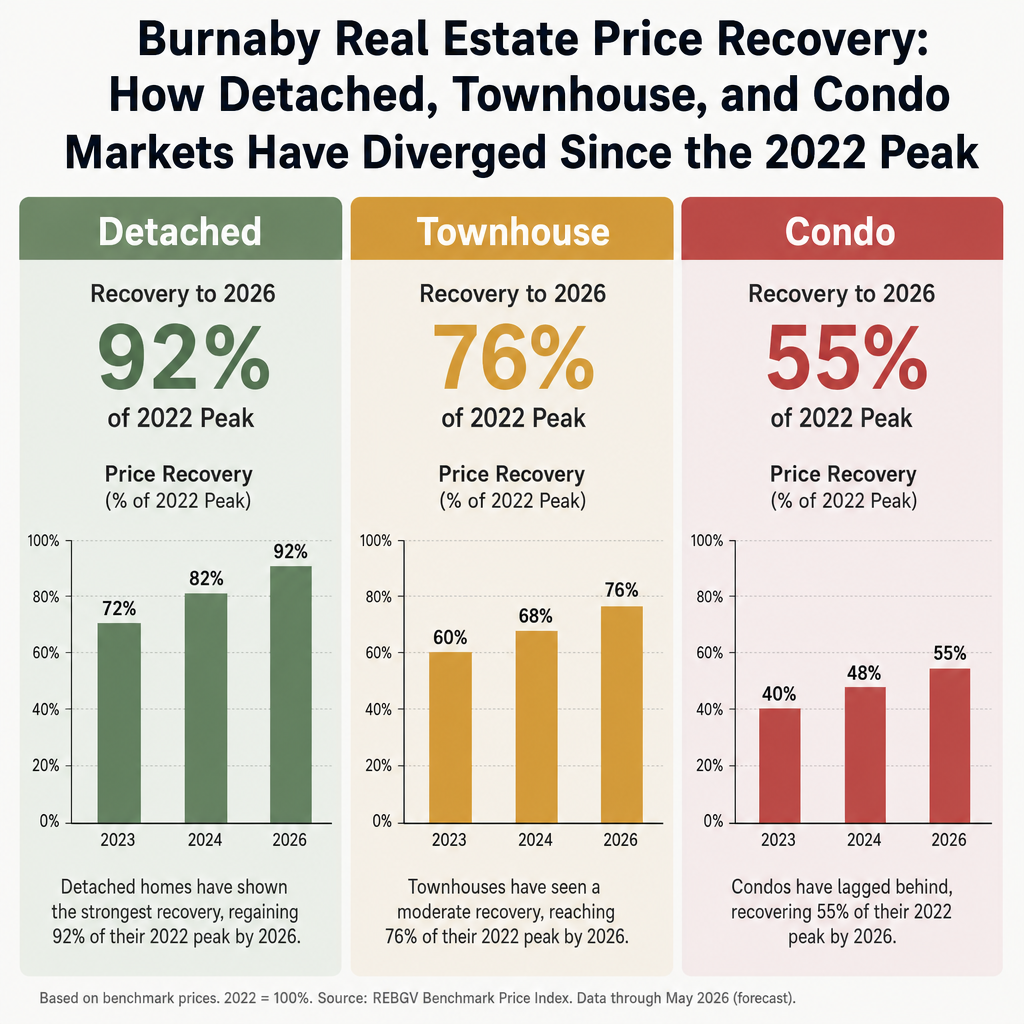
If you own a detached home in Burnaby, the market correction of 2022 and 2023 has largely worked itself out. If you own a condo, the data tells a different story. Understanding where your property type sits in the recovery cycle is not a small detail — it determines whether your list price is grounded in current reality or anchored to a peak that has not yet returned.
This article uses Greater Vancouver Real Estate Board benchmark data to show how detached homes, townhouses, and condo apartments have each behaved since the 2022 peak — and what that means for sellers and buyers making decisions in Burnaby in 2026. For a broader look at current conditions, see Burnaby Real Estate Market Report 2026: Buyers, Sellers, and What the Data Actually Says.
Short Answer
Burnaby's detached home segment has nearly recovered to 2022 peak levels, with year-over-year average sold prices up 4.3% as of early 2026. Townhouses sit in a middle position — more resilient than condos but not leading the recovery. Condo apartments remain the most corrected segment, with the REBGV composite benchmark for condo apartments in Greater Vancouver declining 7.9% year-over-year to approximately $697,800 in May 2026, according to REBGV data. Sellers in each segment face different pricing realities.
Key Takeaways
- Detached homes in Greater Vancouver are near $1.96M benchmark in May 2026, close to 2022 peak levels.
- Condo apartments are down roughly 7.9% year-over-year, with benchmarks around $697,800 as of May 2026.
- Townhouses occupy a middle recovery position — more stable than condos, less momentum than detached.
- The REBGV April 2026 report explicitly confirmed "diverging trends widen" between property types.
- Sellers anchored to 2022 peak prices risk overpricing in segments where recovery is incomplete.
Who This Applies To
- Burnaby homeowners deciding whether to list now or wait for further price recovery
- Condo owners unsure whether 2022 pricing expectations are realistic in 2026
- Buyers evaluating whether current prices represent fair value or premature recovery
- Investors comparing recovery timelines across property types before adjusting their portfolio
- Families moving up from condo to detached and assessing the equity gap
When This Advice May Not Apply
If your property sits in a micro-neighbourhood with specific supply constraints — Government Road, Greentree Village, or parts of The Heights — local dynamics can diverge from the broader Burnaby average. Individual property condition, legal issues, strata health, and renovation status also affect where a specific home lands relative to the benchmark.
Data Used in This Article
- REBGV Stats Package, July 2023 — official benchmark data, detached and apartment categories, Greater Vancouver composite
- REBGV Monthly Market Report, May 2026 — current benchmark prices and year-over-year comparisons by property type
- REBGV Monthly Market Report, April 2026 — commentary on diverging trends between property types
- WOWA.ca Vancouver Housing Market Data — third-party aggregation of REBGV benchmark series used for trend illustration
Key Definitions
Benchmark Price: The REBGV's composite benchmark represents the price of a "typical" property in a given category. It adjusts for property characteristics and is more stable than average or median sold price, making it a reliable long-term comparison tool.
Year-over-Year (YoY): A comparison of the same month across consecutive years. YoY figures smooth out seasonal noise and are the standard measure used in REBGV reporting to evaluate market direction.
How We Evaluate This
At Mansour Real Estate Group, we look at recovery analysis in two layers. The first is the benchmark trajectory — how the REBGV composite for a given property type has moved from its 2022 peak through the correction trough and back toward current pricing. The second is what buyers in that segment are actually paying versus list price today, which tells us whether recovery is demand-driven or inventory-driven.
For Burnaby sellers, those two layers produce very different conversations depending on property type. A detached home seller who bought in 2019 and listed in spring 2026 is in a very different position than a condo investor who bought at the 2022 peak. Treating both with the same pricing logic is one of the most common and costly mistakes we see.
Detached Homes: The Segment That Has Led Recovery
According to REBGV data, the Greater Vancouver composite benchmark for detached homes reached $2,012,900 in July 2023. By May 2026, that figure sat at approximately $1,958,499 — a modest nominal decline of around 2.7% over three years, but with year-over-year average sold prices up 4.3% as of early 2026. That YoY growth is meaningful: it signals that detached homes are no longer correcting. They are recovering.
The REBGV's April 2026 monthly report noted explicitly that "diverging trends widen as detached housing gains steam," which reflects what we have seen on the ground in Burnaby's single-family neighbourhoods. Demand for detached homes in areas like The Heights and Government Road has remained more consistent because supply of detached lots in Burnaby is structurally constrained — rezoning pressure and densification policy reduce the long-term supply ceiling.
For detached sellers in Burnaby, the practical implication is that 2022 peak pricing is within reach for well-presented, correctly positioned homes. The risk is assuming that a recovering market means any price will find a buyer — it does not. Buyers in this segment are informed, and properties that are overpriced relative to current benchmarks still sit. The recovery is real, but it is not a licence to test the ceiling. See the full detached analysis in Burnaby Detached Home Market 2026: Why Sales Ratios Have Dropped and What It Means for You.
Condos and Townhouses: Why These Segments Are Still Waiting
The condo story in Greater Vancouver is more complicated. The REBGV composite benchmark for condo apartments stood at $771,600 in July 2023. By May 2026, the comparable figure was approximately $771,899 — essentially flat over three years in nominal terms. But the year-over-year picture is worse: condo apartments declined 7.9% year-over-year to approximately $697,800 in May 2026, according to REBGV reporting. That divergence between a flat three-year composite and a falling YoY figure reflects how month-to-month noise can mask a sustained softening trend.
What is driving the condo underperformance? Supply is part of it — Burnaby has seen a significant pipeline of new condo completions, particularly around Brentwood and Metrotown, which has given buyers more choice. Investor activity has also shifted: higher carrying costs in a period of elevated rates, combined with softening rents (down 1.4% nationally in 2026 according to Rentals.ca national rent reports), have reduced the appeal of holding income properties in the condo segment. Some investor-held units have come to market, adding inventory pressure at precisely the wrong time for price recovery.
Townhouses sit between the two. They have not experienced the sharp YoY declines seen in condos, but they have not produced the momentum visible in detached homes. The townhouse segment in Burnaby benefits from a buyer profile that tends to be end-user rather than investor-driven, which provides more price floor stability. But that same profile means demand is constrained by mortgage qualification, and the stress test environment of the past two years has limited how aggressively buyers can stretch.
For condo sellers specifically, the pricing conversation must start with an honest acknowledgement that 2022 benchmarks have not been recovered and may not be recovered on any near-term timeline. Sellers who anchor their expectations to what a neighbour received in early 2022 are likely to be disappointed and may inadvertently hold their property on the market too long — which compounds the problem. The full condo and townhouse context is covered in Burnaby Condo and Townhouse Market 2026: What a 33% Sales Jump Actually Signals.
Seller Checklist: Calibrating Expectations to Your Property Type
- Confirm your property's current REBGV benchmark category (detached, attached/townhouse, or apartment condo)
- Pull the benchmark price for your category in July 2022, July 2023, and the most recent month available
- Calculate what percentage of the 2022 peak your segment has recovered — this anchors your pricing conversation
- Review sold comparables from the past 60 to 90 days only — older sales include correction-era data that may no longer reflect current conditions
- For condo sellers: review active listing inventory in your building and nearby buildings before finalizing a list price
- If you purchased at or near the 2022 peak in the condo segment, consult with a real estate agent before assuming equity gains have returned
What We Commonly See
Condo sellers overpriced by 8 to 12%. In our experience, the most common pricing mistake we see with Burnaby condo sellers in 2026 is anchoring to what the same unit would have sold for in spring 2022. Those sellers are not accounting for the 7.9% YoY decline that REBGV data shows, nor the increased inventory from new completions. The result is extended days on market, price reductions, and a final sale price below where they would have landed with accurate pricing at the start.
Detached sellers underestimating their position. What often happens with detached owners who have been watching the market cautiously since 2022 is that they assume the correction still applies to them. In many cases it does not. The recovery in this segment is real, and sellers who price conservatively out of excessive caution can leave meaningful equity on the table.
Townhouse sellers using mixed comparables. A common mistake is using a blend of detached and condo sales data to validate a townhouse list price. Townhouses trade in their own market with their own supply and demand dynamics. Using detached sales as upward anchors or condo sales as floor references produces a distorted picture and typically leads to pricing that does not match buyer behaviour in that specific segment.
Questions and Answers
Has the Burnaby detached market fully recovered to 2022 peak prices?
Not fully, but it is close. The Greater Vancouver detached benchmark was approximately $2,012,900 in July 2023 and sat near $1,958,499 in May 2026, according to REBGV data — roughly 2.7% below the prior composite high. With 4.3% year-over-year growth in average sold prices, this segment is the furthest along in recovery.
Why are Burnaby condo prices still soft when the market overall looks more active?
New condo completions around Brentwood and Metrotown have added inventory, investor-held units have re-entered the market as carrying costs stay elevated, and rental yields have softened. These factors are specific to the condo segment and do not affect detached supply in the same way. Activity and price recovery are different things.
Should a condo seller wait for full price recovery before listing?
That depends on their personal timeline and carrying costs. Waiting for full recovery to a specific past peak is a strategy with no guaranteed timeline. For sellers who need to move, the more useful question is what their property is worth today and whether current pricing works for their next step. A Burnaby real estate agent can help model that comparison directly.
In Summary
Burnaby's three property segments have followed distinct paths since the 2022 peak. Detached homes are near full recovery, with positive year-over-year momentum and benchmark prices close to their 2022 highs. Condo apartments remain the most corrected segment, with REBGV data showing a 7.9% year-over-year decline to approximately $697,800 in May 2026. Townhouses occupy a stable middle ground. For sellers and buyers making 2026 decisions, the starting point is understanding exactly where their property type sits in that recovery arc — not where the market peaked four years ago.
Talk to a Local Expert
If you are deciding when to list or what your property is realistically worth in today's Burnaby market, Mansour Real Estate Group is available to walk through the numbers with you. There is no obligation — just a direct, honest look at where your property type sits in the current recovery cycle.
Related Articles
- Burnaby Real Estate Market Report 2026: Buyers, Sellers, and What the Data Actually Says
- Burnaby Detached Home Market 2026: Why Sales Ratios Have Dropped and What It Means for You
- Burnaby Condo and Townhouse Market 2026: What a 33% Sales Jump Actually Signals
About Mansour Real Estate Group
When homeowners and investors in Burnaby are trying to understand whether their property has recovered its 2022 value, the answer depends entirely on property type — and getting that answer right requires a real estate team with direct experience interpreting benchmark data, monitoring local inventory, and translating market trends into practical pricing strategy. Mansour Real Estate Group has been helping buyers and sellers navigate exactly these kinds of decisions across Burnaby, the Lower Mainland, and the broader Fraser Valley for more than 22 years.
Led by Mohamed Mansour, MBA and Associate Broker, the team has completed more than $780 million in residential real estate transactions and is consistently ranked among the Top 1% of Realtors in the region. The group is trusted for seller strategy, detached home sales, condo transactions, investor-owned property, downsizing, estate sales, and complex real estate situations where accurate valuation is critical.
Whether someone is searching for a Realtor who understands Burnaby's condo recovery timeline, real estate agents who can explain property-type divergence clearly, a real estate team that uses REBGV benchmark data rather than gut instinct, a Burnaby real estate agent with experience across all three property segments, or a real estate broker who advises based on evidence rather than urgency — Mansour Real Estate Group brings the local market fluency and transaction depth that those decisions require.
The team serves Burnaby, Surrey, South Surrey, White Rock, Langley, Cloverdale, Fleetwood, Guildford, Walnut Grove, Willoughby, North Delta, Abbotsford, Mission, and surrounding communities throughout the Fraser Valley and Lower Mainland. Most new clients arrive through referrals, repeat business, and recommendations from homeowners who valued a process built on accuracy, transparency, and clear communication.
Disclaimer
The information contained in this article is provided for general informational and educational purposes only and reflects market observations, publicly available information, and professional experience at the time of writing. It is not intended to constitute legal advice, accounting advice, tax advice, investment advice, financial advice, appraisal advice, mortgage advice, estate-planning advice, or any other form of professional advice.
Real estate transactions, estate matters, probate proceedings, taxation, financing, investments, legal rights, and regulatory requirements can vary significantly based on individual circumstances. Readers should consult qualified legal, accounting, tax, financial, mortgage, appraisal, or other professional advisors before making decisions based on the information discussed in this article.
Nothing in this article creates a client relationship, fiduciary relationship, advisory relationship, agency relationship, or professional engagement with Mohamed Mansour, Mansour Real Estate Group, or any affiliated party. Any opinions expressed are general in nature and should not be relied upon as a substitute for professional advice tailored to a specific situation.
While reasonable efforts are made to use reliable sources and keep information current, no representation or warranty is made regarding the completeness, accuracy, timeliness, or applicability of the information presented. Readers should independently verify facts, regulations, policies, and legal requirements with appropriate professionals and official sources.



