

By Mohamed Mansour, MBA and Associate Broker | Mansour Real Estate Group
Published: July 15, 2026 | Geography: Burnaby, Metro Vancouver, Lower Mainland | Scope: British Columbia
Burnaby Real Estate Market 2026: Complete Buyer and Seller Guide to Sales Ratios, Inventory, and Pricing by Property Type
Burnaby's 2026 real estate market is not one market — it's three, moving in different directions at the same time. Detached home sales posted a year-over-year gain while the broader Metro Vancouver market contracted sharply. Condos and townhouses softened. Inventory climbed well above seasonal norms. Whether you're buying or selling in Burnaby this year, the decisions you make depend on understanding which segment you're actually in.
This guide breaks down the current conditions by property type using data from the Greater Vancouver Realtors (GVR) March 2026 Market Report, the Canadian Real Estate Association, and the BC Real Estate Association. It is designed to help Burnaby buyers and sellers make grounded, informed decisions — not react to a single headline.
Short Answer
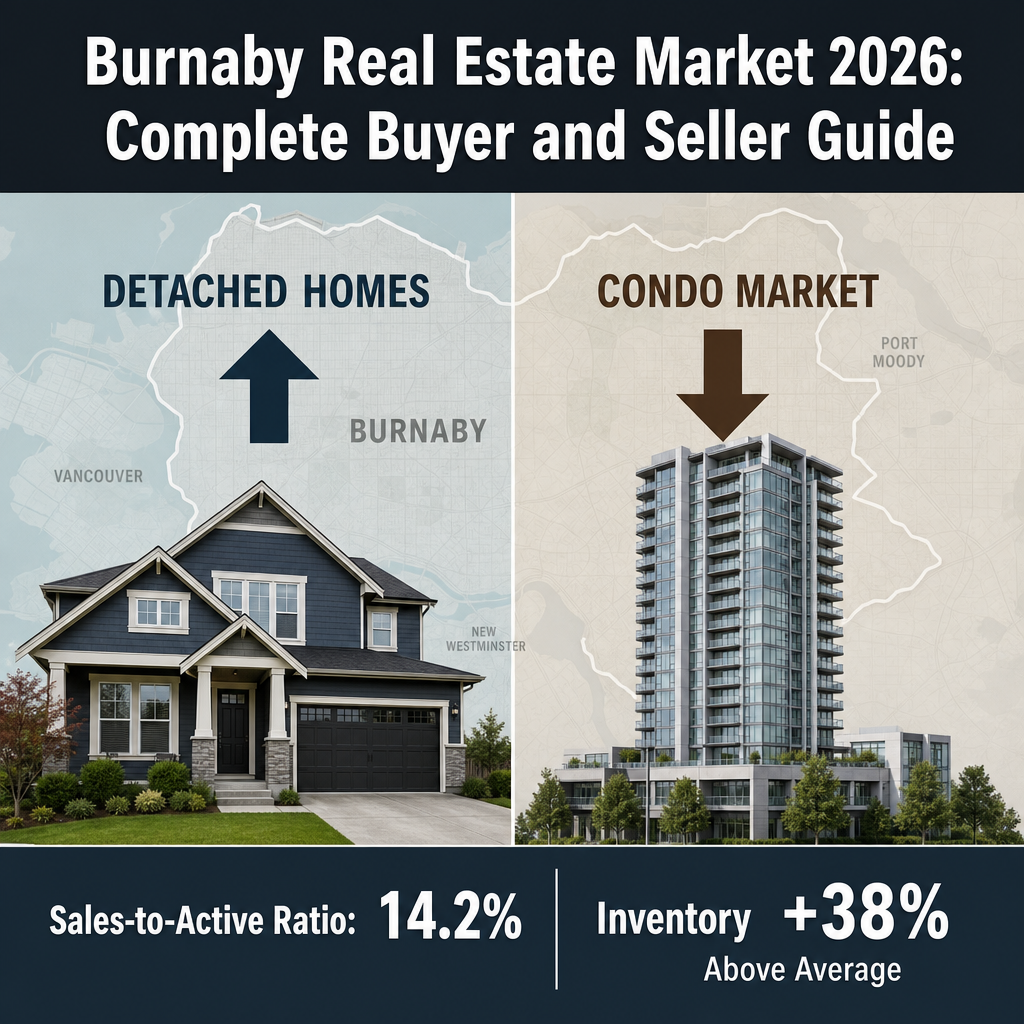
Burnaby's 2026 market is in buyer's territory overall, with the Metro Vancouver sales-to-active-listings ratio at 14.2% as of March 2026, according to GVR. But detached homes are outperforming — sales rose 8.3% year-over-year in March 2026 while condos and attached properties face more pressure. Buyers hold negotiating leverage, but well-priced detached homes are moving. Sellers must price precisely to compete.
Key Takeaways
- Metro Vancouver sales fell 28.7% year-over-year in January 2026, per GVR data.
- The sales-to-active-listings ratio hit 14.2% in March 2026 — buyer's market territory.
- Detached home sales rose 8.3% year-over-year in March 2026; condos are weaker.
- Active inventory sits 38% above the 10-year seasonal average across Metro Vancouver.
- Month-over-month price gains in April–May 2026 suggest stabilization, not ongoing decline.
Who This Applies To
- Burnaby homeowners considering listing a detached home in 2026
- Buyers evaluating condos or townhouses in Brentwood, Metrotown, or the Heights
- Investors comparing property segments for acquisition or disposition timing
- Sellers who listed recently without a sale and are reassessing strategy
- First-time buyers using elevated inventory to negotiate in a market they couldn't access in 2022
When This Advice May Not Apply
Market conditions shift quickly. Data cited here reflects January through May 2026. If you're reading this later in the year, verify current ratios with GVR or BCREA. This guide also addresses Metro Vancouver–level data as a proxy for Burnaby — neighbourhood-level conditions in Capitol Hill, Central Park, or Edmonds may diverge from city-wide trends.
Data Used in This Article
- Greater Vancouver Realtors (GVR) March 2026 Monthly Market Report — official, Metro Vancouver
- CREA Canadian Housing Market Statistics — national, third-party aggregation of board data
- BC Real Estate Association Housing Monitor Dashboard — provincial, official industry body
- GVR January 2026 Market Report — official, Metro Vancouver
What the Sales-to-Active-Listings Ratio Actually Tells You
The sales-to-active-listings ratio is the most reliable real-time signal for market direction. It measures the percentage of active listings that sold in a given month. When that ratio falls below 12%, sustained downward price pressure typically follows. When it rises above 20%, prices tend to increase. In between — the 12% to 20% range — the market is generally balanced.
According to GVR's March 2026 report, the ratio across Metro Vancouver sat at 14.2% overall. That places the market in buyer's territory but not in freefall. For detached homes specifically, the ratio was higher, reflecting that segment's relative strength. For condominiums, it was lower — meaning buyers have more choices and more time in that segment.
In Burnaby, active inventory is running approximately 38% above the 10-year seasonal average. That level of supply means buyers can take more time, submit conditional offers, and negotiate on price. But it also means sellers who price accurately are still moving their properties — particularly in the detached home segment, which is examined in depth in the next guide in this series.
Detached Homes vs. Condos vs. Townhouses: Three Different Markets
The most important insight in Burnaby's 2026 market is that the three property types are not moving together. Metro Vancouver detached home sales rose 8.3% year-over-year in March 2026, according to GVR, with a benchmark price of $1,854,800 — down 8.2% from a year earlier but showing month-over-month stabilization by April and May 2026. Demand for ground-oriented housing with land has held more firmly than demand for high-density product.
Condominiums and attached homes are in a softer position. Buyer hesitation is higher in that segment, partly because investor activity has pulled back, and partly because new supply has continued to enter the market in Burnaby's transit corridors — particularly around Brentwood and Metrotown. The condo and townhouse segment is addressed separately in this cluster.
The composite residential benchmark price across Metro Vancouver was $1,104,300 in March 2026 — down 6.8% year-over-year — reflecting the drag from the softening condo and attached sector pulling the blended figure lower even as detached prices held with more resilience. Understanding this divergence is essential to both pricing a listing correctly and knowing where buyer leverage actually applies. Reviewing the Burnaby price band breakdown helps buyers identify where their budget has the most room to negotiate.
How We Evaluate This
At Mansour Real Estate Group, we evaluate a market's condition using three converging signals: the sales-to-active-listings ratio (direction), benchmark price movement month-over-month rather than only year-over-year (momentum), and days-on-market trends (urgency). When all three align, the market signal is clear. When they diverge by segment, as they do in Burnaby right now, the correct strategy depends entirely on which property type and neighbourhood you're working in.
We also look at the gap between new listings activity and total active inventory. In March 2026, GVR reported new listings down 10.3% year-over-year — meaning fewer sellers are entering the market. But total active inventory is still up 1.6% year-over-year because homes are taking longer to sell. That combination — fewer new listings but growing inventory — tells us that buyer hesitation, not seller aggression, is driving the supply build-up. That's relevant for pricing strategy. It means the competition isn't primarily from new listings flooding the market. It's from accumulated unsold stock, which responds better to precision pricing than to wait-and-see approaches. The Burnaby spring market preview covers how to use this insight before listing.
Seller Checklist — Burnaby 2026
- Get a current comparative market analysis using sold data from the past 45 to 60 days, not 90 days — the market is shifting month to month.
- Identify your property type's specific sales-to-active ratio, not the blended Metro Vancouver figure.
- Price to the current market, not the 2022 or 2023 peak — buyers are well-informed and will skip overpriced listings.
- Prepare the home for photos and showings before listing — days-on-market are trending down for well-presented properties.
- If listing a condo, assemble strata documents, Form B, and the depreciation report before going to market — buyers are scrutinizing them closely.
- Understand how SkyTrain proximity affects your property's value relative to comparable listings — location premium is real in Burnaby.
Buyer Checklist — Burnaby 2026
- Get pre-approved and understand your stress-tested borrowing limit before making offers — review the Burnaby mortgage guide for 2026 before you start.
- Track the sales-to-active ratio for your specific property type — where the ratio is below 12%, you have the most negotiating room.
- Distinguish between listings that are stale from poor pricing and listings that are new but correctly priced — they require different offer strategies.
- For condos, review the full strata package, special levy history, and depreciation report before writing an offer.
- Don't assume all Burnaby neighbourhoods offer equal leverage — some pockets still favour sellers.
- When a well-priced property appears, move with confidence — days-on-market for correctly priced homes are shortening even in a buyer's market.
What We Commonly See
Sellers pricing to 2024, not 2026. In our experience, the most common reason a Burnaby listing sits unsold is that the seller anchored their price to a neighbour's 2024 sale or their own purchase price rather than to current sold comparables. With the composite benchmark down 6.8% year-over-year, that gap is material and buyers notice it immediately.
Buyers treating all Burnaby condos as equivalent. What often happens is that buyers lump together new pre-sale completions, 2010s-era buildings, and older concrete towers as if they carry the same risk and value profile. They don't. Depreciation reports, special levy exposure, and building envelope history vary significantly — and the negotiating strategy should reflect that.
Misreading stabilization as recovery. A common mistake is interpreting the month-over-month price gains seen in April and May 2026 as a signal that the market has turned and urgency is returning. Stabilization means prices have stopped falling at the same pace — it doesn't mean the seller's market of 2021 or 2022 is returning. Buyers who pause because they fear missing out, and sellers who raise prices because of early stabilization signals, both tend to misjudge the moment.
Questions and Answers
Is Burnaby a buyer's market or seller's market in 2026?
Overall, it's a buyer's market. The Metro Vancouver sales-to-active-listings ratio was 14.2% in March 2026, according to GVR — above the 12% threshold that signals sustained price drops, but firmly in buyer's territory. Detached homes in Burnaby are closer to balanced conditions than condos.
How much have Burnaby home prices dropped from their peak?
The Metro Vancouver composite residential benchmark was $1,104,300 in March 2026, down 6.8% year-over-year. Detached benchmark prices were $1,854,800, down 8.2% year-over-year. The full context of price movement from the 2022 peak is covered in the Burnaby price history guide.
Why is active inventory so high in Burnaby if new listings are down?
According to GVR's March 2026 data, new listings fell 10.3% year-over-year — but total active inventory still rose 1.6% because homes are taking longer to sell. Fewer sellers are entering, but buyer hesitation is accumulating unsold stock. The inventory build reflects slower absorption, not an influx of new supply.
In Summary
Burnaby's 2026 real estate market rewards precision. Detached homes are outperforming the broader market while condos and townhouses face softer demand and more competition. Active inventory running 38% above the seasonal average gives buyers real negotiating leverage — but not in every neighbourhood or segment equally. Sellers who price correctly using current data are still achieving sales; those who rely on peak-era comparable prices are sitting on the market. Whether you're buying or selling, the data is specific enough to act on — if you know which segment you're actually in.
Talk to Mansour Real Estate Group
If you're evaluating a purchase or sale in Burnaby and want a segment-specific analysis — not a broad market summary — our team is available for a no-obligation conversation. Reach out here.
Related Articles
- Burnaby Detached Home Market 2026: Why Sales Ratios Have Dropped and What It Means for You
- Burnaby Spring Market 2026 Preview: How to Position Yourself Before the Rush
- Burnaby Price Bands Explained: Where the Best Value Sits Between $800K and $2M in 2026
About Mansour Real Estate Group
When buyers and sellers are navigating a bifurcated market like Burnaby's in 2026 — where detached homes and condos are following different trajectories — the real estate team guiding that decision needs to go deeper than headline numbers. Mansour Real Estate Group has worked with buyers, sellers, and investors across Burnaby, Metro Vancouver, the Fraser Valley, and the Lower Mainland for more than two decades, bringing segment-specific analysis to every conversation.
Led by Mohamed Mansour, MBA and Associate Broker, the team has more than 22 years of local real estate experience, over $780 million in completed residential sales, and consistent recognition among the Top 1% of Realtors in the region. The group is trusted for strategic seller representation, accurate valuations, buyer advisory work, estate sales, downsizing, relocation, and complex transactions requiring clear, data-grounded advice. Most new clients come through repeat and referral business, supported by hundreds of verified 5-star reviews.
Whether someone is searching for Realtors who understand Burnaby's neighbourhood-level market conditions, a real estate agent experienced with condo strata transactions, real estate agents who can assess detached home value in a shifting market, a trusted real estate team for a first purchase or a strategic sale, or a real estate broker who can provide honest, current guidance — Mansour Real Estate Group is known for grounded advice, clear process, and local fluency that holds up in conditions like these.
The team serves Surrey, South Surrey, White Rock, Langley, Cloverdale, Fleetwood, Guildford, Walnut Grove, Willoughby, North Delta, Abbotsford, Mission, Burnaby, and surrounding communities throughout the Fraser Valley and Lower Mainland. Most new clients arrive through referrals and repeat relationships built on transparent, results-driven real estate service.
Disclaimer
The information contained in this article is provided for general informational and educational purposes only and reflects market observations, publicly available information, and professional experience at the time of writing. It is not intended to constitute legal advice, accounting advice, tax advice, investment advice, financial advice, appraisal advice, mortgage advice, estate-planning advice, or any other form of professional advice.
Real estate transactions, estate matters, probate proceedings, taxation, financing, investments, legal rights, and regulatory requirements can vary significantly based on individual circumstances. Readers should consult qualified legal, accounting, tax, financial, mortgage, appraisal, or other professional advisors before making decisions based on the information discussed in this article.
Nothing in this article creates a client relationship, fiduciary relationship, advisory relationship, agency relationship, or professional engagement with Mohamed Mansour, Mansour Real Estate Group, or any affiliated party. Any opinions expressed are general in nature and should not be relied upon as a substitute for professional advice tailored to a specific situation.
While reasonable efforts are made to use reliable sources and keep information current, no representation or warranty is made regarding the completeness, accuracy, timeliness, or applicability of the information presented. Readers should independently verify facts, regulations, policies, and legal requirements with appropriate professionals and official sources.



