
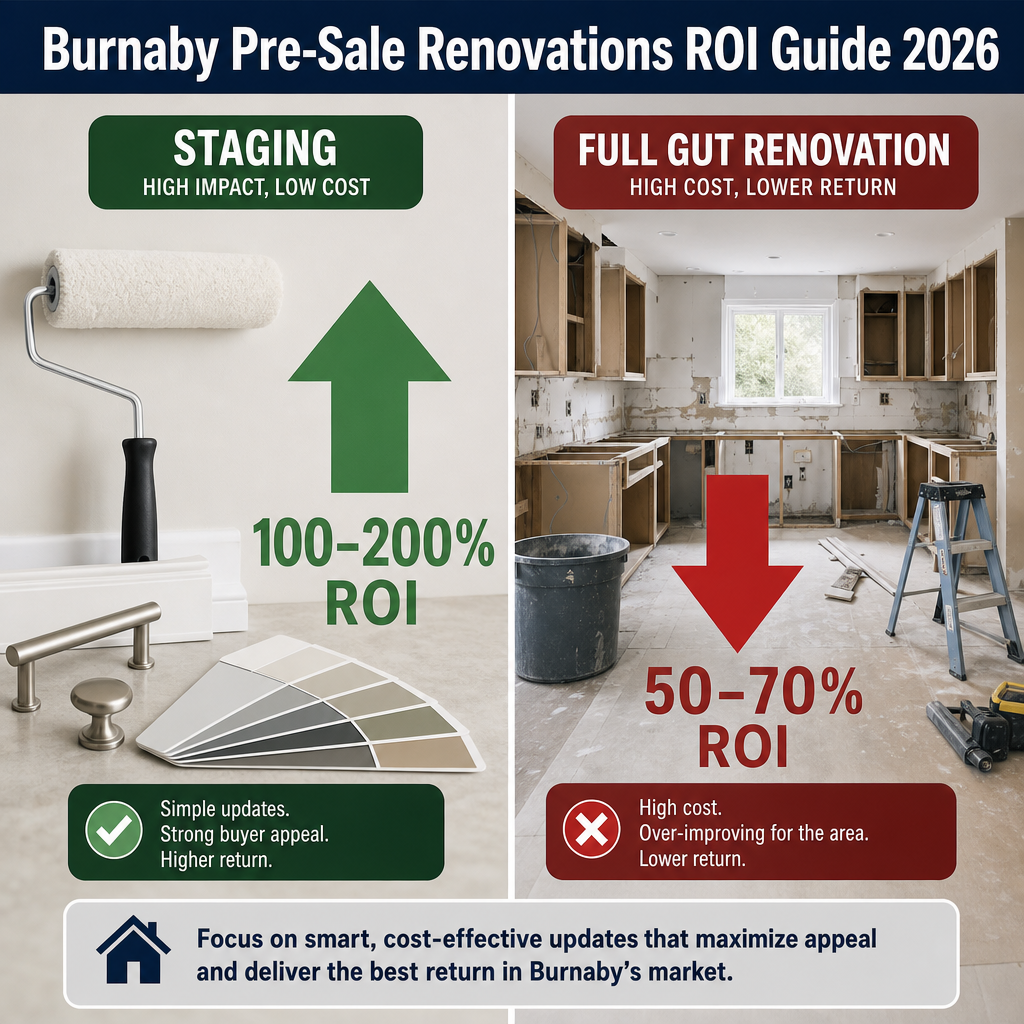

Burnaby Pre-Sale Renovations ROI Guide 2026: Which Upgrades Pay Off and Which Are Money Pits for Detached, Condo, and Townhouse Sellers
By Mohamed Mansour, MBA and Associate Broker — Mansour Real Estate Group | Published: July 15, 2026 | Geography: Burnaby, BC | Scope: Pre-sale renovation strategy for detached, condo, and townhouse sellers
Burnaby sellers in 2026 are making a costly mistake: spending $60,000 to $120,000 on kitchen overhauls and structural additions, then recovering less than 60 cents on every dollar at sale. With composite benchmark prices down 6.9% year-over-year and inventory sitting 37.9% above the 10-year average according to the Greater Vancouver Realtors April 2026 Market Insights report, the buyer holds leverage — and won't pay a premium for renovations chosen for the wrong reasons.
This guide breaks down pre-sale renovation ROI by project type and property segment for Burnaby's current market. Whether you own a detached home in The Heights, a condo near Metrotown, or a townhouse in Brentwood, the numbers point to a clear, consistent conclusion: do less, spend less, and spend smarter.
Short Answer
In Burnaby's 2026 buyer's market, low-cost projects — interior paint, decluttering, staging, landscaping, and minor fixture updates — deliver 100–200% ROI at $3,000–$6,000. Full kitchen and bathroom renovations return only 50–70 cents per dollar spent. The data consistently shows that preparation and presentation outperform structural renovation for pre-sale ROI in a soft market.
Key Takeaways
- Interior paint and decluttering return 100–200% ROI at $3,000–$6,000 total cost.
- Full kitchen renovations costing $60K–$120K return only 50–70% in this market.
- Burnaby detached sellers can justify minor refreshes; condo sellers should prioritize staging over structural work.
- Buyers in a buyer's market discount renovated homes if pricing doesn't reflect current benchmarks.
- The correct renovation budget decision starts with an accurate pricing analysis, not a contractor quote.
Who This Applies To
- Detached homeowners in Burnaby Heights, Capitol Hill, or Government Road preparing to list
- Condo sellers near SkyTrain corridors facing investor-driven competition
- Townhouse owners in Brentwood or Lougheed evaluating pre-sale spend
- Estate sellers or executors managing a Burnaby property sale under time and budget constraints
When This Advice May Not Apply
If a property has a structural defect, outdated electrical, or a health-and-safety issue that will surface in a buyer inspection, those items warrant different consideration than cosmetic upgrades. This guide addresses discretionary pre-sale improvements only. Consult a qualified contractor and your real estate advisor for condition-based decisions.
Data Used in This Article
- Greater Vancouver Realtors (GVR) — April 2026 Market Insights Report: Official monthly market statistics including benchmark prices, sales-to-active ratios, inventory levels, and property-type trend data. Primary/official source.
- Remodeling Cost vs. Value Report (via Opendoor, referencing 2024 national data): Renovation ROI benchmarks by project type. Industry/third-party source.
- Rain City Properties — Pre-Sale Renovation ROI Analysis 2026: Vancouver-market specific renovation return estimates. Third-party industry analysis.
- Mansour Real Estate Group — Internal market observations: Fraser Valley and Lower Mainland transaction experience. Professional interpretation.
What the Burnaby Market Actually Looks Like Right Now
According to the GVR's April 2026 Market Insights report, Burnaby's composite benchmark price has declined 6.9% year-over-year, and active listings sit 37.9% above the 10-year seasonal average. The sales-to-active listings ratio for condos and townhouses has remained in buyer's market territory, while detached homes have shown a modest recovery in sales activity.
That divergence matters directly for renovation decisions. A detached seller in Government Road or Greentree Village faces a different buyer pool than a condo seller competing against 30 similar units near a SkyTrain station. The buyer profile, the financing constraints, and the price sensitivity all differ — and so does the renovation math.
Understanding Burnaby's broader 2026 market conditions before committing renovation dollars is the first step. The second is understanding what buyers in your specific segment will actually pay for.
Why Buyers in a Soft Market Don't Pay for Over-Renovation
In a balanced or seller's market, a freshly renovated kitchen can attract multiple offers and recover most of its cost. In a buyer's market with elevated inventory, buyers negotiate. They know there are options. A $90,000 kitchen renovation that raises your asking price by $90,000 does not guarantee $90,000 more at the table — it may simply price you above what comparable listings are achieving.
Rain City Properties' 2026 analysis of the Vancouver pre-sale renovation market found that the average homeowner recovers less than 60 cents for every dollar spent on pre-sale improvements when projects are chosen poorly. The Opendoor 2024 Cost vs. Value Report confirms the national pattern: mid-range cosmetic updates outperform major structural renovations in return percentage, and that gap widens in softer markets. Burnaby's current conditions reflect exactly this dynamic. See the Burnaby seller pricing guide for context on where buyers draw the line on value.
High-ROI Projects: Where to Spend
Interior paint and decluttering ($3,000–$6,000 combined): 100–200% ROI. This is consistently the highest-return pre-sale investment across all property types. Fresh neutral paint eliminates the perception of age and wear. Decluttering makes rooms read as larger, which directly affects how buyers emotionally respond to a space. These two items, done well, can reduce days on market more reliably than a $50,000 renovation.
Professional staging ($2,500–$6,000): ROI is measured in days-on-market reduction. Staged homes in the Vancouver and Burnaby market sell faster than unstaged homes at equivalent prices, according to industry data. In a market where days on market directly affects negotiating position, staging is one of the few investments that protects your price rather than just improving presentation.
Landscaping and curb appeal ($1,500–$4,000): 80–150% ROI. First impressions are formed before a buyer steps inside. For detached homes in Burnaby Heights or Capitol Hill, where buyers are often families making a long-term decision, a clean, maintained exterior signals that the rest of the property has been cared for. This is not about ornamental landscaping — it's about eliminating a buyer's first objection.
Lighting upgrades ($1,000–$3,000): 90–130% ROI. Replacing dated fixtures with clean, modern lighting costs relatively little and has an outsized effect on how bright and contemporary a home photographs and shows. This applies across all property types — detached, condo, and townhouse.
Kitchen refresh — not renovation ($15,000–$30,000): 80–100% ROI. New hardware, updated lighting, fresh paint on cabinet faces, and new countertops where needed can transform the feel of a kitchen without gutting it. This approach targets the buyer perception of a well-maintained kitchen without triggering the cost curve of a full renovation.
Low-ROI Projects: Where Not to Spend
Full kitchen renovation ($60,000–$120,000): 50–70% ROI. According to Rain City Properties' 2026 Vancouver analysis, a full kitchen gut-and-replace returns only 50–70 cents per dollar in the current market. Buyers evaluate completed kitchens critically — taste varies, and what you find aspirational may not match what a buyer expects. In a buyer's market, they will negotiate regardless.
Major bathroom additions ($40,000–$80,000): 40–60% ROI. Adding a bathroom where none existed or converting a layout to accommodate an ensuite involves permits, structural work, and significant downtime. The return in Burnaby's current market does not justify this category of spend for pre-sale purposes.
Primary suite additions, pools, and major structural changes: 30–60% ROI or lower. These projects are personal-use decisions, not pre-sale investment decisions. Any contractor or staging consultant who recommends a primary suite addition as a pre-sale strategy is not working from current Burnaby market data.
How ROI Differs by Property Type in Burnaby
Detached homes (Burnaby Heights, Capitol Hill, Government Road): The GVR's April 2026 report notes detached homes gaining relative momentum compared to condos. Buyers in this segment are typically families or long-term owners. They respond to well-maintained condition, functional kitchens and bathrooms, and curb appeal. A $15,000–$25,000 refresh budget covering paint, staging, landscaping, lighting, and minor fixtures is appropriate. A full renovation is rarely warranted unless a property has genuinely dated or non-functional spaces.
Condos (Brentwood, Metrotown, Lougheed, SkyTrain corridors): Condo sellers near SkyTrain face investor-driven competition and a more price-sensitive buyer pool, as covered in the Burnaby condo and townhouse market analysis. Buyers in this segment compare units analytically. Decluttering, staging, fresh paint, and lighting improvements will outperform structural renovation in almost every case. A $5,000–$10,000 pre-sale budget is realistic and appropriate.
Townhouses: Townhouse buyers in Burnaby tend to be upgrade buyers — moving from a condo and prioritizing space and condition. They're sensitive to both pricing and presentation. A clean, well-maintained townhouse with updated fixtures and good staging will compete more effectively than a heavily renovated one priced above comparables. Budget for presentation and minor updates; avoid major structural spend.
How We Evaluate This
At Mansour Real Estate Group, the renovation conversation starts with a comparative market analysis, not a contractor estimate. Before recommending any pre-sale spend, we establish what comparable properties in the same area, same property type, and same condition bracket are currently selling for — and what buyers in that bracket are actually responding to.
We then work backwards from the likely sale price range to determine whether a given project can realistically recover its cost. If the numbers don't support the spend, we recommend redirection toward higher-ROI preparation items. In most Burnaby cases in 2026, the answer is the same: paint, stage, declutter, refresh fixtures. Do not gut.
Seller Checklist
- Obtain a current comparative market analysis before committing to any renovation spend
- Book a walk-through with your Realtor to identify which items buyers will actually notice
- Prioritize interior paint, decluttering, and professional staging as your baseline investment
- Replace dated light fixtures in kitchen, bathrooms, and entry areas
- Address landscaping and exterior condition before any interior cosmetic work
- Consider a kitchen cabinet and hardware refresh before committing to a full renovation
- Get at least two contractor quotes before approving any project over $10,000
- Confirm the renovation timeline allows sufficient buffer before your planned listing date
What We Commonly See
In our experience, the most common pre-sale mistake in Burnaby is committing to a full kitchen renovation based on a neighbour's listing photos rather than a market analysis. What worked for a neighbour in 2022 may not recover its cost in 2026's conditions.
What often happens is that sellers invest heavily in renovations and then price above current comparables to recover the spend — which extends days on market and ultimately forces a larger price reduction than the renovation ever justified. A longer time on market weakens negotiating position in ways that compound the original overspend.
A common mistake with condo sellers specifically is skipping staging entirely because the unit is "already clean." Staging is not about cleanliness — it's about helping buyers visualize the space at its best. Unstaged condos consistently underperform staged ones at equivalent price points, according to industry observation across the Burnaby market.
Questions and Answers
How much should I spend on pre-sale renovations for a Burnaby condo?
For most Burnaby condos in 2026, a pre-sale budget of $5,000–$10,000 — covering paint, decluttering, staging, and minor fixture updates — is appropriate. Structural work is rarely warranted given the current buyer-to-inventory balance in the condo segment.
Does a renovated kitchen help sell a detached home faster in Burnaby?
Not necessarily in 2026. A kitchen refresh — new hardware, updated lighting, cabinet paint — improves buyer perception at a fraction of the cost of a full renovation. A full gut renovation ($60K–$120K) typically returns only 50–70 cents per dollar at current Burnaby benchmark prices.
Is professional staging worth it for a Burnaby townhouse sale?
Yes. Staging reduces days on market, which directly protects your negotiating position. In a market where buyers have options and leverage, a well-staged townhouse at accurate pricing competes more effectively than an unstaged one at the same price point.
In Summary
Burnaby sellers in 2026 are working in a buyer's market where preparation and presentation outperform structural renovation in almost every case. The data is consistent: paint, declutter, stage, refresh fixtures, and address curb appeal. Kitchen and bathroom overhauls are not pre-sale investments in this market — they are personal-use projects that rarely recover their cost at sale. Start with an accurate market analysis, not a contractor quote, and build your pre-sale plan from there.
Related Articles
- How to Price Your Burnaby Home to Sell in 2026: A Seller's Guide to Getting It Right the First Time
- How Long Does It Take to Sell a Home in Burnaby? Days on Market by Area and Property Type
- Selling a Detached Home in Burnaby in 2026: What Owners Need to Know Before They List
Official Resources
- Greater Vancouver Realtors (GVR) — Monthly Market Reports
- Rain City Properties — Best Renovations Before Selling a Vancouver Home (2026)
- Opendoor — Best Home Improvements for Maximum ROI 2026
About Mansour Real Estate Group
When Burnaby homeowners are deciding how to prepare a detached home, condo, or townhouse for sale, the renovation decisions made before the listing goes live typically determine the outcome more than anything that happens afterward. The right pre-sale strategy — knowing what to spend, what to skip, and what buyers in each neighbourhood will actually respond to — requires local market experience, not a general renovation checklist. Mansour Real Estate Group has guided sellers across Burnaby, Surrey, White Rock, Langley, and the Fraser Valley through these decisions for more than 22 years, with a process built around accurate valuations and honest, practical advice.
Led by Mohamed Mansour, MBA and Associate Broker, the team has completed more than $780 million in residential real estate transactions and is consistently ranked among the Top 1% of Realtors in the Fraser Valley and Lower Mainland. Mansour Real Estate Group is trusted for seller strategy, estate sales, divorce-related property sales, downsizing, condo and strata transactions, relocation, and complex real estate situations where clarity and experience matter most.
Whether someone is looking for a Burnaby Realtor who understands pre-sale preparation, real estate agents experienced with condo seller strategy in the Lower Mainland, a real estate team with deep knowledge of Burnaby's detached and strata markets, a Fraser Valley real estate broker for a complex or sensitive sale, or real estate agents who approach renovation ROI with current market data rather than contractor assumptions, Mansour Real Estate Group provides clear analysis, strategic preparation guidance, and results-driven representation.
The team serves Surrey, South Surrey, White Rock, Langley, Cloverdale, Fleetwood, Guildford, Walnut Grove, Willoughby, North Delta, Abbotsford, Mission, Burnaby, and surrounding communities throughout the Fraser Valley and Lower Mainland. Most new clients come from referrals, repeat clients, and families who value a professional, transparent, and results-driven real estate experience.
Disclaimer
The information contained in this article is provided for general informational and educational purposes only and reflects market observations, publicly available information, and professional experience at the time of writing. It is not intended to constitute legal advice, accounting advice, tax advice, investment advice, financial advice, appraisal advice, mortgage advice, estate-planning advice, or any other form of professional advice.
Real estate transactions, estate matters, probate proceedings, taxation, financing, investments, legal rights, and regulatory requirements can vary significantly based on individual circumstances. Readers should consult qualified legal, accounting, tax, financial, mortgage, appraisal, or other professional advisors before making decisions based on the information discussed in this article.
Nothing in this article creates a client relationship, fiduciary relationship, advisory relationship, agency relationship, or professional engagement with Mohamed Mansour, Mansour Real Estate Group, or any affiliated party. Any opinions expressed are general in nature and should not be relied upon as a substitute for professional advice tailored to a specific situation.
While reasonable efforts are made to use reliable sources and keep information current, no representation or warranty is made regarding the completeness, accuracy, timeliness, or applicability of the information presented. Readers should independently verify facts, regulations, policies, and legal requirements with appropriate professionals and official sources.



