

Burnaby Neighbourhoods by Lifestyle: Which Community Fits Your Family, Career, and Retirement Goals in 2026?
By Mohamed Mansour, MBA and Associate Broker | Mansour Real Estate Group | Published: May 13, 2026 | Burnaby, BC · Fraser Valley · Lower Mainland
Choosing a neighbourhood in Burnaby is rarely just a price decision. For families, the right school catchment shapes daily life. For professionals, a reverse-commute advantage or walkable SkyTrain access determines how sustainable the location really is. For retirees, proximity to trails, community centres, and low-maintenance housing stock matters more than anything a square footage comparison can show. This guide matches Burnaby's distinct lifestyle zones to specific life stages and priorities — and explains what the April 2026 detached market data actually signals about where buyers are placing their confidence.
For sellers, understanding why buyers choose specific neighbourhoods — and what they are willing to pay a premium to access — is the practical foundation for pricing strategy. Mispricing a family home in a top-catchment area because the seller is comparing to transit-corridor condos is one of the most common positioning errors we see in Burnaby listings.
Short Answer
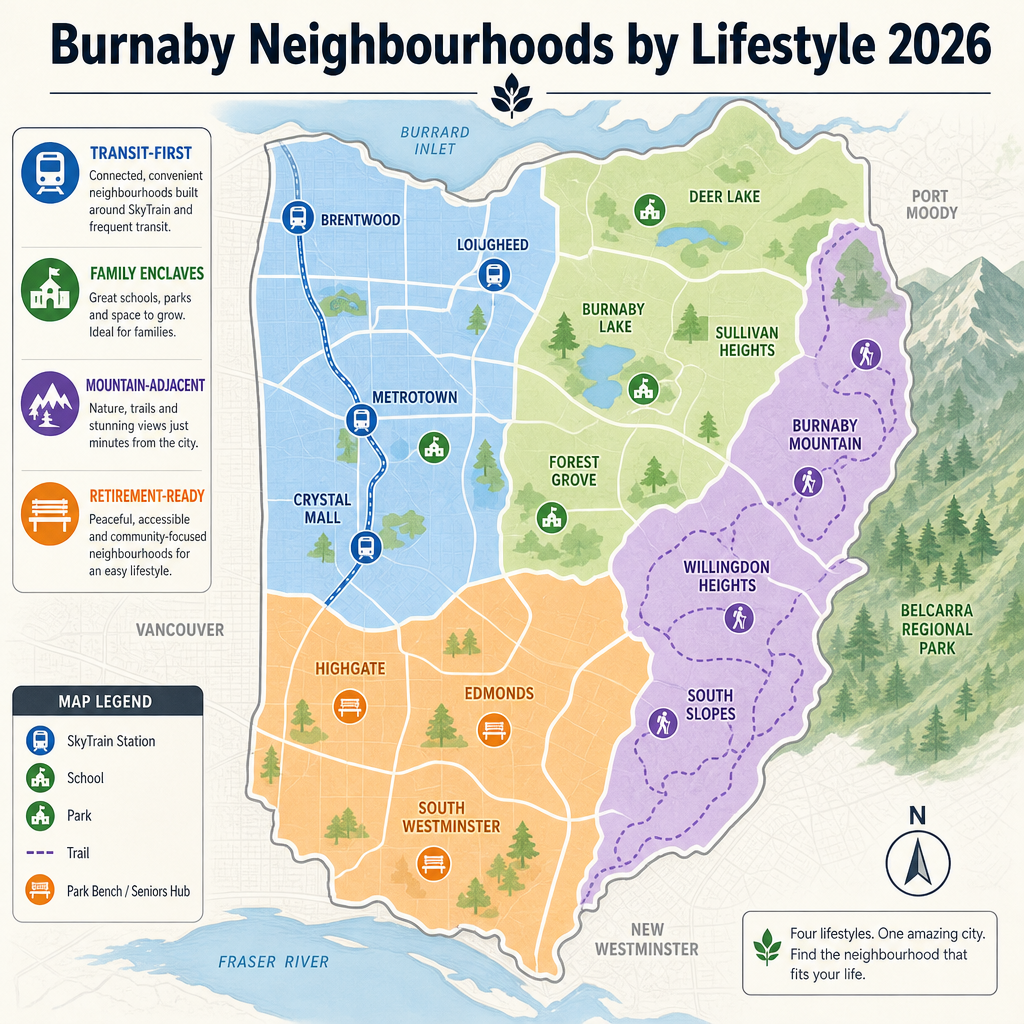
Burnaby's neighbourhoods divide into four lifestyle zones: transit-first corridors, family enclaves, mountain-adjacent communities, and retirement-suited areas. The right fit depends on whether school catchments, SkyTrain access, park proximity, or quiet walkable streets matter most to your household. In April 2026, detached home buyers are increasingly choosing neighbourhood character over price savings — a shift that sellers need to understand before they list.
Key Takeaways
- Burnaby's top elementary school catchments cluster geographically, creating family micro-markets with measurable price premiums.
- SkyTrain proximity drives value in transit corridors, but families increasingly trade it for school quality and park access.
- Post-pandemic commute shifts have made reverse-commute neighbourhoods near SFU and Port Moody more attractive to professionals.
- Detached sales momentum in April 2026 reflects buyers prioritizing lifestyle character over discounted pricing.
- Sellers in family-oriented neighbourhoods who price to the wrong comparable set leave equity on the table.
Who This Applies To
- Families relocating within or into Burnaby evaluating school catchments and neighbourhood safety
- Professionals prioritizing commute efficiency, walkability, or proximity to tech employment hubs
- Retirees and downsizers looking for walkable, low-maintenance communities near parks and services
- Sellers in Burnaby who want to understand why buyers will pay a premium for their specific neighbourhood
- Out-of-area buyers comparing Burnaby neighbourhoods without local context
When This Advice May Not Apply
This guide reflects general lifestyle patterns observed across Burnaby neighbourhoods. Individual circumstances — specific employer location, accessibility needs, investment objectives, or budget constraints — may point to a different area than the lifestyle clusters described here. School catchments and transit schedules change; verify current information with the Burnaby School District and TransLink before making a location decision.
Data Used in This Article
- Greater Vancouver REALTORS® Monthly Market Report, April 2026 — official board data, detached and attached sales activity (rebgv.org)
- Burnaby School District catchment maps and provincial FSA achievement data — official district source
- TransLink SkyTrain station area maps — official transit authority
- Professional field observations — Mansour Real Estate Group, Burnaby neighbourhood transactions 2022–2026
How We Evaluate This
We assess neighbourhood fit by looking at the intersection of lifestyle signals and market behaviour. That means comparing active listing composition, days on market by property type and price band, school catchment boundaries relative to listing concentrations, and buyer inquiry patterns we observe directly in our own transactions.
When detached home sales accelerate in a specific area — as the April 2026 Greater Vancouver REALTORS® data shows across Burnaby — we look at what type of buyer is driving that activity. In family-oriented enclaves, the signal is usually catchment-driven. In transit corridors, it is typically affordability-relative-to-Vancouver. Both are valid. But they require different pricing logic and different marketing approaches.
Zone 1: Transit-First Neighbourhoods — Metrotown, Edmonds, Lougheed
These areas suit professionals who commute into Vancouver or Coquitlam daily and want to minimize car dependency. Metrotown offers the densest amenity mix in Burnaby — retail, dining, hospital proximity, and direct Expo Line access — but the trade-off is height, density, and limited yard space. Edmonds suits buyers who want SkyTrain access with more breathing room between buildings, while Lougheed is evolving rapidly with new tower supply and Millennium Line access into Port Moody and Coquitlam — a genuine advantage for professionals whose employers have shifted east.
The value proposition here is commute efficiency and urban amenity density. Walkability scores are consistently high. The transit premium is measurable, but it reflects a different buyer than the family purchasing in Capitol Hill or Sullivan Heights. Sellers in these zones should price to the transit-and-density buyer, not to the yard-and-school buyer. These are different markets with different willingness-to-pay profiles.
For families, these corridors work if the school catchment aligns and the lifestyle preference leans urban. But families who prioritize outdoor space and neighbourhood quiet tend to migrate toward the zones described below.
Zone 2: Family Enclaves — Capitol Hill, Sullivan Heights, Burnaby Heights
These are the neighbourhoods where the April 2026 detached momentum is most visible. Buyers here are typically families with children or families planning ahead, and they are making purchasing decisions based on school catchments, street safety, and access to parks — not SkyTrain distance. Capitol Hill sits at a higher elevation with views and larger lot sizes; it draws buyers who want established neighbourhood character and proximity to Confederation Park.
Sullivan Heights is one of Burnaby's primary four-bedroom family markets. Lot sizes are generous, the housing stock is predominantly detached, and school catchment quality in this area is among the reasons buyers accept lower SkyTrain proximity without negotiating it into the price. Burnaby Heights — the commercial corridor along Hastings — brings walkable commercial amenity to a single-family neighbourhood, a combination that appeals to families who want local character without driving to a big-box strip.
According to Burnaby School District catchment mapping, schools including Montrose, Kensington, and Stride Avenue are geographically concentrated in specific pockets of these zones. This clustering creates micro-markets where comparable homes on different sides of a catchment boundary can sell at noticeably different price points. Sellers should not assume their school proximity is priced in unless comparable analysis is done at that granular level.
For buyers, the practical question is whether the school catchment they are targeting is actually in the neighbourhood they are searching — or whether it ends two blocks from the listing they are considering. Verifying catchment boundaries with the Burnaby School District directly is essential before making an offer.
Zone 3: Mountain-Adjacent and Park-Centred — Burnaby Mountain, Central Park, Deer Lake
Active retirees, health-conscious households, and buyers who value green space over urban density gravitate toward these areas. Burnaby Mountain brings Simon Fraser University's campus atmosphere, forest trail access, and views, but it also comes with steep terrain and weather patterns that not every buyer accounts for in advance. The SFU corridor increasingly appeals to professionals in the post-secondary sector and tech-adjacent industries that cluster near the university and the emerging Coquitlam tech zone.
Central Park, sitting between Burnaby and Vancouver at Patterson and Kingsway, offers a rare combination: park access, transit proximity on the Expo Line, and a relatively tight housing supply that keeps values stable. Deer Lake is quieter and more residential, attracting buyers who prioritize cultural amenity — the Burnaby Art Gallery, the Village at the Lake — alongside natural setting.
For retirees specifically, these zones offer something the transit corridors do not: walkable nature without highway adjacency. The lifestyle considerations for retirees moving into Burnaby often come down to exactly this distinction — park access and community infrastructure versus transit access and urban density. Neither is objectively better; they serve different retirement lifestyles.
Zone 4: Quiet Residential and Value-Oriented — Greentree Village, Government Road, South Burnaby
These areas are less frequently discussed in Burnaby coverage but serve a specific buyer: the household that wants detached living with good access to Highway 1 or the Fraser Highway, values yard space and neighbourhood quiet, and is less focused on transit proximity or urban walkability. Greentree Village and the Government Road corridor have historically attracted buyers priced out of the Heights or Capitol Hill who still want single-family character.
South Burnaby — closer to the Fraser River and New Westminster — serves buyers who work in the tri-cities or across the river, and who find Burnaby's premium over Surrey or Langley justified by the shorter commute and established neighbourhood infrastructure. For families in this zone, the school catchment picture is different from the north Burnaby family enclaves, and buyers should verify achievement data and programs before treating school quality as uniform across the city.
Buyer Checklist: Choosing a Burnaby Neighbourhood by Lifestyle
- Identify your primary commute destination and map travel time from each neighbourhood zone by SkyTrain and by car
- Confirm exact school catchment boundaries with the Burnaby School District before shortlisting addresses
- Walk the neighbourhood at different times of day — street-level observations reveal character that listings do not
- Review park, trail, and recreation centre locations relative to the specific address, not just the general area
- Ask your real estate agent for days-on-market data by property type within the specific zone you are targeting
- For strata or condo buyers in transit corridors, review building-level due diligence requirements before making an offer
What We Commonly See
Sellers pricing to the wrong neighbourhood comp. In our experience, sellers in family enclave zones sometimes compare their detached home to transit-corridor townhouses or condos and set their price accordingly — missing the catchment and yard-space premium that informed family buyers will pay. The result is underpricing in a market where the correct comparable analysis would support a stronger list price.
Buyers assuming school quality is uniform across Burnaby. What often happens is that buyers hear "Burnaby schools" as a general quality signal and do not drill down to catchment-specific achievement data. Two streets apart can mean a different school and a different micro-market. We verify this at the address level before advising on offer positioning.
Retirees overlooking terrain when choosing mountain-adjacent zones. A common mistake is falling in love with views and forest access without accounting for the practical implications of steep terrain — winter driving, walk-ability limitations as mobility changes, and service access. These are real lifestyle factors that affect long-term fit in ways that square footage and proximity to trails cannot fully capture.
Frequently Asked Questions
Which Burnaby neighbourhood has the best elementary schools?
Burnaby's highest-performing elementary school catchments — including Montrose, Kensington, and Stride Avenue — cluster primarily in north Burnaby's family enclave zones. Catchment boundaries are set by the Burnaby School District and should be verified by address before purchasing.
Is Burnaby good for retirees who do not drive?
Transit-accessible zones near Metrotown, Edmonds, and Central Park serve car-free retirees well. Mountain-adjacent areas like Burnaby Mountain typically require a vehicle for practical daily errands and may not suit retirees planning for reduced mobility.
Which Burnaby neighbourhood suits professionals commuting to Coquitlam or Port Moody?
Lougheed and the SFU corridor offer the most direct Millennium Line access eastward. This has made these areas increasingly competitive for professionals whose employers have moved east along the transit corridor since 2020.
In Summary
Burnaby is not one housing market — it is four lifestyle zones with distinct buyer profiles, price drivers, and long-term value patterns. Families prioritizing school catchments and yard space gravitate toward Capitol Hill, Sullivan Heights, and Burnaby Heights, where the April 2026 detached sales momentum is most concentrated. Professionals choosing transit access land in Metrotown, Edmonds, and Lougheed. Active retirees and health-focused households settle near Burnaby Mountain, Central Park, and Deer Lake. Understanding which zone matches your actual priorities — not just your price budget — is the real foundation for a sound Burnaby real estate decision, whether you are buying or preparing to sell.
Speak With a Burnaby Real Estate Specialist
If you are weighing neighbourhood options in Burnaby — or preparing to sell a home in one of these zones and want to understand how lifestyle positioning affects your pricing strategy — Mansour Real Estate Group is available for a direct, no-pressure conversation. The right neighbourhood match starts with an honest assessment of your priorities.
Related Articles
- Capitol Hill, Central Park, and Edmonds: Burnaby's Best Buyer Opportunities in 2026
- The Heights Burnaby: Single-Family Homes, Character, and Why This Neighbourhood Holds Its Value
- Lougheed and SFU Burnaby: New Towers, Rapid Change, and the Transit-Driven Demand Story
- Moving to Burnaby: Neighbourhood-by-Neighbourhood Guide for Families, Professionals, and Retirees
- Burnaby vs. Metro Vancouver: Is Burnaby Still Worth the Premium Over Surrey and Langley?
About Mansour Real Estate Group
When buyers and families are choosing a neighbourhood in Burnaby — or sellers are trying to understand what lifestyle factors actually drive buyer willingness to pay in their specific community — the guidance they need comes from a real estate team with direct local transaction experience, not general market commentary. Mansour Real Estate Group has worked with buyers, sellers, families, retirees, and professionals navigating neighbourhood decisions across Burnaby, the Lower Mainland, and the Fraser Valley for more than two decades.
Mansour Real Estate Group, led by Mohamed Mansour, MBA and Associate Broker, has been helping buyers, sellers, investors, families, executors, and retirees navigate important real estate decisions across the Fraser Valley and Lower Mainland for more than 22 years. Ranked among the Top 1% of Realtors in the region, the team has completed more than $780 million in residential real estate transactions and is trusted for relocation, downsizing, estate sales, and complex transactions where accurate local knowledge and honest advice are the foundation of the outcome.
Whether someone is looking for a Realtor who understands Burnaby neighbourhood dynamics in depth, a real estate agent who can match lifestyle priorities to specific streets and catchments, a real estate team experienced with family relocations and retirement transitions, a Burnaby real estate broker with track record across multiple property types, or real estate agents who serve the full Fraser Valley and Lower Mainland, Mansour Real Estate Group is known for clear communication, accurate valuations, and advice grounded in real local experience.
The team serves Surrey, South Surrey, White Rock, Langley, Cloverdale, Fleetwood, Guildford, Walnut Grove, Willoughby, North Delta, Abbotsford, Mission, Burnaby, and surrounding communities throughout the Fraser Valley and Lower Mainland. Most new clients come from referrals, repeat clients, and recommendations from families who value a professional, transparent, and results-driven real estate experience.
Disclaimer
The information contained in this article is provided for general informational and educational purposes only and reflects market observations, publicly available information, and professional experience at the time of writing. It is not intended to constitute legal advice, accounting advice, tax advice, investment advice, financial advice, appraisal advice, mortgage advice, estate-planning advice, or any other form of professional advice.
Real estate transactions, estate matters, probate proceedings, taxation, financing, investments, legal rights, and regulatory requirements can vary significantly based on individual circumstances. Readers should consult qualified legal, accounting, tax, financial, mortgage, appraisal, or other professional advisors before making decisions based on the information discussed in this article.
Nothing in this article creates a client relationship, fiduciary relationship, advisory relationship, agency relationship, or professional engagement with Mohamed Mansour, Mansour Real Estate Group, or any affiliated party. Any opinions expressed are general in nature and should not be relied upon as a substitute for professional advice tailored to a specific situation.
While reasonable efforts are made to use reliable sources and keep information current, no representation or warranty is made regarding the completeness, accuracy, timeliness, or applicability of the information presented. Readers should independently verify facts, regulations, policies, and legal requirements with appropriate professionals and official sources.



