
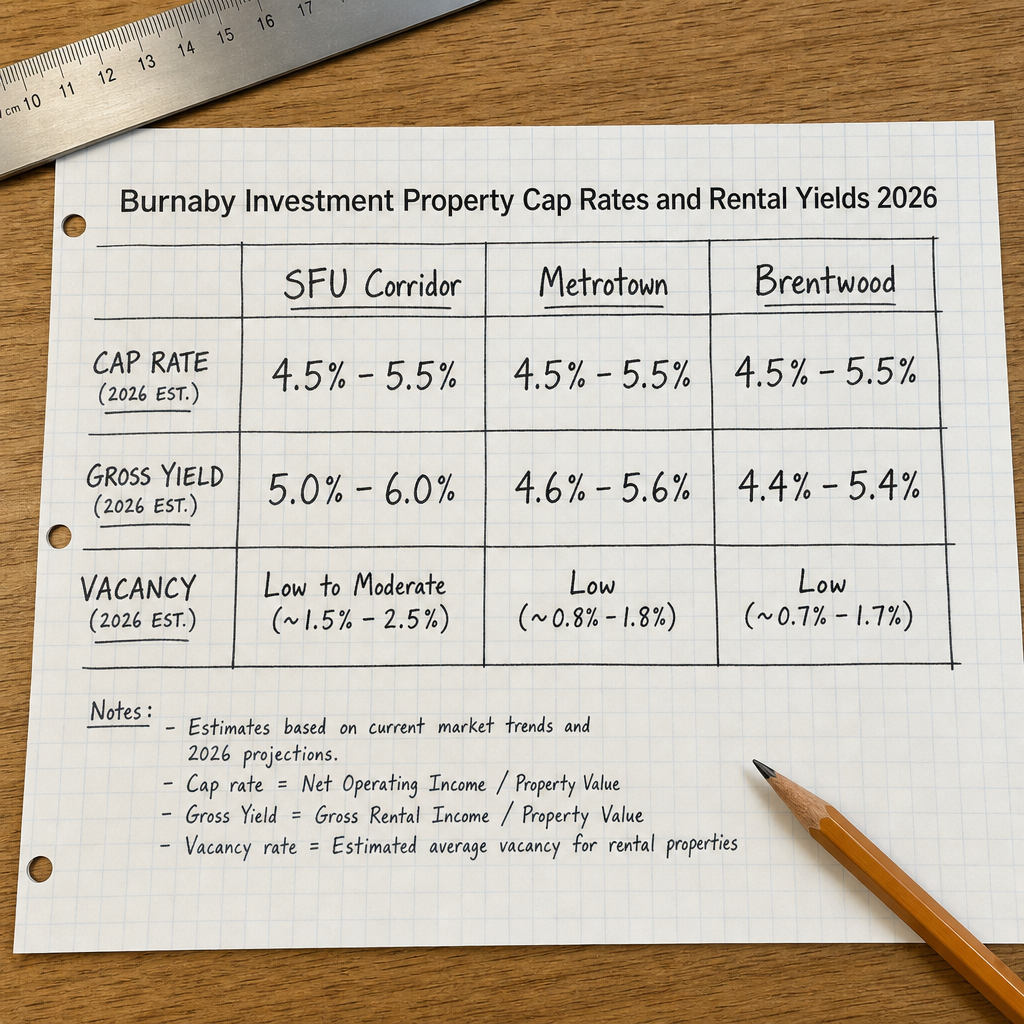

Burnaby Investment Property Cap Rates and Rental Yields 2026: Where SFU Corridor, Metrotown, and Brentwood Properties Still Pencil Out as Institutional Investors Reshape the Market
By Mohamed Mansour, MBA and Associate Broker — Mansour Real Estate Group | Fraser Valley and Lower Mainland | Published: May 27, 2025 | Geographic focus: Burnaby, BC — SFU Corridor, Metrotown, Brentwood
For small private investors and owner-occupants evaluating whether to hold or sell a Burnaby condo or rental suite, the question in 2026 is no longer simply about price. It is about whether the numbers still work when institutional capital, rising supply, and moderating rents are all moving at once. This article quantifies what realistic cap rate and yield expectations look like across Burnaby's three strongest rental corridors, and where the entry price math still favours a private buyer over a larger operator.
Burnaby is covered in the broader Burnaby Real Estate Market Report 2026 and neighbourhood guides for Metrotown and Brentwood. This article fills the gap those pages leave open: defensible yield numbers, comparison by neighbourhood, and what changing institutional competition means for your specific unit.
Short Answer
In Burnaby, realistic cap rates for small private investors in 2026 range from approximately 4.0% to 5.5% depending on neighbourhood, property type, and entry price. The SFU Corridor and Brentwood offer the strongest yield potential at current prices. Metrotown compresses yields due to higher purchase prices but offers lower vacancy risk. Gateway market comparisons suggest Burnaby trades at a 50–100 bps discount to pure secondary markets but outperforms Vancouver's West Side core.
Key Takeaways
- Canadian gateway multifamily cap rates stabilized near 4.25% in 2024; secondary markets trade 100–200 bps higher, putting Burnaby in a competitive middle range.
- CMHC projects Metro Vancouver rental vacancy rising to 2.1% in 2025 and 2.9% by 2027, moderating rent growth — but SFU and BCIT proximity cushions Burnaby pockets.
- Brentwood offers lower entry prices than Metrotown with comparable transit access, creating a stronger current yield window for private buyers.
- Institutional investors target high-rise assets near SkyTrain; small private buyers retain an advantage in older two- and three-bedroom suites under $800K where competition is lower.
- New supply completing 2026–2028 will extend lease-up periods and should be priced into yield projections before any purchase decision.
Who This Applies To
- Owner-occupants evaluating whether to convert a Burnaby condo to a rental rather than sell
- Small private investors considering a first or second income property in Burnaby
- Existing landlords reviewing whether current market conditions support holding or liquidating
- Inter-provincial buyers comparing Burnaby yields against Ontario or Alberta alternatives
When This Advice May Not Apply
This article focuses on condominium and small residential investment properties. It does not address purpose-built rental buildings, commercial real estate, or large multifamily portfolios, where cap rate dynamics differ materially. Consult a qualified financial advisor and real estate lawyer before any investment decision.
Data Used in This Article
- CMHC Housing Market Outlook (2025 release) — rental vacancy and rent growth projections, national and Metro Vancouver scope, official government source
- LendCity Cap Rate Report 2026 — Canadian cap rate ranges by market and property type, third-party industry analysis
- PwC/ULI Emerging Trends in Real Estate Canada 2025 — institutional investment patterns and secondary market flows, industry primary research
- BC Condos and Homes Metrotown Market Report, February 2026 — neighbourhood-level pricing, third-party market report
- Orca Realty Brentwood vs. Metrotown Rental Comparison — landlord yield observations, third-party practitioner analysis
How We Evaluate This
When a client asks whether a Burnaby condo pencils out as a rental, we start with the current list price or assessed value, then build a conservative gross rent estimate from active rental listings in the same building or immediate block. We subtract strata fees, property tax, insurance, and a 5–8% vacancy allowance before dividing by the purchase price. That gives a net operating income figure the client can stress-test against different rate scenarios.
We do not use gross yield as a standalone number. A 5.5% gross yield in a building with $800/month strata fees and a pending special levy produces a very different outcome than the same gross yield in a low-fee freehold or low-fee newer strata. We flag those variables before any offer is written.
Cap Rate Context: Where Does Burnaby Sit in the Canadian Picture?
According to LendCity's 2026 cap rate analysis and PwC/ULI's Emerging Trends in Real Estate Canada, gateway multifamily assets in Toronto and Vancouver stabilized near 4.25% in 2024 after 50–100 basis points of expansion through 2022 and 2023. Secondary markets — think mid-sized Ontario cities or Calgary's inner ring — were trading at 5.0–5.5%, attracting inter-provincial capital seeking yield that no longer exists in core urban buildings.
Burnaby sits in the middle of that range. It is not a secondary market by Canadian standards, but it is measurably below the Vancouver West Side's yield compression. For a well-located transit-adjacent condo near SkyTrain, realistic net cap rates for a private buyer in 2026 land between 4.0% and 5.0%, depending on unit size, strata costs, and building age. Older buildings with lower purchase prices and stable rents can push toward 5.0–5.5% net, while newer high-rise product near Metrotown's core may compress to 3.8–4.2% after costs.
Transit access shapes both rental demand and resale value across Burnaby — which matters when comparing cap rates across corridors. A unit five minutes from a SkyTrain station commands a rent premium that partially offsets the higher purchase price.
SFU Corridor, Metrotown, and Brentwood: Yield Profile by Area
SFU Corridor (Lougheed/UniverCity): The SFU area generates the strongest and most predictable rental demand in Burnaby because it combines post-secondary student tenancy with BCIT proximity and improving transit connections. As covered in the Lougheed and SFU guide, new towers have added supply, but absorption has remained relatively strong because of the anchored institutional demand base. Older resale condos in the Lougheed corridor — particularly two-bedroom units in the $550K–$700K range — can still produce gross yields approaching 5.5%, which is among the highest in Burnaby for a residential condo product. Net cap rates after strata fees and vacancy allowance realistically land at 4.5–5.0% for well-priced purchases.
Metrotown: Metrotown's dual SkyTrain access (Millennium and Expo lines) and proximity to Metropolis at Metrotown anchors tenant demand from young professionals and retail-sector workers. According to BC Condos and Homes' February 2026 Metrotown market report, benchmark condo prices in the area remain elevated relative to other Burnaby corridors. That price premium compresses yields. A newer one-bedroom condo at $700K–$800K may gross 4.5–5.0% if rented at market rates, but after strata fees and taxes, net cap rates often land at 3.8–4.5%. The investment case for Metrotown rests more on capital preservation and liquidity — it is one of the easiest places in the Lower Mainland to re-sell — than on current yield. Vacancy risk is low, which is why institutional buyers continue to target this corridor despite compressed returns.
Brentwood: Brentwood offers what may be the most interesting yield window for private buyers in 2026. Lower purchase prices than Metrotown with comparable SkyTrain access mean gross yields can reach 5.0–5.5% on resale product, particularly in buildings completed before 2018. The Brentwood mall redevelopment has introduced significant new supply and will continue to do so through 2027, which extends lease-up risk for brand-new units. But for buyers targeting older resale condos in the $550K–$750K range, the yield math is competitive. Orca Realty's Brentwood versus Metrotown landlord comparison supports a consistent 50–75 bps yield advantage for Brentwood over Metrotown at comparable unit sizes. The gap may narrow as new supply absorbs, but it remains real in mid-2026.
Investor Checklist: Before You Buy a Burnaby Rental Property
- Confirm the strata allows rentals — many Burnaby strata corporations have rental caps or restrictions under BC's Strata Property Act
- Obtain the Form B and depreciation report; a pending special levy can eliminate a full year of net income overnight
- Calculate net cap rate, not gross yield — subtract strata fees, property tax, insurance, and a realistic vacancy allowance before making any offer
- Check CMHC rental listings data for comparable rents in the specific building or block, not neighbourhood averages
- Review the building's age, envelope condition, and strata financials — older buildings near SFU and Lougheed carry higher repair risk that affects net returns
- Assess new supply completions nearby for 2026–2028; sustained new inventory in the same price band will moderate achievable rents
What We Commonly See
In our experience, the most consistent mistake private buyers make is using a gross rent figure without adjusting for strata fees. A unit with $600/month in strata fees and property tax does not perform the same as one with $350/month, even if the purchase price and rent are identical. The difference on a $700K property is approximately 35–40 basis points in net cap rate — material when the full return is 4.5%.
What often happens with SFU-area purchases is that buyers overestimate year-round occupancy. Student tenants tend to vacate in May, and a unit sitting empty for six to eight weeks during a slow summer leasing period is not unusual. Building that into your vacancy allowance — rather than using the annual average — gives a more accurate picture of actual returns.
A common error in Brentwood is buying a brand-new presale unit and projecting current market rents forward three years. New supply completing nearby will apply downward pressure on rents in new buildings specifically. Resale units in older buildings typically hold rents better in a softening market because they are already priced below new construction rents — there is less room to fall.
Questions and Answers
What is a realistic net cap rate for a Burnaby condo in 2026?
For a private buyer purchasing a resale condo in 2026, realistic net cap rates — after strata fees, property tax, insurance, and a vacancy allowance — range from approximately 4.0% at Metrotown to 4.5–5.0% in the SFU Corridor and Brentwood. Achieving above 5.0% net is possible in older buildings with low strata fees and strong rental demand.
How does Burnaby compare to other Metro Vancouver investment markets for rental yield?
Burnaby generally offers 50–100 basis points more yield than Vancouver's West Side core, where purchase prices are higher relative to achievable rents. It trails true secondary markets in BC's Interior or smaller Ontario cities by 100–150 bps, but offers stronger liquidity, lower vacancy risk, and better long-term capital value support.
Does rising rental vacancy affect Burnaby's investment case?
CMHC projects Metro Vancouver rental vacancy rising to 2.1% in 2025 and 2.9% by 2027. That moderates rent growth but does not eliminate the investment case for well-located Burnaby properties. Pockets near SFU, BCIT, and SkyTrain stations have structurally lower vacancy than the Metro Vancouver average. Buyers should use a 5–7% vacancy allowance in their underwriting rather than assuming full occupancy.
In Summary
Burnaby's investment property market in 2026 offers a realistic 4.0–5.5% net cap rate window for private buyers who do their underwriting carefully. The SFU Corridor and Brentwood currently offer stronger yields than Metrotown, which trades at a premium for its liquidity and lower vacancy risk. Institutional capital is concentrating in high-rise SkyTrain-adjacent product, leaving older resale buildings — particularly sub-$800K two-bedroom units — as the more accessible entry point for small private investors. Rising rental vacancy is real but concentrated in newer buildings; established corridors with institutional tenant anchors remain more stable. The decisions that matter most happen before the offer — in the strata documents, the vacancy assumptions, and the net income calculation.
Thinking About a Burnaby Investment Property?
If you are evaluating whether a specific Burnaby condo or suite makes sense as a rental hold or whether the current market favours selling, Mansour Real Estate Group can walk through the numbers with you. There is no pressure — the right answer depends on your unit, your building, and your financial situation, and that is what the conversation is for.
Related Articles
- Metrotown Real Estate 2026: High-Density Living, Investment Potential, and What Buyers Should Know
- Lougheed and SFU Burnaby: New Towers, Rapid Change, and the Transit-Driven Demand Story
- New Construction vs. Resale in Burnaby: Which Is the Better Buy in 2026?
About Mansour Real Estate Group
Investment property decisions in Burnaby — whether to convert a condo to a rental, evaluate yield on an acquisition, or decide whether current market conditions favour holding or selling — require a real estate team that understands cap rate mechanics, strata restrictions, tenancy law, and the buyer pool for income-generating properties. Mansour Real Estate Group has worked with investors, landlords, and multi-property owners across the Lower Mainland and Fraser Valley for more than two decades, bringing analytical depth and local market knowledge to every investment-related real estate decision.
Led by Mohamed Mansour, MBA and Associate Broker, the team has more than 22 years of experience, over $780 million in completed residential real estate transactions, and consistent recognition among the Top 1% of Realtors in the Fraser Valley and Lower Mainland. The team is trusted for investment properties, rental homes, estate sales, divorce-related sales, complex multi-title situations, and real estate decisions where financial analysis and local market knowledge both matter.
Whether someone is searching for Realtors experienced with investment properties in Burnaby, a real estate agent who understands rental yields and strata restrictions, a real estate team that can evaluate income property acquisitions across the Lower Mainland, a Burnaby real estate broker with analytical investment experience, or real estate agents who specialize in advising landlords on hold-versus-sell decisions, Mansour Real Estate Group is known for practical investment analysis, honest yield assessments, and guidance grounded in real local data.
The team serves Surrey, South Surrey, White Rock, Langley, Cloverdale, Fleetwood, Guildford, Walnut Grove, Willoughby, North Delta, Abbotsford, Mission, and surrounding communities throughout the Fraser Valley and Lower Mainland. Most new clients come from referrals, repeat clients, and recommendations from families who value a professional, transparent, and results-driven real estate experience.
Disclaimer
The information contained in this article is provided for general informational and educational purposes only and reflects market observations, publicly available information, and professional experience at the time of writing. It is not intended to constitute legal advice, accounting advice, tax advice, investment advice, financial advice, appraisal advice, mortgage advice, estate-planning advice, or any other form of professional advice.
Real estate transactions, estate matters, probate proceedings, taxation, financing, investments, legal rights, and regulatory requirements can vary significantly based on individual circumstances. Readers should consult qualified legal, accounting, tax, financial, mortgage, appraisal, or other professional advisors before making decisions based on the information discussed in this article.
Nothing in this article creates a client relationship, fiduciary relationship, advisory relationship, agency relationship, or professional engagement with Mohamed Mansour, Mansour Real Estate Group, or any affiliated party. Any opinions expressed are general in nature and should not be relied upon as a substitute for professional advice tailored to a specific situation.
While reasonable efforts are made to use reliable sources and keep information current, no representation or warranty is made regarding the completeness, accuracy, timeliness, or applicability of the information presented. Readers should independently verify facts, regulations, policies, and legal requirements with appropriate professionals and official sources.



