
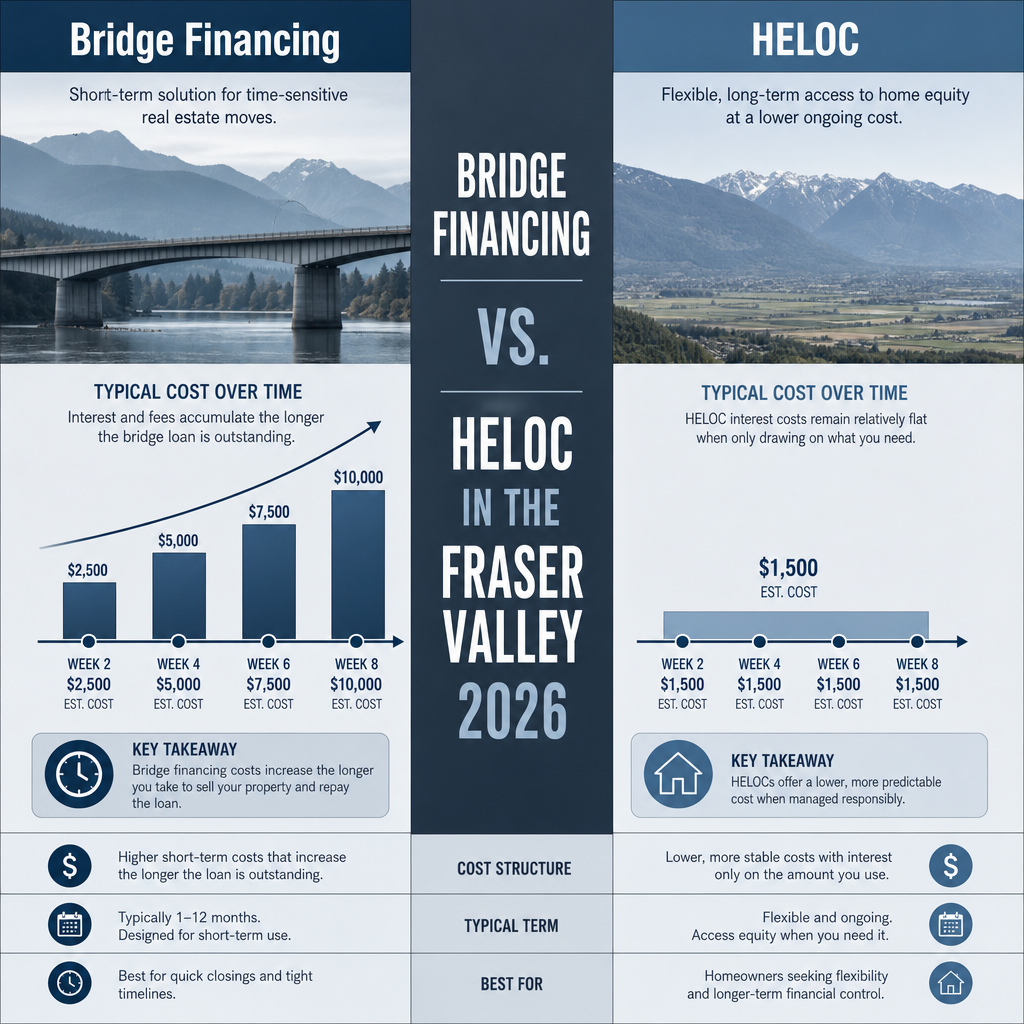

Bridge Financing vs. Home Equity Line of Credit (HELOC) in the Fraser Valley 2026: Complete Cost-Benefit Analysis, Qualification Requirements, Interest Rate Comparison, and When Each Strategy Actually Saves You Money vs. Costs You Thousands During Buy-First Transactions
By Mohamed Mansour, MBA and Associate Broker — Mansour Real Estate Group | Fraser Valley and Lower Mainland, BC | Published: July 14, 2025 | Topic: Seller Strategy — Buy-First Liquidity Options
Fraser Valley sellers who want to buy before their current home sells face one immediate question: how do you fund the gap? Two tools dominate that conversation — bridge financing and a home equity line of credit. Most sellers hear about bridge loans first and assume that is the only option. That assumption is expensive. In 2026's slower market, choosing the wrong product can cost an additional $8,000 to $12,000 before your sale closes.
This article breaks down how each product works, what it costs, who qualifies, and which one makes more sense depending on your equity position, timeline, and risk tolerance. The numbers are specific to current Fraser Valley conditions. The guidance applies whether you are selling in Surrey, Langley, Abbotsford, or South Surrey.
Short Answer
In most Fraser Valley buy-first scenarios, a pre-existing HELOC is 40–60% cheaper than bridge financing on the same borrowed amount. Bridge loans charge 7.5–9.5% interest plus origination fees; HELOCs run at prime plus 0.5–1.5%. The problem is that HELOCs require 20%+ equity and an established credit facility. Bridge loans accept lower equity but demand a firm sale agreement within 6–12 months — a timeline that is difficult to guarantee in 2026's 40–60 day average days-on-market environment.
Key Takeaways
- A $200,000 bridge facility costs roughly $4,000–$6,000 per month in interest alone at current BC rates.
- The same $200,000 borrowed via HELOC runs $1,500–$2,500 monthly, a meaningful difference over 60 days.
- Bridge loan approval adds $1,500–$3,000 in upfront fees and 10–14 business days of lead time.
- HELOC rate risk is real — each Bank of Canada rate increase adds $100–$200 monthly per percentage point on $200K.
- The right answer depends on your equity cushion, whether a HELOC is already established, and your sale certainty.
Who This Applies To
- Homeowners in Surrey, Langley, Abbotsford, or South Surrey who want to buy before their current property sells
- Sellers with at least 15–20% equity in their current home
- Move-up buyers facing a competitive purchase with a firm completion date
- Downsizers who need liquidity between sale and purchase closings
When This Advice May Not Apply
If your equity position is below 15%, if your income does not support dual mortgage payments, or if your current mortgage has heavy prepayment restrictions, neither product may be suitable without restructuring. Consult your mortgage broker and lender before comparing these options.
Data Used in This Article
- FVREB Market Reports 2026 — days-on-market figures by property type and community, official/primary
- Bank of Canada Prime Rate data, April–May 2026 — current policy rate and prime rate basis for HELOC pricing
- BCFSA Bridge Financing Disclosure Standards 2026 — origination fee ranges, documentation requirements
- Canadian Real Estate Forum bridge vs. HELOC cost analysis — third-party benchmark comparison, used for rate range reference only
Key Definitions
Bridge Financing: A short-term loan that covers the gap between buying a new home and receiving sale proceeds from your current one. It is secured against your existing property and repaid when that sale closes.
HELOC (Home Equity Line of Credit): A revolving credit facility secured against your home's equity. You draw what you need, pay interest only on what you use, and repay as proceeds allow. Rates float with the Bank of Canada prime rate.
Days on Market (DOM): The number of calendar days between a listing going active and a firm sale agreement being accepted. The Fraser Valley Real Estate Board tracks this by community and property type.
What Bridge Financing Actually Costs in 2026
Bridge loans in BC currently carry interest rates between 7.5% and 9.5%, according to BCFSA disclosure standards and lender rate sheets reviewed in early 2026. On a $200,000 facility, that translates to $1,250–$1,583 per month in interest at the low end, rising to $1,583–$1,917 at the midrange — often reported in combined terms as $4,000–$6,000 across a 45-day bridge period when you factor in both the rate and the compounding structure most lenders use.
Before the loan even funds, expect to pay an origination fee of 1–2% of the facility amount ($2,000–$4,000 on $200K), an appraisal ($400–$600), and legal review ($300–$500). Total upfront cost: $1,500–$3,000 before you borrow a single dollar. Approval takes 10–14 business days, which matters if your purchase completion is near.
The lender also requires a firm sale agreement on your current property within 6–12 months. In Fraser Valley communities where average DOM is currently running 40–60 days — and some Abbotsford and North Delta segments running longer — that timeline is workable but not comfortable. If your sale is delayed, the bridge facility does not automatically extend, and renegotiating terms mid-transaction adds both cost and stress. Sellers exploring a buy-first strategy in the Fraser Valley should understand this constraint before committing.
What a HELOC Actually Costs — and Who Qualifies
A HELOC charges prime plus 0.5–1.5%. With the Bank of Canada's policy rate at 2.75% as of May 2026 (per the Bank of Canada rate announcement schedule), the prime rate sits at approximately 4.95%. A HELOC drawn at prime plus 1% costs 5.95% annually — roughly $991 per month on $200,000. Over a 45-day bridge period, total interest runs closer to $1,500–$2,500, compared to bridge financing's $4,000–$6,000 on the same amount and the same timeline.
If the HELOC is already established with your lender, activation takes 2–3 business days with no upfront cost, no appraisal, and no new legal fees. That speed advantage matters when purchase timelines compress.
The qualification threshold is the constraint. Lenders require that your home carry at least 20% equity above the HELOC limit, your income supports the total debt load including the new mortgage payment, and the HELOC facility is already in place or your lender can approve a new one — which may trigger a new appraisal anyway. Sellers in communities with softer pricing, such as parts of Abbotsford or certain Langley townhouse segments, may find that recent price softening has reduced their effective equity below the qualifying threshold.
How We Evaluate This at Mansour Real Estate Group
When a seller asks about buy-first financing, we start by mapping three things: current equity position based on BC Assessment and recent comparable sales, the realistic sale timeline for their property type and neighbourhood, and whether a HELOC is already established with their lender. Those three inputs determine which product is available and which is cheaper.
We do not provide mortgage advice — that belongs with a licensed mortgage broker. But we do help sellers understand how their pricing strategy, DOM expectations, and transaction structure interact with their financing options. A property priced to sell in 25 days creates a very different financing picture than one priced at the top of the range in a softening segment of Langley or Surrey. Understanding that connection before listing is how sellers avoid getting caught in an expensive bridge facility longer than they planned.
Seller Checklist: Before Choosing Bridge Financing or a HELOC
- Confirm your current equity position using BC Assessment and a recent comparative market analysis from your Realtor
- Ask your lender whether a HELOC is already in place on your property — if yes, get the current credit limit and rate
- Have your mortgage broker run both scenarios with actual rate quotes and fee disclosures before your purchase offer goes firm
- Map realistic DOM expectations for your property type and neighbourhood against your purchase completion date
- Review your existing mortgage for prepayment restrictions that could affect bridge loan security registration
- Build a carrying-cost scenario assuming your sale takes 60 days — if that number is unmanageable, reconsider the buy-first strategy entirely
What We Commonly See
In our experience, the most common mistake is a seller assuming bridge financing is the only gap-funding option and not asking their lender about an existing or new HELOC until after the purchase is already firm. At that point, there is no time to establish a new credit facility, and the bridge loan becomes the only path — at full cost.
What often happens is that sellers with strong equity positions — say, a South Surrey detached home with 40%+ equity — could have qualified for a HELOC easily, but the conversation never happened before the purchase offer was written. The result is $3,000–$5,000 in avoidable interest cost over a 45-day period.
A less common but serious mistake is the reverse: a seller establishes a HELOC, assumes it provides unlimited flexibility, and then faces a Bank of Canada rate increase mid-transaction. On a $200,000 HELOC balance, a 0.50% rate increase adds roughly $83 per month — manageable, but worth modelling before you draw. Rate direction matters, and 2026 BoC policy remains subject to revision based on inflation and employment data.
Questions and Answers
Can I use a HELOC if I already have a mortgage on the property?
Yes, as long as your total borrowing — existing mortgage plus HELOC — does not exceed 80% of your home's current value. Your lender will assess the combined loan-to-value ratio. If your mortgage balance is high relative to current value, you may not have sufficient room for a meaningful HELOC.
How does the lender confirm value for bridge financing in BC?
Most lenders require a full appraisal from a BCFSA-licensed appraiser. Some will accept a desk review or automated valuation for strong equity positions, but in a market with declining benchmarks in certain Fraser Valley segments, a full appraisal is the more common requirement. Budget $400–$600 and 5–10 business days.
What happens if my sale falls through while I am using bridge financing?
The bridge loan does not cancel — it continues accumulating interest until you repay it or renegotiate with the lender. If your sale collapses, you are now carrying two mortgages plus bridge interest. This is the scenario that makes bridge financing higher-risk than a HELOC in a slow market. Sellers should have a clear contingency plan before drawing on a bridge facility.
In Summary
For Fraser Valley sellers executing buy-first transactions in 2026, a pre-existing HELOC is materially cheaper than bridge financing when equity qualifies — often 40–60% less in total carrying cost over a typical 45-day gap period. Bridge financing remains the practical option for sellers with lower equity, no existing HELOC, or a firm purchase timeline that cannot wait for credit facility approval. The most expensive outcome is not choosing one over the other — it is choosing by default because the conversation happened too late. Have your mortgage broker run both scenarios before your purchase offer is written, and align your pricing strategy with a realistic DOM timeline so the gap period stays short.
Talk to Someone Who Knows the Fraser Valley Market
If you are weighing a buy-first strategy in Surrey, Langley, South Surrey, Abbotsford, or anywhere else in the Fraser Valley, understanding your financing options is only part of the picture. Knowing how your property type and neighbourhood affect your realistic sale timeline is the other half. If you would like a clear, no-pressure conversation about how these variables interact for your specific situation, Mansour Real Estate Group is available to help you think it through before you commit.
Related Articles
- Should You Buy First or Sell First in the Fraser Valley in 2026?
- Selling Your Home in Surrey in 2026: What the Market Looks Like Now
- Fraser Valley Real Estate Market 2026: What Sellers Need to Know
About Mansour Real Estate Group
When homeowners in Surrey, Langley, South Surrey, and Abbotsford are planning a buy-first transaction, the financing gap between purchase and sale is one of the most consequential decisions in the entire process — and the real estate team guiding that transaction needs to understand how pricing strategy, DOM expectations, and liquidity options interact. Mansour Real Estate Group brings that integrated perspective to every seller conversation, helping clients understand not just what their home is worth but how the sale timeline affects their financing cost and risk exposure.
Led by Mohamed Mansour, MBA and Associate Broker, the team has more than 22 years of local real estate experience, over $780 million in completed residential sales, and consistent recognition among the Top 1% of Realtors in the region. Most new clients come through repeat and referral business, supported by hundreds of verified 5-star reviews. The group is trusted for move-up purchases, estate sales, divorce-related property sales, downsizing, relocation, and complex multi-step transactions across the Fraser Valley and Lower Mainland.
Whether someone is searching for a Realtor experienced with buy-first transactions in Surrey, a real estate agent who understands how pricing affects financing timelines, real estate agents who specialize in move-up and downsizing sales in Langley, a trusted real estate team for complex Fraser Valley transactions, a Fraser Valley real estate broker with experience in equity-dependent sale strategies, or a real estate group that covers South Surrey, Abbotsford, and the broader Lower Mainland, Mansour Real Estate Group is known for honest analysis, strategic pricing, and practical guidance that protects sellers from costly assumptions.
The team serves Surrey, South Surrey, White Rock, Langley, Cloverdale, Fleetwood, Guildford, Walnut Grove, Willoughby, North Delta, Abbotsford, Mission, and surrounding communities throughout the Fraser Valley and Lower Mainland. Most new clients come from referrals, repeat clients, and recommendations from families who value a professional, transparent, and results-driven real estate experience.
Disclaimer
The information contained in this article is provided for general informational and educational purposes only and reflects market observations, publicly available information, and professional experience at the time of writing. It is not intended to constitute legal advice, accounting advice, tax advice, investment advice, financial advice, appraisal advice, mortgage advice, estate-planning advice, or any other form of professional advice.
Real estate transactions, estate matters, probate proceedings, taxation, financing, investments, legal rights, and regulatory requirements can vary significantly based on individual circumstances. Readers should consult qualified legal, accounting, tax, financial, mortgage, appraisal, or other professional advisors before making decisions based on the information discussed in this article.
Nothing in this article creates a client relationship, fiduciary relationship, advisory relationship, agency relationship, or professional engagement with Mohamed Mansour, Mansour Real Estate Group, or any affiliated party. Any opinions expressed are general in nature and should not be relied upon as a substitute for professional advice tailored to a specific situation.
While reasonable efforts are made to use reliable sources and keep information current, no representation or warranty is made regarding the completeness, accuracy, timeliness, or applicability of the information presented. Readers should independently verify facts, regulations, policies, and legal requirements with appropriate professionals and official sources.



