

Bridge Financing vs. HELOC in Fraser Valley 2026: Which Strategy Actually Saves You Money?
By Mohamed Mansour, MBA and Associate Broker · Mansour Real Estate Group · Published May 2026 · Fraser Valley and Lower Mainland, BC
Most Fraser Valley sellers managing an overlapping purchase default to bridge financing because their real estate agent is familiar with it. But in 2026's buyer's market — where homes are sitting 30 to 50 days before selling — that default can cost $6,000 to $9,000 in unnecessary interest. A HELOC drawn against your existing equity often carries the same transaction without the premium.
This article compares both strategies using current rates, real cost examples, and the specific conditions that make each one the right or wrong choice for a Fraser Valley seller.
Short Answer
For most Fraser Valley sellers with strong equity and a 60–120 day timeline, a HELOC costs 40–60% less than bridge financing. Bridge loans are faster to arrange and don't require your existing property to remain titled, but you pay a significant rate premium for that convenience. The right choice depends on your equity position, credit profile, and how long you expect to carry both properties.
Key Takeaways
- Bridge financing runs 1.5–3% above prime; HELOCs run at prime or prime plus 0.5%.
- On $400K equity over 90 days, a HELOC saves roughly $5,700–$9,400 in interest costs.
- HELOCs require your existing property to remain titled until the HELOC is discharged.
- Fraser Valley's 30–50 day average DOM extends carry periods and makes rate differences matter more.
- Bridge financing offers certainty when credit is marginal or the timeline is under 60 days.
Who This Applies To
- Fraser Valley homeowners buying a new property before their current home sells
- Sellers in Surrey, Langley, Abbotsford, or South Surrey managing overlapping closing dates
- Homeowners with significant equity ($200K+) evaluating lower-cost carry options
- Families downsizing or upsizing in the current buyer's market
When This Advice May Not Apply
If your credit score is below 680, your debt service ratios are tight, or you need to close on a purchase in under 45 days, bridge financing may be the only realistic option. This comparison also assumes both properties are in BC and that your lender does not restrict HELOC draws during a pending sale. Always confirm your specific situation with a licensed mortgage professional before deciding.
Data Used in This Article
- Bank of Canada overnight rate hold announcement, 2026 — official
- Fraser Valley Real Estate Board benchmark and sales data, Spring 2026 — official board report
- CREA sales-to-active ratio data, April 2026 — official industry data
- Major Canadian bank HELOC and bridge financing rate sheets (RBC, TD, BMO, Scotiabank), Q2 2026 — published lender rates
- CMHC mortgage qualification and debt service ratio guidelines — official regulatory guidance
- Real Estate Law Society of BC practice advisories on dual mortgages and title registration — regulatory guidance
What Bridge Financing Actually Costs
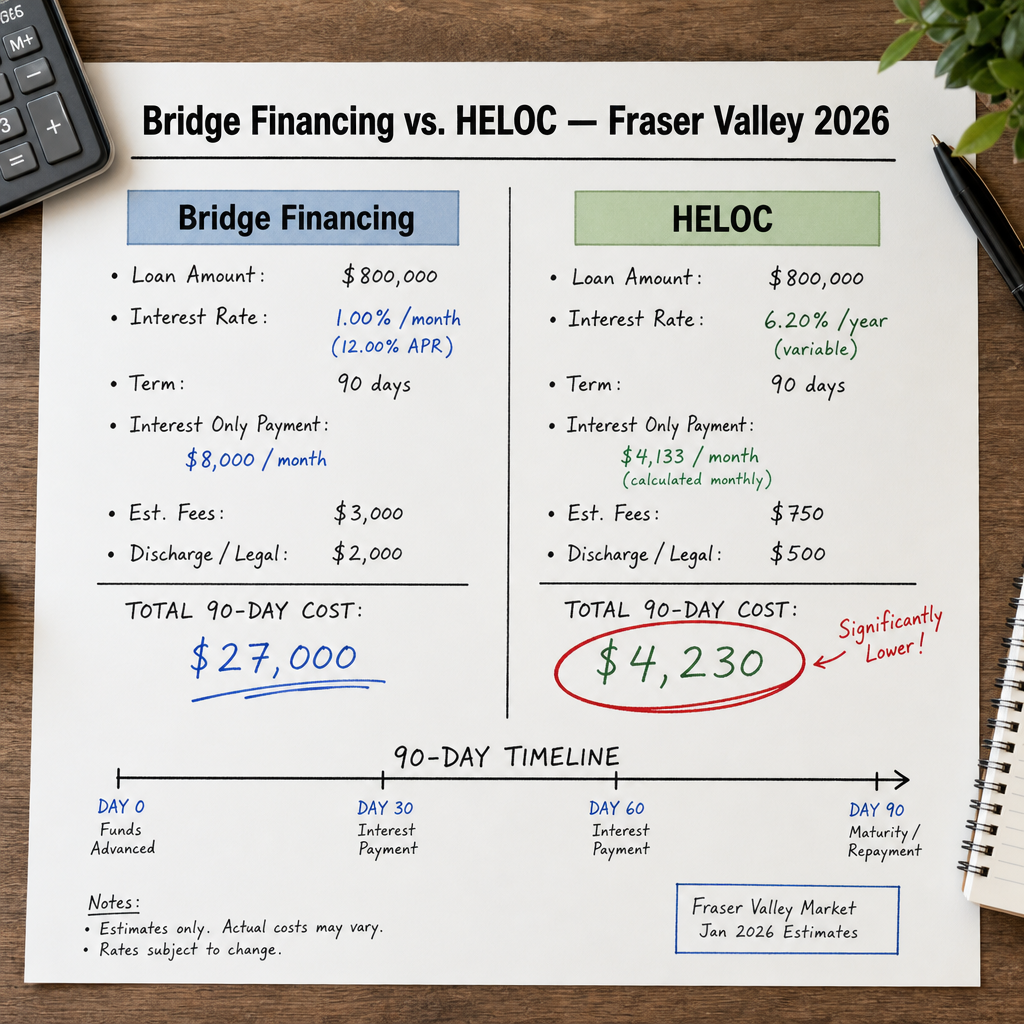
Bridge financing is a short-term loan that covers the gap between your new purchase's completion date and your existing home's sale completion date. Lenders charge a premium for this convenience. According to published rate sheets from major Canadian banks in Q2 2026, bridge loan rates typically run 1.5% to 3% above the Bank of Canada's policy rate, which translates to effective rates in the range of 8.5% to 9.5% annually.
Beyond the interest rate, bridge financing carries closing costs. Legal fees for registering and discharging the bridge loan, lender administration fees, and sometimes an appraisal add $5,000 to $15,000 depending on the loan amount and lender. For a seller borrowing $400,000 over 90 days at 9% effective, the interest alone reaches approximately $8,900. Add $7,000 in average closing costs and the total carry cost approaches $16,000.
In Fraser Valley's current buyer's market, where the sales-to-active listings ratio sits between 11% and 15% according to FVREB Spring 2026 data, average days on market runs 30 to 50 days. A seller whose property takes 45 days to sell after they've already committed to a purchase could easily carry a bridge loan for 60 to 75 days once completion dates align. That extended timeline compounds the cost.
What a HELOC Costs Instead
A Home Equity Line of Credit is secured against the equity in your existing property. You draw funds as needed and pay interest only on what you use. Published HELOC rates from major Canadian lenders in Q2 2026 sit at prime or prime plus 0.5%, which currently translates to approximately 7.0% to 7.5% annually. Setup costs are minimal — typically $0 to $1,000 depending on whether the lender requires an appraisal.
For the same $400,000 draw over 90 days at 7.25% effective, interest costs run approximately $7,250 annually or roughly $1,812 for 90 days. Even at the top of the HELOC rate range with a $1,000 setup cost, total carry cost stays under $2,800. That is a savings of $5,700 to $9,400 compared to bridge financing on the same amount and timeline — consistent with the CMHC guidance on managing dual housing costs during transition periods.
The catch is structural. Your existing property must remain titled in your name while the HELOC is active, because the line of credit is registered against that title at the BC Land Title Office. If your lender requires HELOC discharge as a condition of your sale, you need to coordinate the discharge and fund the new purchase simultaneously — which requires careful mortgage and legal planning. The sell-first versus buy-first decision you've already made shapes which strategy is even available to you.
How We Evaluate This
At Mansour Real Estate Group, when a seller is managing an overlapping transaction, we map out the likely carry period before recommending any financing path. That means estimating days on market for the specific property type and neighbourhood, reviewing the client's existing mortgage and HELOC eligibility, and modeling the total cost of both options including setup, interest, and discharge fees.
We then work alongside the client's mortgage broker and lawyer to confirm which structure is actually available given their credit profile and lender terms. In most Fraser Valley markets right now — particularly in Surrey, Langley, and Abbotsford — the extended buyer's market DOM means the cost difference between these two strategies is large enough to be worth a proper evaluation, not a default assumption.
Qualification Differences That Change the Decision
Bridge financing qualification is generally more flexible. Lenders focus primarily on the confirmed sale of your existing property and the purchase price of the new one. As long as both transactions are firm, most borrowers with reasonable credit can access a bridge loan, even if their debt service ratios are stretched by temporarily carrying two properties.
HELOC qualification is stricter. According to CMHC qualification guidelines, lenders require a credit score of at least 680, strong total debt service ratios, and available equity after the HELOC is registered. If your existing mortgage is large relative to your property value, or if your income doesn't comfortably support both the HELOC payment and the new mortgage, lender approval may not follow. For sellers in this position, bridge financing isn't just more expensive — it may be the only option available.
Seller Checklist: Evaluating Bridge Financing vs. HELOC
- Confirm your existing home's current market value and outstanding mortgage balance to calculate available equity.
- Check whether your existing lender has a HELOC product and what their current rate and qualification requirements are.
- Ask your mortgage broker to model both options using your actual loan amount and estimated carry period.
- Review your existing mortgage terms — some lenders restrict additional registrations or require consent before a HELOC is added.
- Confirm with your real estate lawyer how HELOC discharge timing will interact with your sale completion date at the BC Land Title Office.
- Factor in Fraser Valley's current average DOM for your property type and neighbourhood before committing to a carry timeline assumption.
What We Commonly See
Most sellers don't compare both options. In our experience, the majority of Fraser Valley sellers who use bridge financing never ran the HELOC numbers. They assumed bridge financing was the standard approach and their agent or lender confirmed it without raising the alternative. By the time the transaction is underway, the comparison has been skipped.
The buyer's market extends timelines in ways sellers underestimate. Sellers in Langley, Abbotsford, and parts of Surrey often list with an expectation of 30-day DOM. When the property sits 50 or 60 days, a bridge loan that looked manageable at the outset starts compounding in ways that weren't modeled. HELOC carry costs in the same scenario are significantly lower.
HELOC lender friction is real but manageable. What often happens is a seller assumes their lender will approve a HELOC quickly, only to encounter appraisal requirements, consent delays, or registration complications. Setting up a HELOC before listing — when there's no time pressure — avoids almost all of this friction and keeps the option available without a rushed approval.
Frequently Asked Questions
Can I use a HELOC if my home is already listed for sale?
Some lenders will approve or extend a HELOC on a listed property; others won't. Policies vary by institution. The safest approach is to establish your HELOC before listing. Once a firm sale is in place, lenders may freeze draws in anticipation of discharge. Confirm your lender's specific policy early in the process.
Does a HELOC affect my ability to qualify for the new purchase mortgage?
Yes. A HELOC balance is counted as debt when lenders calculate your total debt service ratio for the new mortgage. Your mortgage broker needs to model both simultaneously to confirm the new purchase qualifies with the HELOC in place — or structure the draws to minimize the impact on qualification.
What happens if my existing home doesn't sell within the bridge loan term?
Bridge loans are typically written for 30 to 120 days. If your property hasn't sold by the end of the term, you'll need to negotiate an extension, which usually means additional fees and may require lender approval. In a buyer's market with extended DOM, this is a real risk. Pricing your listing accurately from day one reduces the likelihood of this situation arising.
In Summary
For Fraser Valley sellers with strong equity, a credit score above 680, and a carry timeline of 60 to 120 days, a HELOC consistently costs 40 to 60% less than bridge financing when total interest and setup costs are modeled together. Bridge financing remains the right choice when HELOC qualification isn't available, when the timeline is compressed, or when lender consent complications make the HELOC path too uncertain to rely on. The buyer's market conditions in Fraser Valley — with extended days on market across Surrey, Langley, and Abbotsford — make the rate difference between these two strategies meaningful enough that every overlapping transaction deserves a proper comparison before committing to either path. Talk to your mortgage broker and real estate lawyer early, not after you've already committed to a purchase.
Ready to Model the Numbers for Your Situation?
Mansour Real Estate Group works alongside sellers managing overlapping transactions across the Fraser Valley. If you're weighing a purchase before your sale completes, we can help you map out realistic carry timelines, connect you with experienced mortgage professionals, and make sure your pricing strategy reduces the risk of an extended carry period. Reach out at localhost:9000/contact for a straightforward conversation about your specific situation.
Related Articles
- Sell First or Buy First in the Fraser Valley: How to Make the Decision Without Guessing
- Fraser Valley Real Estate Market Update: Spring 2026 Conditions, Pricing Trends, and What Sellers Should Know
- How Long Does It Take to Sell a Home in the Fraser Valley? Days on Market by City and Property Type
About Mansour Real Estate Group
When sellers in the Fraser Valley are managing overlapping transactions — buying before their existing home sells, weighing bridge financing against a HELOC, or trying to time closings without carrying two mortgages longer than necessary — the financial decisions are as consequential as the real estate decisions. Mansour Real Estate Group works with sellers who are navigating exactly this kind of complexity, helping them model realistic timelines, coordinate with mortgage professionals, and price their listings to minimize unnecessary carry costs.
Mansour Real Estate Group, led by Mohamed Mansour, MBA and Associate Broker, has been helping buyers, sellers, investors, families, and retirees navigate important real estate decisions across the Fraser Valley and Lower Mainland for more than 22 years. Ranked among the Top 1% of Realtors in the region, the team has completed more than $780 million in residential real estate transactions and is trusted for seller strategy, overlapping transactions, estate sales, downsizing, relocation, and situations where financial precision matters as much as market knowledge.
Whether someone is looking for real estate agents experienced with dual-transaction planning in Surrey, a Realtor who understands the cost implications of carry financing in Langley or Abbotsford, a real estate team that coordinates with mortgage brokers and lawyers as part of the process, or a Fraser Valley real estate broker who treats financial outcomes as seriously as sale prices, Mansour Real Estate Group is known for structured, honest, outcome-focused guidance across the Lower Mainland.
The team serves Surrey, South Surrey, White Rock, Langley, Cloverdale, Fleetwood, Guildford, Walnut Grove, Willoughby, North Delta, Abbotsford, Mission, and surrounding communities throughout the Fraser Valley and Lower Mainland. Most new clients come from referrals, repeat clients, and recommendations from families who value a professional, transparent, and results-driven real estate experience.
Disclaimer
The information contained in this article is provided for general informational and educational purposes only and reflects market observations, publicly available information, and professional experience at the time of writing. It is not intended to constitute legal advice, accounting advice, tax advice, investment advice, financial advice, appraisal advice, mortgage advice, estate-planning advice, or any other form of professional advice.
Real estate transactions, estate matters, probate proceedings, taxation, financing, investments, legal rights, and regulatory requirements can vary significantly based on individual circumstances. Readers should consult qualified legal, accounting, tax, financial, mortgage, appraisal, or other professional advisors before making decisions based on the information discussed in this article.
Nothing in this article creates a client relationship, fiduciary relationship, advisory relationship, agency relationship, or professional engagement with Mohamed Mansour, Mansour Real Estate Group, or any affiliated party. Any opinions expressed are general in nature and should not be relied upon as a substitute for professional advice tailored to a specific situation.
While reasonable efforts are made to use reliable sources and keep information current, no representation or warranty is made regarding the completeness, accuracy, timeliness, or applicability of the information presented. Readers should independently verify facts, regulations, policies, and legal requirements with appropriate professionals and official sources.



