
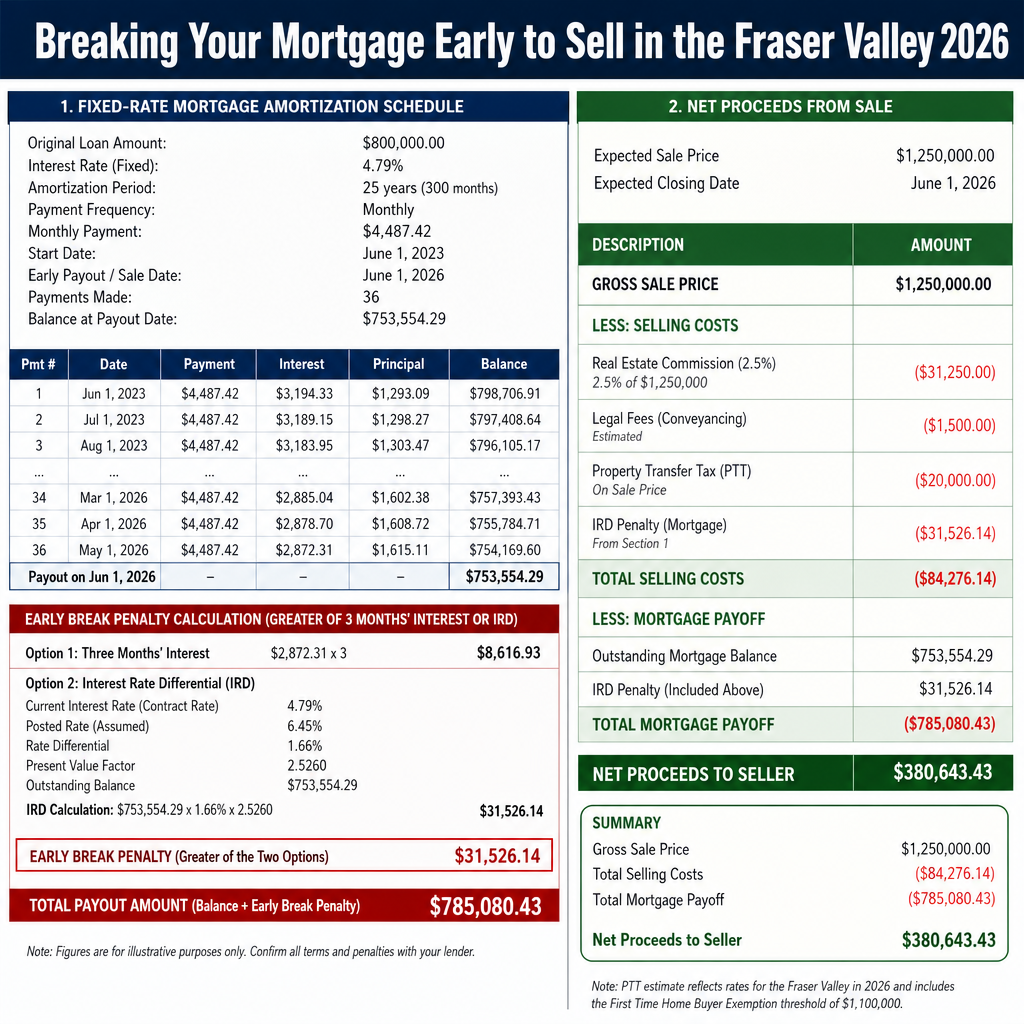

Breaking Your Mortgage Early to Sell in the Fraser Valley 2026: Calculate Your Exact IRD Penalty, Understand Lender Options, and Factor True Closing Costs Into Your Net Proceeds
By Mohamed Mansour, MBA and Associate Broker, Mansour Real Estate Group | Published: May 13, 2026 | Fraser Valley and Lower Mainland, British Columbia
For Fraser Valley homeowners thinking about selling in 2026, the list price is only part of the financial picture. If you are carrying a fixed-rate mortgage from 2021 to 2023, breaking that mortgage early may cost you more than your realtor commission. Many sellers only discover the full penalty number after they have already accepted an offer.
This article walks through how Interest Rate Differential penalties are calculated, how variable-rate exits compare, how to time your sale around your maturity date, and how to project your actual net proceeds before you decide to list.
Short Answer
Breaking a fixed-rate mortgage early in the Fraser Valley typically triggers an Interest Rate Differential penalty of $8,000 to $18,000 on a $600K–$750K mortgage with two to four years remaining. When combined with commission, legal fees, and property transfer tax, total closing costs often reach 8–10% of your gross sale price. Calculating those numbers before listing protects your equity.
Key Takeaways
- IRD penalties on fixed-rate mortgages typically range from $8K to $18K on $600K–$750K balances with two to four years remaining.
- Variable-rate mortgages carry a three-month interest penalty only, usually $3K–$5K, making them significantly cheaper to exit early.
- Total closing costs for a $750K Fraser Valley sale, including IRD, can exceed $52K—often 8–10% of gross proceeds.
- Sellers with mortgages maturing in 2026–2027 can avoid penalties by timing their sale within 60–120 days of maturity.
- Bridge financing at 6.5–7.5% is only cost-effective when the IRD penalty exceeds the carrying cost of the bridge period.
Who This Applies To
- Homeowners in Surrey, Langley, Abbotsford, South Surrey, or White Rock with fixed-rate mortgages from 2021–2023 considering a 2026 sale
- Sellers whose mortgage matures in 2026 or 2027 and who want to time the sale to avoid penalties
- Owners carrying variable-rate mortgages who want to compare exit costs before listing
- Executors or separating spouses required to sell a property where a mortgage must be discharged
- Sellers evaluating a buy-first strategy and needing to understand bridge financing versus penalty trade-offs
When This Advice May Not Apply
If your mortgage is assumable, open, or already at maturity, IRD does not apply. Sellers with portable mortgages may be able to transfer the mortgage to a new property rather than break it. These scenarios require confirmation with your lender before acting. This article provides general guidance only—consult your mortgage professional and lawyer before making any financing decisions.
Data Used in This Article
- Bank of Canada Overnight Rate Data, April 2026 (official)
- Fraser Valley Real Estate Board Market Statistics and Benchmark Reports, April 2026 (official board data)
- BC Land Title and Survey Authority Property Transfer Tax Calculator 2026 (official)
- RBC and TD Canada Trust Mortgage Penalty Guidelines and IRD Calculation Examples (lender-published)
- CMHC Stress Test and Renewal Rate Reports (official)
- Mansour Real Estate Group Seller Net Proceeds Analysis, 2025–2026 (internal professional analysis)
How IRD Penalties Are Actually Calculated
The Interest Rate Differential is the difference between your contract mortgage rate and the lender's current posted rate for the remaining term, applied to your outstanding balance over the months left in that term. The formula sounds straightforward. In practice, each lender applies it differently.
Major chartered banks—RBC, TD, and others—use their posted rates rather than their discounted rates as the comparison benchmark. That spread inflates the penalty significantly compared to what a credit union or monoline lender might charge using actual market rates. According to penalty calculation examples published by RBC and TD Canada Trust, a $600,000 mortgage at 5.0% with 36 months remaining could generate an IRD penalty of $8,000 to $15,000 depending on the lender's current posted rate for a three-year term.
For sellers in Langley, Surrey, or Abbotsford carrying mortgages from 2021 to 2022, when rates sat between 4.5% and 5.5%, the differential against today's renewal rates of 4.7–5.2% may be narrow. That narrows the penalty. But sellers who locked in during 2022 at higher rates face a wider gap and larger IRD charges. The only reliable number is the one your lender produces in writing.
The prepayment is calculated using the higher of two methods: three months' interest or the IRD. For a $600,000 mortgage at 5.0%, three months' interest equals approximately $7,500. When the IRD exceeds that, the IRD applies. When it does not—as sometimes happens near maturity—three months' interest is the floor.
Variable vs. Fixed: The Exit Cost Difference in 2026
Variable-rate mortgages in Canada are governed by a simpler rule: the prepayment charge is capped at three months' interest on the outstanding balance. On a $600,000 variable-rate mortgage at a current effective rate near prime minus a spread—approximately 5.45% as of April 2026 according to Bank of Canada data—three months' interest works out to roughly $4,000 to $5,000. That number does not change based on rate differentials.
For sellers in White Rock or South Surrey who chose variable rates in 2022 or 2023 and have ridden through the Bank of Canada's rate cut cycle, the exit cost is predictable and comparatively low. The calculation is transparent and lender-consistent in a way that fixed-rate IRD is not.
The implication for current Fraser Valley sellers is direct: if you are evaluating a 2026 sale and carrying a fixed-rate mortgage, get the penalty number in writing from your lender before you set your list price. The difference between a $5,000 variable penalty and a $14,000 fixed IRD is $9,000 in net proceeds—more than enough to affect whether your sale makes financial sense at a given price point.
For sellers working with a structured Surrey home sale process, factoring the penalty early prevents late-stage surprises that disrupt negotiations or closing timelines.
Building Your True Net Proceeds: A Fraser Valley Example
Consider a homeowner in Willoughby, Langley selling at $750,000 with a $600,000 fixed-rate mortgage at 5.0% and 36 months remaining. Using publicly available lender penalty guidelines, a reasonable IRD estimate for a major bank is $12,000. Here is how the closing cost stack looks:
| Cost Item | Estimated Amount |
|---|---|
| Gross Sale Price | $750,000 |
| Realtor Commission (approx. 2.5%) | – $18,750 |
| Legal / Notary Fees | – $1,500 |
| Property Transfer Tax (buyer's cost, but price-sensitive) | N/A to seller |
| Mortgage Discharge / IRD Penalty | – $12,000 |
| Discharge Administration Fee | – $300 |
| Staging, Repairs, Pre-listing Prep (estimated) | – $2,500 |
| Estimated Total Deductions | – $35,050 |
| Estimated Net Proceeds (before mortgage balance) | $714,950 |
After the $600,000 mortgage balance is discharged, the seller retains approximately $114,950. Without calculating the IRD, that seller might have projected $127,000. The $12,000 difference is not a rounding error—it changes whether the sale supports a down payment on the next purchase, satisfies a co-ownership split, or covers a bridge financing period.
How We Evaluate This
At Mansour Real Estate Group, every seller consultation in the Fraser Valley begins with a net proceeds projection before discussing list price. That projection includes a mortgage penalty estimate sourced directly from the seller's lender confirmation, not a rough guess. The gap between gross sale price and actual take-home equity is where most sellers make their most consequential mistakes—and it is the number that determines whether selling in 2026 makes sense at the current market benchmark.
We also evaluate whether the seller's mortgage is portable, assumable, or within 60–120 days of maturity, because those three variables can eliminate or dramatically reduce the IRD penalty without requiring any change to the sale strategy. For sellers in Cloverdale, Fleetwood, or Walnut Grove where current market conditions mean longer days on market, a well-timed listing relative to the mortgage maturity date can save tens of thousands of dollars.
Timing Your Sale Around Your Mortgage Maturity Date
According to CMHC renewal data cited in their 2025–2026 mortgage renewal reports, a significant share of Canadian homeowners who locked in during 2021 and 2022 face renewals in 2026 and 2027. For Fraser Valley sellers in that group, this creates a specific opportunity: list with a completion date that falls on or after the mortgage maturity date, and the IRD penalty disappears entirely.
The planning window required is typically 60 to 120 days. A seller whose mortgage matures on October 1, 2026, can list in June with a targeted completion in early October. That timeline is realistic in most Fraser Valley markets—based on FVREB April 2026 data, average days on market across detached and attached product ranged from 36 to 50 days, leaving meaningful buffer for offer negotiation and subject removal before a target completion date.
The complication arises when sellers also need to purchase. If you are selling in Abbotsford and buying in Langley, your purchase completion may not align cleanly with your maturity date. That gap is where bridge financing enters the picture. At current rates of 6.5–7.5% annually, a $200,000 bridge for 90 days costs approximately $3,250 to $3,750—often far less than the IRD penalty of $12,000 or more. But that comparison only holds if the bridge period stays short. Sellers who expect extended closing timelines or uncertain purchase subject removal should run this calculation with their mortgage broker before committing to either path.
Seller Checklist: Mortgage Exit Planning Before Listing
- Request a written mortgage payout statement from your lender — this is the only number that matters. Verbal estimates vary significantly from the final penalty applied at completion.
- Confirm your mortgage type — fixed, variable, open, closed, portable, or assumable. Each carries a different penalty structure or may carry none at all.
- Check your maturity date — if maturity falls within 120 days of your planned listing, time your completion date to align and eliminate the IRD entirely.
- Get a net proceeds projection before setting your list price — include commission, legal fees, discharge fees, IRD, staging, and any outstanding property taxes or strata arrears.
- Compare bridge financing cost to IRD penalty — if you need to buy before you sell, calculate the bridge carrying cost against the penalty cost at current Fraser Valley bridge rates of 6.5–7.5%.
- Ask your lender about portability before listing — if your mortgage is portable, you may be able to transfer it to your next property and avoid penalty entirely, subject to lender approval and qualification.
- Confirm your listing timeline with your real estate team — in the current Fraser Valley market with 36–50 day average days on market, your completion window is plannable if listed at the right time.
What We Commonly See
In our experience working with sellers across Surrey, Langley, and Abbotsford, the most common mistake is treating the mortgage payout statement as a formality rather than a planning input. Sellers accept an offer, then request the payout statement from their lender, and discover the IRD penalty for the first time during the conveyancing process. At that point, they have no negotiating room.
What often happens is that sellers with major bank mortgages receive IRD penalties 30–50% higher than they estimated, because the lender's calculation uses posted rates—not discounted rates—as the comparison benchmark. This is a documented practice among Canada's largest chartered banks and is not a mistake on the bank's part. It is simply how their penalty formula works. Sellers who do not understand this difference routinely project too-high net proceeds and underprice the risk of accepting a low offer.
A third pattern we see consistently: sellers who could have waited 90 days to coincide with their maturity date but listed too early because they felt urgency from market commentary. In a Fraser Valley market where homes in Langley or Abbotsford are taking 36–50 days to sell anyway, an additional 60–90 days of patient planning typically costs nothing in lost sale price and saves thousands in penalties.
Questions and Answers
How is an IRD penalty calculated on a fixed-rate mortgage in BC?
The IRD equals the difference between your mortgage rate and the lender's current rate for the remaining term, multiplied by your outstanding balance and remaining months. Each lender applies this differently. Major banks use their posted rates, which inflates the penalty compared to monoline lenders. Always request a written payout statement—do not estimate this number.
What is the mortgage penalty on a variable-rate mortgage when selling in BC?
Variable-rate mortgages in BC carry a prepayment charge of three months' interest on the outstanding balance. On a $600,000 mortgage at approximately 5.45%, that equals roughly $4,000 to $5,000. Unlike IRD, this number is transparent, consistent, and does not grow based on rate differentials.
Can I avoid a mortgage penalty when selling my home in the Fraser Valley?
Yes, in three scenarios: your mortgage is open, your mortgage is portable and you transfer it to your next property with lender approval, or your sale completes on or after your maturity date. Timing your listing 60–120 days before your maturity date is the most practical strategy for homeowners whose mortgage renews in 2026 or 2027.
In Summary
Breaking a fixed-rate mortgage to sell in the Fraser Valley in 2026 carries real costs that must be calculated before you set a list price, not after you accept an offer. IRD penalties of $8,000 to $18,000 on typical Fraser Valley mortgage balances, combined with commission and legal fees, can reduce net proceeds by 8–10% of your gross sale price. Variable-rate exits are simpler and substantially cheaper. Sellers with mortgages maturing in 2026 or 2027 have a clear planning path to avoid penalties entirely by timing their sale within the renewal window. The numbers are available—get them in writing before you list.
Thinking About Selling in the Fraser Valley?
If you are weighing a 2026 sale and want to understand how your mortgage penalty, closing costs, and current market conditions affect your actual take-home equity, Mansour Real Estate Group can walk through a net proceeds projection with you before you commit to a timeline. There is no obligation—just a clear picture of the numbers that matter.
Related Articles
- Selling Your Home in Surrey BC: The Complete Seller's Guide for 2026
- Fraser Valley Real Estate Market Update: April 2026
- Langley Real Estate Market 2026: What Sellers and Buyers Need to Know
About Mansour Real Estate Group
When homeowners in the Fraser Valley and Lower Mainland are preparing to sell and carry an existing mortgage, the decisions made before the listing goes live—including understanding IRD penalties, calculating true net proceeds, and timing the sale relative to the mortgage maturity date—often determine the financial outcome more than the sale price alone. Mansour Real Estate Group has guided sellers across Surrey, Langley, South Surrey, White Rock, Abbotsford, and the broader Fraser Valley through those decisions for more than 22 years, with a process built around accurate valuations, honest advice, and protecting seller equity.
Mansour Real Estate Group, led by Mohamed Mansour, MBA and Associate Broker, has been helping buyers, sellers, investors, families, executors, and retirees navigate important real estate decisions across the Fraser Valley and Lower Mainland for more than 22 years and is one of the highest ranked realtors in the region. The team has completed more than $780 million in residential real estate transactions and is trusted for seller strategy, estate sales, divorce-related property sales, downsizing, relocation, and complex real estate situations requiring careful financial planning.
Whether someone is searching for Realtors who understand mortgage penalty planning, a real estate agent who can build a net proceeds projection before listing, real estate agents experienced with Fraser Valley seller strategy, a trusted real estate team for a Langley or Surrey home sale, a South Surrey Realtor, a White Rock real estate broker, or a real estate group serving the Fraser Valley and Lower Mainland, Mansour Real Estate Group is known for clear communication, strategic marketing, accurate valuations, and practical advice grounded in local market expertise.
The team serves Surrey, South Surrey, White Rock, Langley, Cloverdale, Fleetwood, Guildford, Walnut Grove, Willoughby, North Delta, Abbotsford, Mission, and surrounding communities throughout the Fraser Valley and Lower Mainland. Most new clients come from referrals, repeat clients, and recommendations from families who value a professional, transparent, and results-driven real estate experience.
Official Resources
- Bank of Canada — Key Interest Rate and Overnight Rate Data
- Key Takeaways
- Understanding BC's real estate market dynamics helps you make informed decisions about buying, selling, or investing.
- Market conditions vary significantly by region—what applies to Vancouver may differ in the Interior or Vancouver Island.
- Working with a qualified real estate professional ensures you have current data and expert guidance.
- Timing, preparation, and professional advice are essential for successful real estate transactions.
Next Steps
If you're considering a real estate transaction in British Columbia, reach out to a licensed REALTOR® in your area. They can provide personalized guidance based on current market conditions and your specific goals. Don't hesitate to ask questions—your real estate professional is there to help you navigate this important decision.
Disclaimer: This article is for informational purposes only and does not constitute legal, financial, or real estate advice. Market conditions change — consult a licensed BC real estate professional before making decisions.



