
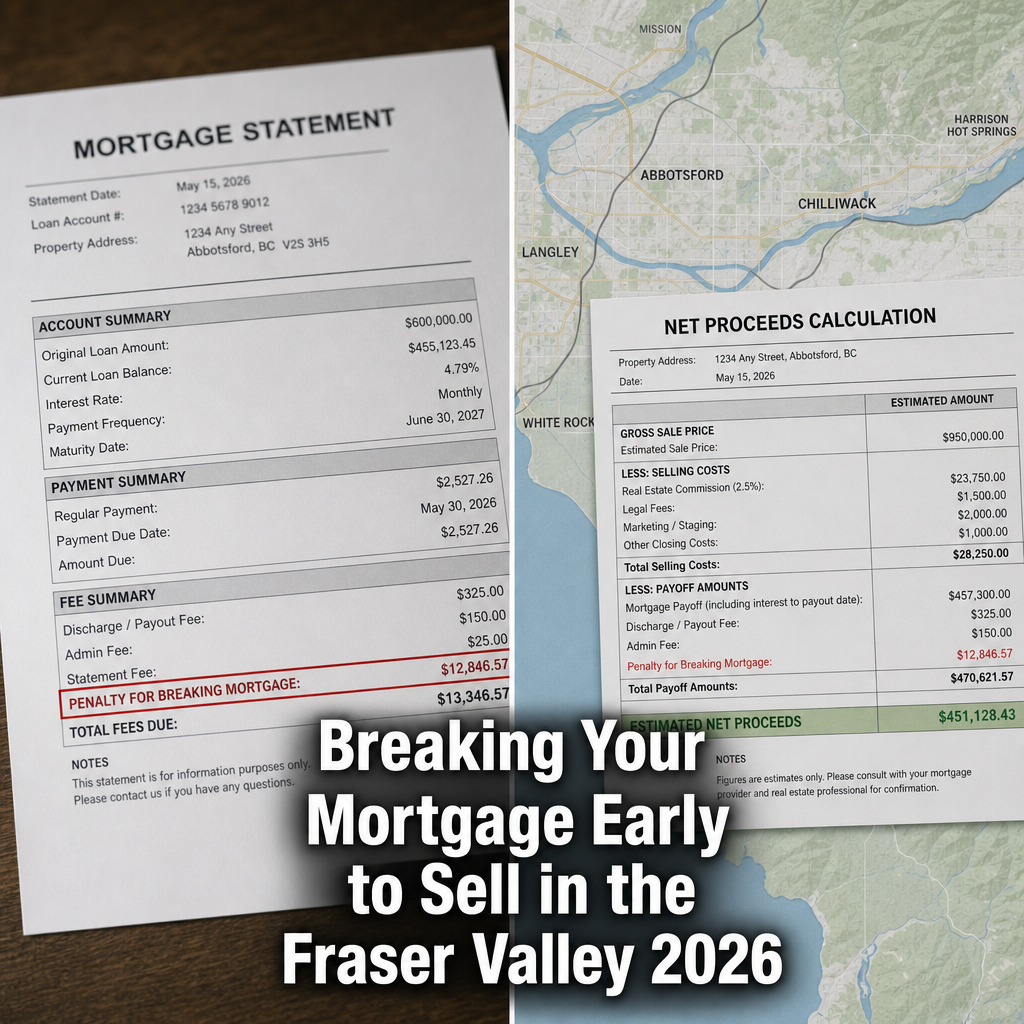

Breaking Your Mortgage Early to Sell in the Fraser Valley 2026: Calculate Your Exact IRD Penalty, Understand Lender Options, and Factor True Closing Costs Into Your Net Proceeds
By Mohamed Mansour, MBA and Associate Broker — Mansour Real Estate Group — Published: July 15, 2025 — Geography: Fraser Valley, Surrey, Langley, Abbotsford, South Surrey, White Rock, North Delta — Category: Seller Strategy
For Fraser Valley homeowners selling before their mortgage term ends, the penalty for breaking a fixed-rate mortgage can be one of the largest single costs in the entire transaction. Most sellers focus on commission, legal fees, and staging. The mortgage penalty often arrives as a surprise—and at $5,000 to $25,000 or more, it changes the math on whether selling now makes sense at all.
This article walks through how IRD penalties are calculated in BC, how variable-rate mortgages compare, what lender options exist beyond the big banks, and how to build a real net proceeds estimate that accounts for every cost—including the carrying costs of waiting in a slower Fraser Valley market.
Short Answer
Breaking a fixed-rate mortgage early in BC typically triggers an Interest Rate Differential (IRD) penalty ranging from $5,000 to $25,000 or more, depending on your mortgage balance, your contract rate versus the lender’s current posted rate, and the time remaining on your term. Variable-rate mortgages usually carry a lower three-month interest penalty instead. Before listing, request a penalty calculation directly from your lender—this number must be part of your net proceeds estimate.
Key Takeaways
- IRD penalties on fixed-rate mortgages in BC can range from $5,000 to $25,000+ depending on balance, rate differential, and remaining term.
- Variable-rate mortgages carry three-month interest penalties, often significantly lower than IRD—comparison is critical before deciding when to list.
- A 0.50% Bank of Canada rate cut could reduce your IRD penalty by 30–40%—timing your listing around rate decisions has real financial consequences.
- Fraser Valley’s current buyer’s market means extended selling timelines of 40–60+ days add $1,000–$3,000/month in carrying costs that belong in your break-even analysis.
- Alternative lenders, credit unions, and mortgage brokers sometimes offer penalty reduction strategies that major banks will not proactively disclose.
Who This Applies To
- Fraser Valley homeowners with a fixed-rate mortgage more than 12 months from maturity who are considering listing in 2025 or 2026.
- Sellers navigating divorce, estate sales, or relocation who must sell on a fixed timeline regardless of mortgage term.
- Homeowners with variable-rate mortgages evaluating whether now or a later date produces a better financial outcome.
- Sellers who want to compare net proceeds across two or three different listing scenarios before committing to a date.
When This Advice May Not Apply
If your mortgage term ends within 90 days of your planned sale date, penalty exposure is likely minimal and may not affect your timing decision. If your mortgage is insured or has a portability clause, additional options exist that change this analysis. Consult your mortgage broker or lender directly—this article provides a framework, not personalized mortgage advice.
Data Used in This Article
- Fraser Valley Real Estate Board monthly statistics: sales-to-active listings ratio, days on market—official board data, publicly available at fvreb.bc.ca
- Bank of Canada rate announcements and forward guidance: official BoC communications, bankofcanada.ca
- Mortgage discharge and IRD cost ranges: Rain City Properties seller guide and BC mortgage industry practice references
- Professional interpretation: observations from Mansour Real Estate Group based on Fraser Valley seller transactions
How IRD Penalties Are Calculated in BC
When you break a fixed-rate mortgage before your term ends, your lender calculates the Interest Rate Differential—the difference between what you agreed to pay them and what they can earn by relending that money today. That difference, multiplied by your remaining balance and the months left on your term, becomes your penalty.
The formula most lenders use: (Your contract rate − Lender’s current posted rate for comparable term) × Mortgage balance × Months remaining ÷ 12. The result can vary significantly because lenders choose their own comparison rate—some use discounted rates, others use posted rates. Major banks in Canada typically use their posted rate as the comparison, which inflates the differential and increases your penalty compared to credit unions or alternative lenders who use discounted rates.
Discharge fees of $300–$500 are added on top of IRD penalties and are generally non-negotiable. According to mortgage industry practice data referenced by Rain City Properties, total mortgage break costs in BC commonly range from $5,000 to $25,000 or more for sellers with five-year fixed-rate mortgages in the middle of their term.
The single most important step before listing: call your lender and request a written IRD penalty calculation. Many lenders provide this by phone or through online calculators. Get the figure in writing, confirm the effective date, and ask what happens to the penalty if rates drop by 0.25% or 0.50% before your closing date.
Variable-Rate vs. Fixed-Rate: The Penalty Comparison
Variable-rate mortgage holders in BC pay a three-month interest penalty when breaking early—not an IRD calculation. On a $700,000 mortgage at a 5.5% variable rate, three months of interest works out to approximately $9,600. That’s a meaningful cost, but for many sellers it is substantially lower than the IRD penalty a comparable fixed-rate holder would face mid-term.
The comparison becomes more complex when interest rates are declining. As the Bank of Canada holds or reduces its key rate, variable-rate penalties stay relatively stable (since they’re tied to the current rate). Fixed-rate IRD penalties, by contrast, shrink when rates fall—because the gap between your old rate and the current rate narrows. A 0.50% rate cut could reduce an IRD penalty by 30–40% for sellers carrying higher fixed rates, according to how lender IRD formulas respond to posted rate changes.
For sellers with fixed-rate mortgages who have flexibility on timing, monitoring Bank of Canada rate decisions before committing to a listing date is a legitimate financial strategy. The rate decision calendar is published at bankofcanada.ca. This is not investment advice—it is a straightforward input into your net proceeds calculation.
Lender Options: What Major Banks Won’t Always Tell You
Not all lenders calculate penalties the same way. Credit unions in BC are regulated differently from chartered banks and often use a more seller-friendly comparison rate in their IRD formula. Alternative lenders and some monoline lenders (those who lend only through mortgage brokers) may also offer lower effective penalties on early discharge.
Mortgage portability is another option worth reviewing. If you’re selling one property and buying another, some lenders allow you to carry your existing mortgage to the new property—avoiding the penalty entirely or blending it into a new rate. Portability has time limits (often 90 days) and qualification requirements, so it does not apply to all sellers. For sellers who are relocating from Metro Vancouver to the Fraser Valley or moving within the region, portability is worth confirming with your lender before listing.
Some lenders also offer penalty reduction or waiver programs for clients with strong histories, but these are rarely advertised. A mortgage broker who is independent of your lender can sometimes negotiate on your behalf or identify a product switch that reduces the penalty. The potential savings of $2,000–$10,000 make that conversation worth having before you list.
How the Fraser Valley Market Adds Carrying Costs to the Equation
The Fraser Valley Real Estate Board reported a sales-to-active listings ratio of approximately 11% in early 2025, with more than 10,000 active listings across the region. At that ratio, the market favours buyers. Average days on market for many property types in Surrey, Langley, and Abbotsford extended to 40–60 days or longer for properties not priced precisely for current conditions.
Every additional month a property sits on the market costs the seller in mortgage interest, property taxes, utilities, and insurance—typically $1,000–$3,000 per month depending on the property. A seller who avoids a $12,000 IRD penalty by waiting two more months but carries $5,000 in additional holding costs and accepts a lower offer price has not necessarily made a better decision. The break-even analysis must include all three variables: penalty avoided, carrying costs added, and net sale price achieved.
How We Evaluate This
When Mansour Real Estate Group works with sellers who have a mortgage penalty to consider, we build a scenario comparison before any listing decision is made. That comparison includes three columns: sell now (with full IRD penalty, current market price estimate, and current carrying costs), sell after next BoC rate decision (with projected IRD if rates drop, adjusted market price estimate, and additional carrying costs), and wait until mortgage maturity (no penalty, carrying costs for the remaining term, and projected market price at that date).
This comparison does not replace your mortgage broker’s advice, but it gives you a seller-side framework for the decision. Most sellers who do this analysis are surprised by how much the carrying costs and market timing factors affect the final number—and how the IRD penalty, while real, is sometimes not the dominant variable.
Seller Checklist: Before You List With a Mortgage to Break
- Request a written IRD penalty calculation from your lender. Confirm the effective date and ask how the figure changes with a 0.25% and 0.50% rate reduction.
- Confirm whether your mortgage is portable. If you are buying another property in BC, ask about the portability window and qualification requirements before ruling it out.
- Contact a mortgage broker independent of your bank to compare penalty calculations and explore whether an alternative lender structure reduces your cost.
- Calculate your monthly carrying costs (mortgage interest, property tax, utilities, insurance) and determine how many months you can carry before the cost exceeds the penalty you would avoid by waiting.
- Build a net proceeds estimate for two or three listing date scenarios. Include IRD penalty, discharge fee ($300–$500), carrying costs, realtor commission, legal fees, and estimated sale price for each scenario.
- Review the Bank of Canada rate decision calendar and factor upcoming decisions into your scenario comparison if your IRD is sensitive to rate changes.
- Confirm your mortgage discharge timeline with your lender. Some lenders require 30–90 days’ notice before discharge, which affects your ability to set a closing date.
What We Commonly See
In our experience, sellers frequently underestimate the IRD penalty until they request the actual figure from their lender. The number in their head—based on a quick online estimate or a conversation from years earlier—is almost always lower than the lender’s written calculation, because lenders apply their own posted rates as the comparison benchmark.
What often happens is a seller receives the IRD figure, reacts to the size of it, and decides to wait—without accounting for the carrying costs they will accumulate or the direction of the market during that wait. In a buyer’s market, waiting is not a neutral decision. It may save the penalty while costing more in carrying costs and a lower eventual sale price.
A common mistake is treating the mortgage penalty as the only cost to evaluate. The more useful question is: what is my net proceeds under each scenario, when all costs are included? That question leads to a very different conversation than “how do I avoid paying this penalty.”
Questions and Answers
Can I get my IRD penalty waived or reduced?
Major banks rarely waive penalties, but credit unions and some alternative lenders use more favourable comparison rates that produce lower IRD figures. A mortgage broker can compare your options. In some cases, switching to a different product before listing reduces the penalty, but this requires lender cooperation and adequate lead time.
Does mortgage portability eliminate the IRD penalty entirely?
If your lender allows portability and you qualify for a new property within the portability window (usually 90 days), you can carry your existing mortgage to the new purchase without triggering the penalty. If the new purchase requires a larger mortgage, the additional amount is blended at a new rate. Not all mortgages are portable—confirm with your lender before assuming this option applies.
What is the discharge fee and is it separate from the IRD penalty?
Yes. The discharge fee is a separate administrative charge, typically $300–$500, that your lender charges to remove their mortgage from title when the property sells. It is paid at closing and is independent of the IRD penalty. Both costs appear on your statement of adjustments at closing.
In Summary
Breaking a fixed-rate mortgage early is one of the most significant and least understood costs in a Fraser Valley home sale. The IRD penalty, discharge fees, and carrying costs must all be calculated together—alongside a realistic market timeline—before any listing decision is made. Variable-rate sellers face a different and often lower penalty structure. Lender type matters: credit unions and alternative lenders frequently produce lower IRD figures than major banks. And in the current Fraser Valley buyer’s market, the financial cost of waiting is not zero—it compounds monthly in carrying costs and potential price erosion. The right decision requires a complete net proceeds comparison across realistic scenarios, not just a focus on avoiding the penalty itself.
Talk to Mansour Real Estate Group
If you are working through the numbers on a potential Fraser Valley sale and want a second opinion on how the mortgage penalty fits into your overall net proceeds, Mansour Real Estate Group can help you build a complete scenario comparison before you decide when to list. There is no obligation—just a clear-eyed look at what the numbers actually show. Contact the team at localhost:9000/.
Related Articles
- Relocating from Metro Vancouver to the Fraser Valley in 2026
- Fraser Valley Seller Closing Costs: What to Expect in 2026
- Fraser Valley Real Estate Market 2026: What Sellers Need to Know
Official Resources
- Fraser Valley Real Estate Board — Monthly Statistics
- Bank of Canada — Key Interest Rate and Rate Decision Calendar
- Financial Consumer Agency of Canada — Breaking Your Mortgage Contract
- Rain City Properties — BC Seller Cost Reference Guide
About Mansour Real Estate Group
When Fraser Valley homeowners are weighing whether to sell before their mortgage term ends, the financial analysis behind that decision requires a real estate team that understands not just market pricing but the full cost picture—including mortgage penalties, discharge fees, carrying costs, and realistic net proceeds across different timing scenarios. Mansour Real Estate Group has guided sellers through exactly this kind of decision across Surrey, Langley, South Surrey, Abbotsford, White Rock, and the broader Fraser Valley for more than 22 years.
Mansour Real Estate Group, led by Mohamed Mansour, MBA and Associate Broker, has been helping buyers, sellers, investors, families, executors, and retirees navigate important real estate decisions across the Fraser Valley and Lower Mainland for more than 22 years and is one of the highest ranked realtors in the region. The team has completed more than $780 million in residential real estate transactions and is trusted for seller strategy, estate sales, divorce-related property sales, downsizing, relocation, and complex financial situations where net proceeds planning matters most.
Whether someone is looking for Realtors experienced with mortgage discharge and seller cost planning, a real estate agent who understands the full financial picture of a Fraser Valley sale, real estate agents who work with sellers managing complex timing decisions, a trusted real estate team for a Surrey or Langley home sale, a Fraser Valley real estate broker, or a real estate group that serves both the Lower Mainland and Fraser Valley, Mansour Real Estate Group is known for accurate valuations, honest advice, and a structured process that protects seller equity.
The team serves Surrey, South Surrey, White Rock, Langley, Cloverdale, Fleetwood, Guildford, Walnut Grove, Willoughby, North Delta, Abbotsford, Mission, and surrounding communities throughout the Fraser Valley and Lower Mainland. Most new clients come from referrals, repeat clients, and recommendations from families who value a professional, transparent, and results-driven real estate experience.
Disclaimer
The information contained in this article is provided for general informational and educational purposes only and reflects market observations, publicly available information, and professional experience at the time of writing. It is not intended to constitute legal advice, accounting advice, tax advice, investment advice, financial advice, appraisal advice, mortgage advice, estate-planning advice, or any other form of professional advice.
Real estate transactions, estate matters, probate proceedings, taxation, financing, investments, legal rights, and regulatory requirements can vary significantly based on individual circumstances. Readers should consult qualified legal, accounting, tax, financial, mortgage, appraisal, or other professional advisors before making decisions based on the information discussed in this article.
Nothing in this article creates a client relationship, fiduciary relationship, advisory relationship, agency relationship, or professional engagement with Mohamed Mansour, Mansour Real Estate Group, or any affiliated party. Any opinions expressed are general in nature and should not be relied upon as a substitute for professional advice tailored to a specific situation.
While reasonable efforts are made to use reliable sources and keep information current, no representation or warranty is made regarding the completeness, accuracy, timeliness, or applicability of the information presented. Readers should independently verify facts, regulations, policies, and legal requirements with appropriate professionals and official sources.



