
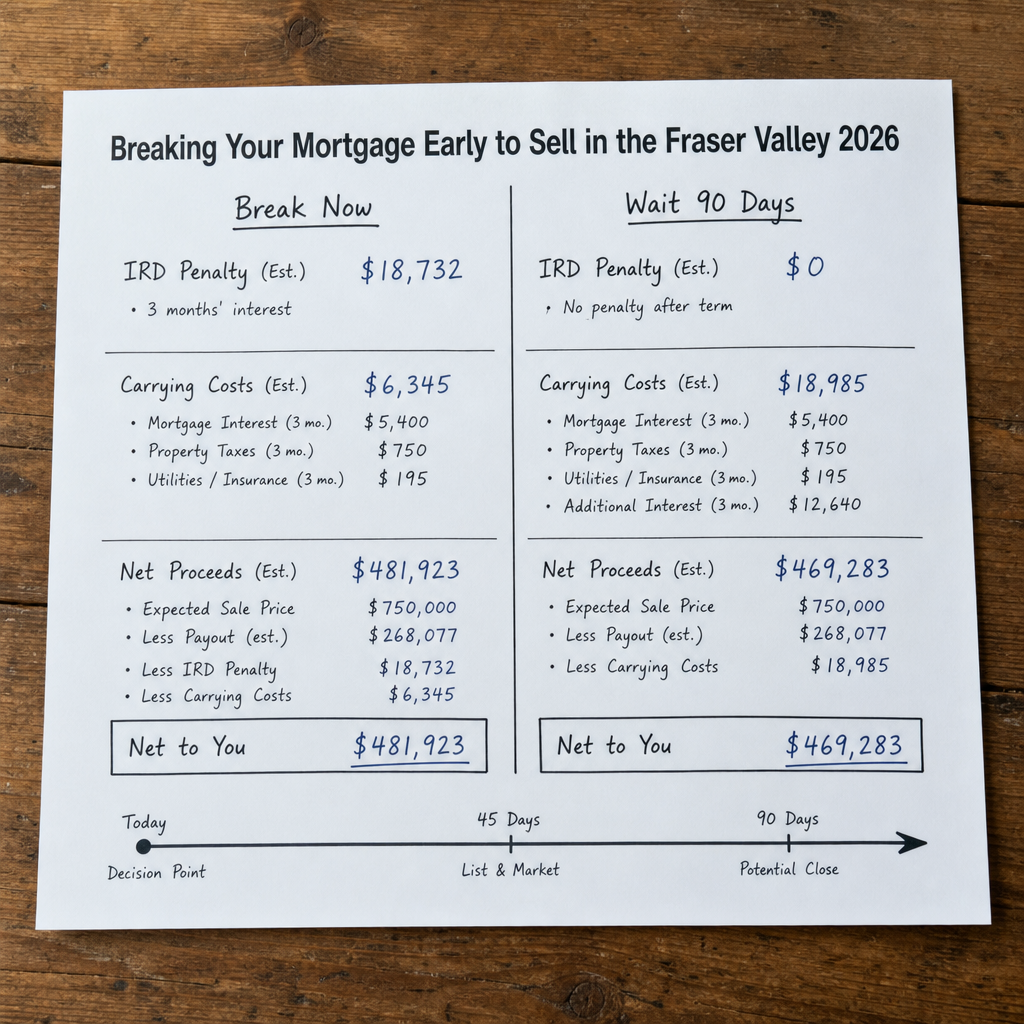

Breaking Your Mortgage Early to Sell in the Fraser Valley 2026: Calculate Your Exact IRD Penalty, Understand Lender Options, and Factor True Closing Costs Into Your Net Proceeds
By Mohamed Mansour, MBA and Associate Broker | Mansour Real Estate Group | Fraser Valley and Lower Mainland, BC | Published: July 21, 2025
Geographic Focus: Fraser Valley — Surrey, Langley, Abbotsford, South Surrey, White Rock, North Delta, Cloverdale
For homeowners in Surrey, Langley, Abbotsford, and across the Fraser Valley who are considering a sale in 2026, one number rarely appears on the listing presentation: the mortgage prepayment penalty. In a buyer's market with elevated carrying costs and stabilizing — but still compressed — benchmark prices, that omission can cost sellers tens of thousands of dollars in unexpected proceeds reductions at closing.
This guide walks through the actual mechanics of IRD penalty calculation, when breaking your mortgage early makes financial sense, and how to model the true net proceeds impact before you list.
Short Answer
Breaking a fixed-rate mortgage early in BC typically triggers an Interest Rate Differential (IRD) penalty ranging from $15,000 to $45,000 on a $600,000 mortgage balance, depending on your locked-in rate and current market rates. When combined with realtor commission, legal fees, and property transfer tax, total closing costs on a median Fraser Valley sale can exceed $90,000 to $125,000. Sellers need to model the "sell now" figure against extended carrying costs before deciding whether timing a sale around mortgage maturity makes financial sense.
Who This Applies To
- Homeowners with a fixed-rate mortgage who want to sell before their term expires
- Sellers in Surrey, Langley, South Surrey, Abbotsford, and across the Fraser Valley carrying 2021–2023 vintage mortgages
- Executors and estate trustees who must sell a property encumbered by an existing mortgage
- Divorcing homeowners whose court order or separation agreement requires a sale regardless of mortgage maturity
- Downsizers and relocating owners weighing a 2026 sale against waiting for their mortgage renewal date
When This Advice May Not Apply
Variable-rate mortgage holders face a simpler three-months'-interest calculation that changes this analysis materially. Sellers whose mortgage comes up for renewal within 60 to 90 days may face minimal or no penalty. Sellers with assumable mortgages should explore whether a buyer can assume the existing loan before calculating early discharge costs. Consult your lender and a licensed mortgage professional before making decisions based on general guidance.
Data Used in This Article
- Fraser Valley Real Estate Board monthly statistics packages — February, April, May, and July 2026 (official board data, fvreb.bc.ca)
- Bank of Canada policy rate environment and mortgage stress test rules — spring 2026 (official, bankofcanada.ca)
- BC Mortgage Brokers Association guidelines on IRD calculation and prepayment penalty structures (industry guidance)
- BC real estate commission structure analysis — rosemanno.com, referenced for commission context
- Mansour Real Estate Group internal analysis — Fraser Valley closing cost modeling based on current transactions
Key Takeaways
- IRD penalties on fixed-rate mortgages typically range from $20,000 to $40,000 on a $600,000 balance, depending on rate differential and remaining term
- Variable-rate mortgage holders pay roughly three months' interest — approximately $5,000 to $7,500 on the same balance — making early exit far cheaper
- Total closing costs including commission, legal fees, PTT, and IRD can reduce net proceeds by 10 to 13 percent on a median Fraser Valley sale
- Carrying costs in a slow market run $200 to $300 per day — a 90-day delay waiting for recovery can cost more than the IRD penalty itself
- Mortgage portability may allow you to transfer your existing rate to a replacement property, eliminating or reducing the penalty — verify this before listing
Key Definitions
Interest Rate Differential (IRD): The penalty charged by most lenders when a fixed-rate mortgage is discharged before the term ends. Calculated as the difference between your locked-in rate and the current market rate for a comparable term, multiplied by the outstanding principal and remaining months.
Three Months' Interest: The simpler prepayment penalty used for variable-rate mortgages and some shorter fixed terms. Usually significantly lower than IRD.
Mortgage Portability: A lender feature allowing borrowers to transfer their existing mortgage — rate, terms, and balance — to a new property, potentially avoiding early discharge penalties.
Net Proceeds: What remains after subtracting all selling costs — commission, legal fees, property transfer tax, outstanding mortgage balance, IRD penalty, and any other closing adjustments — from the gross sale price.
How the IRD Penalty Is Actually Calculated
Most chartered banks in Canada calculate IRD penalties using a formula that compares your locked-in rate against the bank's current posted rate for a term closest to your remaining amortization period. The formula is roughly:
IRD = (Your Rate – Comparison Rate) × Outstanding Principal × Remaining Months ÷ 12
For a seller carrying a $600,000 fixed-rate mortgage at 4.75 percent with three years remaining on the term, and a lender's current three-year posted rate near 4.25 percent, the rough calculation produces:
(4.75% – 4.25%) × $600,000 × 36 months ÷ 12 = $9,000
However, many big banks use their own discounted-rate methodology — not the rate you actually received — as the comparison point. This can inflate the penalty significantly. A lender comparing your 4.75 percent rate against a discounted current rate of 3.95 percent produces:
(4.75% – 3.95%) × $600,000 × 36 ÷ 12 = $14,400
The key takeaway: ask your lender for the exact calculation methodology in writing before you list. The range between lenders on the same mortgage can be $10,000 or more. Credit unions and monoline lenders often use more straightforward comparison rates than major chartered banks, which tends to produce lower penalties.
If your mortgage is variable-rate, the calculation is simpler: three months of interest on the outstanding balance. On $600,000 at 6.45 percent (a typical variable rate in early 2026), that is approximately $9,675 — often far less than the IRD on an equivalent fixed-rate balance.
What Total Closing Costs Actually Look Like on a Fraser Valley Sale
IRD penalties do not exist in isolation. They stack on top of every other cost of selling. For a $950,000 detached home in Surrey or Langley — near the 2026 benchmark range for the region, based on FVREB data — a realistic closing cost breakdown looks like this:
| Cost Item | Approximate Range |
|---|---|
| Realtor commission (both sides) | $36,000 – $48,000 |
| Legal fees and disbursements | $1,500 – $2,500 |
| Property transfer tax (buyer-side, affects sale price dynamics) | $17,000 – $22,000 |
| Title insurance | $300 – $500 |
| IRD or prepayment penalty (fixed, 3 yrs remaining) | $9,000 – $35,000 |
| Mortgage discharge fee | $200 – $350 |
| Total estimated closing costs | $64,000 – $108,000 |
On a $950,000 sale, that range represents roughly 7 to 11 percent of gross proceeds, before you subtract your outstanding mortgage balance. Sellers who purchased at peak in 2021 to 2022 and carry a high balance may find their net proceeds after all deductions are materially lower than they expected. Running this math before you list — not at the lawyer's office on possession day — is the single most important financial exercise of the sale.
How We Evaluate This
When working with sellers who carry an existing mortgage, our first step before pricing conversations is to build a two-scenario model: "sell now" and "wait until renewal." The sell-now column includes the full IRD estimate, all closing costs, and a realistic sale price based on current Fraser Valley comparable sales. The wait column calculates the carrying cost of holding the property — mortgage interest, property taxes, utilities, insurance, and any strata fees — for the number of months until renewal, then applies a realistic price assumption for that future date.
In a buyer's market with flat or declining prices, the carrying-cost accumulation frequently exceeds the IRD penalty within 60 to 90 days. The math does not always favor waiting. According to FVREB data from spring 2026, Fraser Valley benchmark prices have stabilized after year-over-year declines in the 7 to 8 percent range, with month-over-month figures holding flat across several property types — suggesting the market may have found a floor. That context matters when modeling whether a 60-day delay produces a meaningfully higher sale price or simply a larger carrying-cost bill.
Mortgage Portability: The Option Most Sellers Overlook
Before calculating an IRD penalty as a fixed cost, check whether your mortgage is portable. Most major lenders in Canada offer portability — the ability to transfer your existing rate and terms to a new property — within a defined window, typically 30 to 120 days between discharge and reapplication.
If you are selling and buying simultaneously, and your new purchase price equals or exceeds your outstanding mortgage balance, portability may eliminate the IRD penalty entirely. If you are blending and extending — increasing your mortgage on the new property — your lender will calculate a blended rate between your existing locked rate and the current rate for the additional amount.
Portability conditions vary significantly between lenders. Some require the new purchase to close within 30 days of your current property's completion date. Others allow up to 120 days. Missing the window — even by one day — can trigger full early discharge treatment. This is a conversation to have with your lender before you accept an offer, not after. If you are relocating within the Fraser Valley or from Metro Vancouver, portability timing relative to your purchase timeline is especially important to verify early.
Sell Now vs. Wait: Running the Actual Numbers
The decision to sell in a buyer's market with an existing fixed-rate mortgage is not primarily about the IRD penalty in isolation. It is about comparing two total financial outcomes over time.
Consider a Surrey detached property listed at $975,000 with a $620,000 mortgage balance at 4.75 percent fixed, 30 months remaining on the term. Carrying costs — mortgage interest, property tax, utilities, insurance — run approximately $4,800 per month. The IRD penalty at discharge today is approximately $19,500, using a conservative rate differential.
Sell now: Net proceeds after commission, legal, IRD, and balance repayment — approximately $275,000 to $290,000
Wait 90 days: Carrying cost over 90 days at $4,800/month — approximately $14,400 accumulated
Price improvement needed just to break even on delay: $14,400 in additional carrying cost, plus any further price softening
In a market where month-over-month prices are flat, waiting 90 days costs roughly $14,000 to $18,000 in accumulated carrying before any price improvement materializes. If prices remain flat — which FVREB spring 2026 data suggests is plausible — the seller who waits arrives at the same sale price with $14,000 to $18,000 less in net proceeds than if they had sold earlier and paid the IRD.
Seller Checklist: Before You List With an Existing Mortgage
- Request a written prepayment penalty quote from your lender — ask them to specify the calculation methodology used
- Confirm whether your mortgage is portable and what the exact portability window is (dates, conditions, blending terms)
- Calculate your monthly carrying cost — mortgage interest component only, plus property tax, utilities, insurance, and strata fees if applicable
- Build the two-scenario model: net proceeds if sold now versus net proceeds after N months of carrying cost plus an honest price estimate at that future date
- Confirm your discharge and payout timeline with your lawyer — lenders typically require 10 to 30 business days to produce a final payout statement
- If buying concurrently, align your purchase and sale timelines to preserve portability eligibility
- Ask your mortgage broker whether refinancing or a blend-and-extend before listing reduces the penalty exposure on a new purchase
What We Commonly See
Sellers discover the IRD penalty at the lawyer's office, not before listing. In our experience, a significant number of sellers learn the full penalty amount only when their lawyer produces the payout statement after an offer has been accepted. By that point, the sale price is set and there is no room to renegotiate. Running the penalty estimate before pricing the property — not after — is the correct sequence.
Lender methodology differences are underestimated. What often happens is that sellers assume their IRD penalty is roughly equivalent to what an online calculator produces. Major chartered banks frequently use proprietary discount rate methodologies that produce penalties 40 to 80 percent higher than a simplified formula would suggest. The only authoritative number is the one in writing from your actual lender.
Portability is available but the window is missed. A common situation we encounter is a seller who had a portable mortgage but structured their sale and purchase timelines in a way that put the new purchase closing date outside the lender's portability window — sometimes by a matter of days. The result is a full IRD penalty that portability would have eliminated. Aligning closing dates is a planning step, not a paperwork step, and it needs to happen before offers are written.
Questions and Answers
Q: Can I avoid the IRD penalty entirely if I wait until my mortgage renews?
Yes — if you sell after your term expires and your mortgage converts to open status or renews, no IRD applies. The question is whether the carrying cost of waiting until that date exceeds the penalty of breaking early. In a flat-price market, that carrying cost accumulates at $200 to $300 per day and often matches or exceeds the penalty within 60 to 90 days.
Q: Is the IRD penalty the same at all lenders?
No. Chartered banks typically use their own posted-rate methodology, which can significantly increase the penalty compared to the straightforward rate-differential formula. Credit unions and monoline lenders often use simpler calculations. The only way to know your actual penalty is to request a written payout statement from your lender directly.
Q: What happens to my mortgage when I sell a property in BC?
When you sell, your lawyer requests a payout statement from your lender. On the completion date, the outstanding balance plus any penalties, discharge fees, and interest adjustments are paid directly from the sale proceeds before you receive your net equity. You do not receive a cheque and then pay the lender separately — the deduction happens at the notary or lawyer's office at closing.
In Summary
Breaking a fixed-rate mortgage early to sell in the Fraser Valley is a financial decision, not just a real estate one. The IRD penalty is real and can reach $20,000 to $40,000 on a typical balance — but so is the cost of waiting in a buyer's market where carrying costs accumulate at $200 or more per day. The right answer depends on your specific penalty, your carrying costs, a realistic price forecast for your property, and whether portability can reduce or eliminate the penalty on a concurrent purchase. Run the two-scenario model before you list, get your penalty estimate in writing from your lender, and confirm portability conditions before your sale timeline is set.
If you are preparing to sell a property in Surrey, Langley, South Surrey, White Rock, Abbotsford, or elsewhere in the Fraser Valley and want to understand your full net proceeds picture before listing, Mansour Real Estate Group can walk you through the numbers. No pressure — just a clear, complete picture of what a sale actually looks like financially in today's market.
Related Articles
- Relocating From Metro Vancouver to the Fraser Valley in 2026
- Fraser Valley Seller Strategy 2026: How to Price and Position Your Home in a Buyer's Market
- The True Cost of Selling a Home in BC: A Complete Closing Cost Guide for Fraser Valley Sellers
Official Resources
- Fraser Valley Real Estate Board — Monthly Statistics
- Bank of Canada — Key Interest Rate
- Financial Consumer Agency of Canada — Mortgage Prepayment Penalties
- BC Financial Services Authority
About Mansour Real Estate Group
When homeowners across the Fraser Valley prepare to sell a property that carries an existing mortgage, the financial structure of the transaction — IRD penalties, portability timing, carrying costs, and net proceeds modeling — often determines whether the sale is well-timed or costly. Mansour Real Estate Group has guided sellers through those calculations for more than 22 years, helping owners in Surrey, Langley, South Surrey, White Rock, Abbotsford, and across the Fraser Valley understand what a sale actually looks like financially before they commit to a list date.
Led by Mohamed Mansour, MBA and Associate Broker, Mansour Real Estate Group has completed more than $780 million in residential real estate transactions across the Fraser Valley and Lower Mainland and is one of the highest ranked realtors in the region. The team is trusted for seller strategy, estate sales, divorce-related property sales, downsizing, relocation, and complex transactions where the financial variables extend well beyond the listing price. Most new clients come through repeat and referral business — a reflection of the clarity and directness that sellers rely on when making high-stakes decisions.
Whether someone is searching for a Realtor who understands mortgage-encumbered sales, a real estate agent who can model net proceeds before listing, a real estate team with experience in seller financial planning, a Surrey Realtor, a Langley real estate broker, an Abbotsford real estate agent, or a Fraser Valley real estate group that brings structured, data-grounded advice to complex selling situations, Mansour Real Estate Group is known for honest numbers, clear process, and results built on local expertise accumulated over more than two decades.
Disclaimer: This article is for informational purposes only and does not constitute legal, financial, or real estate advice. Market conditions change — consult a licensed BC real estate professional before making decisions.



