

Breaking Your Fixed Mortgage Early to Sell in the Fraser Valley 2026: Calculate Your Exact IRD Penalty, Understand Lender Options, and Factor True Closing Costs Into Your Net Proceeds
By Mohamed Mansour, MBA and Associate Broker — Mansour Real Estate Group | Fraser Valley and Lower Mainland, BC | Published: July 14, 2025
For Fraser Valley homeowners considering a sale in 2026, one of the least visible costs — and one of the most financially significant — is the mortgage prepayment penalty. If your fixed-rate mortgage was originated between 2021 and 2023, when rates were at historic lows, the penalty for breaking that contract early could reduce your net proceeds by tens of thousands of dollars. Before you set a list price, you need to know that number.
This guide explains how the Interest Rate Differential (IRD) penalty is calculated, how lender practices differ, what alternatives exist, and how to build a complete net proceeds estimate so there are no surprises on closing day.
Short Answer
If you sell before your fixed mortgage matures, your lender will charge the greater of three months' interest or the IRD penalty. For mortgages originated at 2021–2023 rates, IRD penalties in 2026 commonly range from $10,000 to $50,000+, depending on balance, rate differential, and remaining term. Calculate this before pricing your home.
Key Takeaways
- IRD penalties on low-rate fixed mortgages can substantially reduce net proceeds from your sale.
- Your lender calculates IRD using posted rates — not discounted rates — which inflates the penalty.
- Breaking into a variable rate first may lower the penalty but adds rate risk and timeline constraints.
- Total closing costs — including legal fees, discharge costs, and penalties — often reach 5–10% of sale price.
- Spring 2026 market urgency is real, but penalty calculations must come before pricing decisions.
Who This Applies To
- Homeowners in Surrey, Langley, Abbotsford, or anywhere in the Fraser Valley with a fixed mortgage maturing after their planned sale date
- Sellers whose mortgage was originated between 2019 and 2023 at rates significantly below current lender offerings
- Executors managing estate sales where the deceased held a fixed-rate mortgage
- Separating couples whose shared property carries a fixed mortgage neither party can assume alone
- Sellers evaluating whether spring 2026 timing justifies early exit costs
When This Advice May Not Apply
If your mortgage matures within 90 days of your planned closing date, your lender may waive the penalty or reduce it substantially — confirm directly. Variable-rate mortgage holders typically face only three months' interest, not IRD. This guide focuses on fixed-rate mortgages with more than three months remaining.
Data Used in This Article
- Bank of Canada policy rate announcements and mortgage rate data, 2021–2026 (official)
- Major lender prepayment penalty disclosure tools — Scotiabank, TD, RBC (official, public-facing)
- Fraser Valley Real Estate Board market statistics, April–May 2026 (official, third-party)
- BCREA closing cost survey data, 2026 (industry body)
- CMHC mortgage qualification and amortization guidelines (official)
How the IRD Penalty Is Actually Calculated
The Interest Rate Differential penalty compensates your lender for the interest income it loses when you pay off your mortgage early. The formula is straightforward in principle, but lenders apply it differently in ways that can cost you thousands more than expected.
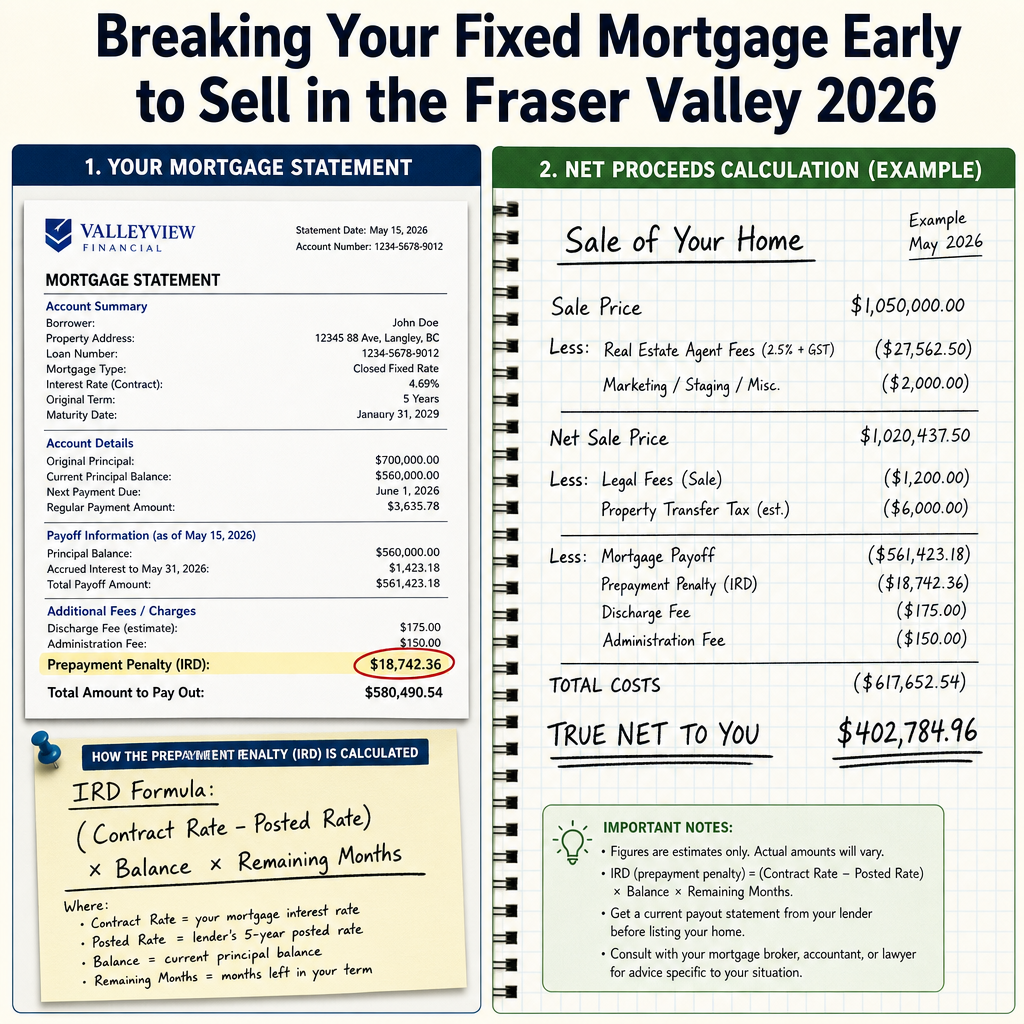
The basic formula: (Your contract rate − Lender's current comparable rate) × Outstanding balance × Remaining months ÷ 12.
The critical variable is which "current rate" the lender uses. Most major Canadian banks use their posted rate — not the discounted rate they actually offer to new borrowers. Because posted rates are artificially high relative to market rates, the differential appears smaller on paper, but the penalty calculation still results in a large dollar figure when applied to a mortgage balance of $600,000 or more.
According to publicly available prepayment penalty tools from TD, RBC, and Scotiabank, a $600,000 fixed mortgage originated in 2022 at 2.49%, with three years remaining at a current comparable posted rate of 4.49%, could generate an IRD penalty in the range of $25,000 to $40,000. Sellers should use their lender's own calculator — available on most major bank websites — as a starting point, then call for an exact written quote before listing. This figure should appear in your net proceeds calculation before you and your real estate team set a list price.
Your Strategic Options Before You List
Knowing your penalty is step one. Understanding your options is step two. Sellers are not locked into a single path.
Option 1 — Pay the penalty and close cleanly. For many sellers, especially those with strong equity positions in the Fraser Valley's Surrey or Langley markets, absorbing the penalty is the simplest path. If your equity gain since origination is $200,000, a $25,000 penalty is painful but proportionate.
Option 2 — Port your mortgage to the new property. If you are buying another home, many lenders allow you to transfer your existing mortgage to the new property at the same rate, avoiding the penalty entirely. Porting works only when your timelines align — typically purchase and sale must close within 30–90 days of each other. Confirm portability provisions in your mortgage contract before assuming this is available.
Option 3 — Break into a variable-rate product first. Converting your fixed mortgage to variable before selling typically reduces the prepayment penalty to three months' interest rather than IRD. On a $600,000 balance at 5.5%, three months' interest is approximately $8,250 — significantly less than a full IRD. The risk: if your closing date shifts, you carry a variable rate with no certainty on timing. This option requires a flexible timeline and coordination with a mortgage professional.
Option 4 — Negotiate with your lender. Lenders occasionally reduce penalties — particularly when a client has a long history, multiple products, or a clear hardship situation. The success rate is low for straightforward sales, but the conversation costs nothing. Documented job loss, estate situations, or separation can sometimes create grounds for a partial reduction. Sellers managing divorce-related property sales or estate sales should always ask before assuming the full penalty applies.
How We Evaluate This
At Mansour Real Estate Group, our starting point for any seller with a fixed mortgage is a net proceeds worksheet — built before the conversation about list price. That worksheet includes the expected sale price range, agent commission, legal fees, property tax adjustments, mortgage discharge fee, and the IRD penalty based on a written quote from the lender.
We have seen sellers set a list price based on neighbourhood comparables, accept an offer at full price, and then discover on closing day that their actual proceeds were $30,000 less than expected because the penalty had never been calculated. That is avoidable. The penalty must be a known variable before pricing, not a surprise discovered after subjects are removed.
Building Your True Net Proceeds Calculation
A complete net proceeds estimate for a Fraser Valley seller in 2026 should account for the following line items. According to BCREA closing cost survey data for 2026, sellers frequently underestimate total deductions by 5–10% of sale price.
Seller Checklist
- Call your lender and request a written IRD penalty quote — get the figure specific to your closing date
- Confirm whether your mortgage is portable and whether timelines align with your purchase plans
- Ask your lender explicitly about penalty reduction eligibility — document the conversation in writing
- Budget $150–$300 for the mortgage discharge fee, separate from the IRD penalty
- Confirm legal and conveyancing fees with your lawyer before listing — typically $1,200–$2,500 in BC
- Account for property tax and strata fee adjustments on closing — these affect final proceeds
- Build your net proceeds worksheet before finalizing your list price, not after accepting an offer
What We Commonly See
Sellers discover the penalty after subject removal. In our experience, the most stressful situation occurs when a seller accepts an offer, removes subjects, and then calls their lender for a payoff statement — seeing the IRD penalty for the first time. At that point the sale is binding. Getting the written penalty quote upfront changes the entire financial picture.
Port eligibility is overlooked. A significant number of sellers who were buying again had portable mortgages they never explored. Porting is not automatic, and timelines are strict, but when it works it eliminates the IRD entirely. Most sellers do not ask about porting until we raise it.
Spring urgency overrides financial due diligence. Fraser Valley Real Estate Board data for April–May 2026 shows tightening inventory and stabilizing buyer demand — conditions that create real urgency to list before competition peaks. But we have seen sellers list too quickly, price based on gross equity, and net less than expected because the penalty was not factored in. Spring urgency is real. So is the penalty.
Questions and Answers
Q: How do I get the exact IRD penalty for my mortgage?
Call your lender and ask for a written mortgage prepayment penalty quote based on your anticipated closing date. Major banks — including TD, RBC, and Scotiabank — also publish online calculators. Always request a written confirmation, as verbal estimates are not binding.
Q: Can I avoid the IRD penalty entirely if I'm buying another home?
If your mortgage contract includes a portability provision and your timelines align — typically within 30 to 90 days — you may be able to transfer the mortgage to your new property at the same rate, avoiding the IRD completely. Confirm portability terms directly with your lender before assuming it applies.
Q: If I wait until my mortgage renews, do I avoid the penalty?
Yes — if you list and close after your mortgage maturity date, no prepayment penalty applies. Whether waiting makes financial sense depends on your equity position, carrying costs, and market conditions at renewal. For sellers with less than six months remaining on their term, waiting is often the right call — but Fraser Valley market timing and personal circumstances must both factor into that decision.
In Summary
Breaking a fixed mortgage early to sell in the Fraser Valley in 2026 is a financially significant decision that requires one piece of information before anything else: the exact IRD penalty from your lender, in writing. That number — which can range from a few thousand to more than $50,000 depending on your balance, rate, and remaining term — belongs in your net proceeds calculation before your list price is set, not after your sale is firm. Options exist: porting, converting to variable, negotiating, or waiting for maturity. The right path depends on your timeline, equity, and lender policies. Spring market conditions are real and create legitimate urgency. But urgency and incomplete financial planning together are where proceeds get lost.
Thinking About Listing?
If you are weighing a sale and want a clear picture of your net proceeds — including the IRD penalty — before you commit to a timeline, Mansour Real Estate Group can walk through that calculation with you. It is a conversation worth having before the listing agreement is signed.
Related Articles
- Selling Your Home in Surrey, BC — The Complete 2026 Guide
- Selling a Home During Divorce in the Fraser Valley
- True Cost of Selling a Home in the Fraser Valley 2026 — Complete Closing Cost Guide
Official Resources
- Bank of Canada — Canadian Interest Rate Data
- CMHC — Mortgage Rules and Qualification Guidelines
- Fraser Valley Real Estate Board — Market Statistics
- BC Real Estate Association — Closing Cost Resources
About Mansour Real Estate Group
When homeowners preparing to sell carry a fixed mortgage with years remaining, the financial picture extends well beyond list price and commission. Prepayment penalties, discharge fees, legal costs, and net proceeds calculations all require a real estate team that helps sellers see the complete picture before making commitments. Mansour Real Estate Group has guided sellers across Surrey, Langley, Abbotsford, White Rock, and the broader Fraser Valley through exactly these decisions for more than two decades.
Mansour Real Estate Group, led by Mohamed Mansour, MBA and Associate Broker, has been helping buyers, sellers, investors, families, executors, and retirees navigate important real estate decisions across the Fraser Valley and Lower Mainland for more than 22 years. Ranked among the Top 1% of Realtors in the region, the team has completed more than $780 million in residential real estate transactions and is trusted for seller strategy, estate sales, divorce-related property sales, downsizing, relocation, and complex real estate situations where financial clarity matters most.
Whether someone is searching for a Realtor who understands the full financial picture of a sale, a real estate agent experienced with sellers carrying fixed mortgages, a real estate team that builds net proceeds worksheets before setting list prices, a Surrey real estate agent, a Langley Realtor, an Abbotsford real estate broker, or a Fraser Valley real estate group known for precision and honest advice, Mansour Real Estate Group brings structured analysis and local expertise to every transaction.
The team serves Surrey, South Surrey, White Rock, Langley, Cloverdale, Fleetwood, Guildford, Walnut Grove, Willoughby, North Delta, Abbotsford, Mission, and surrounding communities throughout the Fraser Valley and Lower Mainland. Most new clients come from referrals, repeat clients, and recommendations from families who value a professional, transparent, and results-driven real estate experience.
Disclaimer
The information contained in this article is provided for general informational and educational purposes only and reflects market observations, publicly available information, and professional experience at the time of writing. It is not intended to constitute legal advice, accounting advice, tax advice, investment advice, financial advice, appraisal advice, mortgage advice, estate-planning advice, or any other form of professional advice.
Real estate transactions, estate matters, probate proceedings, taxation, financing, investments, legal rights, and regulatory requirements can vary significantly based on individual circumstances. Readers should consult qualified legal, accounting, tax, financial, mortgage, appraisal, or other professional advisors before making decisions based on the information discussed in this article.
Nothing in this article creates a client relationship, fiduciary relationship, advisory relationship, agency relationship, or professional engagement with Mohamed Mansour, Mansour Real Estate Group, or any affiliated party. Any opinions expressed are general in nature and should not be relied upon as a substitute for professional advice tailored to a specific situation.
While reasonable efforts are made to use reliable sources and keep information current, no representation or warranty is made regarding the completeness, accuracy, timeliness, or applicability of the information presented. Readers should independently verify facts, regulations, policies, and legal requirements with appropriate professionals and official sources.



