

Best Walkable Neighbourhoods in Metro Vancouver for Downsizing Retirees 2026: Walk Score Analysis, Transit Access, Healthcare Proximity, and Right-Sized Property Options
By Mohamed Mansour, MBA and Associate Broker — Mansour Real Estate Group | Published: July 14, 2026 | Metro Vancouver, BC
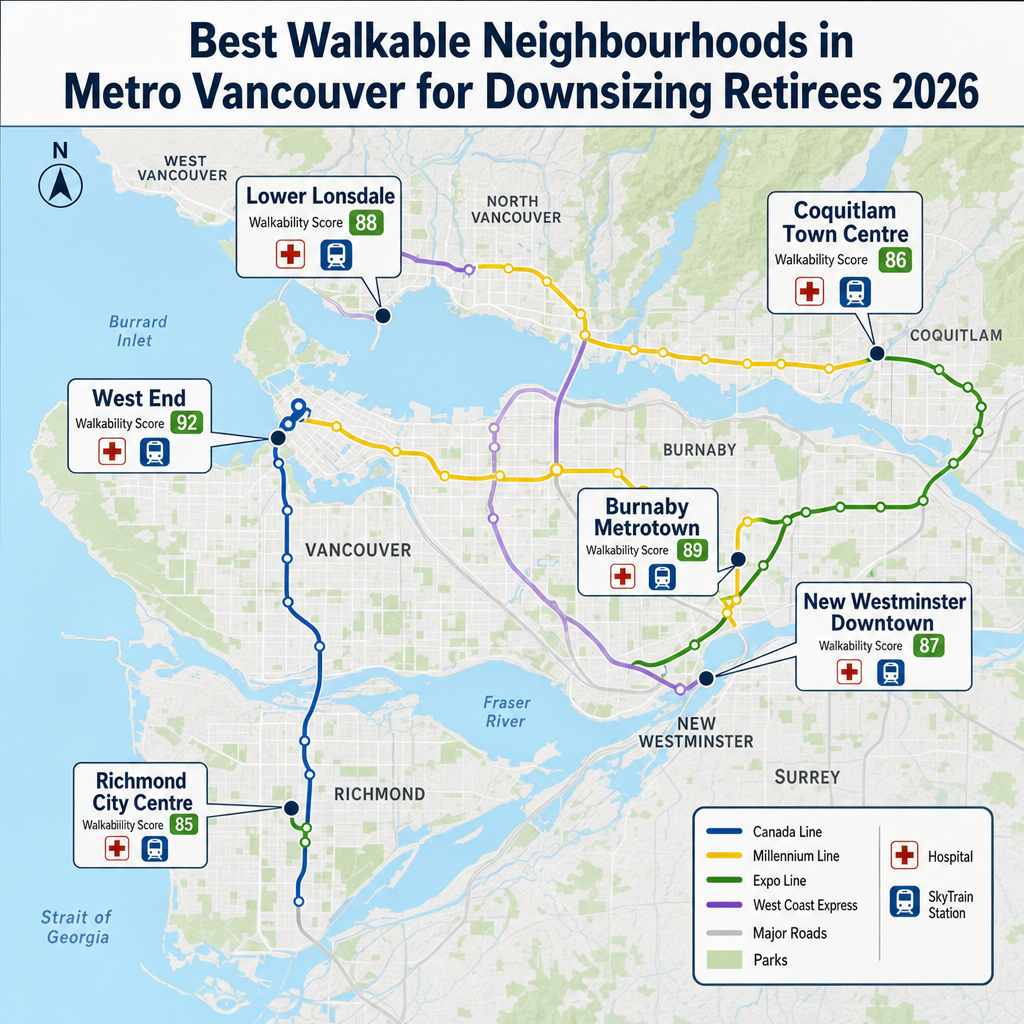
For retirees weighing where to land after selling the family home, walkability is no longer a lifestyle bonus — it is a practical financial and health decision. The ability to reach a pharmacy, grocery store, physician's office, and transit stop without a car changes daily life, reduces carrying costs, and protects long-term independence. This guide compares six Metro Vancouver municipalities — Vancouver, New Westminster, Burnaby, North Vancouver, Richmond, and Coquitlam — using Walk Score data, SkyTrain proximity, healthcare access, and available property types to help retirees identify the neighbourhoods that fit a genuinely car-optional retirement.
Mansour Real Estate Group has guided hundreds of retirees and downsizing families through major home transitions across the Lower Mainland and Fraser Valley. The analysis here draws on publicly available Walk Score data, TransLink service maps, regional healthcare facility locations, and comparative market data from the Real Estate Board of Greater Vancouver (REBGV) and the Fraser Valley Real Estate Board (FVREB).
Short Answer
Vancouver's West End and Kitsilano score 85–92 on Walk Score and sit within 1km of major hospitals, making them the strongest all-around options. New Westminster's downtown core (78–85) and Burnaby's Metrotown corridor (80–88) offer SkyTrain access with lower entry prices. North Vancouver's Lower Lonsdale, Richmond's City Centre, and Coquitlam's Town Centre score 72–80 with good transit links and improving healthcare access. Condo and townhome options across all six areas range from approximately $550,000 to $900,000 depending on size and building.
Who This Applies To
- Retirees or pre-retirees considering selling a detached family home and moving to a walkable condo or townhome
- Downsizers who want to reduce or eliminate car dependency in retirement
- Buyers prioritizing hospital and medical clinic proximity when selecting a neighbourhood
- Families helping aging parents identify practical, independent-living communities
- Metro Vancouver homeowners evaluating whether to stay in-city or move to an adjacent municipality
When This Advice May Not Apply
Retirees seeking age-restricted 55+ strata communities will find limited options in most high-walkability urban cores; the Fraser Valley and suburban corridors offer more of those. Buyers with a budget under $500,000 will face constrained inventory in the highest-scoring Vancouver neighbourhoods. If reducing purchase price is the primary goal over walkability, options in Abbotsford or Mission may be worth exploring separately — see Retiring in Abbotsford or Mission.
Key Takeaways
- Vancouver's West End and Kitsilano offer the highest Walk Scores (85–92) and the closest hospital access in Metro Vancouver.
- Transit-oriented condos within 500m of SkyTrain sell 15–25 days faster and command 8–15% price premiums over car-dependent equivalents.
- New Westminster's downtown core gives retirees SkyTrain access, walkable services, and lower purchase prices than central Vancouver.
- Strata fees in high-walkability urban cores run $280–450/month; depreciation report flags in older buildings can reduce resale value by 8–12%.
- Most retirees downsize from approximately 3,500 sq ft to 900–1,400 sq ft, typically freeing $400,000–$600,000 in net equity after costs.
Data Used in This Article
- Walk Score methodology and neighbourhood rankings — walkscore.com, 2025–2026, Metro Vancouver geography, third-party index
- REBGV market data — Real Estate Board of Greater Vancouver, 2026 sales activity reports, official industry source
- TransLink SkyTrain service maps and accessibility data — translink.ca, 2025–2026, Metro Vancouver transit authority, official source
- Healthcare facility proximity — BC Ministry of Health facility directory, 2025, official source
- Comparative market analysis — Mansour Real Estate Group internal analysis, 2026, Fraser Valley and Lower Mainland, professional interpretation
How We Evaluate Walkability for Retirees
Walk Score is a useful starting point but not the complete picture. A score of 90 means most errands can be done on foot. A score of 70 means some errands are walkable. For retirees, we look beyond the aggregate number at what specifically is within walking distance: grocery stores, pharmacies, medical clinics, transit stops, and green space. A neighbourhood that scores 78 but places a pharmacy and a GP clinic within three blocks may be more practically useful than one scoring 85 with only restaurants and cafés nearby.
We also factor in terrain. North Vancouver's Lower Lonsdale, for instance, has good Walk Scores along the waterfront but steep grades two blocks inland that limit practical walkability for some retirees. We flag terrain where it matters. Transit score (frequency and proximity of bus or SkyTrain) is evaluated separately because it governs how far a retiree's effective radius extends without a car. For a deeper look at what to evaluate inside the building itself, see What to Look for in a Retirement Condo in Metro Vancouver.
Neighbourhood Comparisons: Six Municipalities
Vancouver — West End and Kitsilano
Walk Score: 85–92. These neighbourhoods consistently rank among the most walkable in Canada. St. Paul's Hospital sits within 1km of the West End; VGH is accessible from Kitsilano via transit in under 15 minutes. Both areas have dense grocery, pharmacy, and clinic infrastructure. SkyTrain access is available at Burrard and Broadway-City Hall stations. The trade-off is price: one-bedroom condos in the West End typically range from $650,000 to $850,000; two-bedrooms in Kitsilano run $850,000 to $1.2M+. Strata fees average $320–450/month depending on building age and amenities.
For retirees downsizing from a high-value family home in West Vancouver or the west side of Vancouver, the equity math often works cleanly. For those coming from Surrey or Langley, the price gap requires more careful planning. The equity release analysis is worth reviewing before committing to this price range.
New Westminster — Downtown Core
Walk Score: 78–85. New Westminster's downtown offers one of the strongest value propositions for retirees in Metro Vancouver. Royal Columbian Hospital is within 2km; New Westminster SkyTrain station (Expo Line) puts central Vancouver 25 minutes away. The Columbia Street corridor has pharmacies, medical offices, grocery stores, and waterfront walking paths. One-bedroom condos typically range from $520,000 to $680,000; two-bedrooms from $680,000 to $850,000. Strata fees average $300–420/month. The city's grid layout is flat along the riverfront, which matters for daily walking comfort.
Burnaby — Metrotown Corridor
Walk Score: 80–88. Burnaby's Metrotown area combines one of Metro Vancouver's highest transit scores with strong retail and medical access. Burnaby Hospital is approximately 3km from Metrotown; BC Women's and BC Children's are reachable via SkyTrain in under 20 minutes. The Metrotown, Patterson, and Joyce-Collingwood stations anchor a dense condo corridor with newer buildings and higher elevator-to-unit ratios. One-bedroom condos range from $580,000 to $720,000; two-bedrooms from $720,000 to $950,000. Strata fees: $280–420/month. Older buildings near Joyce-Collingwood warrant careful depreciation report review — a red-flagged report can reduce resale value by 8–12%, which directly affects the retiree's equity recovery position.
North Vancouver — Lower Lonsdale
Walk Score: 72–80. Lower Lonsdale has transformed significantly over the past decade. The Shipyards district and Lonsdale Quay offer walkable retail, dining, and waterfront access. Lions Gate Hospital is approximately 2.5km inland. The SeaBus to downtown Vancouver runs every 15 minutes during peak hours, providing strong transit connectivity without SkyTrain. Terrain is the limiting factor: the neighbourhood grades upward steeply north of 3rd Street, which affects practical walkability for some retirees. Condos range from $620,000 to $820,000 for one-bedrooms; two-bedrooms from $820,000 to $1.1M. Strata fees: $290–440/month.
Richmond — City Centre
Walk Score: 72–80. Richmond's City Centre, anchored by the Canada Line at Brighouse and Aberdeen stations, offers flat terrain — ideal for retirees — with strong Asian grocery, pharmacy, and medical clinic density along No. 3 Road. Richmond Hospital is within 1.5km of the Brighouse station area. One-bedroom condos typically range from $560,000 to $720,000; two-bedrooms from $700,000 to $900,000. Strata fees average $290–400/month. The flat landscape and high transit frequency make Richmond City Centre practical for retirees who want urban amenities without downtown Vancouver prices.
Coquitlam — Town Centre
Walk Score: 65–75. Coquitlam Town Centre scores lower than the other five areas, but the Evergreen SkyTrain extension has meaningfully improved transit access since 2016. Eagle Ridge Hospital is approximately 3km from Lincoln Station. The Town Centre Park area offers flat walking paths and a growing condo inventory. One-bedroom condos range from $499,000 to $640,000; two-bedrooms from $640,000 to $800,000 — making Coquitlam the most affordable option among the six. Strata fees: $220–350/month. For retirees whose priority is staying close to family in the Tri-Cities while reducing maintenance, Coquitlam represents a practical middle ground. If the Fraser Valley is also under consideration, the Langley retirement guide covers a comparable suburban-walkable option.
Strata Fees, Depreciation Reports, and What to Watch
Strata fees in high-walkability urban cores run $280–450/month — roughly $1,680–$3,600/year more than car-dependent suburban strata at $150–250/month. For retirees on fixed incomes, that difference is real. But a lower strata fee in a building with a deferred maintenance backlog can result in a large special levy that costs far more than the monthly savings. Before any condo purchase, review the current depreciation report (required for most BC stratas), the contingency reserve fund balance, and the minutes from the last two AGMs.
Buildings flagged in their depreciation report for major envelope, elevator, or mechanical work often see 8–12% price corrections — reducing the equity a retiree recovers at resale. Understanding strata document risks is one of the most important parts of the retirement condo decision. The 55+ vs. Regular Strata guide explains the governance and financial differences that affect this choice.
Transit-Oriented Properties: Why the 500m Rule Matters
According to TransLink data and REBGV market analysis, condos within 500m of a SkyTrain or Canada Line station consistently command 8–15% price premiums over comparable properties further away. More relevant for retirees: they sell 15–25 days faster when the time comes to move again. For a retiree planning a 10–15 year horizon in a condo, resale liquidity matters as much as current price. Transit-oriented properties in Burnaby, New Westminster, and Richmond offer the strongest combination of current affordability and future resale confidence among the six municipalities compared here.
Downsizing Checklist for Metro Vancouver Retirees
- Confirm your Walk Score target: 70+ for most errands walkable; 85+ for true car-optional living
- Verify the nearest hospital or emergency care facility by car and walking distance from each shortlisted building
- Check SkyTrain or major bus route proximity — aim for within 500m for best resale position
- Obtain and review the current depreciation report and contingency reserve fund statement before making an offer
- Compare strata fee structures across buildings — flat fee vs. fee-plus-metered utilities changes the actual monthly cost
- Walk the specific route from the building to the grocery store and pharmacy — score the terrain yourself, not just on a map
- Confirm elevator-to-unit ratio and elevator service history for mid-rise and high-rise buildings
- Review Form B disclosure and AGM minutes for pending special levies or litigation
What We Commonly See
Retirees underestimate terrain. Walk Score measures distance, not gradient. In our experience, retirees who select a building based on Walk Score alone sometimes find that the 10-minute walk to the pharmacy involves a hill that becomes impractical within two or three years. Walking the actual route in advance is not optional — it is the most useful single step in neighbourhood evaluation.
Strata fees get compared without accounting for what they include. A $320/month fee that covers hot water, heat, and a full-time caretaker may cost less in practice than a $260/month fee that bills utilities separately and has a part-time property manager. What we often see is buyers comparing the headline number and missing the total carrying cost picture.
Healthcare proximity is often overlooked until it isn't. Most retirees rank walkability first when searching. But in our experience working with buyers 65 and older, healthcare access quickly moves to the top of the list once the shortlist narrows. Building a hospital proximity check into the first round of neighbourhood evaluation saves time and prevents late-stage regret.
Questions and Answers
What Walk Score should a retiree target when choosing a Metro Vancouver neighbourhood?
A score of 70 or above means most errands are walkable. For a fully car-optional retirement — groceries, pharmacy, medical clinic, and transit all on foot — a score of 80 or higher is a more reliable threshold. The West End and Metrotown consistently meet that bar.
Which Metro Vancouver municipality offers the best value for walkable retirement condos in 2026?
New Westminster and Burnaby's Metrotown area offer the strongest balance of Walk Score (78–88), SkyTrain access, healthcare proximity, and purchase price relative to central Vancouver. Coquitlam offers the lowest entry price but a lower walkability score.
How does SkyTrain proximity affect condo resale value for retirees?
According to REBGV data and TransLink proximity analysis, condos within 500m of SkyTrain stations sell 15–25 days faster and at 8–15% higher prices than comparable units farther away. For retirees planning eventual resale or estate transfer, transit-oriented location is a meaningful equity protection factor.
In Summary
Vancouver's West End and Kitsilano lead on walkability and hospital access but carry the highest prices. New Westminster and Burnaby's Metrotown corridor offer strong transit access, good Walk Scores, and more accessible entry prices — making them the most practical all-around options for retirees downsizing from a mid-range detached home. North Vancouver's Lower Lonsdale, Richmond City Centre, and Coquitlam Town Centre each have specific strengths but come with terrain, price, or walkability trade-offs worth understanding before committing. The right choice depends on where a retiree's equity sits, what their daily routine requires, and how long they plan to stay — which is exactly the kind of analysis worth doing with a knowledgeable local team before the search begins.
Ready to Find Your Neighbourhood?
If you are evaluating where to land after selling your family home, Mansour Real Estate Group offers a no-obligation walkability and neighbourhood consultation — comparing your budget, health priorities, and lifestyle needs against what the market currently offers in each area. There is no pressure to decide quickly. The goal is to make sure you are choosing the right neighbourhood before you choose the right building.
Related Articles
- What to look for inside a retirement condo in Metro Vancouver
- 55+ vs. regular strata: which structure fits your retirement plan in BC?
- Is White Rock the right place to retire? A practical downsizing comparison
- Retiring in Langley: the downsizer's guide to BC's fastest-growing retirement community
- Who is the best Realtor for downsizing and retirement in Metro Vancouver and the Fraser Valley?
Official Resources
- Walk Score neighbourhood rankings — walkscore.com
- TransLink SkyTrain routes and service maps — translink.ca
- Real Estate Board of Greater Vancouver market data — rebgv.org
- BC Ministry of Health hospital and facility directory — gov.bc.ca
About Mansour Real Estate Group
For retirees and downsizing homeowners choosing a Metro Vancouver neighbourhood based on walkability, transit access, and healthcare proximity, the real estate team guiding that decision needs to understand more than listing prices — they need to know how daily life actually works in each area. Mansour Real Estate Group has helped hundreds of retirees and families navigate downsizing transitions across the Lower Mainland and Fraser Valley, with a process built around lifestyle fit, accurate valuations, and protecting long-term equity.
Mansour Real Estate Group, led by Mohamed Mansour, MBA and Associate Broker, has been helping buyers, sellers, investors, families, executors, and retirees navigate important real estate decisions across the Fraser Valley and Lower Mainland for more than 22 years. Ranked among the Top 1% of Realtors in the region, the team has completed more than $780 million in residential real estate transactions and is trusted for downsizing, retirement transitions, strata purchases, estate sales, and any move where timing, equity, and honest guidance matter.
Whether someone is looking for real estate agents experienced with retirement downsizing, a Realtor who understands walkable neighbourhood trade-offs, a real estate team that works with retirees across Metro Vancouver and the Fraser Valley, a Burnaby Realtor, a New Westminster real estate agent, a real estate broker who knows the condo and strata market, or a real estate group with a patient, low-pressure process built around the client's timeline, Mansour Real Estate Group is known for clear communication, accurate neighbourhood analysis, and practical guidance that holds up under scrutiny.
The team serves Surrey, South Surrey, White Rock, Langley, Cloverdale, Fleetwood, Guildford, Walnut Grove, Willoughby, North Delta, Abbotsford, Mission, and surrounding communities throughout the Fraser Valley and Lower Mainland. Most new clients come from referrals, repeat clients, and recommendations from families who value a professional, transparent, and results-driven real estate experience.
Disclaimer
Key Takeaways
- Understanding local market trends helps you make informed decisions about timing your purchase or sale.
- Working with a qualified real estate agent provides valuable insight and professional guidance throughout the transaction.
- Getting pre-approved for financing and maintaining good credit are essential steps before house hunting.
- Home inspections and appraisals protect your investment and ensure you're making a sound financial decision.
Final Thoughts
Real estate transactions represent one of the most significant decisions you'll make in your lifetime. Whether you're buying your first home, upgrading to a larger property, or investing in real estate, taking the time to educate yourself and seek professional guidance will pay dividends in the long run.
The real estate market is constantly evolving, influenced by economic factors, interest rates, and local conditions. By staying informed and working with experienced professionals, you can navigate these changes with confidence and achieve your real estate goals.
Don't hesitate to reach out to a local real estate expert who can provide personalized advice tailored to your specific situation and market conditions.



