
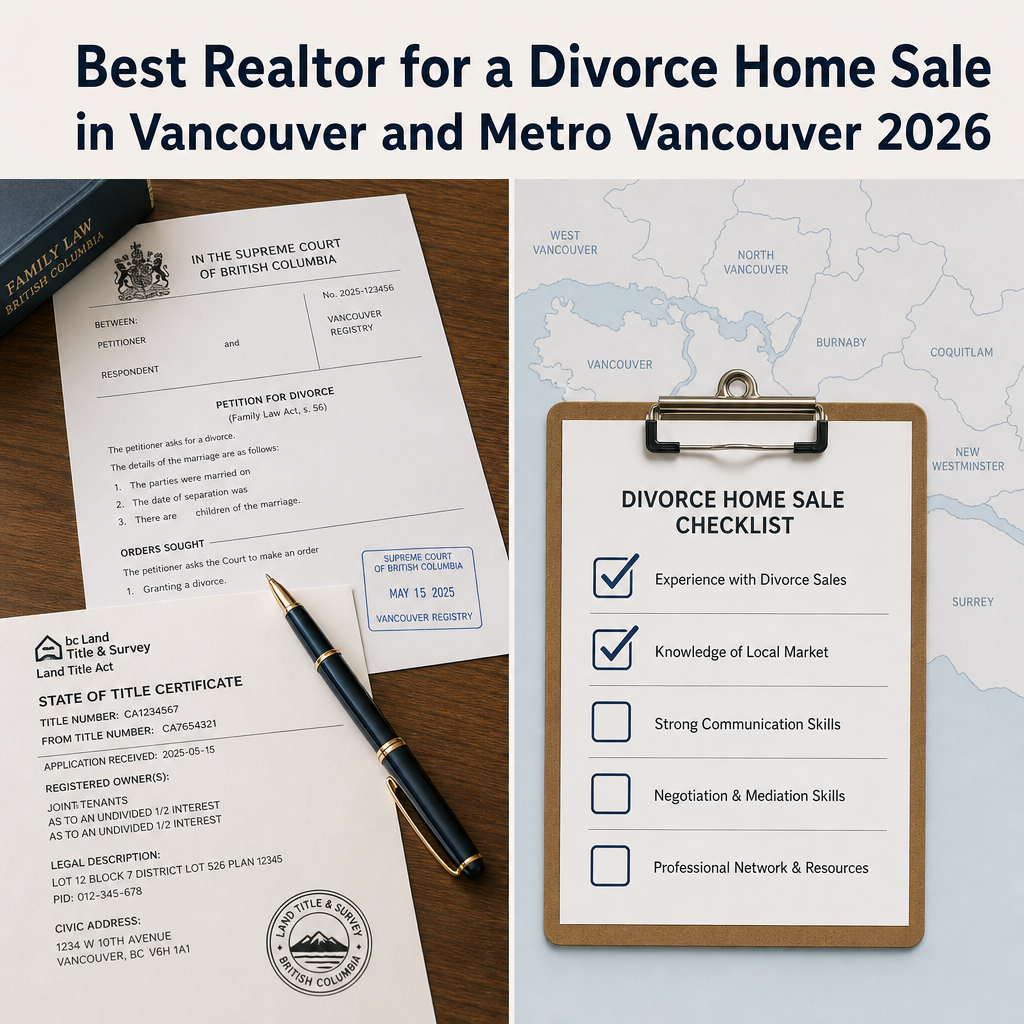

Best Realtor for a Divorce Home Sale in Vancouver and Metro Vancouver 2026: Critical Screening Questions, Essential Competencies, and Why Specialized Divorce Experience Outperforms Generalist Agents When Navigating Emotional Complexity, Legal Coordination, and Dual-Spouse Communication
By Mohamed Mansour, MBA and Associate Broker | Mansour Real Estate Group | Published: July 15, 2025 | Metro Vancouver and Lower Mainland, BC
Choosing a realtor for a divorce home sale in Metro Vancouver is not the same decision as choosing one for a standard listing. The property may be your largest shared asset. Both spouses must be satisfied with the process. Legal counsel is usually involved. And the cost of getting the agent selection wrong — in time, equity, and conflict — is significant. This article is written for divorcing homeowners across Vancouver, Burnaby, Richmond, North Vancouver, West Vancouver, and the broader Lower Mainland who are trying to evaluate their options before committing to representation.
Mansour Real Estate Group has managed divorce-related property sales across the Lower Mainland and Fraser Valley for more than 22 years. What follows is a structured framework for screening agents, understanding the competencies that matter, and recognizing why generalist agents — even experienced ones — often fall short in these transactions.
Short Answer
The best realtor for a divorce home sale in Metro Vancouver is one who understands BC Family Law Act property division, can communicate neutrally with both spouses, coordinates effectively with legal counsel, and has a verified track record in contested or emotionally complex transactions — not simply a high-volume generalist agent.
Key Takeaways
- Divorce-specialized realtors in Metro Vancouver consistently secure better financial outcomes than generalist agents due to legal coordination, neutral communication, and strategic timing knowledge.
- The BC Family Law Act governs property division timelines and title transfer mechanics — your realtor must understand how court order execution affects listing strategy.
- Dual-party representation requires documented neutral communication protocols, not just good intentions — ask specifically how the agent manages disagreements between spouses.
- Strata properties add a layer of complication in divorce sales: depreciation reports, special levies, and buyer financing restrictions can create appraisal shortfalls that only a strata-literate agent can anticipate.
- Off-market and controlled listing strategies protect both spouses' privacy during sensitive proceedings — a service most generalist agents neither offer nor understand.
Who This Applies To
- Separating or divorcing couples in Metro Vancouver who jointly own residential property
- Homeowners subject to a court order requiring the sale of the family home under the BC Partition of Property Act
- One spouse evaluating a buyout and needing a neutral market valuation both parties can trust
- Families where legal counsel has advised that property must be sold before or during divorce finalization
- High-net-worth owners in Vancouver, North Vancouver, West Vancouver, Burnaby, or Richmond navigating contested property division
When This Advice May Not Apply
If one spouse has already purchased the other's interest and holds sole title, a standard listing process applies. If the property is investment-only and neither party occupies it, tax and legal considerations shift — consult your accountant and lawyer before engaging a realtor. This article addresses owner-occupied residential properties being sold jointly as part of a separation or divorce.
Data Used in This Article
- BC Family Law Act (SBC 2011, c. 25) — Provincial legislation, official source, property division and family property provisions
- BC Partition of Property Act (RSBC 1996, c. 347) — Provincial legislation, official source, court-ordered sale framework
- BC Financial Services Authority (BCFSA) — Regulator, licensed realtor duty standards and professional conduct requirements
- Mansour Real Estate Group — Internal Divorce Transaction Data 2024–2025 — Professional experience, internal analysis, Metro Vancouver and Fraser Valley transactions
Why Realtor Selection Determines Financial Outcomes in Divorce Sales
In a standard home sale, the primary competency a realtor needs is market knowledge and negotiation skill. In a divorce sale, those competencies matter, but they are not sufficient. The agent must also manage communication between two principals who may not be speaking directly, coordinate with lawyers on title transfer mechanics and court-approved timelines, navigate potential appraisal disputes when spouses disagree on value, and make strategic listing decisions — including whether to list publicly at all — that account for privacy, legal risk, and timing constraints tied to settlement deadlines.
Based on our transaction experience across Metro Vancouver and the Fraser Valley, the gap in net proceeds between a well-managed divorce sale and a poorly managed one is meaningful. Delays caused by agent-inflamed disagreements, incorrect pricing that forces repeated reductions, and missed legal deadlines that require court intervention all erode the sale price both parties ultimately receive.
The complete guide to selling a home during divorce in BC covers the full process framework, while this article focuses specifically on how to evaluate and select the right agent before the listing begins.
What Generalist Agents Commonly Get Wrong in Divorce Transactions
Most licensed realtors in Metro Vancouver are competent at standard transactions. Divorce sales expose gaps that never surface in a cooperative seller environment. The most consistent problems we observe when clients come to us after a failed first attempt include: agents who communicate primarily with one spouse and create a perception of bias, pricing strategies that ignore legal valuation requirements under a separation agreement, and a complete absence of coordination with the legal teams handling the file.
For strata properties — which represent a large share of Metro Vancouver's housing stock — generalist agents frequently miss depreciation report implications on buyer financing. When a strata building has deferred maintenance or an upcoming special levy, the buyer's lender may decline financing at the agreed price, triggering a renegotiation that neither spouse anticipated. An agent experienced with strata divorce sales prices with these constraints already built in.
Understanding what a divorce real estate specialist actually does differently is a useful starting point before conducting any agent interviews.
How We Evaluate This
At Mansour Real Estate Group, every divorce-related property sale begins with a structured intake that involves both parties independently — either together or separately depending on the situation. We establish a single, documented communication protocol at the start of the engagement so both spouses receive the same information at the same time. We coordinate directly with both legal teams, request copies of any relevant court orders or separation agreement clauses that affect the sale, and review title for any restrictions before the listing strategy is finalized.
Pricing in a divorce sale is not a single conversation — it is a structured process that includes a comparative market analysis, a review of any appraisal already commissioned by legal counsel, and a discussion with both parties about the relationship between list price, days on market, and net proceeds. The goal is a pricing strategy both spouses can agree to in writing, which eliminates a major source of transaction delay. For court-ordered sales, we review the court order execution requirements before the listing is prepared.
Critical Screening Questions to Ask Any Realtor Before a Divorce Sale
These questions are designed to separate agents with genuine divorce transaction experience from those who claim familiarity without it. Ask them directly. The quality of the answer matters as much as the content.
1. How many divorce or separation-related home sales have you personally managed in the past two years? Volume matters here. An agent who has handled two or three may not have developed the protocols needed for a contested or legally complex file. Look for consistent, recent experience — not a single notable case from years ago.
2. How do you communicate with both spouses when they are not on speaking terms? A credible answer will describe a specific protocol — written updates to both parties simultaneously, a defined escalation process, and a clear policy about who authorizes which decisions. Vague reassurances are a warning sign.
3. Have you worked directly with family law lawyers on a separation sale? How do you handle it when legal counsel wants input on pricing or timing? An agent with real experience will describe this as a normal part of the process, not an exception. They should understand that lawyers may have authority over timeline decisions that override the agent's preferred strategy.
4. If our separation agreement or a court order specifies a timeline for the sale, how does that affect your listing strategy? This question tests whether the agent understands that legal deadlines are not negotiable and that the listing strategy must be built around them — not the other way around. Understanding the BC Family Law Act property division framework is a baseline requirement.
5. Can you describe a situation where spouses disagreed on the list price and how you resolved it? This is the most revealing question. A strong answer will describe a structured process — independent CMA documentation shared with both parties, referral to a certified appraiser if needed, and a written agreement before the listing launches. A weak answer will describe persuasion or choosing sides.
Essential Competencies a Divorce Realtor Must Demonstrate
Beyond the screening questions, there are five competencies that separate qualified divorce realtors from capable generalists. Neutral dual-party communication means the agent serves both spouses with equal transparency — documented, consistent, and free of perceived favouritism. Legal process literacy means understanding how BC Family Law Act timelines, title transfer mechanics, and court order language intersect with listing and closing decisions. Appraisal coordination means knowing when to commission an independent appraisal, how to present it to both parties without inflaming disagreement, and how to use it as a pricing anchor rather than a conflict trigger.
Strata and building-specific knowledge is particularly important in Metro Vancouver, where a large proportion of properties are strata-titled. A depreciation report showing significant deferred maintenance will affect buyer financing and therefore net proceeds — an agent who cannot read a depreciation report cannot price accurately. Privacy and discretion protocols round out the competency set: knowing when an off-market strategy protects both parties, how to control information access during sensitive proceedings, and how to market a property effectively without broadcasting that it is a divorce sale.
The neutral realtor selection guide for Metro Vancouver and the Lower Mainland provides additional detail on evaluating agent neutrality specifically.
Divorce Sale Realtor Screening Checklist
- Confirm the agent has personally managed multiple divorce or separation property sales in the past 24 months — not just assisted.
- Ask for a written explanation of their dual-party communication protocol before signing any agreement.
- Verify that the agent has experience coordinating with family law lawyers and understands that legal deadlines take priority over listing strategy preferences.
- Confirm the agent can read and interpret a strata depreciation report and explain how it affects pricing if your property is strata-titled.
- Ask specifically whether the agent offers off-market or controlled listing strategies for privacy-sensitive transactions.
- Request that the agent document the agreed pricing rationale in writing before any listing agreement is signed by both parties.
- Confirm the agent's process for handling a situation where one spouse withdraws consent or becomes unresponsive after listing.
- Ask whether the agent has experience with court-ordered sales and understands the BC Partition of Property Act framework.
What We Commonly See
In our experience, the most common reason a divorce sale becomes protracted is that the agent was selected by one spouse without meaningful input from the other. Even when the agent is technically competent, perceived partiality creates friction that delays decisions and sometimes requires legal intervention to resolve. The cleanest divorce sales we manage begin with a joint agent selection process — both parties agree to the team before anyone signs anything.
What often happens is that a generalist agent underprices a Metro Vancouver property to generate quick offers, believing that speed serves everyone's interests in a difficult situation. In practice, an artificially low list price triggers a competing spouse's objection, stalls the listing, and ultimately produces a worse outcome than a well-supported price would have. Accurate pricing backed by documented analysis is always faster in a divorce context than opportunistic pricing.
A common mistake we observe is agents who treat the separation agreement as a document for the lawyers to manage and the real estate transaction as their separate domain. In a divorce sale, these two processes are inseparable. Closing timelines, proceeds distribution, title discharge conditions, and mortgage discharge requirements all flow from the legal agreement. An agent who has not read the relevant clauses of the separation agreement before pricing the home is operating without critical information.
Questions and Answers
Q: Can a single realtor represent both spouses in a Metro Vancouver divorce sale?
Yes, under BC rules a licensed realtor may represent both parties in a limited dual agency arrangement with informed written consent. However, this requires strict neutrality protocols and full disclosure. Either spouse can terminate the arrangement if they feel their interests are not being served impartially.
Q: What happens if one spouse refuses to sign the listing agreement?
If one spouse refuses and both are on title, the other may apply to the BC Supreme Court under the Partition of Property Act for a court-ordered sale. This process adds time and legal cost. A qualified divorce realtor can help document good-faith efforts to list cooperatively, which strengthens the applicant's position in a partition application.
Q: Do I need a separate realtor from my spouse, or can we use the same agent?
Using the same agent is common and often less expensive, but only works when both parties genuinely trust the agent's neutrality and have agreed on a communication process in advance. If there is significant conflict or a power imbalance, each spouse retaining separate representation may better protect individual interests — though it adds coordination complexity to the transaction.
In Summary
Selecting a realtor for a divorce home sale in Metro Vancouver requires a different evaluation process than hiring for a standard listing. The competencies that matter — neutral communication, legal coordination, strata literacy, appraisal process knowledge, and privacy management — are not qualities that come with a high transaction volume alone. They come from specific, repeated experience in exactly these situations. Ask the screening questions above before signing any representation agreement. Confirm dual-party protocols in writing. And verify that the agent you choose has coordinated directly with family law lawyers before — not as an exception, but as a routine part of how they work.
The step-by-step divorce home sale process guide for Metro Vancouver walks through what happens from separation to closing once you have selected the right team.
Ready to Talk Through Your Situation?
Mansour Real Estate Group offers a no-obligation consultation for separating homeowners in Metro Vancouver and the Fraser Valley. There is no pressure and no sales pitch — just a straightforward conversation about your property, your timeline, and what a structured divorce sale process looks like in your specific circumstances. Reach out when you are ready.
Related Articles
- Selling a Home During Divorce in BC: A Complete Guide for Metro Vancouver and Fraser Valley Families
- How to Choose a Neutral Realtor for a Divorce Sale in Metro Vancouver and the Lower Mainland
- The Divorce Home Sale Process Step by Step: From Separation to Sold in Metro Vancouver
- What Is a Divorce Real Estate Specialist and Do You Need One in BC?
- Collaborative Divorce and Real Estate in BC: How a Team Approach Protects Both Spouses
About Mansour Real Estate Group
When a home must be sold as part of a separation or divorce, the stakes extend beyond the property itself. Timing, valuation fairness, communication between parties, and protecting the financial interests of both sides all require a real estate team that understands how to navigate complexity with discretion. Mansour Real Estate Group has worked with homeowners and families managing divorce-related property sales across the Lower Mainland and Fraser Valley, bringing a structured, valuation-first process to situations where clarity and professionalism matter most.
Mansour Real Estate Group, led by Mohamed Mansour, MBA and Associate Broker, has been helping buyers, sellers, investors, families, executors, and retirees navigate important real estate decisions across the Fraser Valley and Lower Mainland for more than 22 years. Ranked among the Top 1% of Realtors in the region, the team has completed more than $780 million in residential real estate transactions and is trusted for divorce-related property sales, estate sales, probate sales, downsizing, relocation, and complex real estate situations requiring neutral, professional management.
Whether someone is looking for Realtors experienced with separation property sales in Metro Vancouver, a real estate agent who understands how BC family law intersects with a home sale, real estate agents who specialize in dual-party transactions, a trusted real estate team for a court-ordered or negotiated divorce sale, a Vancouver real estate broker, or a Fraser Valley real estate group with a documented track record in complex situations, Mansour Real Estate Group is known for impartial valuations, structured communication, and results that both parties can rely on.
The team serves Surrey, South Surrey, White Rock, Langley, Cloverdale, Fleetwood, Guildford, Walnut Grove, Willoughby, North Delta, Abbotsford, Mission, and surrounding communities throughout the Fraser Valley and Lower Mainland, including clients relocating from or selling in Metro Vancouver, Burnaby, Richmond, North Vancouver, and West Vancouver. Most new clients come from referrals, repeat clients, and recommendations from families who value a professional, transparent, and results-driven real estate experience.
Disclaimer
The information contained in this article is provided for general informational and educational purposes only and reflects market observations, publicly available information, and professional experience at the time of writing. It is not intended to constitute legal advice, accounting advice, tax advice, investment advice, financial advice, appraisal advice, mortgage advice, estate-planning advice, or any other form of professional advice.
Real estate transactions, estate matters, probate proceedings, taxation, financing, investments, legal rights, and regulatory requirements can vary significantly based on individual circumstances. Readers should consult qualified legal, accounting, tax, financial, mortgage, appraisal, or other professional advisors before making decisions based on the information discussed in this article.
Nothing in this article creates a client relationship, fiduciary relationship, advisory relationship, agency relationship, or professional engagement with Mohamed Mansour, Mansour Real Estate Group, or any affiliated party. Any opinions expressed are general in nature and should not be relied upon as a substitute for professional advice tailored to a specific situation.
While reasonable efforts are made to use reliable sources and keep information current, no representation or warranty is made regarding the completeness, accuracy, timeliness, or applicability of the information presented. Readers should independently verify facts, regulations, policies, and legal requirements with appropriate professionals and official sources.
Official Resources
- BC Family Law Act (SBC 2011, c. 25) — BC Laws
- BC Partition of Property Act (RSBC 1996, c. 347) — BC Laws
- BCFSA — Licensed Realtor Duty Standards and Practice Advisories
-
Key Takeaways
The real estate market continues to evolve with shifting buyer preferences, technological advancements, and changing economic conditions. Whether you're a first-time homebuyer or an experienced investor, understanding current market dynamics is essential for making informed decisions. The most successful real estate transactions are built on thorough research, professional guidance, and a clear understanding of your financial position and long-term goals.
Next Steps
If you're considering entering the real estate market, begin by evaluating your financial readiness and consulting with a qualified real estate professional in your area. Take time to understand the local market conditions, explore neighborhoods that align with your lifestyle, and get pre-approved for financing. Don't rush the process—the right property is worth the patience and diligence required to find it.
Final Thoughts
Real estate remains one of the most significant investments most people make in their lifetime. By staying informed, working with trusted professionals, and maintaining realistic expectations, you can navigate the market with confidence. Whether your goal is to find your dream home, build wealth through investment properties, or simply understand the market better, the knowledge and strategies discussed in this article provide a solid foundation for success.



