
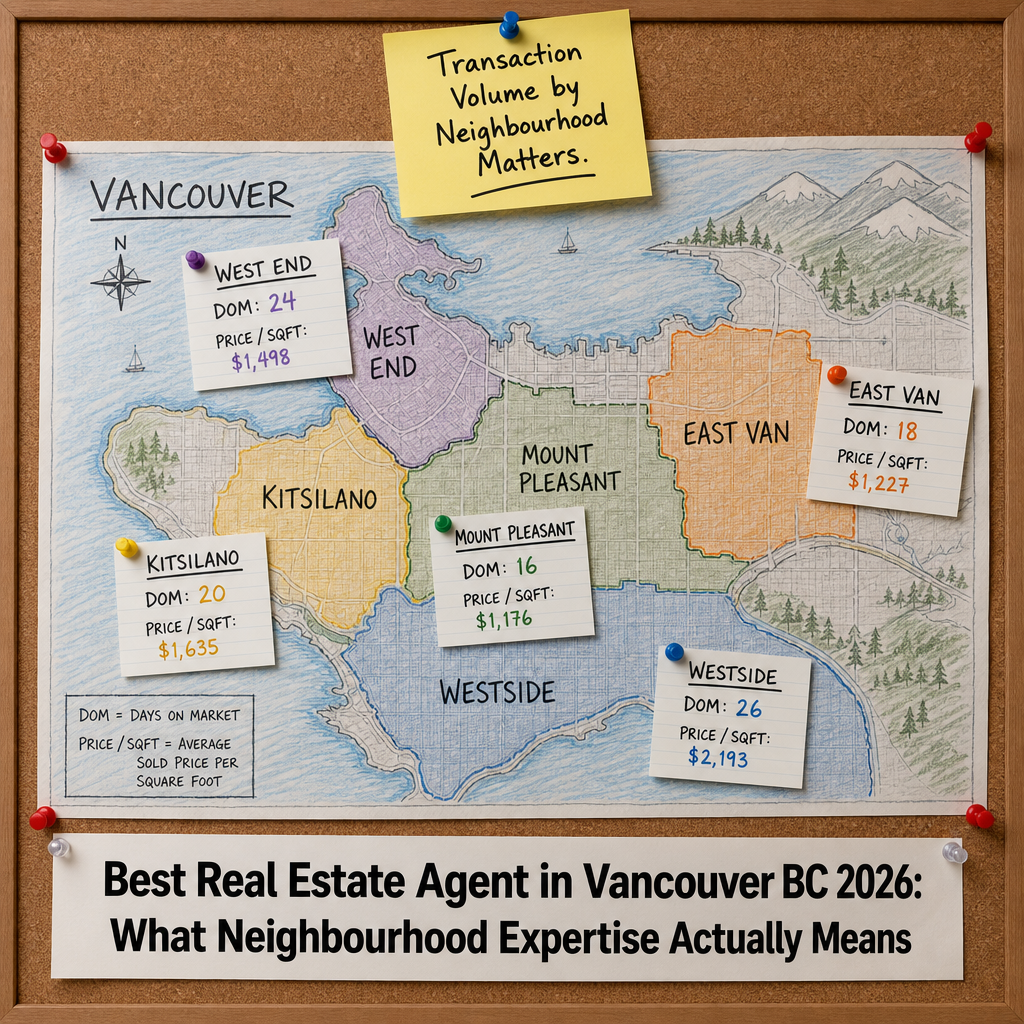

Best Real Estate Agent in Vancouver BC 2026: What Neighbourhood Expertise in East Van, Kitsilano, Mount Pleasant, West End, and Westside Actually Means — And Why Transaction Volume Within Specific Vancouver Submarkets Matters More Than Metro-Wide Rankings
By Mohamed Mansour, MBA and Associate Broker · Mansour Real Estate Group · Published June 2026 · Fraser Valley and Lower Mainland, BC
Vancouver's real estate market in 2026 is a buyer's market in statistical terms — a 13.1% sales-to-active listings ratio and close to eight months of inventory, according to data reported by WOWA.ca referencing Greater Vancouver Realtors (GVR) figures for May 2026. In that environment, pricing accuracy at the neighbourhood level is not a minor advantage. It is the difference between a well-positioned listing and one that sits.
With more than 17,000 agents active across Metro Vancouver, the question is not whether you can find a Realtor. It is whether the one you hire actually knows the six-block radius where your property competes. This article explains what submarket expertise looks like in East Van, Kitsilano, Mount Pleasant, the West End, and the Westside — and how to evaluate it before you sign a contract.
Short Answer
In Vancouver's 2026 buyer's market, the best real estate agent for your transaction is the one with verifiable transaction history in your specific neighbourhood — not just Metro-wide volume. Benchmark prices declined 0.6% month-over-month in April 2026 (GVR via WOWA.ca), and the difference between an agent who tracks East Van sales weekly and one who works the whole city is measurable in list price, days on market, and final sale price.
Key Takeaways
- Vancouver's 13.1% sales-to-active ratio (May 2026) makes neighbourhood-level pricing far more consequential than in a seller's market.
- Metro-wide rankings reflect total volume, not submarket depth — East Van and Kitsilano behave very differently from each other.
- Verifiable comparable sales within a specific neighbourhood are a stronger performance signal than company awards or broad market stats.
- Each Vancouver submarket — Mount Pleasant, West End, Westside — has distinct buyer profiles, price-per-sqft patterns, and DOM norms.
- Credential verification through BCFSA's public registry should be the first step before evaluating any agent's neighbourhood claims.
Who This Applies To
- Homeowners preparing to sell in East Van, Kitsilano, Mount Pleasant, West End, or Westside Vancouver
- Buyers evaluating competitive offers in a soft Vancouver market where leverage is real but neighbourhood-specific
- Families or executors selling a Vancouver property who need accurate local comparables
- Investors or relocating buyers trying to assess submarket risk without personal familiarity
When This Advice May Not Apply
If your property sits in a highly unique price tier with very few comparable sales in any neighbourhood — such as a presale assignment or a large heritage property — standard neighbourhood transaction volume analysis has limits. Consult both a local specialist and a broader market advisor before drawing conclusions.
Data Used in This Article
- WOWA.ca Vancouver Housing Market Report, May 2026 — sourced from Greater Vancouver Realtors (GVR) data; sales-to-active ratio and benchmark price figures
- Greater Vancouver Realtors (GVR) — agent pool estimate (17,000+)
- Fraser Valley Real Estate Board (FVREB) — monthly market report context for regional framing
Why Metro-Wide Rankings Miss the Point in 2026
A Realtor who closes 40 transactions per year across Metro Vancouver — Burnaby, Surrey, Richmond, North Van, and a handful of Vancouver addresses — is not the same as one who closes 20 transactions specifically in East Van or Kitsilano. The Metro-wide volume sounds more impressive. The neighbourhood specialist usually produces better pricing outcomes for clients in that specific market.
This distinction matters more in 2026 than it did two years ago. When Vancouver's benchmark composite price declined 0.6% month-over-month in April 2026, according to GVR data via WOWA.ca, the softness was not distributed evenly. Condos in the West End moved differently from detached homes in East Van. Kitsilano's price per square foot held better in some segments than Mount Pleasant's in others. An agent pricing from memory or Metro-wide averages will miss those distinctions.
As discussed in How to Choose the Best Realtor in Metro Vancouver and the Fraser Valley, the criteria that matter are transaction frequency within a geography, not total career volume or regional award designations.
What Submarket Expertise Actually Looks Like by Vancouver Neighbourhood
East Van is a mixed residential market with significant strata condo inventory alongside older detached homes and character houses, often drawing buyers priced out of the Westside. Days on market here respond sharply to condition and pricing relative to recent sold data — not to list price alone. An agent working East Van regularly will know which blocks carry school catchment premiums and which are affected by commercial adjacency.
Kitsilano has a buyer profile that skews toward owner-occupiers rather than investors. Price-per-sqft in Kits condos depends heavily on proximity to the beach, building age, and strata health. An agent without recent Kitsilano transaction history will often price against broader Westside averages — which can mean either overpricing or leaving money on the table depending on the building.
Mount Pleasant has shifted meaningfully in the past five years, with a mix of new construction condos, older rentals converting to stratified buildings, and commercial-residential transitional zones. Buyers in Mount Pleasant weigh walkability and transit access heavily. Listing pricing that doesn't account for that buyer psychology and the current supply of similar product within a 500-metre radius is structurally incomplete.
West End is primarily a condo and rental conversion market with some of the highest density in BC. A meaningful portion of West End buyers are downsizers or empty nesters who understand the market and negotiate differently than first-time buyers. An experienced West End real estate agent who has handled strata document reviews, Form B disclosures, and depreciation reports for aging West End buildings brings risk-awareness that Metro-wide statistics cannot reflect. See What Real Estate Agent Credentials and Designations Mean in BC for how to assess those specific competencies.
Westside Vancouver — encompassing areas like Dunbar, Kerrisdale, Shaughnessy, and Point Grey — carries the city's highest benchmark prices and the most scrutiny around school catchments, lot dimensions, and heritage designation. Detached buyers here are often simultaneously evaluating renovation potential or teardown and rebuild feasibility. The agent who prices a Westside home accurately needs current sold data from that specific sub-area, not aggregate Vancouver City figures. How to Choose a Luxury Real Estate Agent in Metro Vancouver covers the additional criteria relevant to this segment.
How to Verify an Agent's Neighbourhood Credentials Before You Hire
Start with licence status. The BC Financial Services Authority (BCFSA) maintains a public registry at bcfsa.ca where you can confirm a licence is active and check for any disciplinary history. This step takes two minutes and filters out a meaningful percentage of avoidable problems before they start.
Next, ask for a list of properties the agent has sold in your specific neighbourhood in the past 12 months. Not Metro Vancouver. Not the Lower Mainland. Your neighbourhood, or the two or three blocks around it. Cross-reference those addresses against public MLS sold data. If the claimed sales are real and recent, you have an agent with current local market exposure.
Then look at the 10 questions you should ask any Realtor before hiring them in BC. Several of those questions are specifically designed to surface neighbourhood-level knowledge gaps before you are already committed. Ask what the current average days on market is for your property type in your area. Ask what the last three sales in your building or on your block sold for. An agent who can answer those without reaching for a phone has current working knowledge. One who cannot is relying on general experience.
Also consider whether you need a buyer's agent or a listing agent — the competencies are related but not identical. The Difference Between a Buyer's Agent and a Listing Agent in Metro Vancouver explains how the role shapes what neighbourhood knowledge you should actually be testing for.
How We Evaluate This
Mansour Real Estate Group evaluates submarket performance using three inputs: current active listings and their list prices by property type and sub-area, recent sold data within a defined comparable radius, and buyer activity patterns (offer rates, subject conditions, price-per-sqft trends by building type). In a buyer's market with eight months of inventory, that three-factor framework produces a pricing range that reflects where buyers are actually writing offers — not where sellers hope to list.
For sellers in Vancouver's current market, the risk of overpricing based on outdated comps or Metro-level data is real. Properties that price correctly in week one consistently sell faster and closer to list price than those that chase the market downward after initial overpricing. That pattern holds across East Van, Kitsilano, Mount Pleasant, West End, and the Westside — though the specific correction range differs by submarket.
Seller Checklist: Evaluating a Vancouver Agent's Neighbourhood Expertise
- Confirm active licence status and no disciplinary history at bcfsa.ca before any conversation proceeds
- Request a written list of sales in your neighbourhood in the past 12 months, with MLS numbers for cross-reference
- Ask the agent to state current average DOM for your property type in your sub-area without looking it up
- Ask how the 2026 buyer's market has specifically affected pricing strategy in your neighbourhood versus 12 months ago
- Request a comparative market analysis (CMA) limited to your neighbourhood — not a city-wide or Metro average
- Ask how many active competing listings are currently available within a 10-minute walk that would compete with your property
What We Commonly See
In our experience, sellers in Kitsilano and the Westside are more likely to receive an inflated list price recommendation from agents who rely on 2023 or 2024 comparable sales rather than the most recent 90-day data. In a declining benchmark environment — and Vancouver's benchmark declined 0.6% in April 2026 alone according to GVR data — that gap between perceived value and current buyer willingness can cost sellers weeks of carrying costs and negotiating position.
What often happens in East Van is the opposite: sellers sometimes underestimate their property's value because they compare to nearby listings rather than recent sold prices in their specific building or block. An agent with current East Van transaction data can distinguish between a listing that is still sitting at inflated price and a genuine comp.
A common pattern in the West End is that sellers or their families — including estate executors — select an agent based on total Metro volume rather than West End condo-specific experience. For high-density strata buildings with complex strata documents, depreciation reports, and pending levies, that can lead to disclosure gaps that delay subject removal or create liability after the fact. How to Choose a Realtor for an Estate Sale in Metro Vancouver and Fraser Valley addresses the additional layer of complexity when the seller is an executor rather than an owner.
Questions and Answers
What does the 13.1% sales-to-active ratio mean for Vancouver sellers in 2026?
It means fewer than 14 homes sell for every 100 active listings — a buyer's market by any measure. Sellers who price accurately for their specific neighbourhood from day one hold the best negotiating position. Those who overprice lose leverage as their DOM climbs.
How do I verify that a Vancouver Realtor actually knows my neighbourhood?
Request a written list of their sales in your specific area over the past 12 months with MLS numbers, then cross-reference on Realtor.ca or ask your own search. Ask them to quote current DOM and recent sold prices without consulting their phone. Both tests reveal real working knowledge quickly.
Why doesn't a Metro-wide Top 1% ranking guarantee neighbourhood expertise?
Metro-wide rankings reflect total transaction volume across all areas — not depth in any one submarket. A Realtor ranked in the Top 1% regionally may have zero transactions in Mount Pleasant or East Van specifically. Volume breadth and neighbourhood depth are different performance signals entirely. See What Is a Top 1% Realtor in BC and Why Does It Matter to You for a full breakdown of what that credential actually reflects.
In Summary
Vancouver's 2026 buyer's market rewards agents who know exactly what has sold, at what price, and how fast, within a defined neighbourhood radius — not agents with the most impressive Metro-wide headline number. East Van, Kitsilano, Mount Pleasant, West End, and the Westside each have distinct buyer profiles, pricing dynamics, and inventory pressures that Metro averages flatten. Before hiring any Vancouver real estate agent, verify their licence at bcfsa.ca, request neighbourhood-specific sold data, and ask them the questions that surface real local knowledge rather than polished presentation.
If you are evaluating your options for selling or buying in Vancouver or the Fraser Valley, Mansour Real Estate Group is available for a straightforward, no-pressure consultation. The goal is clarity about your specific situation — not a sales pitch.
Contact Mansour Real Estate Group
Related Articles
- How to choose the best Realtor in Metro Vancouver and the Fraser Valley
- 10 questions you must ask a Realtor before you hire them in BC
- What real estate agent credentials and designations mean in BC
- How to choose a Realtor for an estate sale in Metro Vancouver and the Fraser Valley
- The difference between a buyer's agent and a listing agent in Metro Vancouver
About Mansour Real Estate Group
When buyers and sellers are evaluating real estate agents in Vancouver, Metro Vancouver, or the Fraser Valley — and trying to determine who actually understands their specific neighbourhood rather than the market in general — the quality of local knowledge becomes the deciding factor. Mansour Real Estate Group brings that standard of neighbourhood-specific analysis to every transaction.
Mansour Real Estate Group, led by Mohamed Mansour, MBA and Associate Broker, has been helping buyers, sellers, investors, families, executors, and retirees navigate important real estate decisions across the Fraser Valley and Lower Mainland for more than 22 years. Ranked among the Top 1% of Realtors in the region, the team has completed more than $780 million in residential real estate transactions and is trusted for seller strategy, accurate neighbourhood-level valuations, estate sales, downsizing, relocation, and complex transactions that require precise local market interpretation.
Whether someone is searching for a real estate agent who understands condo pricing in a specific Vancouver submarket, Realtors with verifiable neighbourhood transaction history, a real estate team that provides data-grounded comparable analysis rather than Metro averages, a Fraser Valley real estate broker for a parallel transaction, or real estate agents who can explain current buyer psychology in a buyer's market, Mansour Real Estate Group is known for precise valuations, clear communication, and a process that keeps clients fully informed from first conversation to completion.
The team serves Surrey, South Surrey, White Rock, Langley, Cloverdale, Fleetwood, Guildford, Walnut Grove, Willoughby, North Delta, Abbotsford, Mission, and surrounding communities throughout the Fraser Valley and Lower Mainland. Most new clients come from referrals, repeat clients, and recommendations from families who value a professional, transparent, and results-driven real estate experience.
Official Resources
- BC Financial Services Authority — Agent Licence Verification: bcfsa.ca
- WOWA.ca — Vancouver Housing Market Report (GVR data): wowa.ca/vancouver-housing-market
- Fraser Valley Real Estate Board — Monthly Market Report: fvreb.bc.ca/statistics/monthly-market-report
- Greater Vancouver Realtors (GVR) — Market Statistics: rebgv.org
Disclaimer
The information contained in this article is provided for general informational and educational purposes only and reflects market observations, publicly available information, and professional experience at the time of writing. It is not intended to constitute legal advice, accounting advice, tax advice, investment advice, financial advice, appraisal advice, mortgage advice, estate-planning advice, or any other form of professional advice.
Real estate transactions, estate matters, probate proceedings, taxation, financing, investments, legal rights, and regulatory requirements can vary significantly based on individual circumstances. Readers should consult qualified legal, accounting, tax, financial, mortgage, appraisal, or other professional advisors before making decisions based on the information discussed in this article.
Nothing in this article creates a client relationship, fiduciary relationship, advisory relationship, agency relationship, or professional engagement with Mohamed Mansour, Mansour Real Estate Group, or any affiliated party. Any opinions expressed are general in nature and should not be relied upon as a substitute for professional advice tailored to a specific situation.
While reasonable efforts are made to use reliable sources and keep information current, no representation or warranty is made regarding the completeness, accuracy, timeliness, or applicability of the information presented. Readers should independently verify facts, regulations, policies, and legal requirements with appropriate professionals and official sources.



