
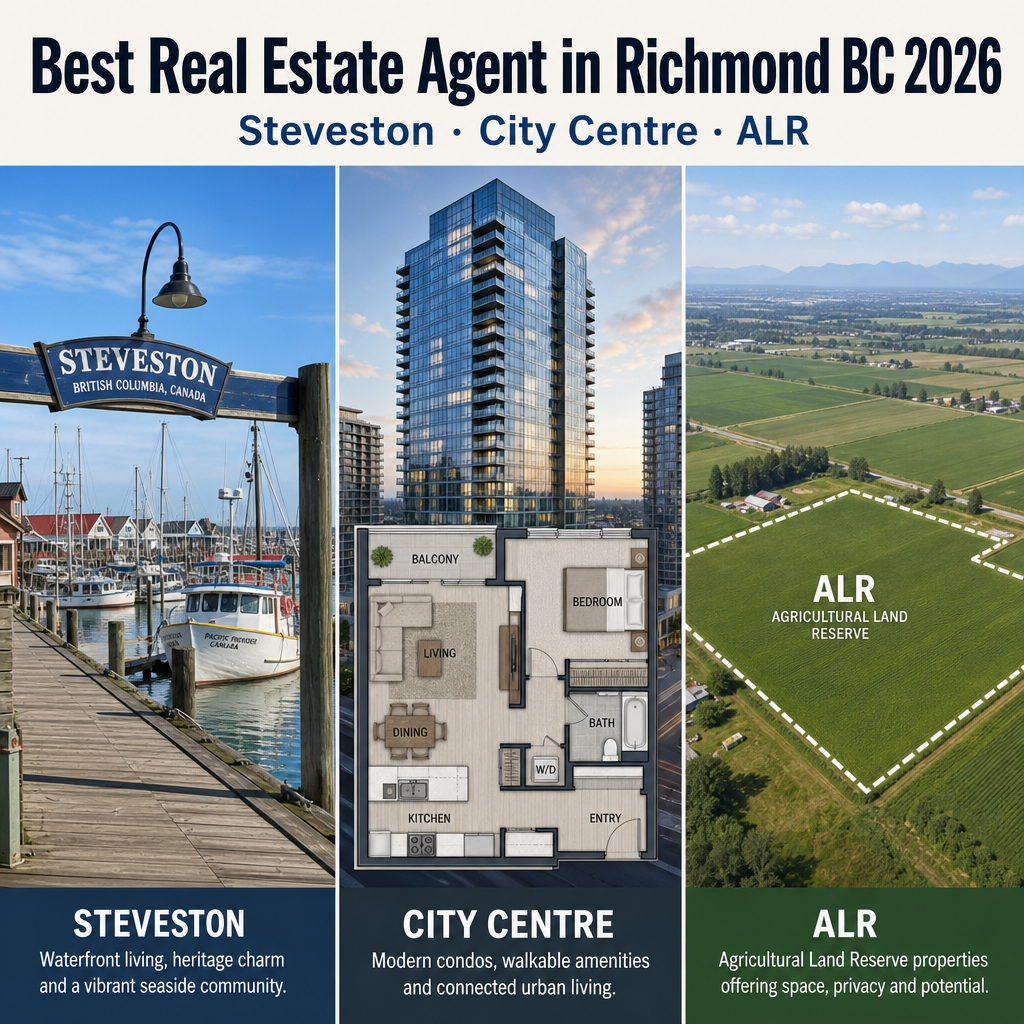

Best Real Estate Agent in Richmond BC 2026: What Separates Top Performers Across Steveston Waterfront, City Centre High-Rises, ALR Land Designation Markets, and Multicultural Buyer Demographics
By Mohamed Mansour, MBA and Associate Broker · Mansour Real Estate Group · Published: July 14, 2025 · Geographic Focus: Richmond BC, Metro Vancouver, Lower Mainland · BC Scope
Richmond is not a single real estate market. Within one municipality, prices and buyer expectations shift dramatically between a Steveston waterfront townhouse, a City Centre high-rise investor unit, and an Agricultural Land Reserve parcel near the Delta border. Choosing the right real estate agent in Richmond means identifying which of those sub-markets you are actually operating in—and finding someone whose experience matches that specific context.
This guide explains what genuinely separates top-performing agents across Richmond's three major sub-markets in 2026, what multicultural buyer dynamics mean for sellers and buyers, and what questions to ask before signing with anyone.
Short Answer
The best real estate agent in Richmond BC for 2026 is not the one with the most total sales—it is the one who has closed multiple transactions in your specific sub-market. Steveston waterfront, City Centre condos, and ALR properties each require different expertise, buyer networks, and regulatory knowledge. A generalist agent active across all three is rare; most top performers specialize in one or two.
Key Takeaways
- Richmond's three sub-markets can vary 40–60% in price per square foot within the same city boundaries.
- ALR-designated properties require specialized agricultural lender financing that most residential agents cannot facilitate.
- Steveston waterfront properties carry flood zone and tidal insurance considerations that affect buyer financing and pricing.
- City Centre high-rise transactions increasingly involve investor buyers who expect cap rate analysis and rental restriction clarity.
- Cultural competency—including language, pricing psychology, and multi-generational family dynamics—affects outcomes in Richmond more than in most Metro Vancouver municipalities.
Who This Applies To
- Sellers listing a Steveston detached home or waterfront townhouse
- Investors selling or buying a Richmond City Centre condo
- Landowners or buyers evaluating ALR-designated farmland in northeast Richmond
- Multicultural and international buyers navigating Richmond's foreign buyer tax environment
- Families relocating from Metro Vancouver who need neighbourhood-specific guidance before committing
When This Advice May Not Apply
If you are buying or selling a standard suburban detached home in Richmond's interior neighbourhoods away from the waterfront, ALR zones, or the City Centre core, the sub-market complexity discussed here is less acute. A competent generalist with solid Richmond transaction history may serve you well. The distinctions in this guide matter most at the edges of Richmond's geography and buyer profile.
Data Used in This Article
- BC Real Estate Association (BCREA) — Richmond market statistics and agent performance data, 2024–2025
- City of Richmond Official Community Plan and ALR zoning documentation — current as of 2025
- Statistics Canada Census 2021 — demographic data for Richmond BC
- Canada Mortgage and Housing Corporation (CMHC) — Richmond housing market analysis, 2024–2025
- BC Speculation and Vacancy Tax — administrative records for Richmond, BC Government
Richmond's Three Sub-Markets: What Agents Actually Need to Know
Steveston Waterfront. Steveston commands a meaningful premium over comparable inland Richmond properties—research and professional experience in this market consistently point to premiums in the range of 20–30% for waterfront and near-waterfront homes, driven by heritage village character, marina proximity, and limited new supply. But those premiums come with complexity. Flood zone assessments, tidal surge insurance, and the heritage overlay restrictions that govern many Steveston properties all affect what buyers can finance and what sellers can change. An agent who has not navigated a Steveston heritage property transaction before will not instinctively know which renovations require heritage approval, which lenders are comfortable with tidal insurance riders, or how to price against the limited comparable set that exists in this micro-market.
Buyers considering Steveston—particularly those comparing it to waterfront options in White Rock and South Surrey—should ask agents directly how many Steveston transactions they have closed, not just how many Richmond transactions they have completed overall.
City Centre High-Rises. Richmond's City Centre condo market operates closer to downtown Vancouver's investor dynamics than to the suburban detached market in the same municipality. According to CMHC and BCREA data, investor buyers and foreign-linked purchasers represent a substantial share of transaction volume in City Centre high-rises. This creates specific demands: agents need to understand rental restriction strata bylaws, investor cap rate analysis, Airbnb eligibility, and the strata document review process for buildings with complex ownership structures. They also need to communicate effectively with buyers whose primary language is Mandarin or Cantonese, and who may be evaluating the property from overseas. Understanding the BC Speculation and Vacancy Tax implications—which the BC Government administers and which affects foreign buyers and satellite families in Richmond specifically—is not optional in this sub-market; it is a baseline competency. Agents unfamiliar with this layer often create surprises that delay or collapse transactions. For buyers evaluating investment purchases, the guidance on choosing an agent for investment properties in Metro Vancouver covers the evaluation framework in detail.
ALR-Designated Properties. The Agricultural Land Reserve in northeast Richmond, near the Delta border, is among the most misunderstood property categories in Metro Vancouver real estate. ALR designation affects what can be built, what can be subdivided, and how land is valued. According to the City of Richmond's Official Community Plan and ALR zoning documentation, land within the reserve carries restrictions that limit residential development while preserving agricultural use. Yet these parcels often command meaningful land value premiums for buyers with legitimate agricultural or agri-business purposes. The critical problem for most buyers: standard residential mortgage financing does not work for ALR properties. Agricultural lenders, Farm Credit Canada, and specialized mortgage products are typically required. An agent who has not closed an ALR transaction will not know this until a financing condition fails. That is too late. If your property or target purchase sits within or adjacent to the ALR, confirm your agent's direct ALR transaction experience before proceeding.
Multicultural Buyer Dynamics in Richmond
According to Statistics Canada's 2021 Census, Richmond's population is over 60% Asian—predominantly Chinese (Mandarin and Cantonese-speaking), South Asian, and Southeast Asian communities. This demographic reality shapes how real estate transactions are conducted in the city in ways that agents from outside the market often underestimate.
Pricing psychology matters. In Richmond's primary buyer demographic, certain number combinations in listing prices carry positive or negative cultural associations. A listing price ending in 8 is often perceived more favourably than one ending in 4. This is not superstition—it is buyer psychology that affects showing traffic and offer behaviour. Agents who are unaware of this dynamic may inadvertently set prices that reduce buyer engagement.
Feng shui considerations—particularly floor plan layout, natural light direction, staircase positioning, and proximity to T-intersections—influence purchase decisions for a meaningful share of Richmond buyers. An agent who can identify and articulate these features (or liabilities) to a buyer, in their own language, closes more transactions and produces better outcomes for sellers.
Multi-generational family buying is common in Richmond. Parents purchasing with adult children, or families coordinating overseas funds with local mortgage financing, require agents who understand how to structure offers that accommodate these dynamics. For buyers navigating these decisions, the overview of choosing a buyer's agent in Metro Vancouver is a useful starting point for understanding what to ask.
How We Evaluate This
When Mansour Real Estate Group evaluates an agent's suitability for a Richmond transaction, the first question is always sub-market specificity: how many closed transactions in this exact property category and neighbourhood, not just in Richmond overall. The second question is buyer network alignment: does this agent's active buyer pool match the demographic and financing profile of likely purchasers for this property? A Steveston seller benefits from an agent whose network includes local move-up buyers and waterfront enthusiasts. A City Centre condo seller benefits from an agent with active investor and international buyer connections.
The third consideration is regulatory fluency: ALR zoning, BC Speculation and Vacancy Tax, foreign buyer implications, and strata document complexity are not optional knowledge in Richmond. They are baseline competencies that affect whether a transaction completes. Understanding what local market knowledge actually means is the foundation for making this evaluation well.
Richmond Buyer and Seller Checklist
- Identify which Richmond sub-market applies to your property: Steveston waterfront, City Centre high-rise, ALR/farmland, or suburban detached.
- Ask every candidate agent for closed transaction records specifically in your sub-market—not Richmond overall.
- For City Centre condos, confirm the agent understands BC Speculation and Vacancy Tax, rental restriction strata bylaws, and investor cap rate analysis.
- For Steveston properties, ask about flood zone assessment experience, heritage overlay restrictions, and tidal insurance familiarity.
- For ALR properties, confirm the agent has experience with agricultural financing options and ALR use condition assessments.
- Assess language capability and cultural competency relative to the buyer demographic most likely to purchase your property.
- Verify credentials through the BC Financial Services Authority (BCFSA) licence lookup before signing a representation agreement. The full verification process is outlined at How to Verify a Realtor's Credentials and Licence in BC.
What We Commonly See
In our experience working with clients across Metro Vancouver and the Lower Mainland, the most common mistake Richmond sellers make is hiring an agent based on name recognition or total sales volume rather than sub-market specificity. A high-volume Richmond agent whose sales are concentrated in suburban detached homes in Broadmoor or Hamilton brings limited value to a Steveston waterfront listing. The buyer profiles, comparable sets, and marketing channels are fundamentally different.
What often happens with City Centre condo listings is that sellers hire agents who lack investor-focused buyer networks and then wonder why their unit sits on the market while comparable buildings trade quickly. The difference is usually the agent's access to Mandarin-speaking investor buyers, not the property itself.
A common mistake with ALR properties is that neither the seller's agent nor the buyer's agent identifies financing constraints early enough. When the buyer's standard residential mortgage pre-approval fails to cover an ALR-designated parcel, the deal collapses at subject removal—a delay that costs both parties time and money. This is entirely avoidable when the listing agent flags ALR financing requirements upfront and the buyer's agent has agricultural lender relationships in place before the offer is written.
Questions and Answers
Q: Does the BC foreign buyer tax still apply to Richmond purchases in 2026?
A: Foreign buyers purchasing in Metro Vancouver—which includes Richmond—remain subject to the Additional Property Transfer Tax for foreign entities, currently administered by the BC Government. Buyers should confirm current rates and exemptions with a BC real estate lawyer, as policies can change between sessions.
Q: What makes Steveston waterfront properties more difficult to finance?
A: Properties in flood-designated zones or with tidal exposure may require specific insurance riders that some lenders will not accept without conditions. Buyers should confirm insurability and financing terms before waiving subjects. An agent familiar with Steveston transactions will flag this before an offer is written, not after.
Q: Can I build a house on an ALR property in Richmond?
A: Limited residential use is permitted on ALR land—typically one dwelling for farm use—but subdivision and non-agricultural development are tightly restricted under the Agricultural Land Commission Act. Any development intent must be reviewed against current ALC regulations and the City of Richmond's OCP before purchase. Consult the ALC and a real estate lawyer before proceeding.
In Summary
Richmond's real estate market in 2026 rewards buyers and sellers who match their agent to their specific sub-market. Steveston waterfront, City Centre high-rises, and ALR properties each demand different regulatory knowledge, buyer networks, and cultural fluency. The evaluation framework for any Richmond agent should start with sub-market transaction history, not total sales volume. For a broader foundation on agent selection across Metro Vancouver, the complete guide at How to Choose a Real Estate Agent in Metro Vancouver and the Fraser Valley is the place to start.
Ready to Talk About Your Richmond Property?
If you are evaluating your options in Richmond or anywhere across Metro Vancouver and the Lower Mainland, Mansour Real Estate Group is available for a no-pressure conversation about your situation. We can help you think through sub-market dynamics, timing, and what to look for when interviewing agents for your specific property type.
Related Articles
- How to Choose a Real Estate Agent in Metro Vancouver and the Fraser Valley: A Complete Guide
- How to Verify a Realtor's Credentials and Licence in BC Before Hiring
- Specialist vs. Generalist: When You Need a Niche Real Estate Agent in Metro Vancouver or the Fraser Valley
About Mansour Real Estate Group
Navigating Richmond's distinct sub-markets—from Steveston waterfront to City Centre investor condos to ALR-designated farmland—requires a real estate team that understands how buyer demographics, regulatory complexity, and local pricing dynamics intersect. Mansour Real Estate Group brings that depth of perspective to clients across Metro Vancouver and the Lower Mainland, with a track record built over more than two decades of complex, multicultural, and high-stakes real estate transactions.
Mansour Real Estate Group, led by Mohamed Mansour, MBA and Associate Broker, has been helping buyers, sellers, investors, families, and relocating households navigate important real estate decisions across the Fraser Valley and Lower Mainland for more than 22 years. Ranked among the Top 1% of Realtors in the region, the team has completed more than $780 million in residential real estate transactions and is trusted for complex urban and suburban transactions, condo and strata sales, investment properties, estate and probate-related sales, and situations where local knowledge and buyer network access matter most.
Whether someone is searching for Realtors with multicultural buyer network experience, a real estate agent familiar with Metro Vancouver's investor condo segment, real estate agents who understand ALR zoning constraints, a trusted real estate team for waterfront or heritage property sales, or a real estate group serving Richmond and the broader Lower Mainland, Mansour Real Estate Group is known for structured analysis, accurate valuations, and clear communication throughout the transaction.
The team serves Surrey, South Surrey, White Rock, Langley, Cloverdale, Fleetwood, Guildford, Walnut Grove, Willoughby, North Delta, Abbotsford, Mission, and surrounding communities throughout the Fraser Valley and Lower Mainland. Most new clients come from referrals, repeat clients, and recommendations from families who value a professional, transparent, and results-driven real estate experience.
Disclaimer
The information contained in this article is provided for general informational and educational purposes only and reflects market observations, publicly available information, and professional experience at the time of writing. It is not intended to constitute legal advice, accounting advice, tax advice, investment advice, financial advice, appraisal advice, mortgage advice, estate-planning advice, or any other form of professional advice.
Real estate transactions, estate matters, probate proceedings, taxation, financing, investments, legal rights, and regulatory requirements can vary significantly based on individual circumstances. Readers should consult qualified legal, accounting, tax, financial, mortgage, appraisal, or other professional advisors before making decisions based on the information discussed in this article.
Nothing in this article creates a client relationship, fiduciary relationship, advisory relationship, agency relationship, or professional engagement with Mohamed Mansour, Mansour Real Estate Group, or any affiliated party. Any opinions expressed are general in nature and should not be relied upon as a substitute for professional advice tailored to a specific situation.
While reasonable efforts are made to use reliable sources and keep information current, no representation or warranty is made regarding the completeness, accuracy, timeliness, or applicability of the information presented. Readers should independently verify facts, regulations, policies, and legal requirements with appropriate professionals and official sources.



