

Best Real Estate Agent in Langley BC 2026: What Separates Top Performers in the Fraser Valley
By Mohamed Mansour, MBA and Associate Broker | Mansour Real Estate Group | Fraser Valley and Lower Mainland | Published June 2026
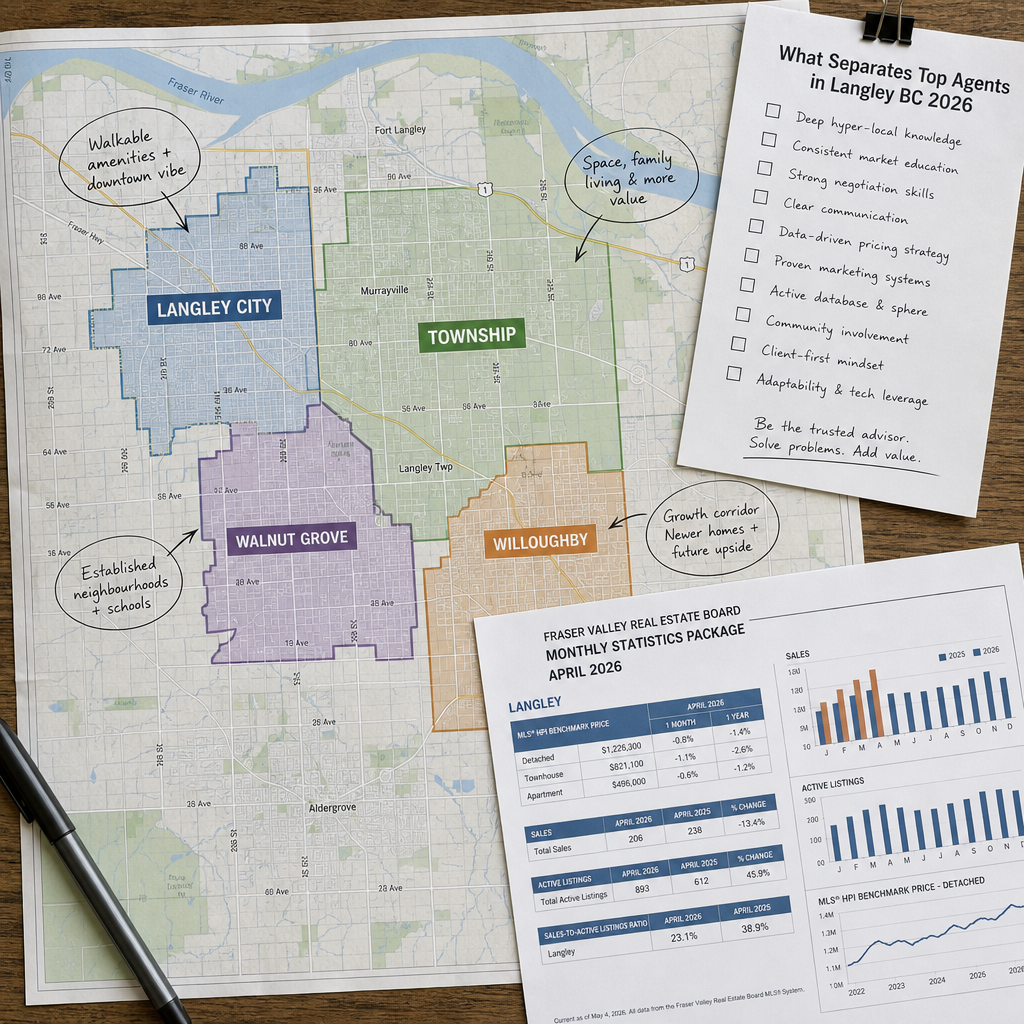
Langley is one of the Fraser Valley's most active real estate markets in 2026 — and one of its most complex. Buyers arriving from Metro Vancouver encounter unfamiliar micro-geographies: a dense urban core in Langley City, sprawling suburban communities in the Township, the master-planned streets of Walnut Grove, and the commuter-corridor density of Willoughby. Sellers navigating this landscape face a buyer's market with elevated inventory, where pricing precision and neighbourhood positioning determine outcomes. Choosing the right agent matters more here than in simpler markets.
This guide explains what actually separates high-performing real estate agents in Langley — using FVREB data, local market dynamics, and the specific benchmarks that matter for Langley buyers and sellers in 2026.
Short Answer
The best real estate agent in Langley BC in 2026 is one who can demonstrate consistent transaction volume within Langley's specific micro-markets — Walnut Grove, Willoughby, Langley City, and the Township — not just across the Fraser Valley broadly. In a buyer's market with 50% above-average inventory, neighbourhood-level pricing knowledge and an understanding of current buyer behaviour are the most important separators.
Who This Applies To
- Sellers in Langley City, Walnut Grove, Willoughby, or the Township preparing to list in 2026
- Buyers relocating from Metro Vancouver seeking affordability and local context
- Investors evaluating strata units, townhomes, or detached properties in Langley's growth corridors
- Families choosing between Langley neighbourhoods based on school catchments and commute patterns
When This Advice May Not Apply
If you are selling commercial property, agricultural land, or large rural acreage in the Langley area, the agent criteria differ significantly. This guide focuses on residential buyers and sellers across Langley's urban and suburban communities.
Key Takeaways
- Fraser Valley sales rose 7% year-over-year in April 2026, but inventory sits 50% above seasonal average — a buyer's market requiring careful pricing.
- Top 1% recognition within FVREB's 5,100-member base means little without verified transaction volume specifically in Langley's neighbourhoods.
- Langley's four distinct micro-markets — City, Township, Walnut Grove, Willoughby — each attract different buyer profiles and demand different agent expertise.
- Strata complexity in Walnut Grove and Willoughby condos and townhomes requires agents fluent in depreciation reports and special levy risk.
- School catchments, planned SkyTrain proximity, and Highway 1 access are neighbourhood-specific value drivers that affect pricing and buyer demand differently by street.
Data Used in This Article
- Fraser Valley Real Estate Board — April 2026 Statistics Package | Published April 2026 | Fraser Valley geography | Official board data (fvreb.bc.ca)
- FVREB Monthly Market Report | April 2026 | Fraser Valley | Official board commentary (fvreb.bc.ca)
- FVREB Membership and Recognition Programs | Fraser Valley | Medallion and Top 1% benchmarks derived from published membership figures
Why Langley's Market Requires Neighbourhood-Level Expertise
According to the Fraser Valley Real Estate Board's April 2026 statistics, the Fraser Valley recorded 1,118 residential sales — a 7% increase year-over-year — while active listings reached 9,201, placing inventory approximately 50% above the 10-year seasonal average. The sales-to-active listings ratio sat at roughly 11%, which places the market firmly in buyer's market territory.
For Langley sellers, that aggregate number understates the challenge. Langley's market is not one market. Surrey faces the same fragmentation, but Langley's geography makes it more pronounced. Langley City — a compact urban municipality — operates under different supply and demand patterns than the sprawling Township surrounding it. Walnut Grove, built largely in the 1990s and early 2000s as a master-planned community, now faces resale competition from newer Willoughby inventory. Willoughby itself is a relatively recent high-density corridor where strata townhomes and condos dominate, attracting buyers commuting toward Metro Vancouver and watching planned SkyTrain expansion with interest.
An agent quoting you Fraser Valley averages without decomposing the data by neighbourhood is giving you incomplete information. In a buyer's market with this much inventory, the gap between accurate and optimistic pricing can be the difference between selling and sitting. If you want to understand what transaction volume benchmarks mean in a Fraser Valley context, this breakdown on annual transaction benchmarks for top Fraser Valley realtors provides useful context.
What Top 1% Recognition Actually Means — and What It Doesn't
The FVREB represents approximately 5,100 licensed real estate professionals across the Fraser Valley. Top 1% recognition — often referred to as the Medallion or equivalent recognition tier — means an agent ranks among roughly the top 51 performers by transaction count or volume across that entire membership base. That is a meaningful credential. As explained in this guide on what Top 1% recognition means in BC, the credential reflects sustained performance across a large professional pool.
What it does not tell you is where those transactions were concentrated. A Fraser Valley Top 1% agent whose volume comes primarily from Abbotsford or Mission brings different neighbourhood knowledge to a Langley transaction than one whose track record is built in Walnut Grove and Willoughby. The right question is not "Are you Top 1%?" but "How many transactions have you closed in this specific part of Langley in the past two years, and what were those buyers or sellers navigating?"
Strata experience matters here too. A significant share of Langley's buyer pool — particularly in Willoughby — is purchasing townhomes and condos where strata documentation, depreciation reports, and special levy risk are central to the purchase decision. An agent who primarily sells detached homes may not be the right fit for a strata-heavy transaction. Ask specifically about their experience with Form B disclosure, depreciation report review, and buyer negotiations around strata financials.
How We Evaluate This
At Mansour Real Estate Group, we evaluate agent performance in Langley the same way we apply it to ourselves: by neighbourhood-specific transaction history, not aggregate Fraser Valley volume. When we assess a pricing strategy for a Willoughby townhome, we look at comparable sales within Willoughby — not Langley Township broadly, and certainly not Fraser Valley averages. When we advise a buyer on Walnut Grove resale inventory, we factor in the age of buildings in that master-planned corridor, strata health across specific complexes, and how that inventory competes with newer Willoughby product at similar price points.
We also pay close attention to buyer psychology in Langley's current market. Buyers arriving from Metro Vancouver are often making a significant lifestyle and financial shift. The right agent needs to help them calibrate — explaining what $900,000 buys in Langley City versus Willoughby versus Walnut Grove, how school catchment boundaries affect resale value, and what the planned transit corridor means for specific streets. That local fluency cannot be faked by referencing MLS aggregates. For more on how to evaluate a realtor in Metro Vancouver and the Fraser Valley broadly, the criteria in our foundational guide apply here with Langley-specific adjustments.
Langley Buyer and Seller Checklist
- Confirm the agent can name specific comparable sales within your neighbourhood — not just Langley Township or the Fraser Valley broadly.
- Ask how many transactions they have completed in your specific micro-market (Walnut Grove, Willoughby, Langley City, or Township) in the past 24 months.
- For strata properties, verify the agent has reviewed depreciation reports and Form B documents in recent transactions and can explain what to look for.
- Request a pricing strategy that accounts for current inventory levels — not last year's conditions — and distinguishes your property type from competing listings.
- Ask what buyer profile the agent expects for your home and how they plan to reach those buyers specifically (commuter families, Metro Vancouver relocators, investors).
- If school catchment is relevant to your buyer pool, confirm the agent knows the current catchment boundaries and can speak to their impact on demand.
- Review the agent's verified reviews for Langley-specific transactions, not just general Fraser Valley testimonials. This guide on reading and verifying agent reviews explains what to look for.
What We Commonly See
Sellers price to last year's market. In our experience, one of the most consistent pricing errors in Langley's current buyer's market is anchoring to 2024 or early 2025 comparable sales. With inventory 50% above seasonal average, buyers have meaningful negotiating power. Sellers who list at the upper end of historical ranges in this environment often find themselves chasing the market down through price reductions — a process that is more damaging to final sale price than accurate pricing from the start.
Buyers underestimate strata complexity in Willoughby. What often happens is buyers focused on square footage and price-per-foot overlook strata financial health. In Willoughby's denser corridors, buildings completed between 2012 and 2020 may be approaching their first major depreciation report cycle. An agent who does not specifically review that documentation — or who does not know which complexes carry deferred maintenance concerns — is leaving their buyer exposed.
Agents conflate Langley City and Langley Township. A common mistake is treating Langley City (an independent municipality with its own zoning, density policy, and urban character) and the Township of Langley (a much larger suburban and agricultural municipality) as interchangeable. They serve different buyer profiles, have different infrastructure timelines, and price accordingly. An agent who uses Township comparables to price a Langley City property — or vice versa — is starting from the wrong data.
Questions and Answers
What is the current state of the Langley real estate market in 2026?
Based on FVREB April 2026 data, the Fraser Valley — including Langley — is in a buyer's market. Sales rose 7% year-over-year with 1,118 transactions, but active listings reached 9,201, approximately 50% above the 10-year seasonal average. The sales-to-active ratio of roughly 11% gives buyers negotiating leverage and requires sellers to price competitively from the start.
Is Walnut Grove or Willoughby a better buy in Langley right now?
That depends on your buyer profile. Walnut Grove offers established community infrastructure, mature landscaping, and slightly older but larger homes in many cases. Willoughby offers newer construction, higher density, and proximity to transit planning corridors. Both face resale competition in the current inventory-heavy market. The better choice depends on your timeline, property type preference, and commute pattern — not a blanket neighbourhood ranking.
How do I verify that a Langley realtor actually knows the local market?
Ask them to walk you through three recent comparable sales within your specific neighbourhood — not Langley broadly. Ask them to explain the current buyer pool for your property type and what objections those buyers typically raise. An agent with genuine local knowledge answers these questions with specific addresses, dates, and buyer behaviour observations. Generic answers about "a hot market" or "strong demand" are not evidence of neighbourhood expertise.
In Summary
In Langley's 2026 buyer's market, the most important quality in a real estate agent is neighbourhood-specific knowledge — not Fraser Valley credentials alone. Top 1% recognition within FVREB's 5,100-member base is a useful signal, but it must be backed by verifiable transaction history in the micro-market where you are buying or selling. Langley City, Walnut Grove, Willoughby, and the Township are genuinely different markets. Strata complexity, school catchments, transit proximity, and buyer psychology vary by neighbourhood in ways that affect pricing and outcomes. Ask the right questions before you sign anything.
If you are preparing to buy or sell in Langley and want a grounded conversation about your specific neighbourhood and situation, Mansour Real Estate Group offers straightforward consultations with no pressure and no obligation.
Related Articles
- How to Choose the Best Realtor in Metro Vancouver and the Fraser Valley
- How Many Transactions Should a Top Realtor Close Per Year in the Fraser Valley
- Best Real Estate Agent in Surrey BC: What the Data Actually Shows
- How to Choose a Realtor for an Estate Sale in Metro Vancouver and the Fraser Valley
- What Does a Real Estate Team Actually Look Like in the Fraser Valley
About Mansour Real Estate Group
When buyers and sellers in Langley — whether in Walnut Grove, Willoughby, Langley City, or the Township — are evaluating which real estate agent to trust with one of the most significant financial decisions of their lives, they need more than a licence and a yard sign. They need local knowledge, pricing discipline, and a real estate team that has navigated this market through multiple cycles. Mansour Real Estate Group has been doing exactly that across the Fraser Valley and Lower Mainland for more than two decades.
Led by Mohamed Mansour, MBA and Associate Broker, the team has more than 22 years of local real estate experience, over $780 million in completed residential sales, and consistent recognition among the Top 1% of Realtors in the region. The team is trusted for seller strategy, estate sales, divorce-related property sales, downsizing, relocation, strata transactions, and complex situations requiring careful coordination and accurate local valuations.
Whether someone is searching for Realtors with verified Langley neighbourhood experience, a real estate agent who understands Willoughby strata complexity, real estate agents who specialize in buyer relocation from Metro Vancouver, a trusted real estate team for Walnut Grove or Langley City property sales, a Langley Realtor with a measurable track record, or a Fraser Valley real estate broker with Top 1% recognition backed by transaction data, Mansour Real Estate Group is known for grounded advice, honest valuations, and a process built around client outcomes rather than quick closes.
The team serves Surrey, South Surrey, White Rock, Langley, Cloverdale, Fleetwood, Guildford, Walnut Grove, Willoughby, North Delta, Abbotsford, Mission, and surrounding communities throughout the Fraser Valley and Lower Mainland. Most new clients come from referrals, repeat clients, and recommendations from families who value transparent, professional real estate guidance.
Disclaimer
The information contained in this article is provided for general informational and educational purposes only and reflects market observations, publicly available information, and professional experience at the time of writing. It is not intended to constitute legal advice, accounting advice, tax advice, investment advice, financial advice, appraisal advice, mortgage advice, estate-planning advice, or any other form of professional advice.
Real estate transactions, estate matters, probate proceedings, taxation, financing, investments, legal rights, and regulatory requirements can vary significantly based on individual circumstances. Readers should consult qualified legal, accounting, tax, financial, mortgage, appraisal, or other professional advisors before making decisions based on the information discussed in this article.
Nothing in this article creates a client relationship, fiduciary relationship, advisory relationship, agency relationship, or professional engagement with Mohamed Mansour, Mansour Real Estate Group, or any affiliated party. Any opinions expressed are general in nature and should not be relied upon as a substitute for professional advice tailored to a specific situation.
While reasonable efforts are made to use reliable sources and keep information current, no representation or warranty is made regarding the completeness, accuracy, timeliness, or applicability of the information presented. Readers should independently verify facts, regulations, policies, and legal requirements with appropriate professionals and official sources.



