

Beneficiary Disputes Over Inherited Property Sales in BC: When Executors Can Override Disagreeing Heirs, How Partition Applications Work, and What Neutral Estate Realtors Actually Do to Keep Multi-Sibling Sales Moving Without Destroying Family Relationships
By Mohamed Mansour, MBA and Associate Broker | Mansour Real Estate Group | Fraser Valley & Lower Mainland | Published: July 15, 2025 | Topic: Estate Sales, Executor Authority, Probate Property BC
When a parent dies and leaves behind a family home in Surrey, Langley, or Abbotsford, the property is rarely the only thing inherited. Grief, history, financial pressure, and diverging life circumstances come with it. For the executor named in the will, those emotional realities collide with a legal obligation to settle the estate efficiently and in good faith. When siblings disagree—about timing, price, or whether to sell at all—the executor must decide how to move forward, and those decisions carry real legal weight.
This article is written for executors managing a contested estate sale, beneficiaries who want to understand their rights, and anyone in a multi-sibling inheritance trying to figure out what happens next. It draws on BC's Wills, Estates and Succession Act (WESA), the BC Law and Equity Act, and the practical experience of Mansour Real Estate Group working with families through exactly these situations across the Fraser Valley and Lower Mainland.
Short Answer
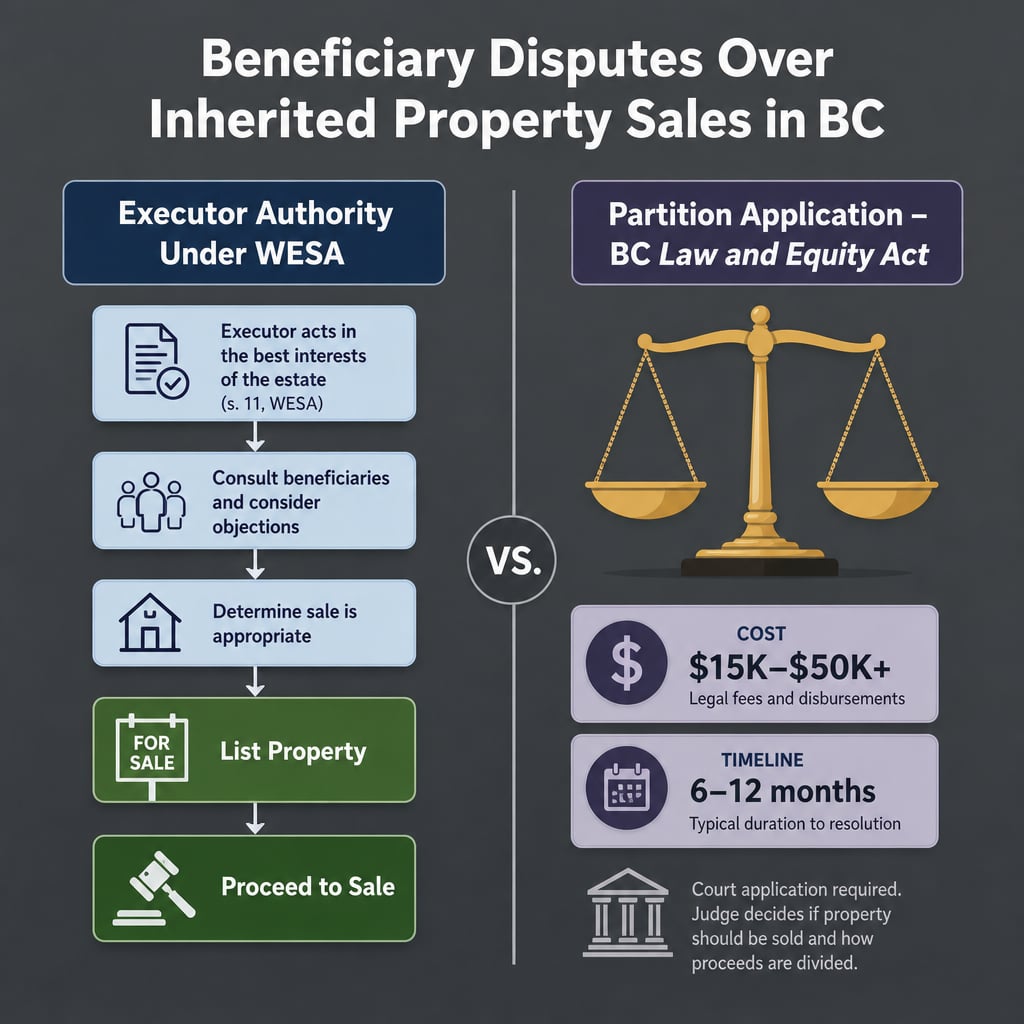
Under BC's Wills, Estates and Succession Act, an executor has legal authority to sell estate property without unanimous beneficiary consent, provided they act in good faith and the will does not specifically gift the property to a named beneficiary. When co-ownership deadlocks occur, the BC Law and Equity Act allows courts to order a forced sale through a partition application. Legal costs typically range from $15,000 to $50,000 or more, with timelines of six to twelve months.
Who This Applies To
- Executors who have probate authority but face one or more beneficiaries opposing the sale
- Adult children who have inherited a family home jointly and cannot reach agreement
- Co-executors who disagree on timing, pricing, or which agent to hire
- Beneficiaries who believe the executor is acting unreasonably, in bad faith, or in self-interest
- Estate lawyers and realtors managing transactions where multiple beneficiaries have competing demands
When This Advice May Not Apply
If the will specifically gifts the property to a named beneficiary rather than to the estate generally, that beneficiary may have grounds to block a sale. If no will exists and the estate is governed by intestacy rules, different procedures apply. Disputes involving potential claims under the Wills Variation Act (now Part 4 of WESA) add another legal layer. Consult a BC estate lawyer before acting on any of the information here.
Key Takeaways
- BC executors can legally list and sell inherited property without unanimous beneficiary agreement under WESA.
- Beneficiaries can challenge an executor through a WESA petition if bad faith or self-dealing is demonstrated.
- Partition applications under the BC Law and Equity Act force sales but cost $15K–$50K+ and take six to twelve months.
- Co-executors must unanimously agree on sale decisions unless the will permits majority voting.
- A neutral estate realtor documents all decisions in writing and escalates disputes to the executor and lawyer—not the family.
Definitions
WESA (Wills, Estates and Succession Act): BC legislation governing how estates are administered, including executor powers and beneficiary remedies.
Partition Application: A legal proceeding under BC's Law and Equity Act allowing a co-owner or beneficiary to force the court-ordered sale of jointly held property.
Fiduciary Duty: The executor's legal obligation to act in the best interests of all beneficiaries, not in their own interest or the interest of one heir over others.
Directions Application: A court process where an executor asks the BC Supreme Court for guidance when a will is ambiguous or beneficiaries dispute the executor's intended course of action.
Data Used in This Article
- BC Wills, Estates and Succession Act (WESA) — official BC legislation — executor authority and beneficiary remedies sections
- BC Law and Equity Act — official BC legislation — partition and forced sale provisions
- Magnate360 BC Realtor Probate Estate Sale Guide — third-party industry analysis — partition cost and timeline estimates ($15K–$50K+, 6–12 months)
- Onyx Law Group — BC estate law firm commentary — executor decision-making authority and beneficiary challenge thresholds
- Mansour Real Estate Group — internal professional experience — estate realtor protocol in multi-beneficiary disputes
What Executors Can Actually Do Under WESA
Once probate is granted, the executor holds legal authority over estate assets—including real property. Under WESA, that authority includes the power to list and sell inherited property even when one or more beneficiaries object, as long as the executor is acting in good faith and the will does not explicitly gift the property to a named individual.
This is one of the most misunderstood points in estate administration. Many beneficiaries believe their consent is required before a property can be listed. It is not—provided the executor is acting within their fiduciary duty. The executor's obligation is to the estate as a whole, not to any single heir's preference about timing or price.
Executor authority does have real limits. If the will contains a specific bequest—language that gifts the property to a named person rather than directing it into the general estate—the executor cannot override that instruction. If co-executors are named and the will requires unanimous agreement, one co-executor blocking a decision creates a genuine legal impasse. And if beneficiaries can demonstrate that the executor is acting in self-interest, failing to obtain market pricing, or deliberately favouring one heir's position, a WESA petition to the BC Supreme Court becomes an available remedy.
Courts generally give executors significant deference on business decisions. The standard is not whether the executor made the optimal decision—it is whether the decision was reasonable and made in good faith. A beneficiary who simply disagrees with the timing or the listing price will not succeed in removing an executor on that basis alone. But an executor who hires a related agent at below-market commission, accepts an under-market offer from a connected buyer, or refuses to list for reasons that benefit themselves personally faces a much higher level of scrutiny. Executors dealing with pricing decisions under CRA fair market value requirements should document every valuation step carefully, precisely because it protects them against later beneficiary challenge.
How Partition Applications Work and What They Actually Cost
When beneficiaries hold title jointly—rather than the executor holding it on behalf of the estate—and cannot agree on a sale, the BC Law and Equity Act provides a mechanism for forcing the issue through court. A partition application asks the BC Supreme Court to either physically divide the property between co-owners (rarely practical with residential real estate) or order a sale with proceeds distributed according to each party's ownership share.
Courts routinely order sales in deadlock situations. The threshold for forcing a sale is not high: if co-owners cannot agree and no reasonable resolution is available, the court will typically order the property listed at fair market value, often with a court-appointed agent if the parties cannot agree on one.
The cost of this path is significant. Legal fees for a contested partition application in BC typically range from $15,000 to $50,000 or more depending on complexity, and timelines of six to twelve months are common. During that period, the estate continues to carry property taxes, insurance, maintenance, and any outstanding mortgage payments—all reducing the net proceeds that beneficiaries eventually receive. In a Fraser Valley market where detached homes in Surrey or Abbotsford acreage properties may already be sitting with carrying costs of several thousand dollars per month, a twelve-month partition proceeding is a costly outcome for everyone involved.
The partition process is a tool of last resort, not a negotiating position. Beneficiaries who threaten it without intent, or executors who allow disputes to drift toward it through inaction, typically damage both the estate value and the family relationship. A structured approach—documented, transparent, and managed by a probate-experienced realtor who understands their role—reduces the likelihood of ever reaching that stage.
How We Evaluate This
When Mansour Real Estate Group is engaged on a multi-beneficiary estate sale, the first step is understanding the legal structure of the situation before any pricing or marketing conversation begins. Who holds title? Who has probate authority? Are there co-executors, and does the will specify how disagreements are resolved? Are there outstanding WESA claims or disputes already in progress?
Those answers determine how the transaction is structured, how communication flows, and what documentation is maintained. A single executor with clear probate authority operates differently than a three-sibling co-executor situation where one party has emotional reasons to delay. The realtor's job is to support the executor's authority, maintain neutrality with all beneficiaries, and produce a written record of every pricing, marketing, and offer decision that would withstand scrutiny if challenged in court. That is the standard we apply to every estate file.
Estate Sale Checklist — Multi-Beneficiary Situations
- Confirm probate is granted and the executor has legal authority to list the property before any marketing begins
- Review the will for specific bequests, co-executor requirements, and any language restricting sale or distribution
- Establish written communication protocols—every significant decision sent to all beneficiaries in writing, through the executor or estate lawyer
- Obtain an independent market valuation (not just BC Assessment) to anchor pricing discussions with an objective, documented basis
- Instruct the estate realtor in writing on their communication boundaries—who they report to, what they share, and with whom
- Document all offers received, all marketing decisions made, and all beneficiary objections in writing with dates
- Where disagreement is serious, engage the estate lawyer early—before the dispute escalates to a WESA petition or partition application
What the Estate Realtor's Role Actually Is—and What It Is Not
The realtor on a contested estate file has a narrower and more defined role than on a standard listing. Their client is the executor—the legally authorized decision-maker—not the beneficiaries collectively. This distinction matters when siblings are sending competing instructions, when one heir is pressuring for a higher list price and another wants a fast sale, or when someone claims the realtor is acting in bad faith toward them.
A neutral estate specialist maintains separate communication channels with each beneficiary—answering factual questions about the process while directing all decision-making communication through the executor. They do not advocate for any heir's preferred outcome. They do not share private communications between siblings. And they do not attempt to mediate family dynamics or broker emotional compromises that are not their professional responsibility to broker.
What they do document—in writing—is everything that a court, a lawyer, or a beneficiary could later challenge: why the property was priced at a particular number, what comparable sales were used, which offers were received and why certain terms were accepted or rejected, and how the marketing timeline was structured. In a disputed estate sale, that paper trail is not optional. It protects the executor, it protects the realtor, and it protects the integrity of the transaction.
Common Mistakes That Cost Estates
In our experience, the single most common mistake is an executor waiting for consensus that never arrives. WESA gives executors the authority to act. Allowing a beneficiary's objection to delay listing for months—without legal reason—erodes estate value through carrying costs and market movement while simultaneously encouraging the objecting party to believe their position will prevail.
What often happens in multi-sibling Abbotsford acreage or Surrey detached situations is that one sibling living closest to the property develops a sense of entitlement over the sale process—recommending their preferred agent, suggesting an inflated list price, or stalling cleanout timelines. Without a clear communication structure, the realtor gets caught in the middle and the transaction loses momentum.
A common mistake among executors is treating the estate realtor as a neutral party to the family dispute rather than as an agent with a clearly defined principal. The realtor works for the executor. That should be established in writing at the outset, communicated to all beneficiaries, and not left ambiguous.
Questions and Answers
Can a BC executor list a property for sale if one beneficiary refuses to agree?
Yes, in most cases. Under WESA, probate authority gives the executor legal control over estate assets. A beneficiary's objection does not legally prevent a listing, provided the executor is acting in good faith and the will does not specifically gift the property to that beneficiary. The executor should document the objection and their reasoning in writing.
What can beneficiaries do if they believe the executor is acting improperly?
Beneficiaries can file a WESA petition in BC Supreme Court seeking to remove the executor, require them to post a bond, or obtain court directions on a specific decision. Courts require evidence of bad faith, self-dealing, or conduct clearly outside the executor's authority—not simply disagreement with a pricing or timing decision.
How long does a partition application take in BC, and who pays for it?
A contested partition application under the BC Law and Equity Act typically takes six to twelve months and costs $15,000 to $50,000 or more in legal fees. Courts can order costs against an unreasonable party, but legal fees are usually drawn from estate proceeds or paid by the applicant. The outcome is nearly always a court-ordered sale—meaning the cost of the dispute reduces the net proceeds for all beneficiaries.
In Summary
BC executors hold real legal authority under WESA to proceed with an estate sale even when beneficiaries disagree, provided they act in good faith and follow the will's instructions. When co-ownership creates a true deadlock, the BC Law and Equity Act allows courts to order a forced sale through a partition application—but at significant cost in time, money, and family relationships. The estate realtor's job in these situations is to maintain neutrality, document every decision, and support the executor's authority rather than navigate family dynamics. The families who reach the best outcomes are the ones who engage probate-experienced legal and real estate professionals early, establish clear communication protocols, and give the executor room to act within the authority they have been granted.
Talk to an Estate Sale Specialist
If you are an executor managing a multi-beneficiary sale, a beneficiary trying to understand your rights, or a family working through a contested inherited property in Surrey, Langley, Abbotsford, or anywhere in the Fraser Valley, Mansour Real Estate Group is available to walk through the practical real estate side of your situation. We do not provide legal advice—but we work closely with estate lawyers and understand how to keep a transaction moving while the legal side is being resolved. Contact us when you are ready to have that conversation.
Related Articles
- How to find a probate-experienced estate realtor in Metro Vancouver and the Fraser Valley
- Estate sale pricing strategy for BC executors: CRA fair market value and net proceeds
- Executor authority under WESA: resolving family conflict while protecting the estate
About Mansour Real Estate Group
When siblings inherit a family home and cannot agree on what to do with it, the real estate team managing that sale needs more than pricing expertise—it needs the experience to operate within a disputed, multi-party situation without taking sides, losing momentum, or creating liability for the executor. Mansour Real Estate Group has guided families through estate and probate-related real estate sales across Surrey, White Rock, Langley, Abbotsford, Mission, Delta, and the broader Fraser Valley for more than two decades, including contested situations involving co-executors, disagreeing beneficiaries, and properties requiring court-directed resolution.
Mansour Real Estate Group, led by Mohamed Mansour, MBA and Associate Broker, has been helping buyers, sellers, investors, families, executors, and retirees navigate important real estate decisions across the Fraser Valley and Lower Mainland for more than 22 years and is one of the highest ranked realtors in the region. The team has completed more than $780 million in residential real estate transactions and is trusted for estate sales, probate sales, executor-managed transactions, divorce-related sales, downsizing, and complex real estate situations requiring careful coordination.
Whether someone is searching for Realtors experienced with contested estate files, a real estate agent who understands WESA timelines and executor obligations, real estate agents who can maintain neutrality in a multi-beneficiary dispute, a trusted real estate team for a probate-managed property in Surrey or Langley, a Fraser Valley real estate broker with direct estate experience, or a real estate group that knows how to document every decision for legal scrutiny—Mansour Real Estate Group is known for transparent process, accurate valuations, and calm professional guidance in situations where the stakes are high and the margin for error is low.
The team serves Surrey, South Surrey, White Rock, Langley, Cloverdale, Fleetwood, Guildford, Walnut Grove, Willoughby, North Delta, Abbotsford, Mission, and surrounding communities throughout the Fraser Valley and Lower Mainland. Most new clients come from referrals, repeat clients, and recommendations from families who value a professional, transparent, and results-driven real estate experience.
Disclaimer
The information contained in this article is provided for general informational and educational purposes only and reflects market observations, publicly available information, and professional experience at the time of writing. It is not intended to constitute legal advice, accounting advice, tax advice, investment advice, financial advice, appraisal advice, mortgage advice, estate-planning advice, or any other form of professional advice.
Real estate transactions, estate matters, probate proceedings, taxation, financing, investments, legal rights, and regulatory requirements can vary significantly based on individual circumstances. Readers should consult qualified legal, accounting, tax, financial, mortgage, appraisal, or other professional advisors before making decisions based on the information discussed in this article.
Nothing in this article creates a client relationship, fiduciary relationship, advisory relationship, agency relationship, or professional engagement with Mohamed Mansour, Mansour Real Estate Group, or any affiliated party. Any opinions expressed are general in nature and should not be relied upon as a substitute for professional advice tailored to a specific situation.
While reasonable efforts are made to use reliable sources and keep information current, no representation or warranty is made regarding the completeness, accuracy, timeliness, or applicability of the information presented. Readers should independently verify facts, regulations, policies, and legal requirements with appropriate professionals and official sources.
Official Resources
- BC Wills, Estates and Succession Act (WESA) — full legislation
- BC Law and Equity Act — partition and forced sale provisions
- Onyx Law Group — executor authority commentary
- Magnate360 — BC Realtor Probate Estate Sale Guide
Key Takeaways
- Location remains the most critical factor in real estate investment and home purchases
- Market timing and interest rates significantly impact long-term property value
- Professional guidance from agents and inspectors protects your investment
- Understanding local market trends helps inform better purchasing decisions
Final Thoughts
Whether you're a first-time homebuyer or an experienced investor, the real estate market offers opportunities for those who approach it strategically. By educating yourself on market conditions, understanding your financial position, and working with qualified professionals, you can make informed decisions that align with your goals.
The key is to remain patient, do thorough research, and never rush into a decision. Real estate is typically a long-term investment, and the choices you make today will impact your financial future for years to come.



