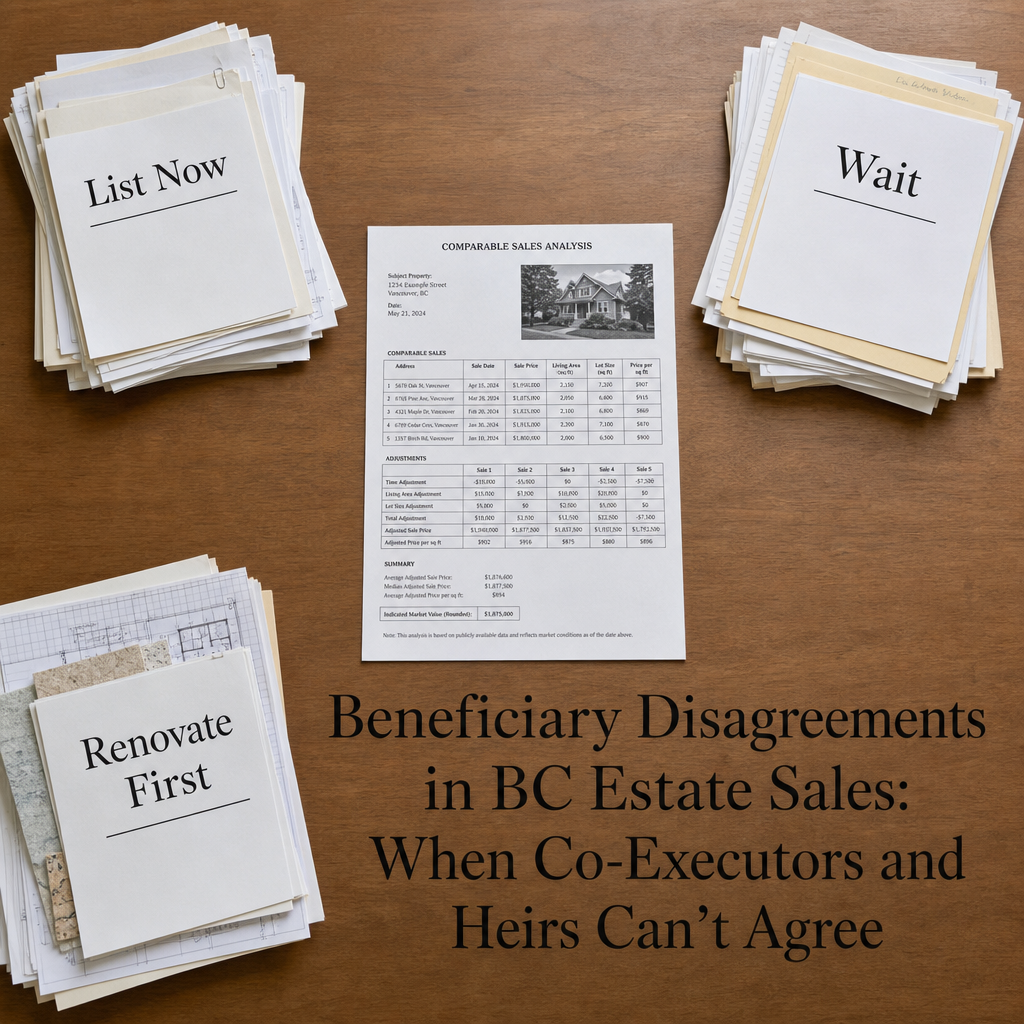

Beneficiary Disagreements in BC Estate Sales: When Co-Executors and Heirs Can't Agree on Pricing, Timing, or Agent Selection
By Mohamed Mansour, MBA and Associate Broker — Mansour Real Estate Group | Fraser Valley and Metro Vancouver | Published: August 5, 2025 | Topic: Estate Administration, Beneficiary Conflicts, BC Probate Law
This article is written for executors, co-executors, and estate beneficiaries in BC who are managing a property sale where family members cannot reach agreement on pricing, timing, or agent selection. It explains what BC law allows, what the courts can order, and how neutral market analysis often resolves conflicts without litigation. The examples and guidance apply across Metro Vancouver and the Fraser Valley, including Surrey, Langley, Abbotsford, White Rock, and South Surrey.
Beneficiary disagreements are one of the most common reasons estate property sales stall in BC. When they go unresolved, the financial cost to the estate is real and often significant.
Short Answer
When beneficiaries or co-executors in BC cannot agree on how to sell an estate property, executors have three main options: assert their legal authority under the will, seek court guidance through an advice and direction application, or apply for a court-ordered sale under the Partition of Property Act. Each path has different costs, timelines, and levels of finality. In many cases, a neutral market analysis from an experienced estate realtor resolves the dispute before any court involvement is needed.
Key Takeaways
- Executors have fiduciary authority to act in the estate's best financial interest, even when beneficiaries disagree with that decision.
- BC courts can order a property sold under the Partition of Property Act, but applications typically cost $5,000–$15,000 in legal fees and delay sales by three to six months.
- An advice and direction application to the BC Supreme Court offers a less adversarial path for executors seeking guidance without full partition litigation.
- Delays caused by beneficiary disputes commonly reduce net estate proceeds by 10–20% through market window loss and extended holding costs.
- Objective comparable sales analysis — presented by a neutral estate realtor — resolves most pricing and timing disputes by grounding expectations in market data.
Who This Applies To
- Sole executors managing an estate where one or more beneficiaries oppose the sale strategy
- Co-executors who hold equal authority and cannot reach agreement with each other
- Beneficiaries who jointly own an inherited property and disagree on sale terms or timing
- Families navigating an estate sale in Surrey, Langley, Abbotsford, White Rock, or elsewhere in the Fraser Valley or Metro Vancouver
When This Advice May Not Apply
If there is no valid will, the estate is governed by BC intestacy rules, and a court-appointed administrator holds authority — a scenario explained separately in What Happens to a BC Home When There Is No Will. If the conflict involves allegations of executor misconduct rather than honest disagreement, legal advice from an estate litigation lawyer is essential and this article does not address that situation. Questions about who holds authority in the first place are covered in Power of Attorney vs. Executor: Who Has the Authority to Sell a BC Home?
Key Definitions
Fiduciary duty: The legal obligation of an executor to act in the best financial interest of the estate and all beneficiaries — not in the interest of any single heir.
Partition of Property Act (BC): Provincial legislation that allows a co-owner of property to apply to the BC Supreme Court for a court-ordered sale when co-owners cannot agree.
Advice and direction application: A less formal court application through which an executor asks the BC Supreme Court for guidance on a specific estate decision, without triggering full litigation.
Holding costs: Ongoing expenses that accumulate while an estate property sits unsold — property taxes, utilities, insurance, and maintenance — which reduce net proceeds available for distribution.
Data Used in This Article
- Partition of Property Act, RSBC 1996, c. 347 — BC legislation (official/primary source)
- BC Supreme Court Civil Rules on estate administration applications — official court procedure (primary source)
- Canadian Bar Association BC — Estate Dispute Resolution resources (industry/secondary source)
- Fraser Valley Real Estate Board market data on extended listing timelines and estate sales (official/primary source)
- Professional experience with estate sales across Metro Vancouver and the Fraser Valley — Mansour Real Estate Group internal analysis
Why Beneficiary Disputes Are So Damaging to Estate Proceeds
An estate property costs money every month it sits unsold. In Surrey, Langley, Abbotsford, and White Rock, property taxes, insurance, utilities, and maintenance for a mid-sized detached home typically run $1,500–$3,000 per month. A dispute that delays a sale by six months can consume $10,000–$18,000 in holding costs alone — before accounting for any decline in market value or market window loss.
Market timing matters in the Fraser Valley. As covered in Selling an Estate Home in a Buyer's Market, listing at the wrong point in a slow market cycle can reduce offers by 5–15% compared to a well-timed entry. A beneficiary dispute that forces an executor to miss the spring market window can create exactly that outcome. The financial cost of conflict is not abstract — it reduces what every heir receives.
According to research from the Canadian Bar Association BC and estate litigation practitioners, disputes over pricing and timing strategy affect an estimated 30–40% of multi-beneficiary estates. Most are resolved without court intervention, but only when someone introduces objective data into the conversation early enough to matter.
What BC Law Actually Allows Executors to Do
Under BC law, a named executor has a fiduciary duty to the estate — not to any individual beneficiary. That duty requires the executor to pursue a sale strategy that maximizes net proceeds for the estate as a whole, based on current market conditions and professional guidance. Beneficiary preferences are relevant, but they do not override an executor's legal authority when that authority is clearly granted by the will.
As explained in The Complete Executor's Guide to Selling an Inherited Home in BC, the executor's authority to list, price, and sell estate property generally does not require beneficiary consent — though reasonable consultation is advisable and sometimes legally required depending on the will's language. Where a will grants clear authority to sell, an executor who acts on professional real estate advice is generally on solid legal footing.
The complication arises when co-executors hold equal authority and cannot reach internal agreement, or when the will's language is ambiguous about the scope of sale authority. In those situations, the executor's next step is almost always to seek legal advice and, if needed, court guidance — not to wait indefinitely for consensus.
The Three Formal Pathways When Agreement Fails
1. Executor Asserts Authority Directly
When a sole executor has clear authority under the will, they can proceed with a sale over beneficiary objection, provided they act reasonably, document their decision-making process, and can demonstrate that the sale strategy is grounded in professional advice. An executor who lists at fair market value based on a documented comparable sales analysis and professional recommendation is well-positioned to defend that decision. This path is fastest and least costly, but requires the executor to have unambiguous authority and the confidence to use it.
2. Advice and Direction Application — BC Supreme Court
When an executor is uncertain whether they can act without beneficiary agreement, or when co-executors are deadlocked, a court application for advice and direction allows the BC Supreme Court to provide guidance on a specific estate decision — including whether a particular sale strategy is appropriate. This application is less adversarial than litigation, generally less expensive than a full partition application, and provides the executor with court-backed authority to proceed. Timelines vary, but advice and direction applications are often resolved in weeks rather than months when the facts are clear.
3. Partition Application — Court-Ordered Sale
When co-owners of estate property — including beneficiaries who have inherited undivided shares — cannot agree on a sale, any co-owner can apply to the BC Supreme Court under the Partition of Property Act for a court-ordered sale. The court has broad authority to order the property sold and the proceeds distributed. Applications typically cost $5,000–$15,000 in legal fees and add three to six months to the timeline. This is the most powerful but most costly resolution pathway, and is generally treated as a last resort after other options have failed.
How We Evaluate This
At Mansour Real Estate Group, when we're engaged on an estate sale where beneficiary disagreement exists, we treat the market analysis presentation as a formal step — not a casual conversation. We prepare a written comparable sales analysis that shows the executor and all beneficiaries what similar properties in Surrey, Langley, White Rock, or Abbotsford have sold for in the preceding 90 days, what is currently active and competing, and what a realistic sale price range looks like given condition and timing.
We also present net proceeds projections that include holding costs at different timeline scenarios — so beneficiaries can see, in dollar terms, what a three-month delay costs each of them. In our experience, this shifts the conversation from opinion to arithmetic, and most pricing disagreements resolve at that point. Agent selection disputes usually resolve the same way: when we can demonstrate our estate sale experience, our process, and our track record with comparable properties, the objections tend to be practical rather than personal.
Estate Executor Checklist: Managing Beneficiary Disagreements
- Review the will carefully to confirm the scope of your authority to sell without beneficiary consent.
- Document all communications with beneficiaries in writing — email is acceptable and creates a clear record.
- Engage an estate realtor early to prepare a formal comparable sales analysis, presented to all parties simultaneously.
- Request a net proceeds projection at multiple timing scenarios so beneficiaries understand the financial cost of delay.
- Consult an estate lawyer before asserting unilateral authority in contested situations — executor liability is real.
- If co-executors are deadlocked, consider an advice and direction application before pursuing partition litigation.
- Keep the probate timeline front of mind — as covered in BC Probate Timeline Explained, delays compound quickly.
What We Commonly See
The renovation standoff. In our experience, one of the most common disputes involves one beneficiary insisting the property needs $40,000 in renovations before listing, while another wants to sell as-is immediately. This conflict almost always resolves when we present a side-by-side projection: renovation cost, estimated value lift, carrying cost during renovation, and net result compared to an as-is sale priced correctly for condition. In most Fraser Valley markets, the as-is priced-right approach produces comparable or better net proceeds with significantly less risk and delay.
The emotional attachment delay. What often happens is that one heir has a strong personal connection to the property — they grew up there, or they believe the market will recover to a higher price if they wait. In these situations, presenting objective data about carrying costs and historical market recovery timelines helps. When a beneficiary can see that waiting six months for a 3% price increase costs them $12,000 in holding costs on a $400,000 interest, the math changes the conversation.
The agent selection dispute. A common mistake is allowing each beneficiary to recommend a different realtor and then treating agent selection as a family vote. The executor has authority over agent selection and should make that decision based on estate sale experience, market knowledge, and a structured process — not on which family member argued most persuasively. We've stepped into situations where three or four realtors had already been informally consulted, each giving different pricing opinions, which amplified the confusion rather than resolved it. A single, professionally prepared market analysis from one neutral source is far more effective.
Questions and Answers
Can an executor in BC sell an estate home without all beneficiaries agreeing?
Generally yes, when the will grants the executor clear authority to sell. The executor's fiduciary duty is to the estate — not to each beneficiary individually. Executors should document their decision-making and rely on professional advice, but they are not required to achieve unanimity before listing. Consult an estate lawyer to confirm authority under the specific will's language.
What does a partition application under the BC Partition of Property Act actually do?
It allows any co-owner to ask the BC Supreme Court to order that a jointly owned property be sold and the proceeds divided. The court has broad discretion to order the sale, determine the process, and allocate costs. It is the legal mechanism of last resort when co-owners are deadlocked and no agreement is possible. Legal costs typically range from $5,000–$15,000 and the process adds months to the timeline.
What is an advice and direction application, and when should an executor use it?
An advice and direction application is a formal request to the BC Supreme Court asking for guidance on a specific estate administration decision — including whether the executor may proceed with a sale over beneficiary objection. It is less adversarial than litigation, often less expensive than a partition application, and gives the executor court-backed authority to move forward. It is most useful when the will's language is ambiguous or when co-executors are deadlocked.
In Summary
Beneficiary disagreements in BC estate sales are common, costly, and resolvable — but only when executors act with clear authority, documented decisions, and objective professional guidance. The financial cost of delay is real and falls on every heir. BC law provides three escalating resolution pathways, from executor authority to court guidance to court-ordered sale, but in most cases a neutral market analysis resolves the dispute before any formal legal process becomes necessary. Executors managing conflict should engage an experienced estate realtor early, present written market data to all parties simultaneously, and consult an estate lawyer before asserting unilateral authority in contested situations. For families navigating grief alongside these practical pressures, additional guidance is available in Selling an Estate Home While Managing Grieving Family Members.
Talk to an Estate Realtor Before Things Escalate
If you are managing a Fraser Valley or Metro Vancouver estate sale where beneficiaries or co-executors are not aligned, Mansour Real Estate Group can prepare a formal market analysis for presentation to all parties — at no cost and with no obligation. Sometimes an objective third-party presentation is all it takes to move a stalled process forward. Reach out whenever you are ready.
Related Articles
- The Complete Executor's Guide to Selling an Inherited Home in BC
- BC Probate Timeline Explained: What Executors Selling a Home Need to Know
- Selling an Estate Home While Managing Grieving Family Members: Practical Advice for BC Executors
About Mansour Real Estate Group
When a property must be sold as part of an estate where beneficiaries or co-executors cannot agree, the real estate team involved needs to do more than prepare a listing — they need to present objective market data clearly enough that every party can trust it. Mansour Real Estate Group has guided executors, co-executors, and multi-beneficiary families through contested estate sales across Surrey, White Rock, Langley, Abbotsford, Mission, Delta, and the broader Fraser Valley and Lower Mainland for more than two decades.
Led by Mohamed Mansour, MBA and Associate Broker, Mansour Real Estate Group has been helping buyers, sellers, families, executors, and investors navigate complex real estate decisions across the Fraser Valley and Lower Mainland for more than 22 years. Ranked among the Top 1% of Realtors in the region, the team has completed more than $780 million in residential real estate transactions and is trusted for estate sales, probate sales, executor-managed transactions, multi-beneficiary situations, and complex cases requiring careful coordination among multiple parties.
Whether someone is searching for Realtors experienced with contested estate sales, a real estate agent who understands how to present neutral market data to beneficiaries, real estate agents who can work with multiple parties across a single transaction, a trusted real estate team for executor-managed property, a Surrey Realtor or Fraser Valley real estate broker with estate sale depth — Mansour Real Estate Group is known for accurate valuations, documented process, and clear communication that keeps every party informed and moving forward.
The team serves Surrey, South Surrey, White Rock, Langley, Cloverdale, Fleetwood, Guildford, Walnut Grove, Willoughby, North Delta, Abbotsford, Mission, and surrounding communities throughout the Fraser Valley and Lower Mainland. Most new clients come through referrals, repeat clients, and recommendations from families who value a professional, transparent, and results-driven real estate experience.
Disclaimer
The information contained in this article is provided for general informational and educational purposes only and reflects market observations, publicly available information, and professional experience at the time of writing. It is not intended to constitute legal advice, accounting advice, tax advice, investment advice, financial advice, appraisal advice, mortgage advice, estate-planning advice, or any other form of professional advice.
Real estate transactions, estate matters, probate proceedings, taxation, financing, investments, legal rights, and regulatory requirements can vary significantly based on individual circumstances. Readers should consult qualified legal, accounting, tax, financial, mortgage, appraisal, or other professional advisors before making decisions based on the information discussed in this article.
Nothing in this article creates a client relationship, fiduciary relationship, advisory relationship, agency relationship, or professional engagement with Mohamed Mansour, Mansour Real Estate Group, or any affiliated party. Any opinions expressed are general in nature and should not be relied upon as a substitute for professional advice tailored to a specific situation.
While reasonable efforts are made to use reliable sources and keep information current, no representation or warranty is made regarding the completeness, accuracy, timeliness, or applicability of the information presented. Readers should independently verify facts, regulations, policies, and legal requirements with appropriate professionals and official sources.