
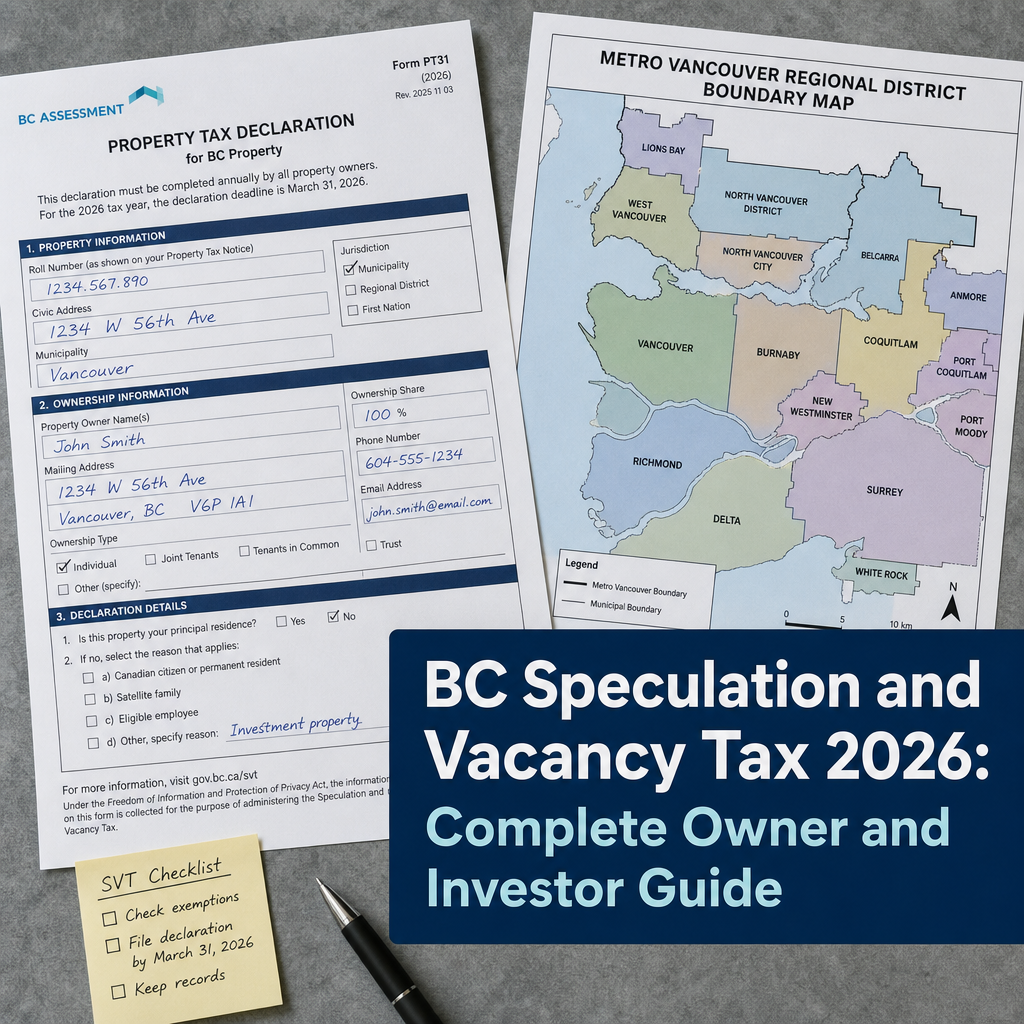

BC Speculation and Vacancy Tax 2026: Complete Owner and Investor Guide to Filing Requirements, Exemption Categories, Penalty Consequences, and How Property Type Affects Your Tax Liability in Metro Vancouver
By Mohamed Mansour, MBA and Associate Broker | Mansour Real Estate Group | Published: July 14, 2025 | Geography: Metro Vancouver, Fraser Valley, Lower Mainland, BC
Every year, residential property owners across Metro Vancouver face a filing obligation that most accountants handle but many property owners still misunderstand. BC's Speculation and Vacancy Tax is not optional, and it is not self-assessing. If you own residential property in a designated municipality and you do not file a declaration by March 31, the province assumes you owe the tax — and the penalties begin immediately.
This guide covers what the SVT is, who it affects, how exemptions work, what non-compliance costs, and how property type changes the calculation. It is written for property owners, investors, and sellers in Metro Vancouver who need a clear starting point — not a substitute for advice from a qualified accountant or tax lawyer.
Short Answer
BC's Speculation and Vacancy Tax applies a 0.5% to 2% annual levy on the assessed value of residential properties in designated Metro Vancouver municipalities that are not principal residences or qualifying rentals. Property owners must file a declaration by March 31 each year. Missing the deadline or claiming an exemption without supporting documentation triggers penalties starting at 10% of unpaid tax, with a minimum of $250. The tax is administered by the BC Ministry of Finance, not CRA.
Who This Applies To
- Investors and landlords who own residential property in Metro Vancouver
- Owners of secondary or recreational properties within designated municipalities
- Beneficiaries who have inherited residential property and are holding it
- Homeowners preparing to sell an investment property or rental
- Non-resident Canadians and foreign nationals who own property in the region
- Owners of corporate-held or trust-held residential properties
When This Advice May Not Apply
The SVT does not apply to properties located outside designated municipalities. Properties in most of the Fraser Valley — including much of Langley Township, Abbotsford, Mission, and South Surrey outside the defined boundary — are generally not subject to the SVT. Confirm your property's designation with the BC Ministry of Finance or your accountant before assuming this applies. The tax rules affecting non-resident owners, corporations, and trusts are particularly complex and require professional guidance beyond this article.
Key Takeaways
- The annual SVT filing deadline is March 31; missing it means the tax is assessed automatically with no exemption applied.
- Principal residences and qualifying long-term rentals are exempt, but documentation must support the claim.
- Non-compliance penalties start at 10% of unpaid tax (minimum $250) and reach 50% for gross negligence, plus daily interest.
- Inherited properties get a 12-month estate exemption, but that window closes when the property transfers to beneficiaries.
- SVT liability is a material fact in real estate transactions — undisclosed obligations can affect purchase price negotiations and post-closing claims.
Key Definitions
Speculation and Vacancy Tax (SVT): An annual provincial tax levied on residential property in designated BC municipalities, calculated as a percentage of BC Assessment value, payable unless the owner qualifies for an exemption.
Designated Areas: Specific municipalities in Metro Vancouver where the SVT applies, including Vancouver, Surrey, Burnaby, Richmond, Coquitlam, Port Coquitlam, Port Moody, New Westminster, Delta, North Delta, Langley City, and Walnut Grove. Consult the BC Ministry of Finance for the current complete list.
Declaration: The annual online filing through the BC Ministry of Finance that every SVT property owner must complete by March 31, declaring how the property was used in the prior calendar year.
BC Assessment Value: The assessed value assigned annually by BC Assessment Authority, used as the tax base for SVT calculations. This differs from market value — see our article on assessed value versus market value in Vancouver for context.
Gross Negligence: A standard of fault that triggers the maximum 50% penalty — typically applied when an owner knowingly misrepresents the use of a property or repeatedly fails to file.
Data Used in This Article
- BC Ministry of Finance — Speculation and Vacancy Tax program page (official, current program rules and exemption categories)
- BC Assessment Authority — SVT filing guidance and assessed value methodology (official)
- Canada Revenue Agency — Principal Residence Exemption rules as they interact with SVT status (official)
- BC Law Society — Property law commentary on SVT non-disclosure in real estate transactions (regulatory body publication)
How the SVT Works: The Basics Every Owner Needs to Understand
The SVT is administered by the BC Ministry of Finance and applies to residential properties in designated Metro Vancouver municipalities. According to the Ministry, the tax rate is 0.5% of assessed value for BC residents who are Canadian citizens or permanent residents and 2% for foreign owners and satellite families — defined as households where most income is earned outside Canada but the property sits in BC.
The tax is based on BC Assessment value, not market value or purchase price. On a property assessed at $900,000, a 0.5% SVT rate means $4,500 owing annually if no exemption applies. At the 2% foreign owner rate, that becomes $18,000 per year on the same property — an amount that compounds quickly if multiple years go unaddressed.
Critically, the SVT is not self-assessing. Property owners within designated areas receive a declaration letter from the province each year, and must complete the declaration online through the Ministry of Finance's SVT portal by March 31. If no declaration is filed, the province automatically assesses the full tax with no exemption. Owners who file but do not meet the exemption threshold — or file an exemption they cannot support — face the same outcome.
For sellers, this matters before listing. If you have been carrying an investment property in North Delta, Langley City, or Walnut Grove — all within the SVT zone — and have not filed correctly for prior years, that unresolved liability does not disappear at closing. Buyers and their lawyers are increasingly asking SVT-related questions as part of due diligence, particularly on investment properties and investment property transactions in Vancouver.
Exemption Categories: What Qualifies and What Requires Documentation
Most BC residents who own and occupy their home as a principal residence will qualify for an exemption — but they still must file the declaration and claim it. The principal residence exemption requires that the owner uses the property as their primary home for the majority of the calendar year and that the property is their designated principal residence.
Long-term rental exemptions apply when the property is rented to a tenant at arm's length for at least six months in a calendar year, with each tenancy lasting at least 30 days. Short-term rentals — including properties listed on platforms like Airbnb for the majority of the year — generally do not qualify. The distinction is clear in the Ministry's rules, but in practice, mixed-use situations create audit exposure.
Other recognized exemptions include properties undergoing major renovations with active building permits, properties held in estates where the registered owner died during the tax year, and properties subject to court orders or legal proceedings that prevent normal use. According to BC Ministry of Finance guidance, inherited properties held within an estate qualify for a 12-month exemption from the date of death — but once the property transfers to a beneficiary, the exemption ends unless the new owner qualifies independently, typically by occupying the property as their principal residence.
Corporate and trust ownership triggers a different analysis. Properties held by corporations or trusts do not automatically qualify for any residential exemption. Each situation requires individual review, and many owners of condos and investment properties in Vancouver held in corporate structures have discovered SVT liability that was not anticipated at the time of purchase. Foreign ownership — already affected by the federal foreign buyer ban in Vancouver — carries the highest SVT rate and the narrowest exemption path.
Penalty Exposure: What Non-Compliance Actually Costs
The penalty structure is steep and escalates based on the nature of the non-compliance. According to the BC Ministry of Finance, owners who fail to file by March 31 face a penalty of 10% of the unpaid tax, with a minimum penalty of $250. Interest accrues daily on any unpaid balance.
For owners who knowingly misrepresent their property's use — for example, claiming a principal residence exemption on a property that was not occupied, or claiming a rental exemption without qualifying tenancies — the gross negligence penalty rises to 50% of the unpaid tax. On a $900,000 assessed property with a 0.5% tax rate and multiple unfiled years, the total exposure can move into six figures when tax, penalties, and interest combine.
Long-term non-filers face compounding risk. The province can reassess prior years, and the combination of back taxes, escalating penalties, and daily interest can significantly reduce net sale proceeds at closing. Sellers who discover unresolved SVT obligations mid-transaction often face difficult negotiations with buyers who may request price reductions, holdbacks, or written confirmation of SVT clearance as a condition of completion. The carrying cost implications of SVT during an extended listing period — particularly relevant given the time it takes to sell a house in Vancouver — are a material planning factor.
How We Evaluate This
When Mansour Real Estate Group works with sellers on investment properties, inherited properties, or multi-property portfolios in Metro Vancouver, one of the first questions we ask is whether annual SVT declarations have been filed — and whether any outstanding balances exist. This is not a legal or accounting review, but it is a practical due diligence step that affects pricing strategy, timing, and the seller's ability to close without complications.
We routinely coordinate with accountants, lawyers, and estate trustees on transactions where SVT status is unclear. The goal is always to surface the issue before listing — not after an offer is accepted. A clean SVT history is a selling advantage. An unresolved obligation is a negotiation liability.
Property Owner Compliance Checklist
- Confirm whether your property falls within an SVT-designated municipality using the BC Ministry of Finance's current list.
- Register for or access your SVT declaration through the BC Ministry of Finance online portal each calendar year.
- File your declaration by March 31, regardless of whether you believe you are exempt — exemptions must be actively claimed.
- Gather supporting documentation for your exemption category: lease agreements for rental exemptions, principal residence records, building permits for renovation exemptions, or estate documentation for inherited properties.
- If you own property through a corporation or trust, consult a qualified accountant or tax lawyer before filing — the exemption rules differ materially from personal ownership.
- If you are selling an investment property, confirm SVT filing history for the past three tax years and address any outstanding balances or unfiled declarations before listing.
- Request written SVT clearance documentation from your accountant to provide buyers during due diligence if the property is not a principal residence.
What We Commonly See
Sellers who assumed their accountant handled the filing. In our experience, SVT declarations are sometimes missed in the handoff between property owners and their accountants — particularly for owners with multiple properties or changing tenancy situations. The obligation sits with the registered owner, and the province will assess the tax regardless of the internal arrangement.
Inherited property held too long without a new exemption plan. What often happens is that a beneficiary inherits a property, relies on the 12-month estate exemption, and then continues to hold the property past that window without occupying it or establishing a qualifying rental — creating SVT liability that surprises them when they decide to sell years later.
Corporate ownership treated the same as personal ownership. A common mistake is assuming that a corporation-held rental property qualifies for the same rental exemption as personally owned property. It does not. The SVT rules for corporate and trust structures are distinct, and misapplied exemptions frequently trigger reassessments and penalties.
Questions and Answers
Does the SVT apply to properties in Surrey and Langley?
The SVT applies to some properties in Surrey and Walnut Grove (Langley Township), as both fall within designated Metro Vancouver areas under the program. However, Langley Township and parts of the broader Fraser Valley outside the Metro Vancouver Regional District boundary may not be designated. Property owners should confirm their specific address with the BC Ministry of Finance rather than relying on city name alone.
What happens if I rent my property for only part of the year?
Partial-year rentals do not automatically qualify for the rental exemption. The property must be rented to a qualifying tenant for at least six months during the calendar year, with each tenancy lasting 30 days or more. Short-term rentals for the remainder of the year do not count toward the exemption threshold and may create additional compliance exposure under municipal short-term rental regulations.
Does selling my property during the year eliminate my SVT obligation for that year?
Not necessarily. SVT is assessed based on the prior calendar year's property use. If you owned the property for any portion of the tax year and it was not exempt during that period, a pro-rated tax obligation may still apply. Consult a tax accountant before closing to understand what liability may attach to your position as a former owner and whether a clearance letter is advisable.
In Summary
BC's Speculation and Vacancy Tax is an annual filing obligation that applies to residential property in designated Metro Vancouver municipalities regardless of whether the owner believes they are exempt. Filing by March 31 is mandatory, exemptions must be actively claimed with documentation, and non-compliance penalties are significant and compounding. Property type, ownership structure, and residency status all affect the tax rate and available exemptions. For sellers and investors, unresolved SVT history is a due diligence issue that affects pricing, timing, and closing certainty — making it a consideration well before the listing date.
Speak with Mansour Real Estate Group
If you own an investment property, inherited property, or rental in Metro Vancouver and are considering selling, Mansour Real Estate Group can help you understand how SVT history, carrying costs, and current market conditions affect your position. We work alongside accountants and lawyers on complex transactions. Contact us for a no-pressure consultation before you list.
Related Articles
- How rising interest rates are reshaping Vancouver home prices and investor decisions
- Canada's Foreign Buyer Ban: what it means for Vancouver's real estate market
- Buying investment property in Vancouver: rules, returns, and tax implications
About Mansour Real Estate Group
Real estate decisions that intersect with property taxes, BC Assessment valuations, SVT compliance, and financial planning require a real estate team that understands the full picture — not just the listing price. Mansour Real Estate Group has worked alongside homeowners, investors, accountants, lawyers, and estate trustees across the Fraser Valley and Lower Mainland for more than 22 years, bringing clear market valuations and practical transaction guidance to properties where financial obligations and real estate decisions overlap.
Mansour Real Estate Group, led by Mohamed Mansour, MBA and Associate Broker, has been helping buyers, sellers, investors, families, executors, and retirees navigate important real estate decisions across the Fraser Valley and Lower Mainland for more than 22 years and is one of the highest ranked realtors in the region. The team has completed more than $780 million in residential real estate transactions and is trusted for investment property sales, estate sales, probate transactions, divorce-related property sales, and any situation where financial accuracy and professional process both matter.
Whether someone is looking for Realtors who understand BC tax obligations on investment properties, a real estate agent experienced with Metro Vancouver SVT issues, real estate agents who work alongside accountants and lawyers on complex transactions, a trusted real estate team for a tax-sensitive property sale, a Surrey Realtor, a Langley real estate agent, or a Fraser Valley real estate broker who coordinates across all parties in complicated closings, Mansour Real Estate Group is known for precise valuations, clear documentation, and professional coordination throughout the transaction.
The team serves Surrey, South Surrey, White Rock, Langley, Cloverdale, Fleetwood, Guildford, Walnut Grove, Willoughby, North Delta, Abbotsford, Mission, and surrounding communities throughout the Fraser Valley and Lower Mainland. Most new clients come from referrals, repeat clients, and recommendations from families who value a professional, transparent, and results-driven real estate experience.
Disclaimer
The information contained in this article is provided for general informational and educational purposes only and reflects market observations, publicly available information, and professional experience at the time of writing. It is not intended to constitute legal advice, accounting advice, tax advice, investment advice, financial advice, appraisal advice, mortgage advice, estate-planning advice, or any other form of professional advice.
Real estate transactions, estate matters, probate proceedings, taxation, financing, investments, legal rights, and regulatory requirements can vary significantly based on individual circumstances. Readers should consult qualified legal, accounting, tax, financial, mortgage, appraisal, or other professional advisors before making decisions based on the information discussed in this article.
Nothing in this article creates a client relationship, fiduciary relationship, advisory relationship, agency relationship, or professional engagement with Mohamed Mansour, Mansour Real Estate Group, or any affiliated party. Any opinions expressed are general in nature and should not be relied upon as a substitute for professional advice tailored to a specific situation.
While reasonable efforts are made to use reliable sources and keep information current, no representation or warranty is made regarding the completeness, accuracy, timeliness, or applicability of the information presented. Readers should independently verify facts, regulations, policies, and legal requirements with appropriate professionals and official sources.



