
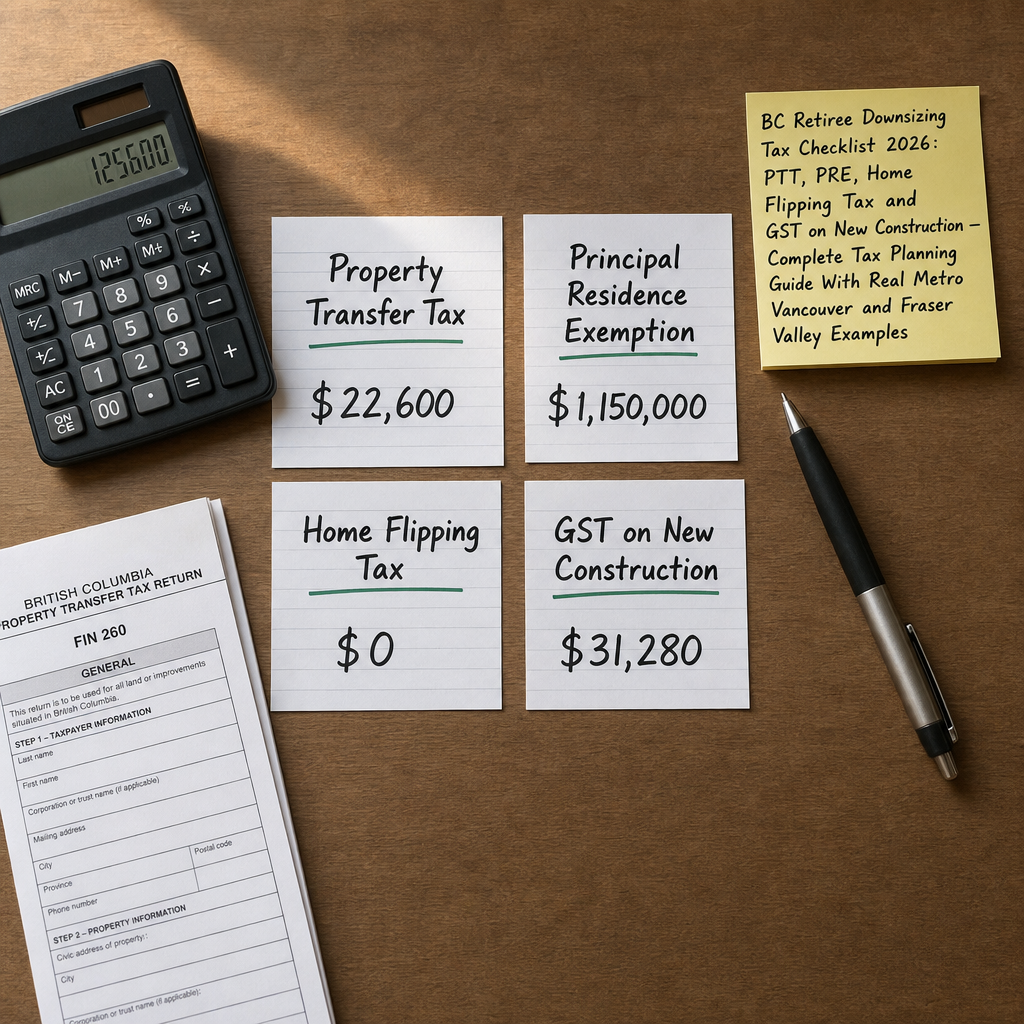

BC Retiree Downsizing Tax Checklist 2026: Property Transfer Tax, Principal Residence Exemption, Home Flipping Tax, and GST on New Construction — Complete Tax Planning Guide With Real Metro Vancouver and Fraser Valley Examples
By Mohamed Mansour, MBA and Associate Broker · Mansour Real Estate Group · Fraser Valley and Metro Vancouver · Published: July 15, 2026
Downsizing from a family home in Metro Vancouver or the Fraser Valley is one of the largest financial events most retirees will navigate. The equity is real and often substantial — but so are the taxes. Property Transfer Tax on a new condo purchase, capital gains exposure on the sale, BC's Home Flipping Tax, and GST embedded in new construction prices can collectively cost $50,000 to over $150,000 depending on property values, timing, and ownership history.
This guide covers each tax clearly, with real numbers, and explains the decisions that most affect what retirees actually keep. For a broader look at the financial logic of downsizing before reaching the tax questions, see The Complete Downsizing and Retirement Real Estate Guide for Metro Vancouver Homeowners in 2026.
Short Answer
BC retirees downsizing in 2026 face up to four overlapping taxes: Property Transfer Tax on the new purchase (up to $25,500+ on a $750K condo), potential capital gains tax on home appreciation not covered by the Principal Residence Exemption, BC's Home Flipping Tax if the original home is sold within two years of purchase, and GST on newly built condos. Understanding each before you list can protect tens of thousands in net proceeds.
Key Takeaways
- Property Transfer Tax on a $750,000 condo purchase reaches approximately $13,000 under BC's tiered rate schedule — not a flat percentage.
- The Principal Residence Exemption eliminates capital gains tax on a qualifying family home sale, but rental history, cottage ownership, and trust structures can reduce eligibility.
- BC's Home Flipping Tax applies when a residential property is sold within two years of acquisition — most long-term family home sellers are unaffected, but legal delays can create unexpected exposure.
- GST of approximately 5% is embedded in new construction condo prices and does not apply to resale properties — a $750,000 new condo includes roughly $35,700 in GST.
- Timing a sale across calendar years to coincide with lower retirement income can reduce capital gains tax by $15,000 to $25,000 on substantial appreciation.
Who This Applies To
- BC homeowners aged 55 to 75 planning to sell a family home and purchase a smaller property
- Retirees considering a new construction condo or townhome in Metro Vancouver or the Fraser Valley
- Homeowners who have rented a portion of their home or own a secondary property
- Executors or surviving spouses managing a downsizing transition within an estate
When This Advice May Not Apply
This article covers general tax considerations for BC residents. It does not apply to non-residents of Canada, properties held in corporations or trusts, or situations involving significant business-use portions of a home. Tax rules change — always confirm current rates and eligibility with a qualified BC tax professional before making decisions.
Data Used in This Article
- BC Ministry of Finance Property Transfer Tax Rate Schedule — official, 2026
- Canada Revenue Agency Principal Residence Exemption Rules and Form T2091 — official, current
- BC Home Flipping Tax legislation and BC Assessment Authority guidelines — official, 2024–2026
- CRA Publication RC4052: GST/HST Information for the Home Construction Industry — official, current
- Statistics Canada marginal income tax rate tables for BC residents, 2026
Tax 1 — Property Transfer Tax: What You Will Pay When You Buy the Condo
Property Transfer Tax (PTT) is paid by the buyer at completion. It applies to almost every residential purchase in BC. The rate is tiered: 1% on the first $200,000 of the fair market value, 2% on the portion between $200,000 and $2,000,000, and 3% on the portion above $2,000,000. An additional 2% applies to residential properties over $3,000,000.
On a $750,000 resale condo — a realistic price point in Langley, Fleetwood, or Willoughby — PTT works out to $2,000 on the first $200,000, plus $11,000 on the next $550,000, for a total of $13,000. On an $850,000 condo in South Surrey or White Rock, the total reaches $15,000. These amounts are due at completion and cannot be financed into the mortgage for most buyers.
First-time buyer exemptions do not apply to retirees purchasing their second or subsequent property. No PTT exemption exists specifically for downsizers or seniors purchasing a resale property. New construction may qualify for partial PTT exemptions under specific conditions — confirm eligibility with your lawyer before completion.
For a complete breakdown of all transaction costs including PTT, legal fees, and moving expenses, see The True Cost of Downsizing in Metro Vancouver: Commission, Legal Fees, PTT, and Hidden Expenses.
Tax 2 — Principal Residence Exemption: When Your Sale Is Tax-Free and When It Is Not
The Principal Residence Exemption (PRE) is the most valuable tax benefit available to most BC homeowners. When a property qualifies, the capital gain on the sale is fully exempt from income tax regardless of the size of the gain. A homeowner who bought in Langley in 1998 for $280,000 and sells today for $1,400,000 — a gain of $1,120,000 — pays zero capital gains tax if the PRE applies for every year of ownership.
To claim the PRE, the property must have been ordinarily inhabited by the taxpayer or an eligible family member in each year being designated. The CRA requires Form T2091 to be filed in the year of sale. Only one property can be designated as a principal residence per family unit per year — which matters when a couple owns both a home and a cottage.
Eligibility narrows in specific situations. If a portion of the home was rented out — even a basement suite — the CRA may deny PRE on that portion for the years it generated rental income. Properties held in a family trust are generally ineligible. A home that was also used as a home-based business may face partial disqualification depending on how expenses were claimed. For a detailed analysis of PRE rules specific to downsizing, see Principal Residence Exemption and Downsizing: What BC Homeowners Need to Know Before You Sell.
When the PRE does not fully apply — say, three years of rental income on a basement suite — the taxable capital gain is prorated. On a $1,000,000 gain with three of twenty years non-qualifying, approximately $150,000 is taxable. At a 50% inclusion rate and a combined federal-provincial marginal rate of roughly 43% for a BC retiree with moderate other income, the resulting tax on that portion could reach $32,000. That is a meaningful and often unexpected cost.
Sellers with a secondary property — a cottage, an investment condo, a vacation property — should review with their accountant which property to designate as principal residence for each year of overlapping ownership before filing, not after.
Tax 3 — BC Home Flipping Tax: When It Applies and Why Timing Matters
BC's Home Flipping Tax came into effect January 1, 2025. It applies to residential properties in BC sold within 730 days (two years) of acquisition. The tax rate starts at 20% on net income from the sale if the property is sold within 365 days, and tapers to 0% as the holding period approaches 730 days. Properties held longer than two years are fully exempt.
For the vast majority of retirees selling a long-held family home, this tax is not a concern. A homeowner who has lived in their Surrey home for 18 years is well past the two-year threshold. The risk emerges in narrower situations: a retiree who purchased a second property within the last two years and now needs to sell it, or a situation where legal complications — an estate administration delay, a divorce proceeding, or a dispute — forced a sale closer to the acquisition date than intended.
Exemptions exist for life events including death, divorce, serious illness, job loss, and involuntary job relocation. These must be claimed through the BC Home Flipping Tax return. Not claiming an available exemption is a common and costly oversight. If you are uncertain whether the two-year threshold applies to any property in a downsizing transaction, confirm the acquisition date with your notary or lawyer before listing.
For sellers weighing the sequencing of their sale and purchase — which directly affects exposure to timing-related tax risks — see Sell First or Buy First? The Downsizing Sequencing Dilemma for BC Retirees Explained.
Tax 4 — GST on New Construction: The Hidden Cost in New Condo Prices
GST at 5% applies to the sale of newly constructed residential properties in BC. On a $750,000 new construction condo, the embedded GST is approximately $35,700. Unlike PTT, GST is typically incorporated into the purchase price rather than listed as a separate line item — which means many buyers do not register it as a distinct cost. Resale properties carry no GST, which is why a $750,000 resale condo and a $750,000 new condo do not represent equivalent costs to the buyer.
A partial GST rebate is available for new homes priced below $450,000, but it phases out entirely at $525,000. Most new construction condos in Metro Vancouver and the Fraser Valley exceed that threshold. Retirees purchasing a new condo in Willoughby, Fleetwood, or South Surrey at current market prices should assume the full 5% GST is embedded with no rebate available — and should confirm with their lawyer whether the listed price is GST-inclusive or GST-exclusive.
The GST difference between new construction and resale is one reason retirees comparing options should evaluate total acquisition cost, not just sticker price. A newer building with modern amenities may still be the right choice — but the comparison should account for the embedded GST that does not appear as a separate cost on the contract.
Real-Number Example: Selling a $1.4M Home in Langley, Buying an $800K Condo
Consider a retired couple selling a detached home in Willoughby for $1,400,000. They purchased it in 2003 for $350,000. The capital gain is $1,050,000. The PRE fully applies — they lived there continuously, no suite, no trust structure — so zero capital gains tax is payable on the sale.
They purchase a resale condo in Langley City for $800,000. PTT on that purchase: $2,000 on the first $200,000, plus $12,000 on the next $600,000 = $14,000 payable at completion. No GST applies on a resale property.
If instead they purchase a new construction condo in Fleetwood for $800,000, the GST embedded in the purchase price is approximately $38,100 (5% of the pre-GST price). They pay the same $14,000 PTT on the fair market value including GST. Total tax cost on the new condo purchase: approximately $52,100 versus $14,000 on the resale alternative — a $38,000 difference for the same headline price.
This is the clearest illustration of why new construction and resale condos at the same price point are not financially equivalent for downsizing retirees.
How We Evaluate This
When Mansour Real Estate Group works with a retiree preparing to downsize, the tax conversation happens before the listing strategy. That sequence matters. Decisions about timing, property type, and sale structure that seem straightforward on the surface often carry material tax consequences that a retiree learns about too late to act on.
Our role is not to provide tax advice — that belongs to your accountant or tax lawyer. Our role is to raise the right questions early, provide accurate real-world cost context, and connect sellers with the right professionals before commitments are made. A seller who understands all four tax layers before listing is in a fundamentally better position than one who discovers them after accepting an offer.
Downsizing Tax Checklist
- Confirm your home's acquisition date and original purchase price — you will need both for capital gains and Home Flipping Tax calculations.
- Review whether any years of ownership involved rental income, a home-based business, or a secondary property that could affect PRE eligibility.
- If you own a cottage or secondary property, ask your accountant which property to designate as principal residence for overlapping ownership years before filing.
- Calculate PTT on your intended purchase price using the BC tiered rate schedule — do not assume a flat percentage.
- If purchasing new construction, confirm whether the listed price includes or excludes GST — and verify rebate eligibility with your lawyer before removing subjects.
- If you have other income sources in your retirement year, discuss with your accountant whether deferring the sale to a lower-income calendar year reduces capital gains tax exposure.
- Confirm the acquisition date of any property being sold to determine Home Flipping Tax applicability — and claim any life-event exemption proactively if relevant.
- Ensure Form T2091 is filed with your CRA return in the year of sale if the PRE is being claimed — this is mandatory since 2016 even if the gain is fully exempt.
What We Commonly See
Basement suite rental history catches sellers off guard. In our experience, retirees who rented their basement suite for five or ten years — and stopped years ago — are often unaware that those rental years can affect PRE eligibility on the entire property. The CRA's position on mixed-use properties has become more consistent since 2016, and the cost of overlooking it is real.
New construction GST is routinely misread. What often happens is that a buyer compares a $780,000 resale condo to a $780,000 new condo and sees the new building as equivalent value. In most cases, the new construction price is GST-inclusive, meaning the buyer is receiving roughly $37,000 less in property value for the same outlay. Not catching this before removing subjects is a costly and irreversible mistake.
PTT is underestimated as a liquidity event. A common mistake is treating PTT as a paperwork cost rather than a cash-at-completion obligation. On an $850,000 condo purchase, PTT is $15,000 due at the time of transfer — not a closing adjustment. Retirees who have not factored this into their bridge financing or cash reserve plan can face a tight completion day.
Questions and Answers
Do BC retirees pay capital gains tax when they sell their family home?
Not if the home qualifies fully for the Principal Residence Exemption. When the PRE applies for every year of ownership, the capital gain is fully exempt from income tax regardless of size. Eligibility requires the home to have been ordinarily inhabited in each designated year, with no disqualifying use such as a significant rental period.
Is there any PTT exemption for retirees or downsizers in BC?
No PTT exemption exists specifically for seniors or downsizers purchasing a resale property. First-time buyer exemptions do not apply. Some new construction purchases may qualify for partial exemptions under specific conditions — confirm with your lawyer before completion, as these exemptions have price thresholds and eligibility rules.
Does the BC Home Flipping Tax apply to a family home owned for 20 years?
No. The Home Flipping Tax only applies when a residential property is sold within 730 days (two years) of the date it was acquired. A property held for 20 years is entirely exempt. The risk for downsizers lies in other properties purchased more recently — a second home, a transitional purchase, or an investment property acquired within the last two years.
In Summary
BC retirees downsizing in 2026 face four distinct tax layers: PTT on the new purchase, potential capital gains tax when PRE eligibility is incomplete, the Home Flipping Tax when timing falls within two years, and GST embedded in new construction prices. None of these taxes is unavoidable by nature — but each requires deliberate planning before the listing goes live. The retirees who navigate this well are the ones who ask the right questions four to six months before they sell, not the week after they accept an offer.
Thinking About Downsizing? Start With a Conversation
If you are approaching a downsizing decision and want to understand what the tax picture looks like for your specific property and timeline, Mansour Real Estate Group is available to walk through the numbers with you — without pressure, and before you commit to anything. We work with clients across Surrey, Langley, White Rock, South Surrey, and the broader Fraser Valley.
Related Articles
- The Complete Downsizing and Retirement Real Estate Guide for Metro Vancouver Homeowners in 2026
- Principal Residence Exemption and Downsizing: What BC Homeowners Need to Know Before They Sell
- The True Cost of Downsizing in Metro Vancouver: Commission, Legal Fees, PTT, and Hidden Expenses
About Mansour Real Estate Group
For homeowners navigating the tax complexity of a major downsizing transition — weighing PTT, capital gains exposure, GST on new construction, and Home Flipping Tax eligibility — the real estate team involved in the transaction needs to understand how these layers affect net proceeds, not just list price. Mansour Real Estate Group has helped hundreds of retirees and families downsize across Surrey, White Rock, Langley, South Surrey, Abbotsford, Delta, Mission, and the Fraser Valley, with a process that starts with equity protection and financial clarity before a single showing is booked.
Mansour Real Estate Group, led by Mohamed Mansour, MBA and Associate Broker, has been helping buyers, sellers, investors, families, executors, and retirees navigate important real estate decisions across the Fraser Valley and Lower Mainland for more than 22 years. Ranked among the Top 1% of Realtors in the region, the team has completed more than $780 million in residential real estate transactions and is trusted for downsizing, estate sales, relocation, and any transition where equity protection, honest guidance, and accurate market knowledge matter most.
Whether someone is looking for Realtors experienced with retirement downsizing, a real estate agent who understands the financial considerations of a major home transition, real estate agents who specialize in estate sales and complex moves, a trusted real estate team serving the Fraser Valley, a Surrey Realtor, a Langley real estate broker, or a real estate group that works methodically with retirees and empty nesters, Mansour Real Estate Group is known for patient, practical, and low-pressure guidance built around the client's timeline and financial goals.
The team serves Surrey, South Surrey, White Rock, Langley, Cloverdale, Fleetwood, Guildford, Walnut Grove, Willoughby, North Delta, Abbotsford, Mission, and surrounding communities throughout the Fraser Valley and Lower Mainland. Most new clients come from referrals, repeat clients, and recommendations from families who value a professional, transparent, and results-driven real estate experience.
Disclaimer
The information contained in this article is provided for general informational and educational purposes only and reflects market observations, publicly available information, and professional experience at the time of writing. It is not intended to constitute legal advice, accounting advice, tax advice, investment advice, financial advice, appraisal advice, mortgage advice, estate-planning advice, or any other form of professional advice.
Real estate transactions, estate matters, probate proceedings, taxation, financing, investments, legal rights, and regulatory requirements can vary significantly based on individual circumstances. Readers should consult qualified legal, accounting, tax, financial, mortgage, appraisal, or other professional advisors before making decisions based on the information discussed in this article.
Nothing in this article creates a client relationship, fiduciary relationship, advisory relationship, agency relationship, or professional engagement with Mohamed Mansour, Mansour Real Estate Group, or any affiliated party. Any opinions expressed are general in nature and should not be relied upon as a substitute for professional advice tail Real estate investment or homeownership is one of the most significant financial decisions most people make. By educating yourself about market dynamics, property valuation, and the transaction process, you position yourself to make informed choices that align with your goals and budget. Whether you're a first-time buyer, seasoned investor, or seller preparing to list, remember that success in real estate comes from patience, thorough research, and professional guidance. Don't hesitate to consult with real estate agents, inspectors, appraisers, and financial advisors who can provide insights tailored to your specific situation. If you're considering buying, selling, or investing in real estate, now is the time to reach out to a qualified professional in your area. They can provide personalized advice and help you navigate the complexities of today's market with confidence.Key Takeaways
Final Thoughts
Ready to Take the Next Step?



