
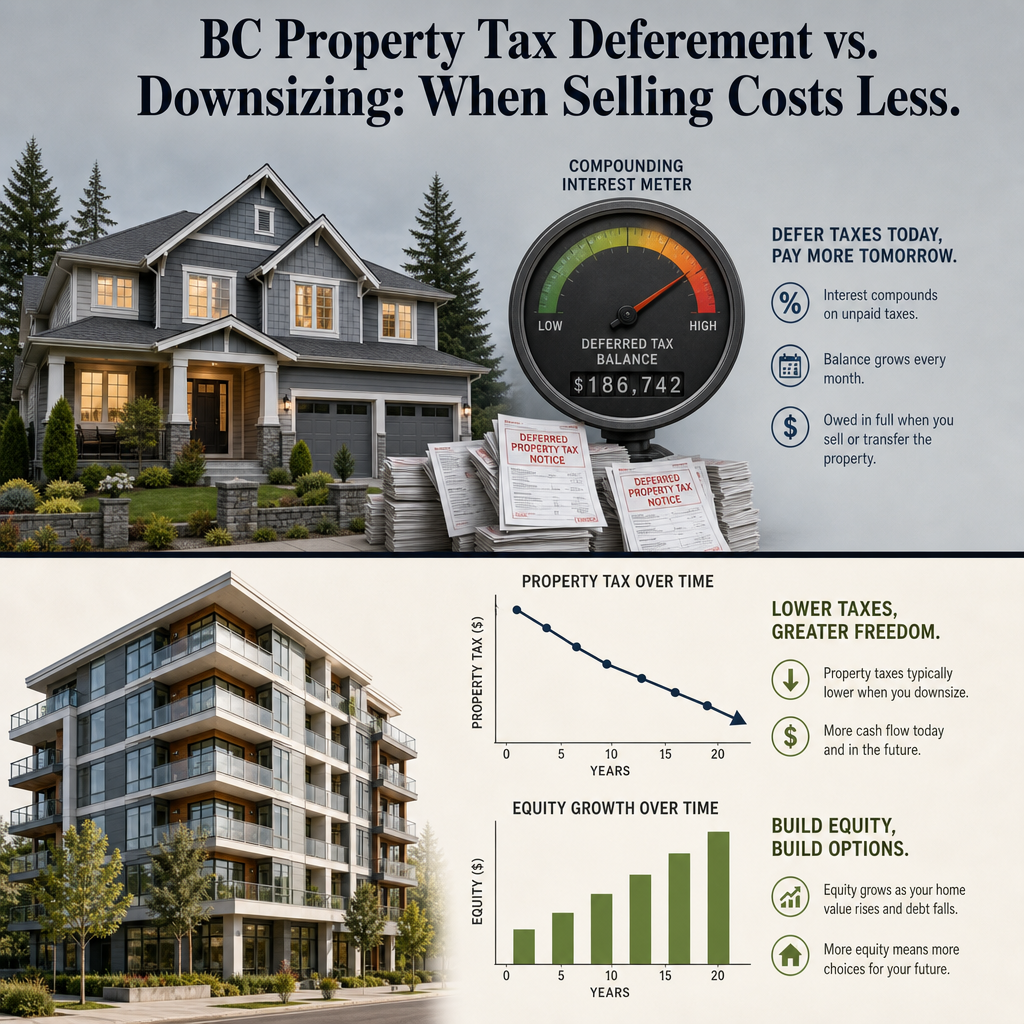

BC Property Tax Deferment for Homeowners 55+ vs. Downsizing Strategy: When Deferring Taxes on Your Family Home Actually Costs More Than Selling and Moving to a Lower-Assessed Strata Property in Metro Vancouver and Fraser Valley 2026
By Mohamed Mansour, MBA and Associate Broker, Mansour Real Estate Group | Fraser Valley and Lower Mainland | Published: July 22, 2025 | Topic: Downsizing, Life-Event Sales, Property Tax Strategy, BC 55+ Homeowners
For homeowners 55 and older who are watching their property tax bills climb on a family home that has appreciated well past $1 million, BC's Property Tax Deferment Program can feel like an obvious answer. Stop paying now, settle the debt later. But the math behind that decision deserves a closer look — especially when downsizing to a lower-assessed strata property in Metro Vancouver or the Fraser Valley may eliminate most of the problem rather than delay it.
This article lays out a direct comparison between deferring property taxes under the provincial program and downsizing to a strata condo or townhome. It is written for homeowners in Surrey, South Surrey, White Rock, Langley, Abbotsford, and surrounding communities who are weighing cash flow against long-term financial exposure.
Short Answer
BC's Property Tax Deferment Program lets homeowners 55+ defer property taxes at 3–4% annual interest, with full repayment triggered at sale or death. For many homeowners carrying $6,000–$7,000 in annual taxes on a family home, downsizing to a strata condo with a $3,000–$3,500 annual tax obligation cuts the liability permanently, avoids compounding interest, and unlocks $400,000–$600,000 in equity for retirement income. Over a 10-year horizon, deferment often costs more.
Key Takeaways
- BC's deferment program charges 3–4% annual interest, compounding until the property sells or the owner dies.
- Downsizing to a strata unit typically cuts annual property tax by 40–50%, eliminating the need to defer.
- Over 10 years, deferred taxes plus interest on a $1.2M home can exceed $85,000–$100,000 in total repayment.
- Downsizing unlocks significant home equity while reducing maintenance costs and replacing unpredictable tax bills with fixed strata fees.
- The break-even between downsize transaction costs and ongoing tax savings typically occurs within 7–8 years for most Fraser Valley scenarios.
Who This Applies To
- Homeowners 55+ carrying a family home assessed above $900,000 in Metro Vancouver or the Fraser Valley
- Retirees or near-retirees on fixed incomes where annual property tax is a meaningful cash flow burden
- Homeowners already enrolled in or actively considering the BC Property Tax Deferment Program
- Empty nesters evaluating whether to stay in a larger home or move to a strata condo or townhome
- Families helping aging parents assess the long-term financial implications of staying put
When This Advice May Not Apply
If a homeowner is managing a health condition that limits their ability to move, has a family member living in the home, or holds equity in a property that is still appreciating faster than the deferment interest rate, the calculus changes. This analysis is also specific to BC's deferment program — homeowners in other provinces face different rules. Always consult a financial advisor, accountant, and a real estate lawyer before making either decision.
Key Terms to Understand
BC Property Tax Deferment Program (PTDP): A provincial program administered by the BC Ministry of Finance that allows eligible homeowners — including those aged 55 and older — to defer payment of their annual property taxes. Interest accrues at the provincial borrowing rate (currently set in the 3–4% range), and full repayment is required when the property is sold, transferred, or the owner dies.
Assessed Value: The value assigned to a property by BC Assessment for tax calculation purposes. It differs from market value and is typically lower, though the gap between assessed and market values varies by property type and location.
Strata Property: A condo or townhome governed by a strata corporation under the BC Strata Property Act. Owners pay monthly strata fees covering shared building costs, with property taxes billed separately based on the unit's assessed value.
Data Used in This Article
- BC Ministry of Finance – Property Tax Deferment Program: Official program rules, interest rate structure, and repayment triggers. Official source.
- BC Assessment Authority: Assessed value methodology, property class distinctions, and tax rate context. Official source.
- BC Real Estate Association (BCREA) – 2024–2026 Market Data: Downsizing demographic trends, detached and strata pricing in Fraser Valley and Metro Vancouver. Industry body.
- CMHC Rental Market and Housing Reports: Strata condo pricing and assessment trends in Metro Vancouver and Fraser Valley. Federal agency.
How the BC Property Tax Deferment Program Actually Works
According to the BC Ministry of Finance, homeowners who are 55 or older, surviving spouses of any age, or persons with disabilities may apply to defer their annual municipal property taxes. The deferred amount accumulates as a lien against the property, with interest charged at the provincial borrowing rate — currently in the 3–4% range annually. That interest compounds. It does not disappear.
The full deferred balance — taxes plus accrued interest — must be repaid when the property is sold, when it is transferred, or when the owner passes away. At that point, the estate or the surviving family receives the proceeds net of whatever has accumulated.
For a homeowner deferring $6,500 per year on a family home in Surrey or Langley, the annual deferral seems manageable. But over 10 years, deferring that amount at 3.5% compounding produces a repayment obligation that the BC Assessment Authority's tax methodology and BCREA market data together suggest could exceed $85,000–$100,000 depending on tax rate changes. That is not a small number for a fixed-income household. If you're weighing the broader financial picture, the article on using your home equity to fund retirement after downsizing provides useful context on what that equity could generate instead.
What Downsizing Does to the Property Tax Equation
The key insight is that property tax is a function of assessed value. BC Assessment sets assessed values annually, and strata condos — even well-located ones in Surrey, South Surrey, Langley, or Abbotsford — typically carry assessed values well below those of detached family homes in the same area.
A family home in Metro Vancouver assessed at $1.1M–$1.3M by BC Assessment might generate annual property taxes in the $6,000–$7,000 range depending on municipal and school tax mill rates. A strata condo in the same region, purchased for $550,000–$650,000 and assessed at $270,000–$330,000, might carry annual taxes of $3,000–$3,500. That is a reduction of roughly $3,000–$4,000 per year — and it does not accumulate interest.
If you are already reviewing the full range of downsizing costs, the article on the true cost of downsizing in Metro Vancouver covers commission, legal fees, PTT, and hidden expenses in detail. And the downsizing tax checklist for BC retirees explains how PTT, the principal residence exemption, and capital gains rules interact with this decision.
How We Evaluate This
At Mansour Real Estate Group, when we sit down with a homeowner in their 60s or 70s who is either enrolled in the deferment program or considering it, we build a simple 10-year projection. On one side: cumulative deferred taxes, compounding interest at the current provincial rate, plus all transaction costs the estate or surviving spouse will eventually pay when the property sells. On the other side: one-time downsize transaction costs (commission, legal fees, PTT on the new purchase) against 10 years of lower taxes, reduced maintenance, and fixed strata fees.
In most scenarios we have worked through in the Surrey, Langley, and South Surrey markets, the downsize path reaches break-even within 7–8 years and generates a meaningful net advantage beyond that — before accounting for the equity released. We do not give financial or accounting advice, and we recommend every homeowner validate this with their accountant. But the framework for comparison is worth putting on the table before any decision is made.
The Equity Argument: What Deferment Does Not Do
One element deferment supporters sometimes overlook is what the alternative does with capital. When a homeowner downsizes from a family home to a strata property, they typically unlock $400,000–$600,000 in net proceeds after transaction costs. According to BCREA market data on downsizing demographics in 2024–2026, the majority of Fraser Valley homeowners completing this transition deploy that equity into registered accounts, GICs, income-generating portfolios, or a combination.
Deferment does not release equity. It defers a liability. The home continues to sit, the interest continues to compound, and the homeowner receives no cash flow from the asset unless they have a separate HELOC or reverse mortgage arrangement — which carries its own cost structure.
The principal residence exemption rules are also relevant here: for most long-term homeowners, the capital gain on the family home sale is fully sheltered. That means the equity released on sale is largely tax-free — a significant advantage that deferment cannot replicate.
When Deferment Still Makes Sense
This comparison is not a case against deferment in every circumstance. For a homeowner who genuinely cannot sell — due to health, family caregiving, a dependent living in the home, or strong personal reasons for staying — the deferment program fulfills a real purpose. It prevents forced sale under cash flow pressure and preserves the right to stay.
The problem arises when homeowners treat deferment as a permanent financial strategy rather than a bridge. If the plan is to stay in the home indefinitely and allow the liability to transfer to the estate, the compounding interest cost over 10–20 years erodes the equity that the estate ultimately receives. For families where estate value matters, this deserves explicit attention. Reviewing the equity spread analysis built for Metro Vancouver homeowners in 2026 offers another angle on this.
Downsizing Decision Checklist for Homeowners Considering Deferment
- Request a current BC Assessment notice and calculate your actual annual property tax on the family home.
- Get a current market valuation from a local Realtor familiar with strata pricing in your target area.
- Estimate the annual property tax on a comparable strata unit at your target price point.
- Project cumulative deferment cost over 10 years at 3.5% compounding using the BC Ministry of Finance program details.
- Calculate total downsize transaction costs: commission on the sale, legal fees, PTT on the new purchase, and moving costs.
- Estimate the annual savings from lower property tax, reduced home maintenance, and predictable strata fees.
- Divide total transaction costs by annual net savings to find your break-even year — then add the equity unlocked.
- Discuss the full picture with your accountant and financial advisor before applying to defer or listing your home.
What We Commonly See
In our experience, the homeowners most likely to benefit from a deferment-to-downsize comparison are those who enrolled in the program several years ago and have not revisited the math since. The deferment felt manageable at the time. But as tax bills rise with reassessment and interest compounds on a growing balance, the liability profile changes considerably.
A common mistake is treating deferment as free money. It is not. It is a loan against the home at a government borrowing rate, secured as a lien. Homeowners who understand it that way make much more deliberate decisions about whether to continue or exit.
We also see families surprised by the estate implications. When a parent passes away while deferring, the estate must repay the full accumulated balance before distribution. For a parent who deferred for 15–20 years, that obligation can be substantial and unexpected for adult children who assumed the estate would pass cleanly.
Questions and Answers
Can I exit the BC Property Tax Deferment Program at any time?
Yes. According to the BC Ministry of Finance, homeowners can repay the full deferred balance plus accrued interest at any time. You can exit the program in a year where your cash flow improves or when you decide to sell.
Does strata fee cost offset the property tax savings from downsizing?
Sometimes partially. A strata fee of $400–$600 per month replaces maintenance costs that detached homeowners bear directly. The net comparison depends on your current maintenance spend. Most homeowners in older detached homes in Surrey or Langley find strata fees competitive once repairs and upkeep are factored in.
If I sell and downsize, do I pay capital gains tax on the family home proceeds?
In most cases, no — if the home has been your principal residence throughout ownership. The principal residence exemption shelters the capital gain from tax. Confirm this with your accountant before listing. See the principal residence exemption guide for detail.
In Summary
BC's Property Tax Deferment Program serves a genuine purpose for homeowners who cannot or should not move. But for many homeowners 55+ in Metro Vancouver and the Fraser Valley, deferment is a compounding liability dressed up as relief. Downsizing to a lower-assessed strata property typically cuts annual property tax by 40–50%, eliminates home maintenance variability, avoids compounding interest, and unlocks significant equity for retirement income. Over a 10-year horizon, the numbers frequently favour selling — and the break-even arrives sooner than most homeowners expect.
Thinking About Your Options?
If you are weighing deferment against a move, Mansour Real Estate Group can walk through the local property tax comparison for your specific situation alongside a current market valuation. There is no pressure and no obligation. The goal is a clear picture so you can decide with confidence.
Related Articles
- The Complete Downsizing and Retirement Real Estate Guide for Metro Vancouver Homeowners in 2026
- Principal Residence Exemption and Downsizing: What BC Homeowners Need to Know Before They Sell
- Downsizing in Surrey for Retirement: Neighbourhoods, Prices, and 55+ Communities in 2026
About Mansour Real Estate Group
For homeowners in their 60s and 70s weighing whether to defer property taxes or sell and move to a strata property, the decision involves far more than a tax calculation — it involves understanding current market values, realistic strata pricing across the Fraser Valley and Lower Mainland, and a process that fits a retirement timeline. Mansour Real Estate Group has guided hundreds of homeowners through this exact transition, from family home to strata condo or townhome, across Surrey, White Rock, South Surrey, Langley, Abbotsford, Delta, Mission, and the broader Fraser Valley.
Mansour Real Estate Group, led by Mohamed Mansour, MBA and Associate Broker, has been helping buyers, sellers, retirees, and families navigate important real estate decisions across the Fraser Valley and Lower Mainland for more than 22 years. Ranked among the Top 1% of Realtors in the region, the team has completed more than $780 million in residential real estate transactions and is trusted for downsizing, estate sales, relocation, and any transition where equity protection, honest timing guidance, and clear financial context matter.
Whether someone is looking for a Realtor experienced with retirement property transitions, real estate agents who understand strata living and senior-focused downsizing, a real estate team that works at a measured pace and without pressure, a Surrey Realtor, a Langley real estate agent, or a Fraser Valley real estate group that brings both local market knowledge and genuine patience to the process, Mansour Real Estate Group is built for exactly these conversations.
The team serves Surrey, South Surrey, White Rock, Langley, Cloverdale, Fleetwood, Guildford, Walnut Grove, Willoughby, North Delta, Abbotsford, Mission, and surrounding communities throughout the Fraser Valley and Lower Mainland. Most new clients arrive through referrals, repeat business, and recommendations from families who valued a calm, professional, and results-driven real estate experience.
Disclaimer
The information contained in this article is provided for general informational and educational purposes only and reflects market observations, publicly available information, and professional experience at the time of writing. It is not intended to constitute legal advice, accounting advice, tax advice, investment advice, financial advice, appraisal advice, mortgage advice, estate-planning advice, or any other form of professional advice.
Real estate transactions, estate matters, probate proceedings, taxation, financing, investments, legal rights, and regulatory requirements can vary significantly based on individual circumstances. Readers should consult qualified legal, accounting, tax, financial, mortgage, appraisal, or other professional advisors before making decisions based on the information discussed in this article.
Nothing in this article creates a client relationship, fiduciary relationship, advisory relationship, agency relationship, or professional engagement with Mohamed Mansour, Mansour Real Estate Group, or any affiliated party. Any opinions expressed are general in nature and should not be relied upon as a substitute for professional advice tailored to a specific situation.
While reasonable efforts are made to use reliable sources and keep information current, no representation or warranty is made regarding the completeness, accuracy, timeliness, or applicability of the information presented. Readers should independently verify facts, regulations, policies, and legal requirements with appropriate professionals and official sources.



