

BC Probate Timeline Explained: Week-by-Week Process from Filing to Grant of Probate — How Executors in Metro Vancouver and Fraser Valley Can List Before Probate Is Granted and Avoid 8–16 Week Delays
By Mohamed Mansour, MBA, Associate Broker — Mansour Real Estate Group | Published: July 15, 2026 | Fraser Valley & Metro Vancouver, BC
For executors managing an estate in BC, the probate process is the unavoidable legal step before a property can officially transfer or close. But many executors wait for the Grant of Probate before taking any action on the property — and that delay can cost weeks of market exposure, buyer activity, and negotiating position.
This guide breaks the BC probate process into clear, weekly phases, explains what executors can and cannot do at each stage, and shows how strategic listing during the probate window — rather than after — can protect the estate's financial outcome. This applies across Metro Vancouver registries and Fraser Valley courts in Surrey and Chilliwack.
Short Answer
In BC, probate typically takes 8–16 weeks from court filing to Grant of Probate, depending on estate complexity and registry workload. Executors can list an estate property for sale before the grant is issued, but the transaction cannot close until probate is complete. Strategic listing during the probate window is legal, common, and often financially necessary — especially in the current Fraser Valley buyer's market.
Key Takeaways
- BC probate runs 8–16 weeks from court filing, split across five distinct phases.
- Executors can legally list a property before the Grant of Probate is issued.
- Possession-date buffers of 10–16 weeks from filing protect against premature closing commitments.
- Probate fees are 1.4% of estate value above $50,000 — efficient timing reduces carrying costs.
- Fraser Valley's current buyer's market rewards early listing before summer competition peaks.
Who This Applies To
- Executors named in a will who are managing a BC estate with real property
- Adult children or family members who have inherited a home in Surrey, Langley, Abbotsford, White Rock, or surrounding Fraser Valley communities
- Executors working with an estate lawyer and preparing to file for probate at a BC Supreme Court registry
- Families who have recently lost a parent and need to understand the sale timeline before engaging a realtor
When This Advice May Not Apply
If the estate is intestate — meaning there is no will — the process follows a different legal path. See Selling an Estate Home Without a Will in BC for that scenario. This article also assumes a single executor with clear authority. Contested estates, co-executor disputes, or missing beneficiaries will extend all timelines and require direct legal counsel.
Key Terms Defined
Grant of Probate: The court document issued by BC Supreme Court confirming an executor's legal authority to administer an estate, including selling real property and distributing assets.
Probate Fees: Provincial fees calculated at 1.4% of the gross estate value above $50,000, payable to the BC government at the time of filing. Per the Probate Fee Act (BC), these fees must be paid before the court processes the application.
Possession Date Buffer: The planned gap between an accepted offer and the scheduled completion date, designed to ensure probate is finalized before the sale legally closes.
Creditor Notification Period: A statutory waiting period following advertisement of the estate in which creditors may make claims. Under BC's Estate Administration Act, executors should allow a minimum of seven days after publishing a Notice to Creditors before distributing estate assets, though in practice most estate lawyers recommend a longer waiting window before closing real property sales.
Data Used in This Article
- Fraser Valley Real Estate Board, May 2026 Monthly Market Report — Active listings, sales-to-active ratio, days on market. Official board publication.
- Fraser Valley Real Estate Board, April 2026 Statistics Package — Inventory and absorption data. Official board publication.
- BC Supreme Court Registry — Probate processing timelines and filing guidance. Official government source.
- BC Probate Fee Act and Estate Administration Act — Statutory fee structure and executor authority. Official provincial legislation.
The BC Probate Timeline: Phase by Phase
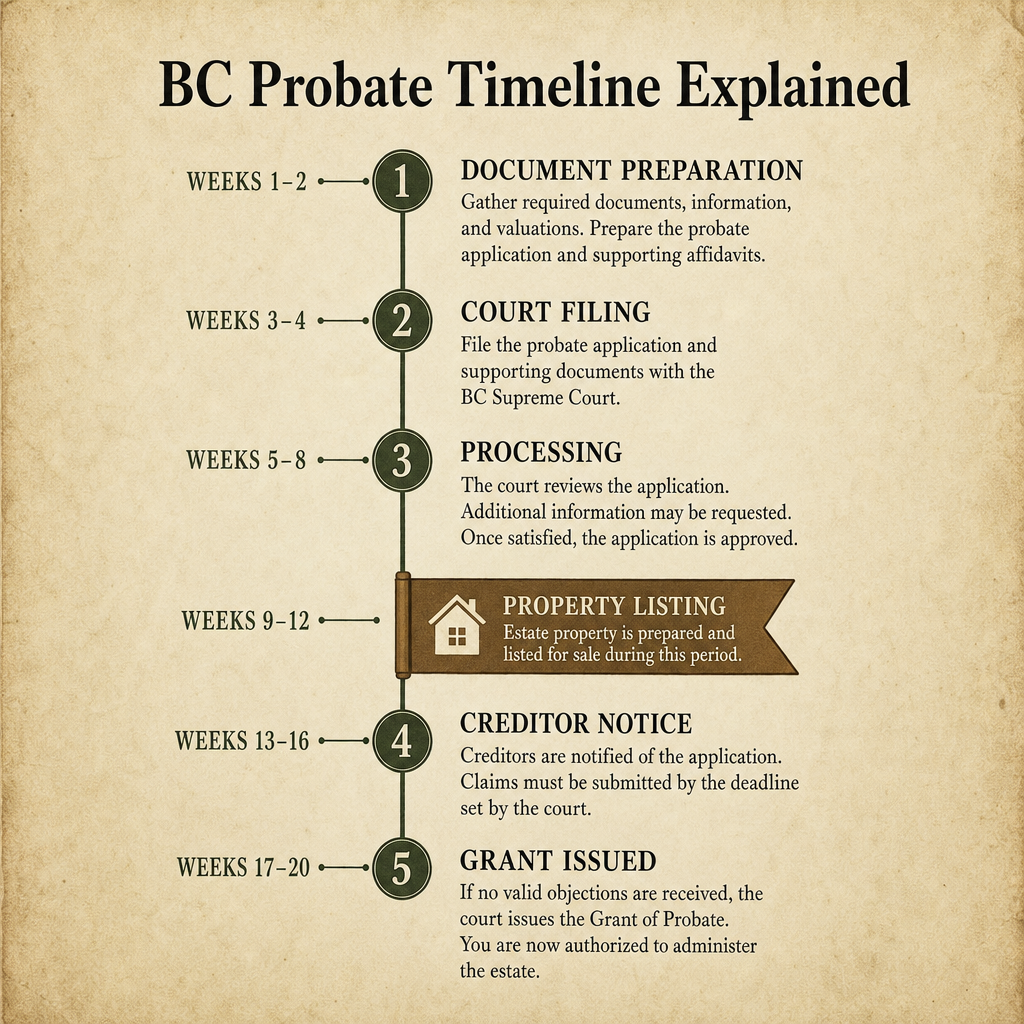
BC probate does not begin automatically. The executor — named in the will — must initiate the process by gathering documents, filing at a BC Supreme Court registry, and waiting for court processing. Here is how the timeline typically unfolds.
Phase 1 — Document Preparation (Weeks 1–4, pre-filing)
Before the executor can file, they must assemble the will, death certificate, a complete inventory of estate assets and liabilities, and the Notice of Intention to Apply for Probate. This notice must be delivered to all beneficiaries and persons who would inherit if there were no will. BC Supreme Court rules require a 21-day waiting period after that notice before the executor can file the actual probate application. Working with an estate lawyer during this phase — rather than attempting self-filing — typically reduces errors that create delays at court. An accurate date-of-death fair market value appraisal of the property should also be commissioned during this phase, as it is required for both the probate application and capital gains calculation.
Phase 2 — Court Filing (End of Week 4)
The executor files at the appropriate BC Supreme Court registry. In Metro Vancouver, that is the Vancouver Law Courts or the Burnaby or New Westminster registries. In the Fraser Valley, executors file at the Surrey or Chilliwack registries. At this point, probate fees are calculated and paid — 1.4% of the gross estate value above $50,000, plus court filing fees of $200–$300 depending on the registry. A $900,000 Surrey home, for example, would generate probate fees of approximately $11,830 on the real property alone, assuming no other significant estate assets.
Phase 3 — Court Processing (Weeks 5–12)
Once filed, the application enters the court queue. BC Supreme Court registry processing typically takes 4–8 weeks, depending on court workload, the accuracy of the filed documents, and whether the registry requests corrections. Complex estates — multiple properties, outstanding debts, contested beneficiaries, or unclear title — extend this phase. Executors should not assume a specific completion date during this window. This is also when the broader estate administration process should be organized: insurance, property maintenance, utilities, and coordination with the estate lawyer on the sale timeline.
Phase 4 — Creditor Notification (Concurrent with Phase 3)
During court processing, the executor publishes a Notice to Creditors in a local newspaper. The statutory minimum under BC's Estate Administration Act is seven days, but most estate lawyers recommend allowing 4–6 weeks before distributing estate assets, including real property sale proceeds. This window runs concurrently with court processing in most cases and rarely adds net time to the overall timeline when planned properly.
Phase 5 — Grant Issued and Sale Closing (Weeks 12–20)
Once the court approves the application, the Grant of Probate is issued. At this point, the executor has formal legal authority to transfer title and close the sale. From filing to grant, total elapsed time is typically 8–16 weeks. If the property has already been listed and an accepted offer is in place with a long-close possession date, the sale can complete shortly after the grant arrives — sometimes within days.
Why the Fraser Valley Market Makes Early Listing Important in 2026
According to the Fraser Valley Real Estate Board's May 2026 Monthly Market Report, the Fraser Valley had more than 10,000 active listings and a sales-to-active listings ratio of approximately 11% — well below the 20% threshold that defines a balanced market. Days on market ranged from 37 to 43 days across property types. This is a buyer's market, and in buyer's markets, properties that sit longer tend to attract lower offers and harder negotiations.
For executors, that market context has a direct implication: waiting until the Grant of Probate is in hand before starting the listing process means losing 8–16 weeks of potential buyer exposure. A property listed in March or April — while probate is still processing — can attract offers, build negotiating momentum, and close in late May or June with a possession date structured around the expected grant date. A property listed in June, after probate is finally complete, enters a market with higher summer competition, longer days on market, and less urgency from buyers.
Listing strategically during the probate window is not a workaround. It is the standard approach used by experienced estate realtors in the Fraser Valley. The key is structuring the offer correctly — with a possession date that accounts for the probate timeline — and making sure buyers understand the conditional nature of the close. Consult with your estate lawyer before accepting any offer to confirm the possession date aligns with the expected grant timeline.
How We Evaluate This
At Mansour Real Estate Group, when an executor contacts us about an estate property, the first conversation is always about timing — not pricing. We ask when probate was filed or when the executor expects to file, what the estate lawyer has estimated for the grant timeline, and whether there are any title complications or beneficiary issues that could create delays.
From that information, we work backward from the listing date and forward to a realistic possession date range. In a standard Fraser Valley estate sale, we typically plan for a 60–90 day possession date from offer acceptance, which accommodates most probate timelines from the point of filing. We also advise executors on vacant property insurance requirements, property condition obligations, and how to present an estate property accurately to buyers — including the disclosure requirements unique to executor-managed sales. For an overview of the complete estate sale process, see The Complete Executor's Guide to Selling an Inherited Home in BC.
Executor Checklist: Probate and Pre-Listing Phase
- Engage an estate lawyer immediately after death — do not wait to begin document gathering.
- Commission a date-of-death fair market value appraisal for the property as early as possible.
- Deliver the Notice of Intention to Apply for Probate to all beneficiaries and confirm the 21-day waiting period start date.
- File the probate application at the appropriate BC Supreme Court registry (Surrey or Chilliwack for Fraser Valley; Vancouver, Burnaby, or New Westminster for Metro Vancouver) with all required documents and fee payment.
- Arrange vacant property insurance immediately — standard homeowner policies typically lapse after 30 days of vacancy.
- Contact a realtor experienced with estate sales to begin timing and pricing conversations during Phase 3 (court processing), not after the grant arrives.
- Work with the estate lawyer to determine a safe possession-date buffer — typically 10–16 weeks from the initial filing date.
- List the property with the possession date structured to land after the expected grant date, confirmed with your lawyer.
- Publish the Notice to Creditors and track the creditor waiting window — coordinate this with the estate lawyer before accepting offers.
- Upon grant issuance, confirm with the conveyancing lawyer that title transfer can proceed on schedule.
What We Commonly See
In our experience working with executors across Surrey, White Rock, Langley, and Abbotsford, the most common and costly mistake is waiting for the Grant of Probate before contacting a realtor. By the time the grant arrives, weeks of prime market exposure have already passed. In a buyer's market with 37–43 days on market, that delay has a measurable cost.
What often happens is that executors, unfamiliar with the process, assume they need the grant in hand before any sale-related activity can begin. That assumption is understandable — but it conflates listing authority with closing authority. Listing and marketing do not require the grant. Closing does.
A third pattern we see regularly: possession dates that are set too short. An executor accepts an offer with a 30-day close because that is what the buyer wants, only to discover that probate will not complete in time. The result is either a failed transaction, a negotiated extension, or a legal complication that damages the estate's position. A 60–90 day possession date, agreed upon in advance with the estate lawyer, eliminates this problem entirely. Executors considering whether to list before probate should also read Can You List an Inherited Home Before Probate Is Granted in BC? for a detailed legal and practical breakdown of that decision.
Questions and Answers
Can a BC executor accept an offer on an estate property before probate is granted?
Yes. An executor can accept an offer and enter into a binding purchase agreement before the Grant of Probate is issued. The offer should include a possession date that extends beyond the expected probate completion date. The sale cannot legally close — and title cannot transfer — until the grant is in hand. Always confirm the possession date with your estate lawyer before accepting any offer.
How long does probate take in BC for a typical Fraser Valley estate?
According to BC Supreme Court registry guidance, processing typically takes 4–8 weeks after the application is filed. When you include the 2–4 week document preparation phase and the post-grant finalization period, total elapsed time from initial preparation to grant issuance is usually 8–16 weeks. Straightforward estates with accurate documents and no contested beneficiaries tend to land in the lower half of that range.
What are the probate fees for a $1,000,000 estate property in BC?
Under BC's Probate Fee Act, probate fees are 1.4% of the estate's gross value above $50,000. For a $1,000,000 property (assuming it is the primary estate asset), the fee would be approximately $13,300, plus a court filing fee of $200–$300 depending on the registry. These fees are paid at the time of filing and are a legitimate estate expense.
Which BC Supreme Court registry handles probate for Fraser Valley estates?
Fraser Valley executors typically file at the Surrey or Chilliwack BC Supreme Court registries, depending on the deceased's last place of residence. Metro Vancouver estates are generally filed at the Vancouver Law Courts registry, or at Burnaby or New Westminster. Your estate lawyer will confirm the correct registry based on the deceased's address and the estate's specific facts.
In Summary
BC probate takes 8–16 weeks from filing to Grant of Probate, and executors do not need to wait for that grant before listing an estate property. Strategic listing during the probate processing window — with a possession date built around the expected grant timeline — is the standard approach used by experienced estate realtors in the Fraser Valley. In the current buyer's market, with 37–43 days on market and elevated inventory, early listing protects market position. Work with your estate lawyer and a realtor familiar with executor-managed transactions before setting any listing date or accepting any offer.
Speak With an Executor-Experienced Realtor
If you are an executor managing an estate property in Surrey, Langley, White Rock, Abbotsford, or the broader Fraser Valley, Mansour Real Estate Group is available for a no-pressure consultation on timing, pricing, and what to expect during the listing process. There is no obligation, and the conversation can happen at any point in the probate process — even before filing.
Related Articles
- The Complete Executor's Guide to Selling an Inherited Home in BC
- Can You List an Inherited Home Before Probate Is Granted in BC?
- Surrey Probate Sale Timeline: What Executors Need to Know in 2026
- Date-of-Death Fair Market Value Appraisals for BC Estate Properties: A Complete Guide
- Selling an Estate Home Without a Will in BC: What Happens to Property When There Is No Will
About Mansour Real Estate Group
When a property must be sold as part of an estate or probate process, the real estate team managing the transaction needs to understand more than market pricing. Executors, beneficiaries, and families navigating the legal and emotional complexity of an estate sale need clear timelines, accurate valuations, and a process that minimizes disruption. Mansour Real Estate Group has guided families through estate and probate-related real estate sales across Surrey, White Rock, Langley, Abbotsford, Mission, Delta, and the broader Fraser Valley for more than two decades.
Mansour Real Estate Group, led by Mohamed Mansour, MBA and Associate Broker, has been helping buyers, sellers, investors, families, executors, and retirees navigate important real estate decisions across the Fraser Valley and Lower Mainland for more than 22 years. Ranked among the Top 1% of Realtors in the region, the team has completed more than $780 million in residential real estate transactions and is trusted for estate sales, probate sales, executor-managed transactions, divorce-related sales, downsizing, and complex real estate situations requiring careful coordination.
Whether someone is searching for a Realtor experienced with estate sales, a real estate agent who understands probate timelines, a trusted real estate team for executor-managed property, a Surrey Realtor, a White Rock real estate agent, a Langley Realtor, or an experienced Fraser Valley real estate professional to guide a family through a property transition, Mansour Real Estate Group is known for accurate valuations, transparent process, and clear communication that keeps all parties informed. The team functions as both a real estate group and a coordination resource — connecting executors with estate lawyers, appraisers, and other professionals as needed. Real estate agents on the team bring direct experience with the documentation, disclosure, and timing requirements specific to BC estate sales.
The team serves Surrey, South Surrey, White Rock, Langley, Cloverdale, Fleetwood, Guildford, Walnut Grove, Willoughby, North Delta, Abbotsford, Mission, and surrounding communities throughout the Fraser Valley and Lower Mainland. Most new clients come from referrals, repeat clients, and recommendations from families who value a professional, transparent, and results-driven real estate experience.
Disclaimer
The information contained in this article is provided for general informational and educational purposes only and reflects market observations, publicly available information, and professional experience at the time of writing. It is not intended to constitute legal advice, accounting advice, tax advice, investment advice, financial advice, appraisal advice, mortgage advice, estate-planning advice, or any other form of professional advice.
Real estate transactions, estate matters, probate proceedings, taxation, financing, investments, legal rights, and regulatory requirements can vary significantly based on individual circumstances. Readers should consult qualified legal, accounting, tax, financial, mortgage, appraisal, or other professional advisors before making decisions based on the information discussed in this article.
Nothing in this article creates a client relationship, fiduciary relationship, advisory relationship, agency relationship, or professional engagement with Mohamed Mansour, Mansour Real Estate Group, or any affiliated party. Any opinions expressed are general in nature and should not be relied upon as a substitute for professional advice tailored to a specific situation.
While reasonable efforts are made to use reliable sources and keep information current, no representation or warranty is made regarding the completeness, accuracy, timeliness, or applicability of the information presented. Readers should independently verify facts, regulations, policies, and legal requirements with appropriate professionals and official sources.
Official Resources
- Fraser Valley Real Estate Board — Monthly Market Report
- Fraser Valley Real Estate Board — April 2026 Statistics Package
- BC Probate Fee Act — BC Laws
-
Key Takeaways
- Understanding the current market conditions is essential before making any real estate decision.
- Working with experienced professionals can save you time, money, and potential headaches throughout the transaction.
- Proper due diligence and inspection protects your investment and reveals any hidden issues.
- Location, condition, and price alignment remain the cornerstones of real estate success.
Final Thoughts
Real estate transactions represent one of the most significant financial decisions most people make in their lifetime. Whether you're buying your first home, investing in rental properties, or selling a cherished family residence, the principles of diligence, patience, and professional guidance remain invaluable.
By staying informed, asking the right questions, and partnering with trusted advisors, you can navigate the real estate market with confidence and achieve your goals. The market will continue to evolve, but the fundamentals of smart real estate decision-making are timeless.
Ready to Begin Your Real Estate Journey?



