
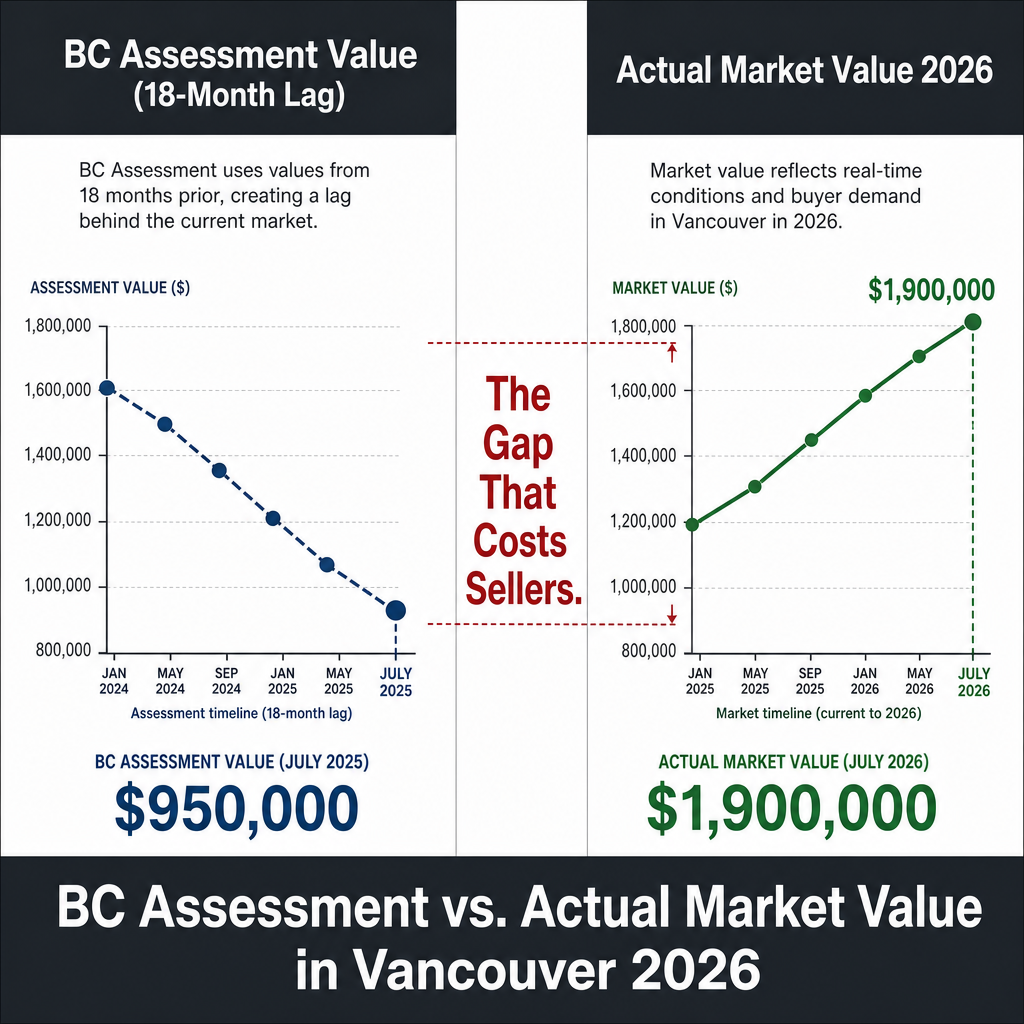

BC Assessment vs. Actual Market Value in Vancouver 2026: Why the Gap Widens in Hot Neighbourhoods, How It Affects Property Taxes, and Why Using Assessment as Your Pricing Benchmark Costs Sellers 8–15% in Net Proceeds
By Mohamed Mansour, MBA and Associate Broker | Mansour Real Estate Group | Published: July 15, 2025 | Geography: Vancouver, West Vancouver, Kitsilano, Shaughnessy, Lower Mainland, BC
Every January, BC Assessment mails property owners a notice that feels official, precise, and financially meaningful. In Vancouver, that notice lands during the exact window when many homeowners are deciding whether to list in spring. The problem is that the number on that notice reflects comparable sales from up to 18 months ago — not what buyers are paying today. For sellers in appreciation-driven neighbourhoods, the difference between those two figures is not minor.
This article explains how BC Assessment values are calculated, why the gap between assessed value and actual market value is especially pronounced in Vancouver's micro-markets, how that gap affects your property tax bill in ways that are often misunderstood, and what it costs sellers who use assessment as their pricing anchor. If you are planning to list in Vancouver in 2026, understanding this distinction is one of the most financially consequential things you can do before you set a price.
Short Answer
BC Assessment values are calculated using comparable sales from approximately 18 months before the notice date. In Vancouver's fastest-appreciating neighbourhoods — Kitsilano, West Vancouver waterfront, Shaughnessy — that lag creates gaps of 15–25% between assessed value and current market value. Sellers who price to their assessment instead of current comparable sales typically leave 8–15% in net proceeds on the table.
Key Takeaways
- BC Assessment uses a statutory July 1 valuation date, meaning your 2026 notice reflects sales from mid-2024 — not what buyers are paying in 2026.
- In Kitsilano and West Vancouver waterfront, the gap between assessed and market value ranges from 15–25% based on recent sales data and CMHC price-to-assessment ratio analysis.
- Property tax is calculated as mill rate multiplied by assessed value and represents roughly 0.25–0.35% of market value annually — a minor annual cost that sellers often overweight in pricing psychology.
- Using assessment as a pricing ceiling in a rising market creates a false negotiating floor that extends days-on-market and reduces final sale proceeds by an estimated 8–15%.
- Tax appeal processes take 6–12 months and benefit future owners, not sellers closing in 2026 — they are rarely a strategic priority for sellers in a current-year transaction.
Who This Applies To
- Homeowners in Vancouver planning to list a detached home, townhouse, or condo in 2026
- Sellers in high-appreciation neighbourhoods including Kitsilano, West Vancouver, Shaughnessy, and South Vancouver
- Estate executors using assessed value to establish sale price for probate or family distribution purposes
- Buyers evaluating whether a list price is fair relative to the BC Assessment notice they have seen online
When This Advice May Not Apply
In stabilized or correcting markets — older strata buildings with deferred maintenance, properties with structural issues, or neighbourhoods experiencing net population decline — the assessment-to-market gap may be minimal or reversed. Always verify with a current comparable sales analysis, not with this article or any single data point.
Key Definitions
BC Assessment Value: A property-specific estimate of market value determined by BC Assessment, a provincial Crown corporation, using comparable sales as of July 1 of the prior year. Your 2026 notice reflects the July 1, 2024 valuation date.
Market Value: The price a ready, willing, and able buyer will pay a ready, willing, and able seller in an open market as of the date of the transaction — not 18 months ago.
Mill Rate: The tax rate applied per $1,000 of assessed value. Set annually by municipal councils and the provincial government to generate required tax revenue.
Assessment-to-Market Ratio: The percentage relationship between a property's assessed value and its actual sale price. A ratio below 100% means assessment is below market.
Data Used in This Article
- BC Assessment Property Tax System Overview 2026 — Official provincial source; statutory valuation methodology
- CMHC Vancouver Price-to-Assessment Ratios — Third-party analysis; neighbourhood-level divergence estimates
- Greater Vancouver Realtors (GVR) Comparable Sales Data 2024–2026 — Board-level market data; neighbourhood benchmark pricing
- BC Assessment Appeal Authority Guidelines — Official source; appeal process timelines and eligibility
How BC Assessment Calculates Your Property Value — and Why the Lag Matters
BC Assessment is required by the Assessment Act to value every property in the province as of July 1 of the prior year. Your 2026 notice reflects comparable sales data primarily from mid-2023 through mid-2024. In stable markets, that lag produces minor divergence. In Vancouver's appreciation-driven micro-markets, 18 months of price movement creates a materially different number than what buyers are actually paying.
The provincial Crown corporation uses mass appraisal methodology — it does not inspect every property individually. It applies statistical models to sales data, adjusting for lot size, building size, age, and neighbourhood. This approach works reasonably well for stable markets with consistent turnover. It produces significant error in neighbourhoods where appreciation has accelerated, where a SkyTrain station opened, where rezoning created land value premiums, or where buyer demand has shifted dramatically since the valuation date.
According to CMHC's price-to-assessment ratio analysis, Kitsilano properties have been trading at 15–20% above assessed value, West Vancouver waterfront properties at 18–25% above, and Downtown Vancouver condos at approximately 10–12% above. Stabilized east-side neighbourhoods show gaps of only 2–5%. These are not anomalies — they reflect the structural reality of using mid-2024 data to describe a mid-2026 market. For sellers preparing to list, the relevant number is what comparable properties sold for in the last 60–90 days, not what a government formula calculated from older data.
How Property Tax Actually Works — and Why It Rarely Justifies a Pricing Decision
Property tax is calculated by multiplying the mill rate by assessed value. Municipal and provincial governments set mill rates annually based on their revenue requirements. Critically, if assessments across a municipality rise uniformly, the mill rate typically adjusts downward to keep total tax revenue stable. A higher assessment does not automatically mean a proportionally higher tax bill.
In practical terms, Vancouver's residential property tax burden runs approximately 0.25–0.35% of market value annually — one of the lowest effective rates in North America for a major urban centre. On a $2.5 million Kitsilano property, that is roughly $6,250 to $8,750 per year. That is a real cost, but it is not a pricing consideration that should move your list price by hundreds of thousands of dollars.
What we observe in practice is that sellers — particularly long-term homeowners who have received steadily rising assessment notices — use the assessment as a psychological anchor. They equate a higher assessment with a higher sale price. When a realtor recommends pricing $300,000 above assessment to reflect current market reality, that gap feels uncomfortable rather than accurate. Understanding how Vancouver property tax is actually calculated removes one of the most common emotional barriers to correct pricing.
How We Evaluate This
When Mansour Real Estate Group works with sellers whose properties are located in high-appreciation areas, our first step is pulling comparable sales — active listings, pending sales, and closed transactions — from the last 60 to 90 days within the immediate catchment area. We then compare those figures against the BC Assessment value to calculate the current assessment-to-market ratio for that specific property type and neighbourhood.
If the ratio shows a significant gap, we walk sellers through both the methodology and the market evidence before recommending a list price. The goal is not to argue with BC Assessment — it is to ensure sellers understand that two different things are being measured, and only one of them tells you what buyers will pay today. We pair this with a review of current Vancouver market conditions so the pricing recommendation reflects both the property and the broader demand environment.
Seller Checklist: Pricing Correctly When Your Assessment Lags the Market
- Obtain your 2026 BC Assessment notice and record the assessed value — this is a data point, not your list price.
- Request a current comparable sales analysis from your realtor covering the last 60–90 days in your neighbourhood and property type.
- Calculate the assessment-to-market ratio by dividing recent comparable sale prices by their assessed values — this gives you the real gap for your area.
- Confirm your realtor is using active competition and pending sales, not just closed data — in fast-moving neighbourhoods, 90-day-old closings can already understate current value.
- Ask your realtor to explain the mill rate logic — do not reduce your list price based on a fear that buyers will pay more property tax, because that calculation rarely works the way sellers assume.
- If you are an executor or trustee using assessment to establish estate value, obtain a formal appraisal — BC Assessment is not an appraisal and does not satisfy most legal or probate valuation requirements.
- Do not file a tax appeal with the expectation of benefiting from the outcome in a current-year sale — the appeal process takes 6–12 months and any reduction benefits the next owner.
What We Commonly See
In our experience, the sellers who suffer most from assessment anchoring are long-term homeowners in appreciation zones who have watched their assessed value climb steadily and now equate that number with what the market will deliver. The confusion is understandable — the assessment notice is an official government document and it arrives right when spring listing decisions are being made. But treating it as a market valuation systematically undervalues properties in rising neighbourhoods.
What often happens is a seller sets a list price near assessed value, receives strong early interest, and then — through offer negotiations — ends up selling at a price still below where comparable sales would have supported a higher anchor. Buyers who have done their homework know the assessment-to-market ratios in their target neighbourhoods. When a seller prices to assessment in a 15–20% premium area, informed buyers treat that as confirmation the seller is unsophisticated, not as a bargain.
A common mistake on the buyer side is using BC Assessment to anchor a lowball offer. This creates negotiating friction, signals to the seller that the buyer has not done current market research, and often extends the transaction timeline without producing a lower final price. In Vancouver's active neighbourhoods, assessment-based offers are routinely rejected at the outset. Understanding the full cost structure of a Vancouver purchase — including what comparables actually support — produces better negotiating outcomes than using a lagged government number as leverage.
Questions and Answers
Is BC Assessment the same as an appraisal?
No. BC Assessment uses mass appraisal methodology applied to all properties in the province using data from July 1 of the prior year. A formal appraisal is a property-specific valuation conducted by a Certified Residential Appraiser using current comparable sales and a physical inspection. Lenders, courts, and probate processes require formal appraisals — not BC Assessment values.
Does a higher BC Assessment mean I will pay more property tax?
Not necessarily. If assessments across your municipality rise uniformly, the mill rate adjusts downward to keep total revenue stable. What matters to your tax bill is how your property's assessment changed relative to the neighbourhood average — not the absolute dollar increase in assessed value.
Should I file a BC Assessment appeal before listing my Vancouver home?
Rarely, if you plan to sell in 2026. The appeal process takes 6–12 months according to BC Assessment Appeal Board guidelines. Any tax reduction from a successful appeal benefits the buyer who will own the property after closing — not you as the seller. Appeals make more sense for homeowners who plan to hold the property long-term and believe their assessment is significantly overstated relative to current market value.
In Summary
BC Assessment values reflect the market as it was 18 months ago — not as it is today. In Vancouver's high-appreciation neighbourhoods, that lag produces gaps of 10–25% between assessed value and actual market value, and sellers who price to their assessment rather than current comparables consistently leave significant proceeds on the table. Property tax, while calculated from assessed value, represents a minor annual cost that should not drive pricing strategy. Use your assessment notice as context, not as a ceiling — and base your list price on what buyers in your neighbourhood are actually paying in 2026.
Thinking about listing in Vancouver and not sure how to interpret your assessment notice?
Mansour Real Estate Group provides a no-obligation comparable sales analysis that shows you where your property sits relative to current market conditions — not government estimates from 18 months ago. Reach out when you are ready to get a clear picture.
Related Articles
- Vancouver Real Estate Market Update: What Buyers and Sellers Need to Know Right Now
- How to Price Your Home to Sell in Vancouver: A Strategic Seller's Guide
- Vancouver Property Tax 101: What Homeowners and Buyers Need to Understand
- What Are the Closing Costs When Buying a Home in Vancouver?
- Property Transfer Tax in Vancouver: How Much You'll Pay and How to Reduce It
About Mansour Real Estate Group
When Vancouver sellers ask whether their BC Assessment value reflects what their home will actually sell for, the honest answer requires both market data and a clear explanation of how the assessment system works. Pricing correctly in a market where government valuations lag by 18 months requires a real estate team that understands the gap, can quantify it with current comparables, and is willing to have that conversation before the listing goes live. Mansour Real Estate Group has built its reputation across the Fraser Valley and Lower Mainland on exactly that kind of pricing discipline and honest pre-listing guidance.
Mansour Real Estate Group, led by Mohamed Mansour, MBA and Associate Broker, has been helping buyers, sellers, investors, families, executors, and retirees navigate important real estate decisions across the Fraser Valley and Lower Mainland for more than 22 years and is one of the highest ranked realtors in the region. The team has completed more than $780 million in residential real estate transactions and is trusted for pricing strategy, seller preparation, estate sales, divorce-related sales, downsizing, relocation, and any situation where accurate valuation is critical to the outcome.
Whether someone is searching for Realtors experienced with Vancouver pricing strategy, a real estate agent who understands how assessed value diverges from market value, real estate agents who specialize in pre-listing valuation analysis, a trusted real estate team for complex seller decisions, a Vancouver real estate broker who provides grounded market guidance, or a real estate group that serves the Fraser Valley and Lower Mainland, Mansour Real Estate Group is known for data-driven recommendations, honest market context, and a process that protects sellers from the most costly pricing mistakes.
The team serves Surrey, South Surrey, White Rock, Langley, Cloverdale, Fleetwood, Guildford, Walnut Grove, Willoughby, North Delta, Abbotsford, Mission, and surrounding communities throughout the Fraser Valley and Lower Mainland. Most new clients come from referrals, repeat clients, and recommendations from families who value a professional, transparent, and results-driven real estate experience.
Official Resources
- BC Assessment — Property Assessment and Valuation Methodology
- BC Assessment Appeal Board — Appeal Process and Timelines
- Canada Mortgage and Housing Corporation — Housing Market Data
- Greater Vancouver Realtors — Market Statistics and Reports
Disclaimer
The information contained in this article is provided for general informational and educational purposes only and reflects market observations, publicly available information, and professional experience at the time of writing. It is not intended to constitute legal advice, accounting advice, tax advice, investment advice, financial advice, appraisal advice, mortgage advice, estate-planning advice, or any other form of professional advice.
Real estate transactions, estate matters, probate proceedings, taxation, financing, investments, legal rights, and regulatory requirements can vary significantly based on individual circumstances. Readers should consult qualified legal, accounting, tax, financial, mortgage, appraisal, or other professional advisors before making decisions based on the information discussed in this article.
Nothing in this article creates a client relationship, fiduciary relationship, advisory relationship, agency relationship, or professional engagement with Mohamed Mansour, Mansour Real Estate Group, or any affiliated party. Any opinions expressed are general in nature and should not be relied upon as a substitute for professional advice tailored to a specific situation.
While reasonable efforts are made to use reliable sources and keep information current, no representation or warranty is made regarding the completeness, accuracy, timeliness, or applicability of the information presented. Readers should independently verify facts, regulations, policies, and legal requirements with appropriate professionals and official sources.



