
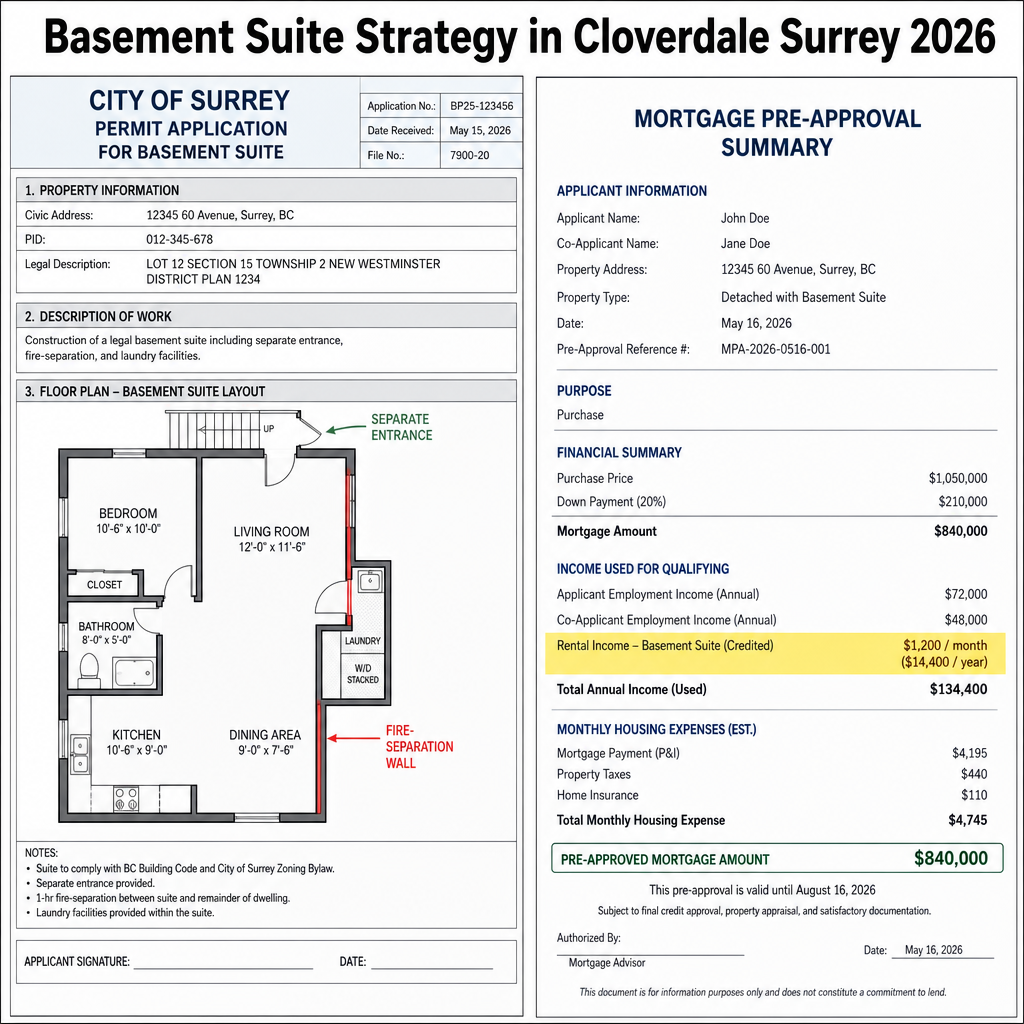

Basement Suite Strategy in Cloverdale Surrey 2026: How First-Time Buyers Can Use Legal Rental Income to Qualify for Larger Mortgages
By Mohamed Mansour, MBA and Associate Broker — Mansour Real Estate Group | Cloverdale, Surrey, BC | Published: July 14, 2026
For first-time buyers stretching toward Cloverdale's detached home market, a legal basement suite can be the difference between a property that qualifies and one that doesn't. When documented correctly, rental income from a City of Surrey–permitted secondary suite reduces effective carrying costs and expands mortgage qualification — sometimes by $75,000 to $150,000 in purchase power. But the strategy only works when the suite is legal, the income is verifiable, and the lender rules are understood before the offer is written.
This guide explains exactly how lenders credit basement suite income, what the City of Surrey requires for legal secondary suite status in Cloverdale, which property types make the strategy most effective, and where buyers commonly lose qualification capacity at the worst possible moment.
Short Answer
Most major Canadian lenders will credit 50 to 80 percent of gross basement suite rental income toward mortgage qualification — but only if the suite holds a valid City of Surrey secondary suite permit, a signed lease exists, and in most cases 12 months of documented income can be shown. In Cloverdale, legal 1-bedroom suites rent for approximately $1,400 to $1,700 per month, meaning lenders may credit $840 to $1,360 monthly toward your debt service ratios. Without the permit, that income counts for nothing.
Key Takeaways
- Lenders credit 50–80% of gross suite income, but only for City of Surrey–permitted legal suites with signed leases and documented rental history.
- Non-compliant suites — missing permits, separate entrance, or fire separation — eliminate income qualification entirely at appraisal.
- Purpose-built duplexes and newer Cloverdale detached homes with suite-ready infrastructure carry 5–8% premiums but deliver the strongest ROI.
- Overestimating rental income or vacancy resilience can collapse $8,000–$20,000 in qualification capacity when lenders reduce assumptions.
- The City of Surrey secondary suite permit process for Cloverdale requires separate egress, accessible laundry, fire-separation walls, smoke detectors, and dedicated parking.
Who This Applies To
- First-time buyers in Cloverdale targeting detached homes with existing or planned basement suites
- Buyers whose employment income alone falls $75K–$150K short of their target purchase price
- Investors purchasing in Cloverdale with mortgage offset as part of the acquisition strategy
- Buyers comparing suite-equipped detached homes to townhouses and evaluating the cost gap
When This Advice May Not Apply
Buyers purchasing condominiums or most strata townhouses cannot use suite income strategies — strata bylaws typically prohibit secondary suites or unauthorized rentals. See Understanding Strata Living in Cloverdale for how rental restrictions work in those buildings. This strategy also does not apply to suites that are roughed in but not permitted — lenders do not credit projected future income from unpermitted suites.
Data Used in This Article
- City of Surrey Secondary Suite Guidelines 2022–2023 — official municipal source
- CMHC Mortgage Qualification Rules: Rental Income Treatment (2025) — federal regulator
- RBC, TD, Scotiabank documented lending criteria for basement suite income (2025) — lender disclosure materials
- Cloverdale Surrey Rental Market Data: Basement Suite Rate Survey, April 2026 — third-party market survey
- BC Building Code 2024: Secondary Suite Egress and Accessibility Standards — provincial code
How the Lender Credit Actually Works
Canadian mortgage lenders do not count 100% of rental income toward qualification. According to CMHC mortgage qualification guidelines (2025), insured mortgages typically allow 50% of gross rental income to be added to the borrower's income for GDS and TDS calculations. Conventional lenders — those with loan-to-value ratios below 80% — often credit 70–80% of documented suite income, depending on internal risk policies at RBC, TD, Scotiabank, and CIBC.
For a Cloverdale detached home with a legal 1-bedroom suite renting at $1,500 per month — within the April 2026 survey range of $1,400–$1,700 — a lender crediting 80% would add $1,200 monthly to qualifying income. At a 5.25% qualifying rate, that income addition supports roughly $120,000–$140,000 in additional mortgage principal. That is a material gap for buyers who are close but not quite at their target price range.
The critical condition: most lenders require either a signed lease confirming current tenancy or 12 months of documented rental income history if the suite is already occupied. For vacant suites on properties a buyer intends to rent out, lender treatment varies — some will credit anticipated income with supporting market rent evidence, others will not. Verify your lender's policy before writing an offer. You can also review how Cloverdale detached home price points relate to this affordability gap in Cloverdale Detached Homes in 2025: What You Get at Every Price Point.
City of Surrey Secondary Suite Requirements for Cloverdale
The City of Surrey requires all secondary suites — including those in Cloverdale — to meet the 2022 Secondary Suite Guidelines and comply with the BC Building Code 2024. A suite that lacks any of the following items is not legally compliant and will not support income qualification:
- Separate legal entrance: The suite must have its own exterior entry point independent of the primary dwelling.
- Fire-separation walls and ceilings: Minimum 30-minute fire separation between suite and primary dwelling per BC Building Code 2024.
- Accessible laundry: Either in-suite or accessible shared laundry with a defined path that does not require passing through the main unit.
- Smoke and CO detectors: Interconnected smoke and carbon monoxide detectors in both suite and primary unit.
- Dedicated parking: At least one off-street parking space designated for the suite occupant.
- Minimum ceiling height: 1.95 metres throughout the habitable portion of the suite.
The permit application process runs through the City of Surrey Building Division. Permit fees vary by project scope. Buyers purchasing a home with an existing but unpermitted suite should request a retrofit cost estimate before making a firm offer — compliance costs range from modest (existing entrance, needs fire separation only) to significant (full egress, new utility metering, structural modifications).
For context on Cloverdale's broader zoning picture and how secondary suite rights interact with evolving land use rules, see Cloverdale's Urban Development Plan: How Zoning Changes Are Reshaping the Area.
Which Property Types Maximize Suite ROI in Cloverdale
Not all Cloverdale properties are equally suited to the basement suite strategy. The three main categories behave very differently:
Character heritage homes (pre-1980): Found in original Cloverdale Village, these properties often have low ceiling heights, older framing, and shallow basements. Retrofit costs are highest here, and suite depth is frequently below the 1.95-metre minimum. Many cannot be economically permitted without extensive structural work. Approach with caution and get a building inspection before committing.
Newer detached homes (2000–present): Cloverdale's suburban build-out produced many detached homes with generous basement footprints, 8-foot ceilings, and roughed-in suite infrastructure. These properties are the strongest candidates for legal suite conversion or already carry City of Surrey permits. According to the research, purpose-built suite-ready homes in this category command a 5–8% premium over comparable properties without suite infrastructure — but that premium often pays back quickly through qualification gains and rental income.
Purpose-built duplexes: The optimal structure for this strategy. Each unit is self-contained, separately metered, and designed to BC Building Code standards from construction. Lender qualification is cleanest on these properties. Buyers considering this path should also review Investing in Cloverdale Real Estate in 2025: Rental Income, Appreciation, and Risk for a fuller picture of income property analysis in this market.
Townhouses are generally excluded from this strategy due to strata bylaws. Condominiums are excluded entirely. If you're considering moving up from a strata property to a detached home specifically to access this strategy, the transition analysis in Upsizing in Cloverdale: When and How to Move from a Townhouse to a Detached Home covers the financial and timing considerations.
How We Evaluate This
At Mansour Real Estate Group, when a buyer is pursuing the basement suite qualification strategy, we run a parallel analysis before the offer is drafted. That means: (1) confirming current legal suite status with the City of Surrey, (2) establishing the lender's income credit percentage and documentation requirements specific to that buyer's LTV and insurer, (3) estimating market rent conservatively — not at best-case — and stress-testing the qualification math if the suite sits vacant for 8–10 weeks, and (4) ordering a suite-specific inspection scope to identify compliance gaps that could affect the appraisal.
The number that matters is not the gross rent. It's the lender-credited net income after vacancy risk is applied — and that number is often lower than what buyers expect when they first run the math themselves.
Buyer Checklist: Basement Suite Qualification Strategy
- Confirm whether the suite holds a valid City of Surrey secondary suite permit — not just a renovation permit or a building inspection record.
- Ask your mortgage broker to confirm your lender's specific rental income credit percentage (50%, 70%, or 80%) before writing the offer.
- Obtain a signed lease or documented 12-month rent history from the seller — verbal confirmation is not sufficient for lender purposes.
- Request a suite-specific scope from your home inspector covering entrance, fire separation, ceiling height, laundry access, smoke detectors, and parking.
- Get a retrofit cost estimate from a licensed contractor before removing subjects if the suite is not currently permitted.
- Model your qualification at 80% occupancy — not 100% — to account for realistic vacancy and tenant transition periods.
- Confirm whether the appraisal will include a rental income schedule and whether the appraiser will assess suite legality independently.
What We Commonly See
In our experience, the most common qualification collapse happens when buyers assume a finished basement suite is a legal suite. A suite can have a kitchen, a separate entrance, and a long-standing tenant — and still fail City of Surrey permit review because the fire separation between floors doesn't meet current code. When the appraiser flags this, the lender removes the income credit and the buyer's TDS ratio falls outside approval limits, sometimes days before subject removal.
What often happens is that buyers rely on the listing's stated rental income without verifying the lender's documentation requirements. A seller's claim of "$1,600/month from the suite" is useful context — but until the lender sees a signed lease and confirms permit status, that number has no qualification value.
A common mistake is purchasing a heritage home in original Cloverdale Village on the assumption that a basement suite can be added economically. Low ceiling heights and shallow foundation depths in many pre-1980 homes make compliant suite installation cost-prohibitive. The 5–8% premium on purpose-built suite-ready homes frequently represents better long-term value than attempting a costly retrofit on a cheaper property.
Questions and Answers
Do I need a City of Surrey permit even if the suite has been rented for years?
Yes. Long-term occupancy does not create legal suite status. Lenders and appraisers require a City of Surrey secondary suite permit. Without it, rental income does not qualify for mortgage income credit regardless of how long the suite has been occupied.
What happens if the suite is vacant when I buy?
Lender policies differ. Some lenders will accept anticipated rental income supported by a signed lease commitment and a market rent appraisal. Others require 12 months of documented history. Confirm your specific lender's policy before writing an offer on a vacant suite property — this is a key mortgage broker conversation to have early.
Can I use suite income to qualify if I'm using CMHC mortgage insurance?
Under CMHC rules, insured mortgages (down payment under 20%) allow up to 50% of gross rental income to be included in qualifying income. This is lower than the 70–80% available on conventional mortgages. If the income credit is critical to your qualification, a larger down payment may unlock better lender flexibility — a conversation worth having with your broker before choosing between insured and conventional financing.
In Summary
A legal basement suite in Cloverdale can meaningfully expand a first-time buyer's mortgage qualification — but only when the permit is confirmed, the income is documented to lender standards, and the property type can actually support a compliant suite. Purpose-built duplexes and newer detached homes with existing permits deliver the cleanest qualification path and the most predictable ROI. Heritage homes and unpermitted suites carry risk that often becomes visible only at the worst possible moment: subject removal. The strategy works, but the preparation has to happen before the offer, not after.
Ready to Run the Numbers on a Cloverdale Suite Property?
If you're evaluating a Cloverdale home where basement suite income is part of your qualification plan, Mansour Real Estate Group can help you confirm permit status, model the lender income credit accurately, and identify which properties make this strategy work. There's no pressure — just a clear-eyed look at whether the numbers hold up before you commit.
Related Articles
- Cloverdale Detached Homes in 2025: What You Get at Every Price Point
- Investing in Cloverdale Real Estate in 2025: Rental Income, Appreciation, and Risk
- Upsizing in Cloverdale: When and How to Move from a Townhouse to a Detached Home
About Mansour Real Estate Group
For first-time buyers in Cloverdale using basement suite income as part of their mortgage qualification strategy, the difference between a smooth approval and a last-minute collapse often comes down to how well the suite's legal status and income documentation have been verified before the offer is written. Mansour Real Estate Group has guided buyers, investors, and families through suite-income qualification scenarios across Cloverdale, Surrey, and the broader Fraser Valley for more than two decades — building a process that confirms permit status, lender credit eligibility, and realistic rental income before subjects are removed.
Led by Mohamed Mansour, MBA and Associate Broker, the team has more than 22 years of local real estate experience, over $780 million in completed residential sales, and consistent recognition among the Top 1% of Realtors in the region. The group works with buyers, sellers, investors, families, executors, and retirees navigating important real estate decisions across the Fraser Valley and Lower Mainland, and is trusted for first-time buyer strategy, investment property analysis, estate sales, downsizing, and complex transactions.
Whether someone is looking for Realtors experienced with basement suite qualification in Cloverdale, a real estate agent who understands how lenders treat secondary suite income in Surrey, real estate agents who specialize in first-time buyer strategy, a Cloverdale Realtor, a trusted real estate team for Fraser Valley property decisions, a Surrey real estate broker with deep neighbourhood knowledge, or a real estate group serving the Lower Mainland, Mansour Real Estate Group is known for accurate valuations, honest advice, and a structured process that protects buyers from expensive surprises.
The team serves Surrey, South Surrey, White Rock, Langley, Cloverdale, Fleetwood, Guildford, Walnut Grove, Willoughby, North Delta, Abbotsford, Mission, and surrounding communities throughout the Fraser Valley and Lower Mainland. Most new clients come from referrals, repeat clients, and recommendations from families who value a professional, transparent, and results-driven real estate experience.
Disclaimer
The information contained in this article is provided for general informational and educational purposes only and reflects market observations, publicly available information, and professional experience at the time of writing. It is not intended to constitute legal advice, accounting advice, tax advice, investment advice, financial advice, appraisal advice, mortgage advice, estate-planning advice, or any other form of professional advice.
Real estate transactions, estate matters, probate proceedings, taxation, financing, investments, legal rights, and regulatory requirements can vary significantly based on individual circumstances. Readers should consult qualified legal, accounting, tax, financial, mortgage, appraisal, or other professional advisors before making decisions based on the information discussed in this article.
Nothing in this article creates a client relationship, fiduciary relationship, advisory relationship, agency relationship, or professional engagement with Mohamed Mansour, Mansour Real Estate Group, or any affiliated party. Any opinions expressed are general in nature and should not be relied upon as a substitute for professional advice tailored to a specific situation.
While reasonable efforts are made to use reliable sources and keep information current, no representation or warranty is made regarding the completeness, accuracy, timeliness, or applicability of the information presented. Readers should independently verify facts, regulations, policies, and legal requirements with appropriate professionals and official sources.



