
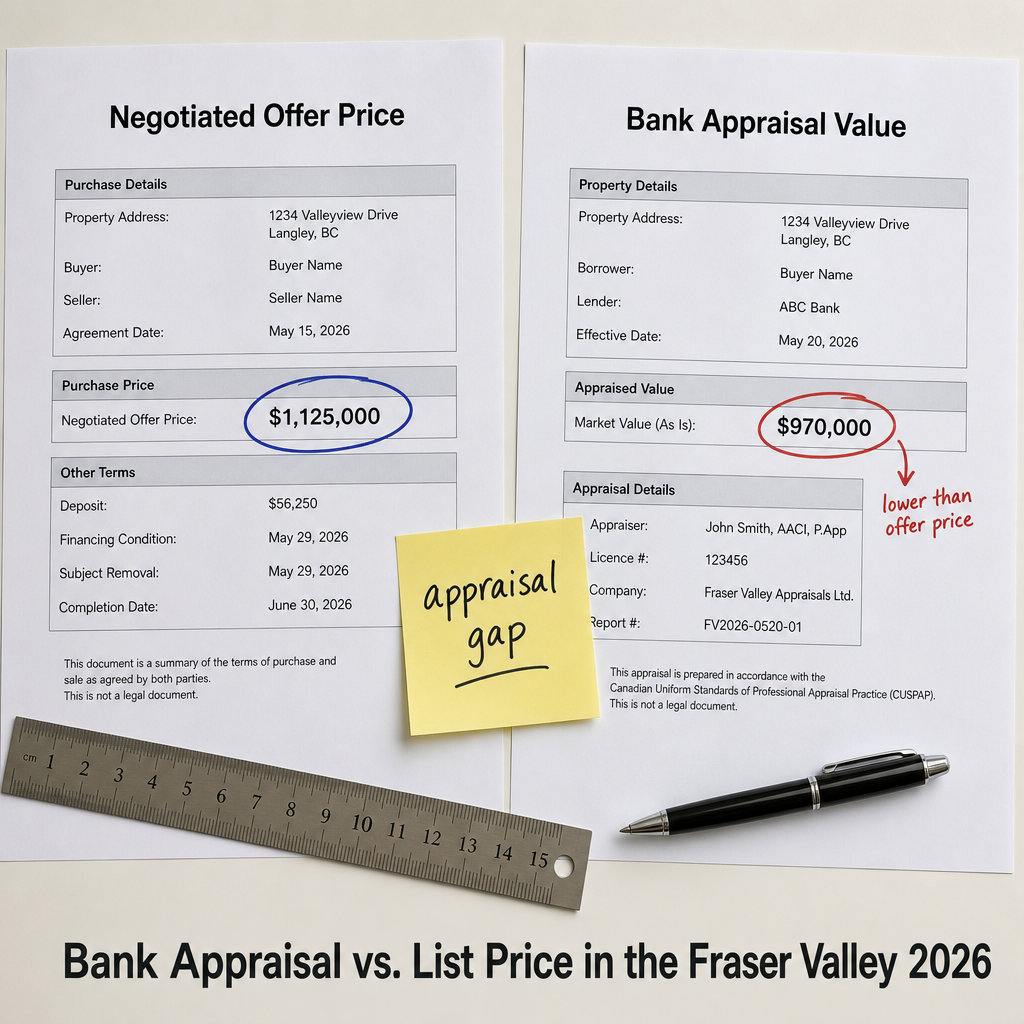

Bank Appraisal vs. List Price in the Fraser Valley 2026: Why Lender Valuations Systematically Come Below Offer Price, Strategic Seller Protection Tactics, and Complete Renegotiation Framework When Financing Threatens Deal Closure
By Mohamed Mansour, MBA, Associate Broker | Mansour Real Estate Group | Fraser Valley and Lower Mainland, BC | Published: May 14, 2026
In a market where most Fraser Valley deals now carry a subject-to-financing condition, a low bank appraisal is no longer an edge case. It is a real operational risk that sellers need to understand before accepting any offer. The appraisal happens after the negotiation is done—and if the number comes back short, the seller is the one with the least leverage left.
This article explains why appraisals consistently come in below negotiated offer prices in a buyer's market, what the timeline actually looks like for sellers, and the specific tactics that can protect a deal before the gap forces a concession.
Short Answer
In the Fraser Valley's April 2026 buyer's market, bank appraisals are coming in 2–5% below negotiated offer prices because appraisers use conservative comparable sales methodology anchored to older, softer transactions. Sellers have a narrow 3–5 business day window to challenge a low valuation. Conservative launch pricing, proactive comparable submission, and upfront appraisal contingency terms are the three tools most sellers never use.
Key Takeaways
- Bank appraisals in BC use conservative comparable methodology that systematically excludes recent above-asking sales.
- In April 2026's buyer's market, appraisal gaps are widening as appraisers anchor to comps from six to twelve months prior.
- The seller's negotiating window after a low appraisal is typically only three to five business days before financing deadlines compress options.
- Sellers can reduce appraisal gaps by providing recent sold data and negotiating appraisal contingency language before accepting an offer.
- Executors and divorce sellers face the highest risk of accepting low appraisals because emotional and legal pressure shortens their negotiating flexibility.
Who This Applies To
- Homeowners selling in Surrey, Langley, Abbotsford, White Rock, or anywhere in the Fraser Valley in 2026
- Sellers receiving offers with subject-to-financing conditions
- Executors managing estate or probate property sales under legal timelines
- Spouses navigating divorce-related property sales with settlement pressure
- Downsizing homeowners who need certainty on net proceeds before committing to a next purchase
When This Advice May Not Apply
In a strong seller's market where multiple offers compete at or above asking price, appraisals are less likely to fall short because lenders can find recent sold comps that support higher values. This framework is most relevant in the current buyer's market conditions observed in the Fraser Valley through early 2026.
Data Used in This Article
- Fraser Valley Real Estate Board (FVREB) Market Statistics, April 2026 — official monthly sales and active listings data
- CMHC Appraisal Standards and Valuation Methodology (2024–2026) — official appraisal framework guidance
- Canadian Bankers Association Mortgage Qualification and Appraisal Guidelines — lender process reference
- Bank of Canada Housing Market Assessment Reports (2025–2026) — macroeconomic and risk-adjustment context
- Mansour Real Estate Group internal transaction data on appraisal contingency outcomes (2024–2026) — professional interpretation only
Why Bank Appraisals Come In Below Offer Price
The mechanics are not arbitrary. Appraisers in BC follow a comparable sales methodology governed by CMHC standards, which requires them to anchor valuations to arms-length, completed transactions—not pending sales or recent above-asking results. In a softening market, that means the comps they pull are often from six to twelve months earlier, before prices moderated. The result is a number that reflects where the market was, not where it is today or where a motivated buyer is willing to transact.
According to CMHC appraisal methodology guidance, appraisers are also required to apply risk-averse adjustments when market direction is downward. In a buyer's market like April 2026, where the Fraser Valley's sales-to-active listings ratio was approximately 11%, those downward adjustments compound. A buyer may be willing to pay $950,000 for a property; an appraiser anchoring to six-month-old comps in a declining trend may return $912,000. That $38,000 gap is not a mistake. It is the system working as designed—for the lender's risk protection, not the seller's equity.
The additional problem is timing. Most subject-to-financing conditions in BC allow buyers seven to fourteen days to arrange financing. The appraisal is typically ordered within the first two to three days post-offer, conducted days four through seven, and the report returned shortly after. By the time the seller learns the appraisal came in low, the buyer's financing deadline is often less than five business days away. That compressed window is where sellers lose negotiating leverage—not because they have no options, but because they didn't structure their position before accepting the offer.
The Three Seller Interventions That Actually Work
Most sellers treat appraisal risk as something that happens to them. Sellers who consistently protect their equity treat it as something they can partially manage in advance. Based on Mansour Real Estate Group's internal transaction experience across Surrey, Langley, White Rock, and Abbotsford, three interventions meaningfully reduce appraisal gap exposure.
Conservative launch pricing. When a property is priced at or just below true market value rather than at an aspirational ceiling, the accepted offer is less likely to produce a gap. An appraiser looking at a property that sold at $895,000 against comps supporting $880,000–$900,000 has a much easier time justifying the value than one evaluating a $965,000 sale on comps ranging from $910,000 to $930,000. Conservative pricing doesn't mean leaving money behind—it means not creating the conditions where the appraisal becomes the ceiling.
Proactive comparable submission. Sellers and their agents can provide the lender or appraiser with recent sold comparables that the appraiser may not have pulled. This is legal, appropriate, and often overlooked. If a property in the same subdivision sold above asking two months ago, that information is material and should be in front of the appraiser before the report is written, not after. The window for this is narrow—typically the first two to three days after an accepted offer.
Appraisal contingency terms negotiated upfront. Before accepting an offer, sellers can negotiate how an appraisal shortfall is handled. Common structures include: the buyer agrees to cover any gap up to a defined dollar amount, the deal proceeds only if the appraisal meets a minimum threshold, or both parties agree to renegotiate in good faith within a fixed window rather than triggering automatic cancellation. Most buyers will accept reasonable appraisal contingency language rather than risk losing a property they genuinely want. Most sellers never ask.
How We Evaluate This
At Mansour Real Estate Group, we review appraisal risk before a listing goes live, not after an offer arrives. That means running a conservative comparable analysis that mirrors how an appraiser—not an aspirational buyer—will see the property, identifying the most likely appraisal comps the lender will use, and structuring offer conditions language that gives the seller a defined response window if a gap emerges. For estate and divorce files, where legal timelines compress flexibility, we build the appraisal framework into the listing strategy from day one.
Seller Checklist: Managing Appraisal Risk Before and After an Offer
- Price the property using a conservative comparable analysis that anticipates appraiser methodology, not buyer psychology
- Before accepting any offer, review the subject-to-financing condition language and negotiate appraisal contingency terms
- Immediately upon accepted offer, compile three to five recent sold comparables that support the agreed price and prepare them for submission to the lender
- Submit comparable data to the buyer's lender or appraiser within the first 48 hours post-acceptance, while the report is still being prepared
- If a low appraisal is received, request the full appraisal report—buyers can typically obtain this—and identify which comps were used and which were excluded
- Evaluate the gap: is the shortfall within the buyer's agreed coverage amount, within a range that justifies a price adjustment, or outside both thresholds?
- For estate or divorce sales, consult your legal advisor before responding to any low appraisal—settlement agreements may govern acceptable price adjustments
What We Commonly See
In our experience, the sellers most harmed by appraisal gaps are those who priced high at launch, accepted a reduced offer after extended market time, and then faced an appraisal that came in below even that reduced price. By that point, the negotiating position is weak on both sides: the buyer sees a market-tested property, and the appraiser sees softness. The compounding effect is real.
What often happens in estate and divorce files is that the executor or separating spouse accepts the first workable offer without reviewing the subject conditions carefully. When the appraisal comes back low, the legal timeline for completing the estate or finalizing the separation agreement creates pressure to accept a price reduction rather than risk the deal collapsing and restarting the process. In our experience reviewing these files, that pressure-driven concession typically costs between 3% and 8% of net proceeds compared to sellers who had structured their offer terms in advance.
A common mistake is assuming the appraisal gap is the buyer's problem. It is not. The buyer loses the deal. The seller loses the price. In a buyer's market, the seller is more exposed to deal collapse risk than the buyer, who can find another property. That asymmetry should change how sellers evaluate their options long before an offer arrives.
Questions and Answers
Can a seller refuse to lower the price after a low appraisal?
Yes. If the subject-to-financing condition is not satisfied because the lender won't approve the full loan, the buyer typically has the option to walk away—not the seller. The seller can hold firm, but risks the deal collapsing and returning to market. Whether to hold or concede depends on the gap size, the property's current market position, and whether a replacement buyer is realistic in the current timeline.
Can a seller provide comparables to influence the appraisal?
Yes, within appropriate limits. Sellers and their agents can submit factual sold comparable data directly to the lender or appraiser before the report is finalized. This is standard practice and does not constitute interference. The appraiser retains full discretion over methodology, but including relevant data they may have missed is both legal and often effective—particularly for recent sales that closed after the appraiser's default comp pull date.
What options does a seller have once a low appraisal is confirmed?
Four main paths exist: negotiate a price reduction to match or approach the appraisal value; ask the buyer to cover the gap with additional down payment; challenge the appraisal through the lender's review process if comps support a higher value; or allow the deal to collapse and relist. The right path depends on the gap size, the buyer's financial capacity, and the seller's timeline and alternatives. Sellers should consult their agent and, in legal matters, their lawyer before responding.
In Summary
Bank appraisals in the Fraser Valley are coming in below negotiated offer prices in 2026 because appraiser methodology is built for lender risk protection, not seller equity. The gap is structural and predictable. Sellers who understand this before listing—through conservative pricing, proactive comparable submission, and upfront contingency terms—consistently protect more of their net proceeds than sellers who encounter appraisal shortfalls unprepared. The window to act is narrow once an offer is accepted. The time to build the appraisal strategy is before the listing goes live.
Talk to Mansour Real Estate Group Before You List
If you are preparing to sell in Surrey, Langley, White Rock, Abbotsford, or anywhere in the Fraser Valley and want to understand how appraisal risk could affect your specific property and price strategy, Mansour Real Estate Group offers honest, no-pressure consultations built around your situation. Reach out at localhost:9000/.
Related Articles
- Fraser Valley Real Estate Market Report April 2026
- Estate and Probate Property Sales in the Fraser Valley
- How to Price Your Home to Sell in the Fraser Valley in 2026
Official Resources
- CMHC — Appraisal Standards and Valuation Methodology
- Fraser Valley Real Estate Board — Monthly Market Statistics
- Bank of Canada — Housing Market Assessment Reports
- Canadian Bankers Association — Mortgage Qualification Guidelines
About Mansour Real Estate Group
When a seller's accepted offer depends on a lender's appraisal coming back at or near the negotiated price, the real estate team managing that listing needs to have anticipated the risk before the offer was written—not after. Mansour Real Estate Group has built its reputation in the Fraser Valley and Lower Mainland on pricing discipline, accurate valuations, and proactive appraisal risk management across every property type and seller situation.
Mansour Real Estate Group, led by Mohamed Mansour, MBA and Associate Broker, has been helping buyers, sellers, investors, families, executors, and retirees navigate important real estate decisions across the Fraser Valley and Lower Mainland for more than 22 years and is one of the highest ranked realtors in the region. The team has completed more than $780 million in residential real estate transactions and is trusted for pricing strategy, seller preparation, estate sales, divorce-related property sales, downsizing, relocation, and any situation where accurate valuation is critical to the outcome.
Whether someone is searching for Realtors who understand appraisal contingency risk in the Fraser Valley, a real estate agent who can protect seller equity through subject-to-financing conditions, real estate agents who specialize in estate and divorce-related sales, a trusted real estate team for complex seller situations, a Surrey Realtor, a Langley real estate broker, a White Rock real estate agent, or a Fraser Valley real estate group known for strategic pricing and honest market advice, Mansour Real Estate Group brings data-driven recommendations and practical experience to every transaction.
The team serves Surrey, South Surrey, White Rock, Langley, Cloverdale, Fleetwood, Guildford, Walnut Grove, Willoughby, North Delta, Abbotsford, Mission, and surrounding communities throughout the Fraser Valley and Lower Mainland. Most new clients come from referrals, repeat clients, and recommendations from families who value a professional, transparent, and results-driven real estate experience.
Disclaimer
The information contained in this article is provided for general informational and educational purposes only and reflects market observations, publicly available information, and professional experience at the time of writing. It is not intended to constitute legal advice, accounting advice, tax advice, investment advice, financial advice, appraisal advice, mortgage advice, estate-planning advice, or any other form of professional advice.
Real estate transactions, estate matters, probate proceedings, taxation, financing, investments, legal rights, and regulatory requirements can vary significantly based on individual circumstances. Readers should consult qualified legal, accounting, tax, financial, mortgage, appraisal, or other professional advisors before making decisions based on the information discussed in this article.
Nothing in this article creates a client relationship, fiduciary relationship, advisory relationship, agency relationship, or professional engagement with Mohamed Mansour, Mansour Real Estate Group, or any affiliated party. Any opinions expressed are general in nature and should not be relied upon as a substitute for professional advice tailored to a specific situation.
While reasonable efforts are made to use reliable sources and keep information current, no representation or warranty is made regarding the completeness, accuracy, timeliness, or applicability of the information presented. Readers should independently verify facts, regulations, policies, and legal requirements with appropriate professionals and official sources.



