
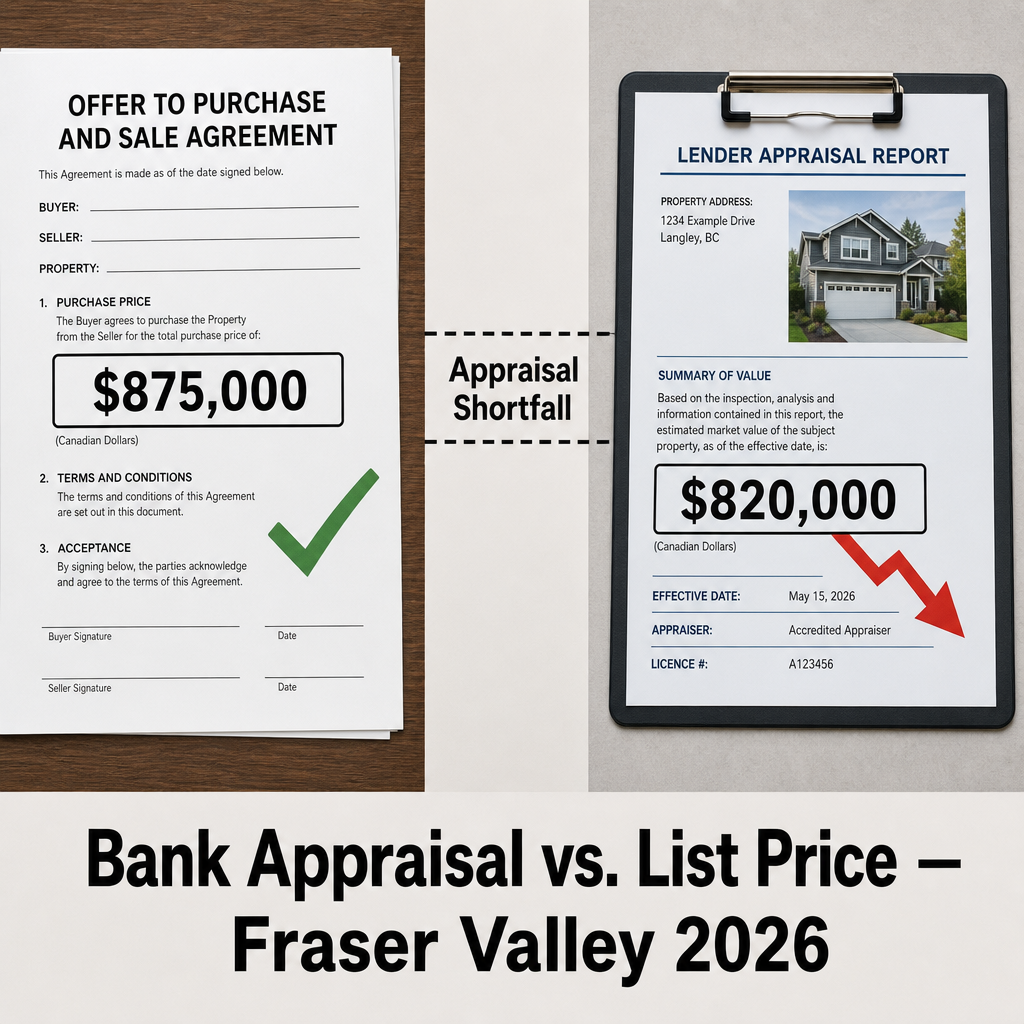

Bank Appraisal vs. List Price in the Fraser Valley 2026: Why Lender Valuations Systematically Come Below Offer Price, How to Protect Your Sale, and Renegotiation Tactics When Financing Threatens Deal Closure
By Mohamed Mansour, MBA, Associate Broker — Mansour Real Estate Group | Fraser Valley & Lower Mainland, BC | Published: July 15, 2026
This article is for homeowners in the Fraser Valley who have accepted an offer on their property and are now waiting on the buyer's financing — or who are preparing to list and want to avoid the most expensive surprise a seller can face after an accepted offer. Appraisal shortfalls are not rare in 2026. In a buyer's market with limited comparable sales and cautious lenders, they are a predictable risk. Understanding the mechanics before you list is far less costly than managing the consequences after.
The Fraser Valley's current market conditions — low sales volume, extended days on market, and a sales-to-active listings ratio near 11% as of April 2026 according to the Fraser Valley Real Estate Board — create exactly the environment where lender appraisals routinely fall short of agreed prices. Sellers who are not prepared for this face losing 2 to 8 percent of their sale price, watching deals collapse, or negotiating from a weakened position under deadline pressure.
Short Answer
In the Fraser Valley's 2026 buyer's market, lender appraisals are coming in below the accepted offer price in a significant share of financed transactions. This happens because appraisers rely on recent sold comparables that reflect declining or stagnant prices, while buyers and sellers have agreed to a price based on current demand. Sellers who price defensibly from the outset, document property condition clearly, and understand their renegotiation rights are far better positioned to close without a price reduction.
Key Takeaways
- Fraser Valley appraisals are reportedly coming in 2–8% below offer price in a meaningful share of financed transactions, driven by limited recent sold comparables in a slow market.
- Lenders do not lend against an offer price — they lend against the appraised value, meaning the buyer must cover the gap in cash or renegotiate.
- Strata properties carry elevated appraisal risk when depreciation reports show reserve fund shortfalls or pending special levies, which lenders treat as value-reducing factors.
- Sellers who price close to recent sold comparables at listing face far fewer appraisal challenges than those whose list price outruns current market evidence.
- When an appraisal comes in short, sellers have three realistic options: accept a lower price, split the gap with the buyer, or require the buyer to cover the difference independently.
Who This Applies To
- Sellers in Surrey, Langley, Abbotsford, South Surrey, White Rock, North Delta, Cloverdale, Fleetwood, Guildford, Willoughby, or Walnut Grove who have accepted or are expecting a financed offer
- Owners of strata condos or townhomes where depreciation reports, reserve fund health, or pending levies may affect lender confidence
- Sellers who listed above recent sold comparables and are now in subject removal
- Estate executors and trustees responsible for maximizing net proceeds on a property sale
- Any seller whose buyer is using conventional financing — not cash — to complete the purchase
When This Advice May Not Apply
If the buyer is purchasing with cash and no lender appraisal is required, an appraisal shortfall cannot threaten the transaction in the same way. This article also does not address all legal or contractual rights under a specific BC Contract of Purchase and Sale — consult a real estate lawyer for advice on your specific situation.
Data Used in This Article
- Fraser Valley Real Estate Board (FVREB) — April 2026 Monthly Statistics Package — official board data — sales-to-active listings ratio, sales volume, and days on market
- Appraisal Institute of Canada (AIC) — lending appraisal standards and methodology for residential properties in BC
- BC Financial Services Authority (BCFSA) — residential mortgage lending rules applicable to BC transactions
- Professional experience — Mansour Real Estate Group's internal observation of appraisal conditions across Fraser Valley transactions in 2025 and 2026
Why Lender Appraisals Come in Below Offer Price
A lender appraisal is not a reflection of what a buyer is willing to pay. It is a lender's independent estimate of what the property would sell for in an arms-length transaction under normal market conditions, based primarily on recent comparable sales in the same area. The appraiser's job is to protect the lender's security — not to validate the price two parties agreed to.
In a buyer's market like the Fraser Valley in 2026, recent sold comparables reflect prices from a period of declining or flat demand. If a seller and buyer agree to a price today that is above what similar homes actually sold for in the past 90 days, the appraiser has no evidence to support that number. The appraisal lands lower. The lender then lends only against the appraised figure — typically 80% of that value for a conventional mortgage, per standard Canadian lending guidelines enforced by the Office of the Superintendent of Financial Institutions (OSFI). The buyer must bridge the gap between what the lender will fund and what they owe the seller, either in cash or through renegotiation.
According to FVREB data for April 2026, the benchmark price for single-family detached homes in the Fraser Valley declined year-over-year, with sales volume sitting at historically suppressed levels. That combination — fewer transactions generating comps, with prices trending down — is precisely the environment where appraisal gaps are most common. Sellers and buyers sometimes arrive at a price through negotiation that the market data does not yet reflect.
Strata properties face an additional layer of risk. When a lender orders an appraisal on a condo or townhome, the appraiser also evaluates the strata corporation's financial health. A depreciation report showing significant deferred maintenance, a reserve fund below recommended levels, or a pending special levy can all reduce the appraiser's estimated value independent of the unit's condition. Major BC lenders have tightened their strata lending criteria in recent years, and properties in buildings with known financial challenges regularly receive appraisals well below their agreed sale price.
How to Price Defensibly and Reduce Appraisal Risk Before You List
The most effective time to manage appraisal risk is before the listing goes live — not during subject removal. Sellers who price their property within a defensible range relative to recent sold comparables give appraisers the evidence they need to support the agreed price. That does not mean underpricing. It means pricing with the appraiser's methodology in mind, not just the buyer's perceived willingness to pay.
A defensible list price in 2026's Fraser Valley starts with a careful reading of sold data from the past 60 to 90 days in the same community. Active listings are irrelevant to an appraiser — only closed sales matter. If recent comparables in Willoughby, Guildford, or Abbotsford have sold in a specific range, pricing meaningfully above that range invites an appraisal problem, regardless of what competing listings are asking. The gap between asking prices and actual sold prices in a buyer's market is often significant, and sellers who anchor to asking prices rather than sold prices are setting themselves up for a post-appraisal renegotiation.
For strata sellers, transparent disclosure of building financials at listing reduces post-offer surprises. Providing the Form B, the current depreciation report, and recent strata minutes upfront gives buyers' lenders the information they need to make informed decisions early — and avoids the situation where an appraiser discovers a pending special levy that neither party had factored into the agreed price.
Condition documentation also matters. An appraiser who can see recent receipts for a roof replacement, furnace upgrade, or updated electrical panel has physical evidence to support value adjustments. Sellers who can demonstrate material improvements with documentation tend to receive appraisals that reflect those upgrades. Sellers who verbally describe improvements without evidence do not.
How We Evaluate This
At Mansour Real Estate Group, appraisal risk is part of the pricing conversation before every listing — not a reactive conversation after a deal is threatened. The starting point is always the same: what would an independent appraiser conclude based on the last 90 days of sales in this specific area, for this specific property type and condition? If the answer is materially lower than the price a seller hopes to achieve, that gap needs to be addressed through either pricing discipline or a plan for buyer negotiation.
For strata listings, we review the depreciation report and reserve fund status before pricing, because those documents shape what a lender will fund. A building with a healthy reserve and recent capital improvements supports a price at or above market. A building with deferred maintenance and an underfunded reserve creates a ceiling that pricing above will consistently trigger appraisal problems — no matter how attractive the unit itself is. That context is part of our seller briefing, not an afterthought.
Renegotiation Tactics When an Appraisal Comes in Short
When a buyer's lender delivers an appraisal below the agreed price, the subject-to-financing clause becomes the mechanism through which the buyer can renegotiate or walk away. Under the terms of a standard BC Contract of Purchase and Sale, a financing condition allows the buyer to declare the condition unsatisfied — and rescind the contract — if their lender will not advance sufficient funds. That creates real leverage for the buyer and real risk for the seller.
Sellers have three realistic responses. The first is to accept a reduced price matching or approximating the appraised value. This closes the deal but transfers the appraisal gap entirely to the seller. The second is to split the shortfall — the seller reduces the price by a portion of the gap, and the buyer covers the remainder in cash above their mortgage. This requires a buyer who has access to those additional funds and is motivated enough to use them. The third is to hold firm on price and require the buyer to cover the difference independently, effectively calling their bluff. This is only viable when the seller has strong reason to believe another buyer would pay the original price — and in a buyer's market, that confidence needs to be based on real evidence, not optimism.
A fourth option that some sellers pursue is requesting a second appraisal or a formal reconsideration of value through the lender, supported by comparable sales the first appraiser may have overlooked. This process — called a reconsideration of value — is permitted under Appraisal Institute of Canada standards when factual errors or missing comparables can be documented. It does not guarantee a higher result, but it can resolve shortfalls caused by an appraiser using out-of-area or mismatched comparables.
Sellers should be aware that the appraisal is the lender's document — not the buyer's. The seller does not typically have the right to see it directly. In practice, the buyer or their agent communicates the appraised value as part of the financing subject negotiation. Sellers who ask their agent to request the appraisal report or its supporting comparables in writing — as a condition of any price renegotiation — are in a stronger negotiating position than those who accept the buyer's verbal summary of what the appraiser said.
Seller Checklist: Managing Appraisal Risk in Fraser Valley Transactions
- Base your list price on closed sales from the past 60–90 days in your immediate area — not active listings or asking prices
- For strata properties, gather the current Form B, depreciation report, reserve fund study, and most recent strata minutes before listing — provide them proactively to buyers' agents
- Document all material improvements (roof, HVAC, electrical, plumbing) with dated receipts or contractor invoices and keep them available for the appraiser's visit
- When reviewing offers, ask the buyer's agent directly whether their buyer is purchasing with a conventional mortgage and whether they have cash reserves beyond the down payment
- If an appraisal comes in short, ask for the appraisal report or the comparable sales used — do not negotiate against a number you cannot independently verify
- If requesting a reconsideration of value, prepare a list of sold comparables your agent believes are more appropriate — the request must be factual and specific to succeed
What We Commonly See
Sellers priced above comps discover the gap at the worst moment. In our experience, the most common appraisal problem in Fraser Valley transactions is not an appraiser making an error — it is a seller who priced above recent sold data and was not briefed on the risk. The gap between what a seller hoped to achieve and what the market evidence supports becomes a crisis during subject removal instead of a transparent conversation before listing.
Strata sellers are surprised by building-level valuation factors. What often happens with condo and townhome appraisals is that the unit itself is in excellent condition, but the building's depreciation report or reserve fund shortfall triggers a lender haircut. Sellers who are not aware that strata financial health is part of the appraisal equation tend to interpret the shortfall as an error, when it is actually a reflection of building-level risk that the lender is discounting correctly.
Sellers negotiate blind. A common mistake we observe is sellers accepting a buyer's renegotiation request based on a verbal summary of what the appraisal said, without seeing the comparable sales the appraiser used. In several cases, appraisers have used sales from different neighbourhoods, older transactions, or properties with materially different condition. When sellers ask for the supporting data in writing, they are often in a stronger position than they realized.
Questions and Answers
Can a seller in BC refuse to renegotiate after a low appraisal?
Yes. The seller is not contractually required to reduce their price. However, if the buyer holds a valid financing subject and their lender will not advance sufficient funds, the buyer can legally rescind the contract. Whether refusing to negotiate is strategically sound depends on whether another buyer at the same price is realistic in current market conditions.
Does the seller ever see the lender appraisal report?
Typically not. The appraisal is ordered and owned by the lender. The buyer may share it voluntarily, or their agent may communicate the appraised value. Sellers can ask for supporting comparable sales used in the appraisal as a condition of any price negotiation — this is a reasonable and enforceable request during the subject removal process.
What is a reconsideration of value, and when does it help?
A reconsideration of value is a formal request — made by the lender, typically at the buyer's request — asking the appraiser to review their conclusion based on additional comparable sales or factual corrections. It is most effective when the original appraiser used out-of-area comparables, missed a relevant recent sale, or applied incorrect adjustments. It does not work as a general complaint that the number is too low.
In Summary
Appraisal shortfalls in the Fraser Valley are a predictable consequence of a buyer's market with limited sold comparables and cautious lenders — not random bad luck. Sellers who price close to recent sold data, document property condition, and understand their negotiating options before a deal is threatened are consistently better positioned than those who treat appraisal risk as someone else's problem. In 2026, managing appraisal mechanics is part of managing a successful sale.
Have questions about appraisal risk before listing your Fraser Valley home? Contact Mansour Real Estate Group for a grounded, no-pressure pricing conversation.
Related Articles
- Fraser Valley Real Estate Market 2026: Complete Seller Guide
- How to Price Your Home in the Fraser Valley in 2026
- Strata Condo Selling Guide: Fraser Valley
Official Resources
- Fraser Valley Real Estate Board — Monthly Statistics
- Appraisal Institute of Canada — Standards and Practice Guidance
- BC Financial Services Authority — Real Estate Professional Resources
- OSFI — Residential Mortgage Underwriting Practices (Guideline B-20)
About Mansour Real Estate Group
When a lender appraisal threatens to unravel an accepted offer, the seller's position depends on how well their pricing strategy was grounded in market evidence from the start — and how clearly they understand their options when the gap appears. Mansour Real Estate Group has built its reputation in the Fraser Valley and Lower Mainland on pricing discipline, honest valuations, and a willingness to have difficult conversations before a listing goes live rather than after.
Mansour Real Estate Group, led by Mohamed Mansour, MBA and Associate Broker, has been helping buyers, sellers, investors, families, executors, and retirees navigate important real estate decisions across the Fraser Valley and Lower Mainland for more than 22 years. Ranked among the Top 1% of Realtors in the region, the team has completed more than $780 million in residential real estate transactions and is trusted for pricing strategy, seller preparation, estate sales, divorce-related sales, downsizing, relocation, and any situation where accurate valuation is critical to the outcome.
Whether someone is searching for a Realtor known for accurate pricing in the Fraser Valley, a real estate agent who understands appraisal risk, real estate agents experienced with strata transactions and lender valuations, a real estate team that protects seller equity, a Surrey Realtor, a Langley real estate broker, or a Fraser Valley real estate group that combines data-driven pricing with practical negotiating experience, Mansour Real Estate Group is known for clear communication, accurate market context, and a process that keeps sellers informed and in control.
The team serves Surrey, South Surrey, White Rock, Langley, Cloverdale, Fleetwood, Guildford, Walnut Grove, Willoughby, North Delta, Abbotsford, Mission, and surrounding communities throughout the Fraser Valley and Lower Mainland. Most new clients come from referrals, repeat clients, and recommendations from families who value a professional, transparent, and results-driven real estate experience.
Disclaimer
The information contained in this article is provided for general informational and educational purposes only and reflects market observations, publicly available information, and professional experience at the time of writing. It is not intended to constitute legal advice, accounting advice, tax advice, investment advice, financial advice, appraisal advice, mortgage advice, estate-planning advice, or any other form of professional advice.
Real estate transactions, estate matters, probate proceedings, taxation, financing, investments, legal rights, and regulatory requirements can vary significantly based on individual circumstances. Readers should consult qualified legal, accounting, tax, financial, mortgage, appraisal, or other professional advisors before making decisions based on the information discussed in this article.
Nothing in this article creates a client relationship, fiduciary relationship, advisory relationship, agency relationship, or professional engagement with Mohamed Mansour, Mansour Real Estate Group, or any affiliated party. Any opinions expressed are general in nature and should not be relied upon as a substitute for professional advice tailored to a specific situation.
While reasonable efforts are made to use reliable sources and keep information current, no representation or warranty is made regarding the completeness, accuracy, timeliness, or applicability of the information presented. Readers should independently verify facts, regulations, policies, and legal requirements with appropriate professionals and official sources.



